What types of domain are there?

If you’re setting up a website or an online shop, choosing the right web address is an essential step. With multiple domain types and countless domain extensions to consider, making the right decision isn’t always easy. What distinguishes top-level, second-level, and third-level domains, and which domain extensions can you choose from?
Overview of domain types and available domain extensions
A memorable web address, or domain, is made up of a suitable name and a matching domain extension. The following sections outline the five main domain types you should know when completing a successful domain registration.
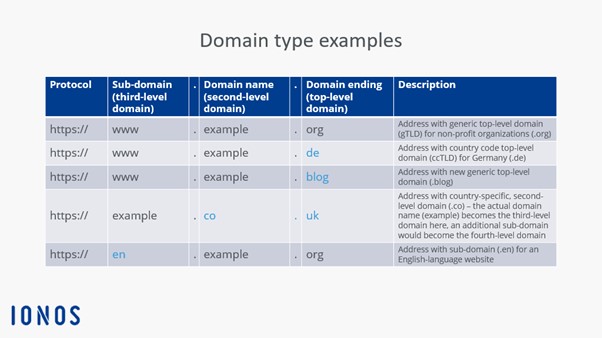
Domain type 1: Top-Level Domain (TLD)
Top-level domains (TLDs) form the highest level in the Domain Name System and appear at the end of a web address, for example .com, or .org. The allocation of TLDs is administered by the IANA, a department of the organisation ICANN (Internet Corporation for Assigned Names and Numbers), founded in 1998. IANA determines which domain extensions exist and grants distribution rights to registrars, which in turn work with domain providers to sell the more than 1,400 available domain extensions, including classic TLDs, country-specific endings, and modern thematic domain extensions.
Examples of original TLDs:
| Original TLD | Meaning of the domain extension |
|---|---|
| .com | Commercial offerings |
| .org | Nonprofit organisations |
| .net | Internet service providers |
| .edu | Educational institution |
| .int | International organisation |
| .gov | U.S. government agencies |
| .mil | U.S. military |
Domain type 2: ccTLDs (country code top-level domains)
ccTLDs are country-specific domain extensions consisting of two letters, such as .de (Germany), .fr (France), or .us (United States). Each country defines its own registration rules. Some countries actively market their ccTLDs, for example Tuvalu with .t v.
The following table presents some country-specific TLDs as examples:
| Country-specific top-level domain | Meaning |
|---|---|
| .ch | Switzerland |
| .cn | China |
| .de | Germany |
| .es | Spain |
| .fr | France |
| .it | Italy |
| .ru | Russia |
| .uk | United Kingdom of Great Britain and Northern Ireland |
| .us | United States of America |
IDN domains are also growing in popularity. These internationalised domain names support special characters, umlauts, and non-Latin scripts, allowing web addresses to appear in local languages. From a technical perspective, they are encoded into a DNS-compatible ASCII format using Punycode.
Domain type 3: gTLDs (generic top-level domains)
gTLDs cover thematic categories and are not tied to a specific geographic location. Within generic domain extensions, a distinction is made between two types:
Unsponsored gTLDs are centrally overseen and administered by ICANN, which cooperates with various partners for this purpose. Originally, these extensions were intended to be assigned only under certain conditions. For example, the .net domain was meant to be reserved exclusively for internet service providers. Today, like many other unsponsored gTLDs, it is available to businesses, organisations, and private individuals alike.
| Nonsponsored gTLDs | Original meaning of the domain extension |
|---|---|
| .biz | Companies |
| .info | Information services |
| .name | Private individuals |
| .pro | Specific professional groups |
Sponsored gTLDs, on the other hand, are subject to the restrictions set by the respective sponsor. In this case, the respective independent companies or organisations are also responsible for managing and controlling these gTLDs.
| Sponsored gTLDs | Meaning of the domain extension |
|---|---|
| .gov | U.S. government agencies |
| .mil | U.S. military |
| .aero | Aviation industry |
| .jobs | Job postings from companies |
Modern new top-level domains such as .blog, .web, and .beauty also belong to the gTLD category.
Domain type 4: Second-level domain (SLD)
The second-level domain is the actual domain name, meaning the part before the TLD, for example ‘example’ in example.com. It is particularly important for branding and SEO because it can clearly describe the content of a project. A second-level domain is always registered together with the chosen top-level domain.
There are even some country-specific second-level domains, as shown in the following table of combinations using the .uk TLD:
| Examples of country-specific SLDs | Meaning of the domain extension |
|---|---|
| .co.uk Commercial websites in the UK | |
| .gov.uk | UK central and local government authorities and services |
| .me.uk | Private individuals in the UK |
| .sch.uk | Schools in the UK |
Domain type 5: Third-level domain (subdomain)
Third-level domains, commonly referred to as subdomains, are placed before the second-level domain and help organise a website or divide it into separate sections.
Examples of third-level domains:
us.example.org(U.S. version)en.example.org(English version)blog.example.org(blog section)app.example.org(web service/app)
Subdomains make it possible to clearly separate different content without needing a new domain.
Tips for choosing the right domain
A basic understanding of the different domain types and domain extensions helps you choose a clear, user- and search engine-friendly web address that fits your project without making the address unnecessarily complicated. We have summarised the most important tips for you.
Tip 1: Choose a suitable domain extension
The top-level domain can shape user expectations and should align with your project:
- .shop signals e-commerce
- .blog indicates a blog
- .uk or .co.uk represents a UK-based business
- etc.
Always choose a domain extension that appeals to your target audience and matches the content of your website.
Tip 2: Clear and memorable domain name
A good domain name should be short, clear, and easy to remember. The shorter the address, the easier it is for users to remember and enter it correctly. This reduces typos and improves the long-term visibility of your website.
Tip 3: Use subdomains only when needed
Subdomains are useful when content needs to be clearly separated from the main website. However, for smaller websites, they are not always the ideal solution. You should therefore only use a separate third-level domain if you have a clear structural concept.
A dedicated subdomain can be helpful in the following situations:
- Separating different language versions
- Distinguishing core content from additional sections such as a service area, blog, or forum
- Hosting a specific web service, such as an app or FTP server
- Operating an online store alongside the main website under the same second-level domain
Tip 4: Check availability and legal considerations
Make sure the domain you want is actually available. Common name variations or versions with different domain extensions can be registered quickly. Also ensure that the name does not violate any existing trademark rights to avoid legal disputes.