Social intranet: the elegant communication solution for companies

The exchange of information plays an important role in every company. The more employees know about current events, developments, and plans, the more likely they are to feel part of the company. On the other hand, employees who are not sufficiently informed about important events or are informed retrospectively will often feel ignored, which can have a negative effect on their satisfaction in the long term. Companies whose employees are spread over several locations, or travel often, have to counteract this situation with appropriate measures. Classic intranets have been regarded as the perfect solution for years, but now more advanced social intranets are becoming more popular.
What is a social intranet?
The first intranets started to be created as soon as computers began to make their way into everyday life. These are internal company networks, which are characterized by the fact that they are not public, but are only accessible to authorized users – in this case, the employees of the respective company. In addition to administrative advantages, such as being able to regulate internet access and maximum control over the security of the network, the main advantage of such intranets is that all employees can be reached better and faster. For this reason, management has a practical tool in the form of company networks, which is still used today to exchange and disseminate internal company information – usually in the form of editorial contributions.
However, since chat platforms and social networks have fundamentally revolutionized digital communication, the traditional intranet model with its rather static, hierarchical structure has lost much of its acceptance. The new ways of communicating interactively and in real-time with each other are consequently fixed components of modern intranets, which are still geared toward business use, but function very similarly to social networks. This is why they are also known as social intranets.
Which components distinguish a social intranet?
Social Intranets lay the foundation for an open company culture. With optimal structuring, every employee should receive relevant information as early as possible. Furthermore, a basic idea of social networking is that all employees participate and provide input. In this way, management not only receives valuable feedback, but is also relieved of some of its management work: Thanks to social intranets taking initiative, the various teams can organize themselves. At the same time, the practical network platforms can also provide access to necessary work materials.
Even though the individual solutions are strongly tailored to the requirements of the respective company and are therefore often different, there are still some elements that can be found with almost every social intranet. The most important are:
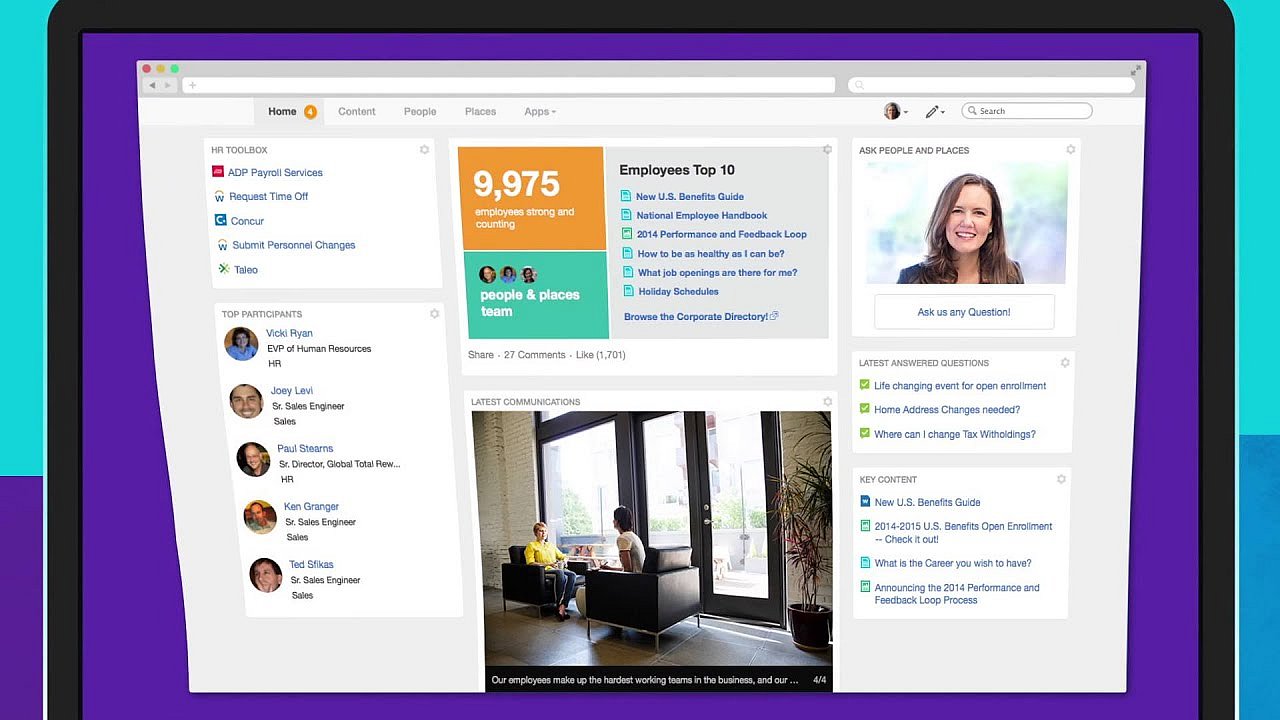
- Newsfeed: Newsfeeds, often referred to as activity streams, are often the central component of a social intranet. They ensure that all employees are provided with up-to-date information about the company and its departments. The articles in the newsfeeds are sorted by date and the messaging history can be retrieved at any time. Activity streams are often realized in the form of a blog, although there is no need for a fixed editorial team to be responsible for writing articles. Unlike traditional intranets, employees can react directly to new messages e.g. through the comment function.
- User profiles and groups: One component that is best known from social networks is the ability to create and manage user profiles. These help to assign contributions and comments and make it easier for individual employees to find the right contact person for the respective issue. The profiles also allow users to be added to specific groups, such as a certain department or project. In a small circle, it’s easier to discuss topics and announce news that would be irrelevant for other employees. Groups often have their own newsfeed in addition to the company’s main feed.
- Messenger: In addition to messaging platforms for the company and individual teams, social intranets usually also offer their own chat messaging system, which is primarily intended to act as a dynamic alternative to traditional e-mail traffic by enabling communication in real-time. Therefore, it doesn’t matter how many contacts take part in a conversation. As with the structuring of the intranet in general, it is common to set up different chats such as a general chat and different group chats.
- Calendar: Despite all communication channels offered by a good corporate social network, a simple, classic calendar function should always be included. Calendars help you to keep track of all important appointments – whether it’s a team meeting, a business lunch, or a deadline. Thanks to the company’s networking, you can also keep track of colleagues’ calendars if they’ve given you access to them.
- Central file storage: For digital collaboration to work in a company, it is not only important to have a good exchange of information; good document management is just as important. A central file storage is therefore an integral part of many social intranets and is accessible to all employees. Documents can be stored or retrieved here. Version management ensures that the selected file is up-to-date.
- Search functions: By definition, a social intranet is intended to promote communication and cooperation between network participants. Even though these network components form the best possible basis for this, it is not always easy to keep track of things, especially in large companies: extensive contact lists, seemingly endless news stories, and a huge range of documents make the search for certain information a tedious task. Search functions for various features should therefore be a standard part of the social intranet structure. This means that certain content or contacts can be found at any time by simply entering a keyword.
Appropriate software is required to implement the various components of a social intranet. To do this, individual programs can be purchased for the various purposes and be coordinated with each other, or complete solutions such as Jive-n can be used, which integrate a complete social platform into the business structure. In both cases, it is important to decide whether the new networking structure will be introduced in a single step or whether it will be introduced gradually. The former option means that the intranet can be used by all employees straightaway, but of course it requires some effort. The step-by-step variant takes several days or weeks, depending on the planning, but has the advantage that day-to-day business is guaranteed at all times (with minimal restrictions).
 To display this video, third-party cookies are required. You can access and change your cookie settings here.
 Which advantages do social intranets bring companies
Setting up a social intranet can pay off for a company for a variety of reasons: first and foremost, it is a matter of optimizing and speeding up internal and external processes, which is guaranteed in particular by the tailored communication options – as a result, e-mail communication and the duration of meetings are significantly reduced. By being able to organize processes and bundling all relevant tools together, this automatically increases productivity of individual employees. It doesn’t matter whether they are in the company, at home on the PC, or at an appointment elsewhere. In addition to increased efficiency, improved collaboration (internal and across teams) ensures that costs can be reduced sustainably.
Furthermore, another advantage of a social intranet is that it can shape a company and drive its developments decisively forward. The possibility of a joint dialogue, especially with management, strengthens the sense of community and has a positive influence on the motivation and initiative of employees. Praise, criticism, and creative ideas are expressed quickly and easily, meaning the company or team leaders can act accordingly. In companies without a social intranet, employees are often reluctant to come forward with their ideas, which means that many promising and important points never get mentioned. Work networks also help to archive the knowledge and expertise accumulated within the company.
According to the software company, mixxt, around 65% of the surveyed users feel a stronger company connection since the in-house intranet solution, tixxt, was integrated. 27% confirm that the collaboration platform has contributed to optimizing processes.
Which companies would benefit from a social intranet?
Companies differ not only in terms of their philosophy, but also in terms of structure and size. When it comes to developing the optimal solution for employee digital networking, the approaches should all lead to success. While a comprehensive social intranet model is primarily profitable for large companies and corporations, small companies can often improve communication structures with individual elements. How much a social intranet can benefit your company, however, cannot simply be determined by the number of employees.
Which components you need depends on the demands you make on the social corporate network. The crucial question is therefore: which goals are pursued when you introduce a social intranet? In many cases, basic structures have already been created and only need some fine tuning. This could mean that a messenger service is not necessary at all because a corresponding software is already being used. It depends on which of the possible social elements offers employees added value. An important argument for introducing the social intranet could be how helpful it is to train and integrate new employees.
Here are some possible motivations and situations in favor of implementing a social intranet in your company:
- The internal e-mail dispatch is too high
- Meetings and decisions are taking too long
- Some of the workforce isn’t being sufficiently informed about current situations and future company developments
- Employees lack possibilities to express criticism and wishes or to share their own ideas
- Know-how in certain subject areas is too strongly tied to a particular person(s)
- Employees work at different locations or from home or while traveling
- It is too complicated to find the right contact person for a certain problem or to establish contact with them
- Sharing, editing, and managing documents is becoming complicated