The best crowdfunding sites – a comparison

Crowdfunding is a popular way to finance private projects and start-ups. A crowdfunding campaign is used to launch an appeal for donations, sometimes with a funding target and reward system for backers (those who donate to the campaign), although this is optional. Thanks to crowdfunding, many interesting projects from a wide variety of subject areas have already turned designers’ dreams into reality. Projects include fundraising campaigns for charities, the design and production of personal, everyday objects, as well as artistic projects.
The main advantage of crowdfunding is that it does not rely on a few, rich investors, but instead on a large number of interested private individuals – hence “crowd” in the name. If the project sells itself, funding momentum can pick up within a group or community, which increases how quickly the project progresses, and its popularity. Transparency and communication with your backers are key factors in a successful crowdfunding campaign.
The increasing popularity of this form of financing has led to a wide range of crowdfunding sites where you can present and manage your campaign, and also process any donations your campaign receives. The most popular websites have managed to integrate themselves into the language of crowdfunding: “I kicked off my project” has become part of crowdfunding jargon. The platform kickstarter.com is the most popular worldwide, but over the years other good competitors have developed, some of which are more specialized than Kickstarter and draw a specific crowd.
The choice of a suitable crowdfunding website depends on a few factors. For example, you can plan your project as a private individual, or as a start-up. The industry which your project is part of, and the target group you want to address, as well as the crowdfunding model you use and the size of your project, are also factors which will influence which crowdfunding site you choose. Furthermore, the conditions and fees of the respective platform are just as decisive as the question of how it deals with failed projects and embezzled donations.
You don't necessarily have to choose just one crowdfunding site for your project. It often makes sense to collect money on several websites. Don't underestimate the effort required for successful crowdfunding campaigns!
The beginnings of crowdfunding
The idea of crowdfunding itself is fairly old. Going back even to the 19th century, book printing was financed by donations from those interested in the book. Even the Statue of Liberty in New York was co-financed by donation campaigns, which raised a total of $160,000 to complete the base construction. However, crowdfunding in the modern sense only became an easily accessible financing model based on the social and globally networked structure of Web 2.0 with the launch of the crowdfunding sites Indiegogo (2008) and Kickstarter (2009).
Kickstarter
The company Kickstarter went live in 2009 and the website of the same name quickly established itself as the most successful and best-known crowdfunding platform. After registering, projects can be posted on the website via a separate, customizable page. Kickstarter must specify a financing target, but the project can also be supported beyond the target. Those interested can participate with a donation of as little as one dollar as soon as they have registered. Payment is made through Stripe when the campaign reaches its funding goal. If the funding goal is not met, no money will be transferred, and the campaign will be considered a failure – Kickstarter is an all-or-nothing crowdfunding site.
Kickstarter.com supports projects across the world. If the fundraising campaign is successful, Kickstarter will charge a fee of 5 percent of the achieved sum. Another 3 to 5 percent are usually added because the Stripe payment service is used to process donations. Kickstarter never claims ownership of projects, but each project is permanently archived and remains visible on the site. In addition, Kickstarter doesn’t take any responsibility for those who are cheated or misled after having donated to a campaign.
Kickstarter’s main focus is on creative projects and start-ups aimed at the supply of cultural goods or innovative commodities. The Pebble Time smart watch, the Coolest Cooler cool-box, the Baubax world travel jacket, the Exploding Kittens card game, and the OUYA video game console, are among the most successful projects. Among the most important “kicked-off” products in the entertainment sector are the feature films The Veronica Mars Movie Project and Wish I Was Here, the video game Broken Age, and the web series Video Game High School.
Reward-based crowdfunding has established itself as the most effective crowdfunding model at Kickstarter. Backers are individually rewarded according to the donation amount. For example, project leaders often promise backers to mention them in later acknowledgments. More generous donations usually get a pre-order discount on the final product – but often merchandise items such as T-shirts and caps are also sent as a thank-you. Kickstarter projects also typically feature stretch goals, i.e. financing goals beyond the initial goal. The backers then activate further “features” of the end product, so to speak, because the developers have more money to invest in research.
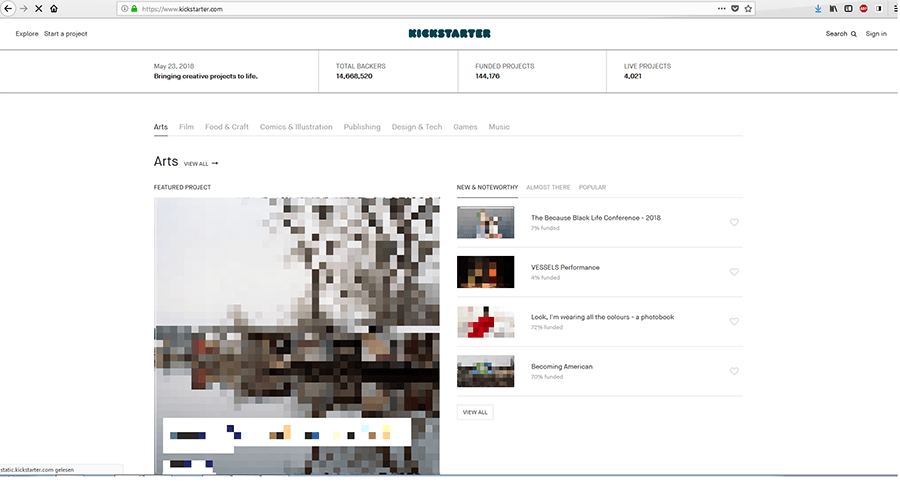
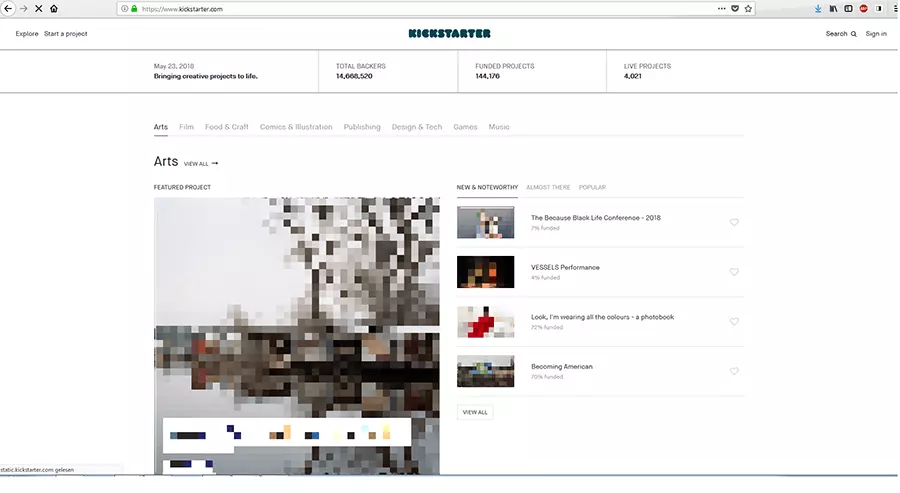
The campaign pages at Kickstarter are stylish and clearly formatted. In the header, Kickstarter shows how much money the project has already collected, how many individual backers have already participated, and how much time remains to achieve the financing goal. Under “campaign” the developers present their project and list the rewards, stretch goals, and other important details of the campaign. Under “updates” you can inform your backer base and other potential interested backers about the progress of the project in the form of a timeline. Registered users can post suggestions, criticism, and praise under “comments.”
The “community” section shows interesting and important information about the backer base and how it is spread out. In addition, some supporters who have already gained some recognition in the Kickstarter community are mentioned here. After all, it is good publicity for a project if dedicated and famous investors could be brought on board – even if the focus is on crowd funding, it never hurts to have the extra support.
A problem that the crowdfunding community has to face, and that remains unsolved by Kickstarter, is how to handle the successfully financed, but nevertheless failed projects. A lot of individuals’ money has gone down the drain, because developers broke off the respective project after successful crowdfunding without reimbursing the donated money. In some cases, there were simply no more updates to certain projects, which then had to be registered as inactive, and the backers were simply abandoned. Whatever the reasons, crowdfunding is always a risk investment. Kickstarter does not seem to be actively looking for a solution to the problem – the rather short rules of Kickstarter do mention it in brief, but not enough to tackle the problem.
Kickstarter has also been criticized for influencing the success of projects too much itself. “Staff pick” badges show the Kickstarter team’s favorite projects. This enables Kickstarter to control which projects attract more attention. However, it is not clear exactly how a project can earn the badge, as the criteria for this do not seem to be easily accessible.
The navigation of the website is not as straightforward as it could be. If you want to see all projects in one category it often takes a while to get to the right page. Until you get to this page, only a selection of projects will be presented, e.g. projects that are close to the financing goal or have already generated a lot of attention. Many visitors simply don’t see most of the projects, because they don’t trawl through the pages and filters of the website. This is a disadvantage for projects which haven’t had much coverage or support yet.
| Pros | Cons |
| Money is only deducted from backers when the campaign has reached its funding target… | ... but this leads to many project creators deliberately setting their financing targets low. |
| Kickstarter only charges a fee of 5% of the total amount for successfully financed projects,... | ... but there are additional fees for transactions. |
| Very clear, informative project pages, ... | ... but the clumsy navigation of the website makes browsing through projects unnecessarily complicated. |
| Staff pick badges highlight certain projects... | ... but it is not clear how these projects can get picked, and has too much influence on the success of projects. |
| Suitable for individuals and start-ups whose focus tends to be on creative projects... | ... but there is no possibility for charitable projects to get going on Kickstarter. |
| Almost fully financed projects are highlighted, adding suspense and excitement, and possibly the last few backers will donate this way ... | ... but the categories “featured projects” and “recommendations for you” aren’t updated regularly. |
GoFundMe
The GoFundMe website is one of the most popular crowdfunding websites, and specialized in charity and non-profit projects right from the start. The campaigns on GoFundMe mostly collect money for social events and charitable projects. GoFundMe started in 2010, and generated over $5 billion by 2017. Campaigns are generally charged a fee of 5 percent for every single donation received, however, additional costs crop up if money transfers from overseas have to be processed.
GoFundMe has two special features. Unlike most crowdfunding sites, you can always keep all donations, even if you don't reach your funding goal. This means that GoFundMe can at least partially finance projects. The second special feature is that there is no deadline for achieving a financing target. This means that each campaign remains online as long as the project creator leaves it online. This will make it easier to implement longer-term projects, such as those that depend on regular donations. This makes GoFundMe's model suited to projects that support charities.
The campaign page on GoFundMe displays all the information about the campaign on a single page. You can find out about the money already raised, and how much is left to the target amount. There is also plenty of space for the main image to draw attention to the project. GoFundMe recognized the power of social networks early on, especially social media’s ability to generate hype and viral advertising, and so below the main image you will find large banners for Twitter and Facebook, making it easy to share a campaign. Visitors to the campaign’s page are invited to take action by sharing the page to increase its reach. Making a donation and sharing the project seem to be equally weighted on GoFundMe in terms of impact on the project’s success.
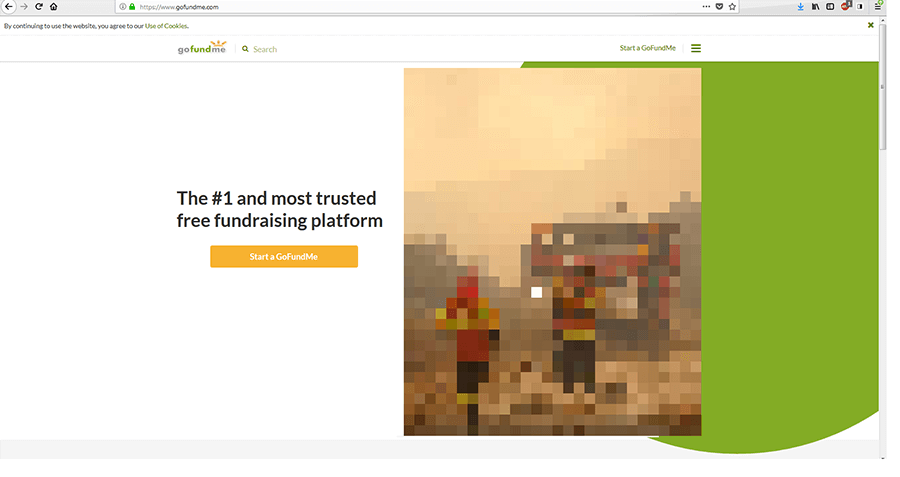
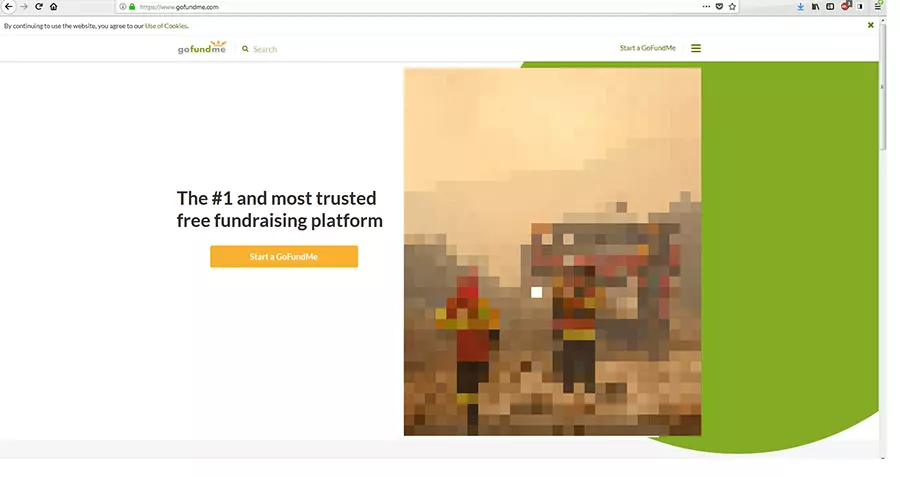
Donations to a GoFundMe project can be made via credit card. After donating, you can also leave messages on the campaign’s page, depending on the type of campaign: e.g. recovery wishes, encouraging contributions, or requests for further donations. The focus of GoFundMe on social projects can also be seen in how the campaigns are categorized by the site itself: education, medical, charity, emergencies, and commemorations are listed first, while common crowdfunding categories such as creative projects and companies don’t play such a big role.
GoFundMe is also on top of things in terms of customer support. If you want, you can consult so-called “coaches” who help to make the campaign page as attractive as possible. The GoFundMe help center also provides relatively detailed guides on how to use the crowdfunding site. Interested backers can also find out about their rights, and how to process donations. In the event of a mistaken donation, or a fraudulent campaign, GoFundMe will provide a contact form if a donation made should be refunded. The operators also promise to control the funds very strictly, and to ensure that all donations go to the right address. If the security measures fail, GoFundMe even agrees to reimburse lost amounts or to pay the difference in donations itself.
However, GoFundMe has an issue in the way it is perceived, because too many personal projects end up on the website. Because private individuals can be sponsored here for their personal plans, many GoFundMe projects have already led to minor scandals. Donation requests from people who want to have their wedding financed is an example of the more innocent kind of personal project, but still does not align with the crowd-funding mindset. Quality control at GoFundMe is not considered particularly well developed, so well-intentioned projects are sometimes lost in the mass of mini-campaigns.
| Pros | Cons |
| The best platform for charitable and social projects… | ... but which also has a fair amount of nonsense projects. |
| GoFundMe promises credible financial protection for backers and campaign leaders alike... | ... but the fees are slightly higher compared to other platforms. |
| Projects get their donations, even if they don’t meet their target funding… | ... which, however, means that projects which don’t reach their funding target may not use the gathered funds appropriately. |
| Financial targets are not as strict, ... | ... meaning that an exciting and motivating aspect of crowdfunding is lost, however. |
| Clear project pages with a comprehensible focus on the integration of social networks,... | ... which, however, only Facebook and Twitter offer as options. |
| Donations can be made with messages of support, creating a social environment,... | ... but you can only make a donation by credit card. |
| Good support pages and guides for backers and project creators |
Indiegogo
Alongside Kickstarter, Indiegogo is considered a pioneer in the field of crowdfunding sites. With the launch of the platform in 2008, Indiegogo was solely focused on reward-based crowdfunding for creative projects and start-ups, but ever since 2016 it has also allowed equity-based crowdfunding for business investors. In 2014, the Indiegogo Life service (now called “generosity”) was added, specially designed for emergencies, medical costs, celebrations, and so on.
Indiegogo is seemingly very similar to Kickstarter and GoFundMe at first glance. Campaigners create a project page and set a financing target which, depending on the choice between fixed funding and flexible funding, can either be an essential target for financing the project, or merely a guideline target. The main page of the project consists of the description of the idea (found under the story tab) and the rewards (here called perks), which are ranked according to the amount of donation. The updates tab reports on the progress of the project, and under comments users can leave their thoughts and opinions. The backers tab shows the complete donation history. The project site has all the necessary social media widgets, but they aren’t as obvious as with GoFundMe, for example.
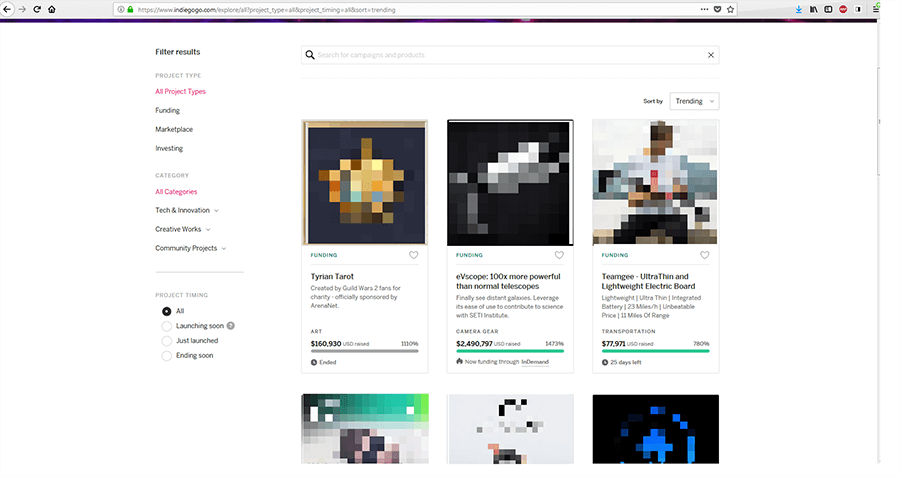
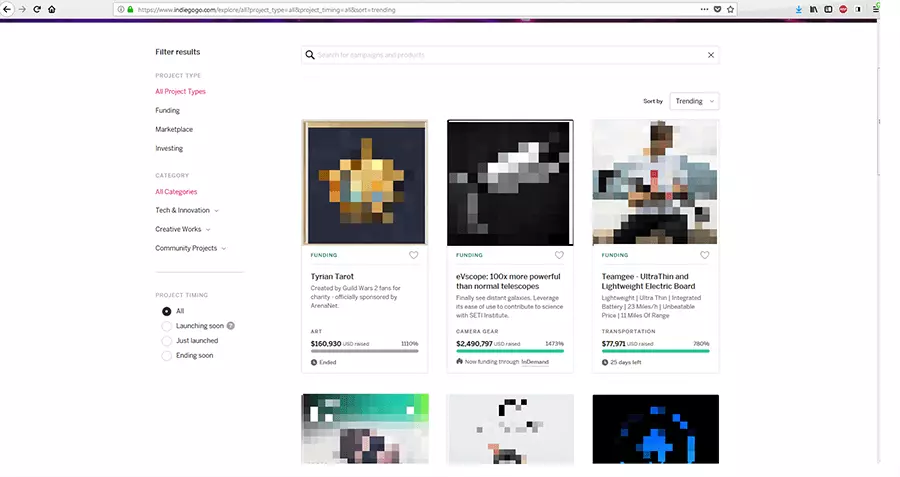
When it comes to its design, Indiegogo has a modern, minimalistic style. The simple structure of the website directs visitors’ attention to the campaigns. Navigating this crowdfunding site is smooth and simple. It is also well structured, especially the way the projects are sorted. In addition, projects can generally be sorted by popularity and funding strength. Otherwise, they are divided into the usual commercial categories and subcategories.
Indiegogo’s special feature is that you as project creator receive most donations immediately. Since the majority of donations are made via the PayPal payment service, there is no need for a waiting time for the donation to be deducted from your account. Indiegogo also offers payment by credit card; however, these donations will not be credited to your account until about two weeks after the end of the campaign. The platform charges the standard 5 percent fee for each donation, with credit card payments at an additional 3 percent plus a fixed 30 cents.
Indiegogo has a few ground rules which must be observed before starting a project. Project leaders under 18 years of age need the permission of a parent or guardian to start a campaign. In addition, projects which aim to collect money for illegal activities, or where the basic idea is absurd or unrealistic, are deleted. Perks which offer drugs, weapons, or gambling rewards are prohibited, and campaigns that promote any kind of physical or psychological violence are banned.
Apart from these common-sense rules, Indiegogo sets no limits to its projects, making it quite an open platform in comparison to its competitors. However, some filters are missing that prevent nonsensical or immoral projects from ending up online on the website. The overall quality of the projects is not, generally speaking, that high, although that does not mean that there are not ingenious projects on the site.
Indiegogo does not take responsibility for the content of individual campaigns, and does not assume any responsibility in cases of fraud. The “trust & safety” protection program is based solely on trusting the interaction between the individuals in the community. After all, in the event of problems, the site provides a special service that can be contacted around the clock. Otherwise Indiegogo mainly relies on personal responsibility: potential backers are encouraged to analyze the campaigns in detail before making a donation, as well as to ask questions and to express concerns. Project creators are asked to ensure full transparency, and to communicate regularly with backers.
It is worth mentioning the extensive education center, which offers a crowdfunding for beginners guide with comprehensive information, as well as tutorials and webinars. However, it is fair to question whether any project creators actually make use of it.
| Pros | Cons |
| The 5% fee is relatively low, … | … but this increases for credit card payment, although the amount is usual for credit card transactions. |
| The money goes via PayPal directly to the project organizer | … which may, however, be ideal for fraudsters. |
| Very few regulations for project creation | …which can mean that a number of nonsensical campaigns land on the platform. |
| Minimalistic design and clear project pages | …which, however, do not provide backer statistics or a FAQ page. |
| Good support pages for backers and project creators | …which, however, cannot replace comprehensive protection against abstraction of funds. |
Patreon
Patreon occupies a special position in the area of crowdfunding. Project financing at Patreon is subscription-based, and provides those who set up a project with a monthly income. Patreon is particularly popular with YouTubers, whose income from the video platform is not sufficient to continue financing their projects. Instead, they depend on regular donations. In return, they provide their backers with rewards, such as exclusive content or prize raffles.
Although the majority of Patreon users are YouTubers, the platform is also very popular with web-comic artists, writers, podcast operators, and musicians. Patreon has enabled many artists to make a living. Donations are subject to a 5 percent fee, making Patreon cheaper than most traditional crowdfunding platforms.
In terms of its design, Patreon does not differ significantly from other well-known crowdfunding sites. Here too, creators run their own project pages on which they advertise their content. In addition, they can stagger their supporters according to their monthly donation amount, so that more generous backers have access to exclusive content or become part of an exclusive club. In addition, backers are usually given a special mention in the creator’s final project, such as in the credits of a video, for example.
Patreon started in 2013 and is a comparatively young crowdfunding platform, but its influence on the YouTube community has been particularly significant. For creative people who publish their works more or less regularly and who have a solid fan base, Patreon is often more worthwhile than the other crowd funders, because the subscription model allows for constant income. However, you should aim to show exactly where the donations are going for financial transparency. Whether for a property, necessary recording equipment, or even if it is just for supporting a living so that you can devote yourself to art full time.
Projects are divided into different categories depending on the type of content, e.g. music and games. In addition to a project description, the project pages themselves also offer information on the rewards for backers and the number of backers who already make a monthly donation. Under this you can indicate how much money you already earn each month, but you do not have to disclose this. The financing targets do not always have to be transparent either – many project creators only use a percentage to indicate how close the project is to the financing target. Because a regular Patreon income is closer to a monthly salary than other forms of crowdfunding, it is sometimes advisable to keep the actual amount collected private.
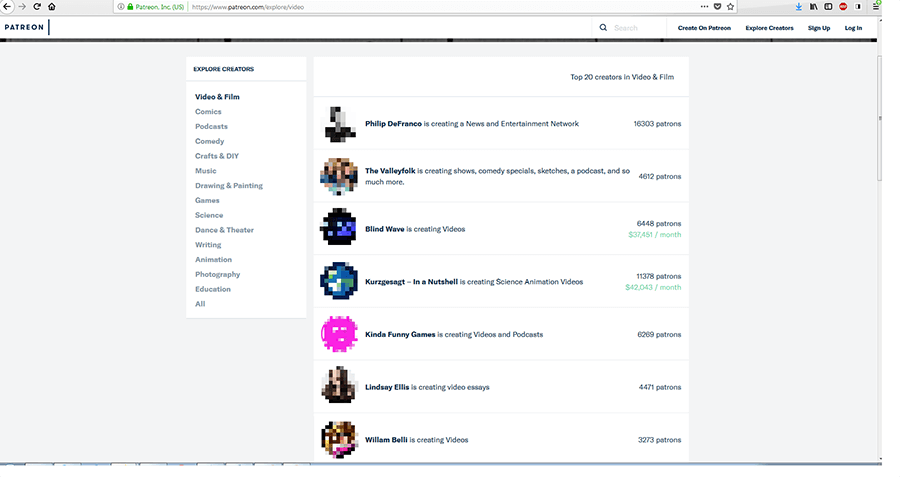
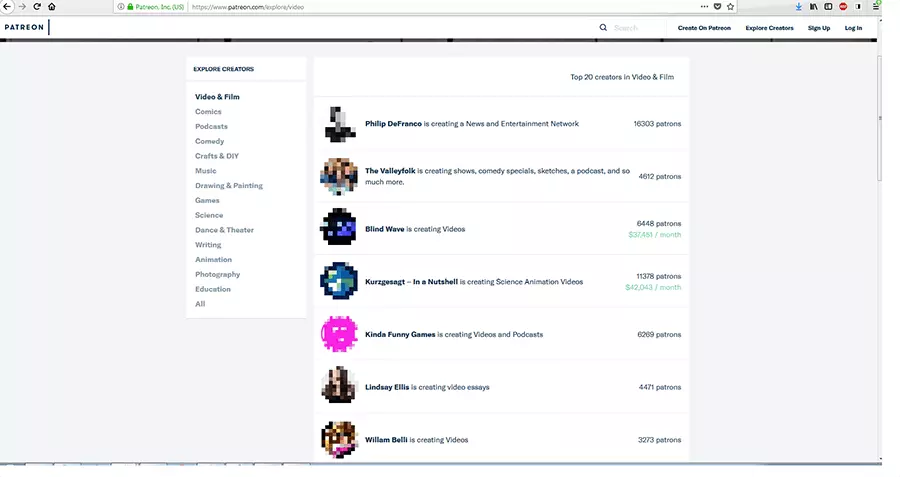
In addition to the fixed monthly donation, Patreon also offers a payment method that comes close to a typical subscription. You can determine a fixed sum from backers when you upload or send something, e.g. a new video. Subscriptions can be adjusted or cancelled at any time. Backers often increase their monthly contribution if you add a new funding target and combine this with certain promises such as even more regular content.
Due to the subscription model, the community aspect is particularly strong at Patreon. The subscribers not only ensure you receive regular income, but also act as a feedback source. The interaction with this community is even more important than with traditional crowdfunding platforms based on one-time donations. Finally, you will be actively supported by your backers, whose personal commitment to your project is much stronger due to their monthly payments. That means that at Patreon, community work is the most important aspect if you want to successfully finance your projects over a long time. It is essential that you include this regular effort in your planning.
This crowdfunding site has relatively relaxed regulations about what kind of content is put online. Only violent, and pornographic content, is banned. Nevertheless, Patreon seems to have certain rules that are not fully communicated. One controversial issue was when a YouTuber project was banned in July 2017, in which the YouTuber requested donations for activity in the Defend Europe group to document the violent blockade of NGO ships. Patreon defended their ban of this project stating that they did not want to promote projects which harm other people. There was also criticism when Patreon deleted the project page of an anarchist group. Patreon was accused of double standards, but promised to improve their policies and evaluation processes.
| Pros | Cons |
| Subscription model is particularly suitable for creative people who create regular content... | ... but the closer connection to backers puts more pressure on content creators. |
| Regular income can mean artistic activities are your full-time occupation… | ... but the flow of money depends on the quality of the product – and the loss of patreons can endanger one's own livelihood. |
| The addition of Patreons as “superfans” can motivate and the interaction with them can bring fresh ideas... | ... but the emotional as well as financial investment of some backers can lead to an overwhelming need to almost co-create, and this limits the creative freedom of project leaders. |
| Patreon gives the project creator the choice to hide the actual amount of monthly income... | ... but successful, ongoing crowdfunding requires the greatest possible transparency and to disclose expenditure. |
| Patreon is very flexible and open in terms of which projects it hosts ... | ... but this also leads to a number of lower quality projects. |
| Extensive and sensible categorization of projects... | ... but the addition of the categories “YouTube,” “Twitch” etc. would make sense. |
| Patreon is elegantly designed and the project pages are both pleasing to the eye, and informative... | ... but the search for backers could be improved by translating the website into other languages i.e. Spanish. |
Barnraiser
Barnraiser was officially launched in 2018, and has quickly gained a dedicated following. This is a crowdfunding platform based in the US only, for now, and focuses on funding sustainable, healthy food projects. The registration process is simple, and the project page will be posted in a category such as healthy snacks, small batch, gluten free, craft spirits, chocolate, teas, plant-based diets, and so on, depending on the focus of your project. The focus is on sustainable, healthy living, and was founded to support farmers and cooks with this vision in mind. This crowdfunding site is targeted towards food and farming, but journalists, artists, software developers, teachers, and activists can all start a page on Barnraiser, provided that they focus on food, and share the ethos of the site: sustainability and health for humans and the planet alike.
Barnraiser supports projects across the US, and you can search for projects close to you using the localized search function – which keeps with the platform’s focus on supporting local businesses. On the “discover” page, you will be able to filter the projects based on what you want, ranging from everything, to being able to type in the exact product you want, and based on where you’re looking for it – be it across the whole of the US, or right down to the town you live in. This feature is just for finding local businesses, but to check out the crowdfunding projects, you should head to the “contribute” page. Here you can sort the projects by most funded, most popular, and recently added – it would be nice to see a platform with a search filter for projects that need a bit of love, especially as crowdfunding has now become so popular.
The rewards of Barnraiser’s campaigns work just like with the other crowdfunding websites, with the rewards getting better the more you’re willing to support the project. Rewards range from nutritional consultations, to organic soaps, from signed copies of books, to taster packs of the projects you’re backing. Barnraiser claims that it is one of the most successful crowdfunding sites, with an astonishing 82% success rate. This could be due to the fact, however, that the average target funding is significantly lower than most projects on other crowdfunding websites. Barnraiser says this is because farmers and those in food production need a lot less money to make a very big difference. The minimum project target is $1,000, and most projects aim for between $10k and $30k.
Similarly to Kickstarter, Barnraiser operates on a tilt model, meaning that the full amount must be raised for the funds to be deducted from supporters’ accounts, and released to the project creators. This can be seen as an incentive for all to share and promote the project, so that the creators will get the money they need, and the backers get the product they’re happy to pay for and support – and often that they’ll be quite passionate about.
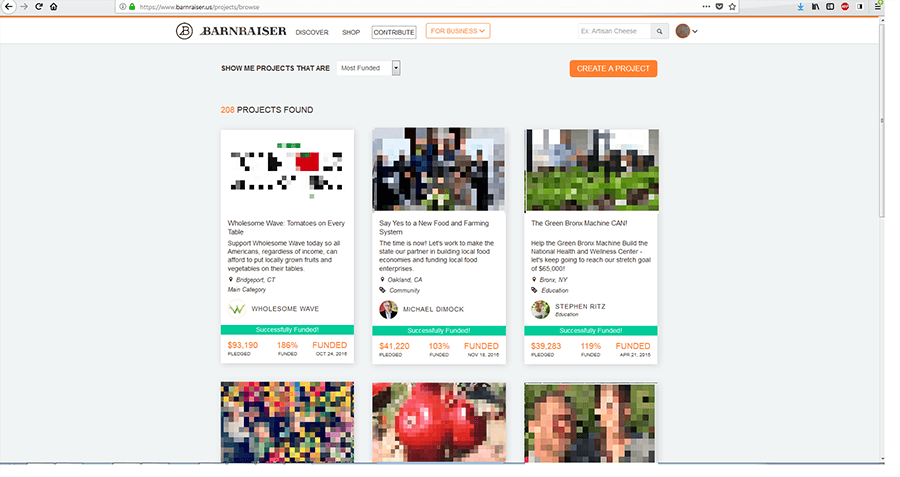
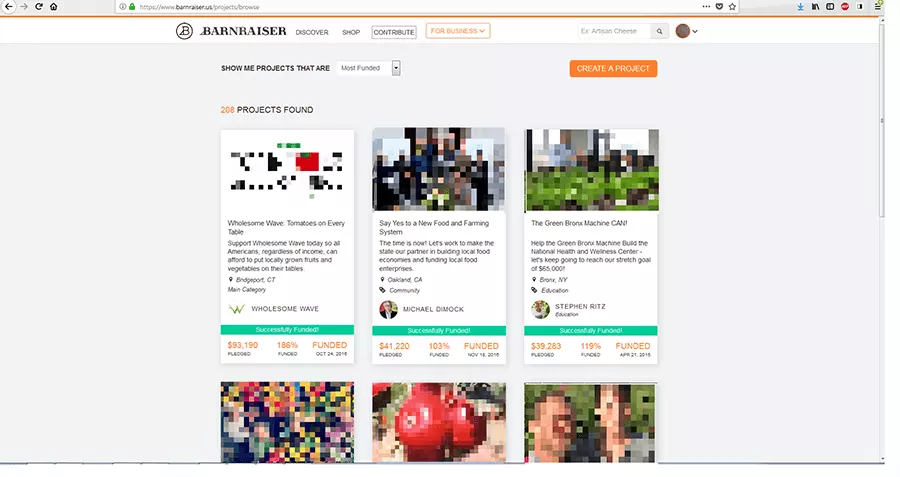
Barnraiser’s design is very focused on images, with lots of bright and quality photos taking center stage. It is not quite as polished as Kickstarter or Indiegogo, but it is also a newer platform, and less focused on tech and design – perhaps it could be considered to be in keeping that the site places its focus on the projects and end-product, rather than convincing visitors through its design. Navigating the site is a little frustrating, and finding essential pages such as the FAQs or transaction policies is a little taxing. However, once you have located them, they are useful and fairly transparent. Barnraiser takes 5% of a successful campaign’s final amount, and you can boost your project using “premium services,” which place your project higher up in searches, for example. These must be paid for, and the revenue for this feature alongside the revenue from sponsored content and the 5% transaction fees make up the business model for this crowdfunding site. You can pay for your pledge via credit card, and international cards are fine too. Just be aware that the amount won’t be deducted from your card until the project is done, so make sure you’re pledging from an account that’s always covered.
| Pros | Cons |
| Highly specified subject area is perfect for those with a sustainable, food based project in mind… | ... but this limits those who want to develop an app, for example, which has nothing to do with these factors. |
| Barnraiser has lots of different projects on their site, meaning you can find local businesses, | ... but only a handful of these are actually part of the crowdfunding part of the site. |
| Projects have a highly motivated backer system because funds are only released when the target is reached, | ... which, however, means that projects which don’t receive funding have used their energy for nothing. |
| There is a high success rate for projects… | … but this may be due to the lower targets set. |
| The FAQs and user guidelines are really helpful, offering sage advice and stating sensible rules… | ... but these pages are hard to find, due to the clumsy site navigation. |
| The site aims to support local projects, meaning that a sense of local community is created… | …but the element of global contribution is somewhat lost. |
| The site has a focus on support and community, as well as the environment and sustainability. |
An overview of all the crowdfunding sites
| Platform | Operating since | Languages | Members (May, 2018) | Fees | Crowdfunding model | Suitable for |
| Kickstarter | 2009 | German, English, Spanish, French | 14,5 million | 5 % + 3–5 % processing fee | Reward-based/classic crowdfunding | Artists, inventors, start-ups |
| GoFundMe | 2010 | German, English, Spanish, French, Italian, Dutch, Portuguese | 50 million individual backers | 8,45 % + 25 cents per donation | Donation-based crowdfunding; all donations are paid, regardless of the success of the campaign | Charitable and charitable causes, private causes, emergencies |
| Indiegogo | 2008 | German, English, French, Spanish | 9 million | 5 % + 3 % + 30 cents per transaction | Reward-based/classic crowdfunding (donations are processed individually and go directly to the project creator) | Artists, inventors, start-ups; charitable and non-profit purposes (Indiegogo Generosity) |
| Patreon | 2013 | English | 1 million | 5 % | Reward-based/classic crowdfunding (Subscriptions) | Artists, content-producers(especially YouTubers) |
| Barnraiser | 2010 | English | unknown | 5 % | Reward-based/classic crowdfunding | Inventors, start-ups, and individuals (must be food or environment related) |
Learn more about "Adding a donate button to your website" in our Digital Guide article on the topic.