

Gap analysis: the starting point for successful strategic planning

Upon being presented with their company’s objectives, many an employee has wondered, while shaking their heads, what the management team is thinking when the gap between the strategic planning and feasible execution of an objective is so obvious. When a company clings to its objectives without attempting to adapt to the internal situation, this is a sign of poor, or at the very least, inadequate business planning. Using gap analysis, you can determine the gap between the actual performance and the desired performance early on in the planning phase of a project. However, this is only useful if the company subsequently takes actions for improvement or strategic redirection.
What is gap analysis?
You can guess what this analysis focuses on from its name. The word “gap” describes it all. Gap analysis is a traditional tool for strategic marketing, which is used to determine the gap between the potential business planning objectives and the actual possible results from a company’s regular activities. This allows you to identify the weak points in your strategic planning early on. The company can then attempt to prevent these potential setbacks by redirecting their strategy or by modifying their business processes.
Gap analysis is therefore only effective if the company takes the time to assess and implement additional measures. All this analysis does is describe the current situation and show whether the targeted business objectives are realistic. The only way to bring about any positive change is through the use of additional strategic marketing tools based on thoughtful analysis.
Conducting gap analysis
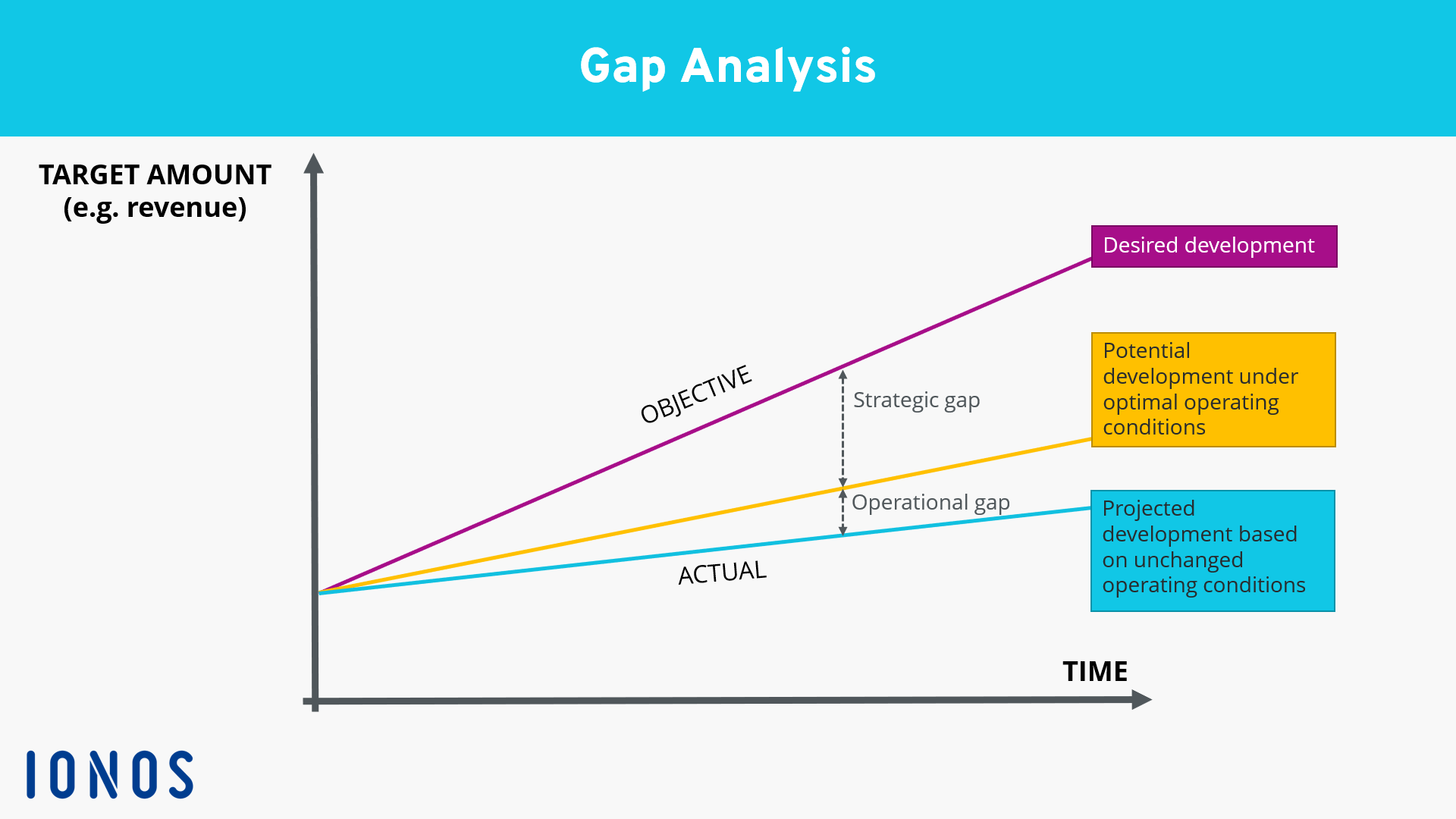
Gap analysis is represented in a curve graph, with the x-axis representing time and the y-axis representing the targeted amount (e.g. revenue). Three curves are plotted on this coordinate system:
- The desired development.
- The potential development under optimal operating conditions.
- The projected development under unchanged operating conditions.
The distances between these curves are the gaps, which need to be analyzed and addressed.
Gap analysis can be best illustrated using the following example:
Determining the curve values
First, the values for the strategic objective are plotted on the graph. These naturally form the top and most steeply rising curve, since a company with a new market model will always want to maximize their profits.
Then, the values related to future performance are predicted using the actual values from the current business processes. This curve shows how the business will develop under unchanged conditions. Usually, this is the flattest curve.
Lastly, the values which would be obtained under optimal conditions are calculated. The resulting curve is usually located between the curve for the objective and the curve for the current situation.
Interpreting the gaps
The most important part of gap analysis, however, is not the curves but rather the gaps between them. They clearly indicate how much the strategic objective, optimal conditions and current conditions differ from one another. The gap between the objective and the optimal conditions is referred to as the strategic gap, while the gap between the optimal conditions and current conditions is referred to as the operational gap.
A large strategic gap indicates that the objective is highly unrealistic and that the available (or lack of) resources in the company were not given proper consideration during planning. This may result in needing to revise the strategy or improve the company’s potential performance, such as by increasing the number of employees or procuring more efficient machines.
A large operational gap indicates that something is preventing business processes from running optimally. There is a long list of possible causes for this, ranging from technical malfunctions in business equipment to a lack of motivation among employees. Therefore, further research is required to find out how the current situation can be improved.
The potential and limitations of gap analysis
Gap analysis is a useful tool for conducting an initial general assessment of the current situation. It can be used to identify weak points early on and implement the necessary corrective actions.
However, the range of possible factors associated with this analysis is so great that further research is necessary in order to apply these findings to the strategic direction of the company. Yet another problem is that factors external to the company are not considered. Therefore, any projections for the future using current data are highly speculative.
As long as these limitations are kept in mind when conducting gap analysis, it can be a helpful starting point for the strategic planning of a company.
Click here for important legal disclaimers.