Minimum Viable Product: maximizing potential while minimizing risk

Many start-ups spend years developing a product idea, working out a marketing strategy and investing a lot of money in production. Then they present the finished product to potential customers. However, if the target group rejects the idea, the new company will quickly disappear, since it cannot recoup its investment without revenue. Those who invested everything they had in it will then be on the brink of ruin. So clever founders take a different path. They start with a Minimum Viable Product (MVP).
What is an MVP? It is a product which is functional, no more, no less. This sounds quite simplistic at first, but there is solid theory behind it. Frank Robinson, the CEO of SyncDev Incorporated, coined and defined the term "Minimum Viable Product" for the first time in the early 2000s. This concept spread throughout the start-up community through books such as The Lean Start-up by Eric Ries. The Minimum Viable Product is a key concept in the lean start-up philosophy. The following will explain how an MVP can help you get the most out of your product idea with minimal risk.
MVP: its significance in product development
You can use a Minimum Viable Product to learn whether there is a basic interest in the product and what the target group wants from the product without spending a lot of money developing it. The basic idea is to avoid investing a lot of time and money in a product without knowing whether customers will be interested in it. Instead, you develop a product which only has the most important functions. These functions need to work perfectly. Additional features and design elements are not necessary. The first development stage of a product is not about generating a lot of revenue. Rather, you use an MVP to learn from your customers and ideally answer the following questions:
- What are the basic needs of your target group?
- Does the product idea fill a gap in the market, or does it not interest the target group?
- What extra features do potential customers feel are missing?
- Can the existing core concept be further developed, or does it need to be modified in order to be successful?
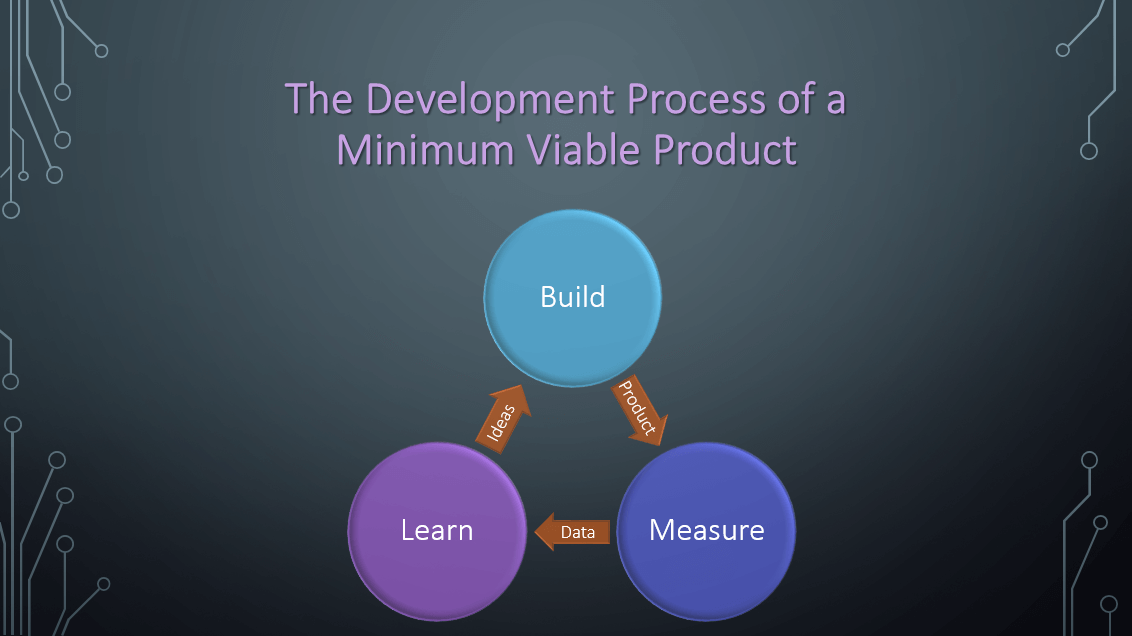
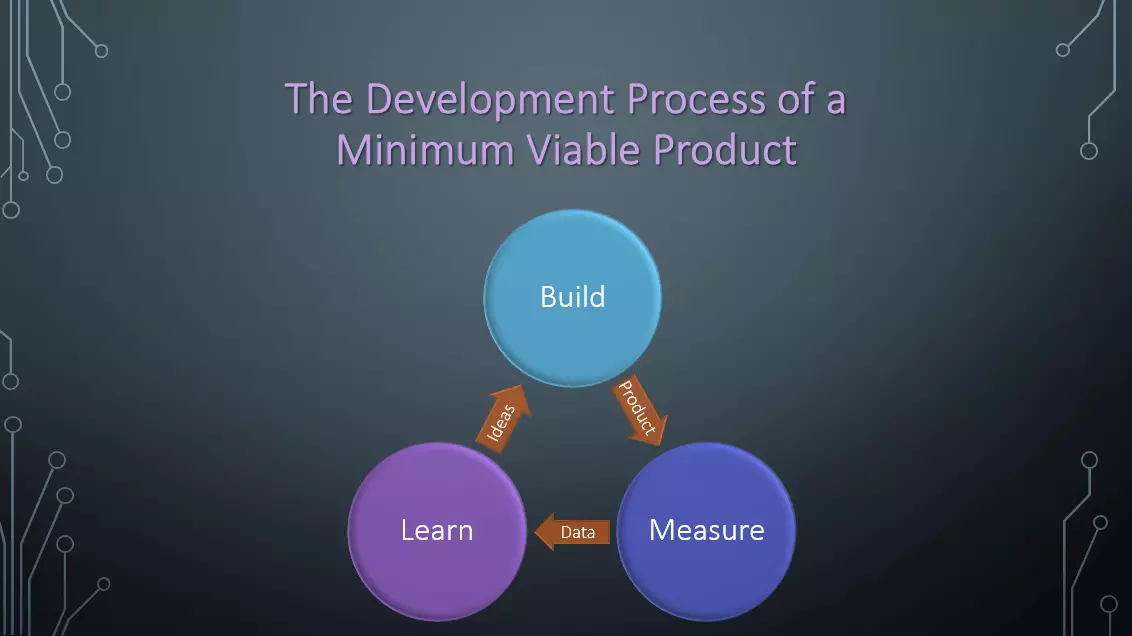
The MVP was initially mainly used in software development teams. For agile software development using Kanban or Scrum, they rely on the build-measure-learn feedback loop. This is a feedback loop based on building, measuring and learning in which customer needs are taken into account in the early stages of product development.
Initially, there is an MVP which early adopters are the first to use. As a developer, you should inform them in advance that it is a rudimentary yet functional product. You should also ask for feedback. It can provide valuable insight. Then focus on making small, gradual changes. If your product has added value and you work together with your testers in developing it, your potential customer base will grow with every added improvement. By working together with consumers, you will know what your customers want even before officially launching the product.
The Minimum Viable Product (MVP) is a product developed with minimal effort while also providing the most important functions and meeting the key requirements. In the lean start-up philosophy, developers use the Minimum Viable Product to have customers test their product and continually improve upon it.
Eric Ries, the creator of the lean start-up philosophy, describes start-ups as organizations that want to create something new under very risky conditions. Therefore, in his opinion, founders need to devise a management strategy which can be constantly adapted to new circumstances. This requires creativity and a willingness to learn.
The lean start-up methodology is based on several basic principles. One of these is referred to as “Build-Measure-Learn”. The Minimum Viable Product is an extremely important component in this context. Feedback loops are used to determine whether an idea should be pursued to its completion or whether to change course. Using the shortest possible intervals, you build your product, measure customer reactions and learn from them. This way you learn what customers like as well as to give up on ideas when there is no need for your product. This is the underlying rationale behind the Minimum Viable Product.
The Minimum Viable Product explained
The Minimum Viable Product is used in the early stages of product development and takes customer feedback into account. However, it is more than a prototype, since its key features need to work. It is also more than just a stage of the process. It is what results from the proper application of feedback loops.
Henrik Kniberg explained how this approach is often misinterpreted or improperly applied using a quick sketch. The sketch below illustrates a development process in which the MVP approach was implemented incorrectly. Each symbol, from left to right, stands for an improvement made to a product being launched on the market. The smileys underneath the sketch represent customer reactions. The finished product is a car. The developer is supposed to meet certain customer needs with the vehicle.
According to Kniberg, the underlying desire is “I want to get from point A to point B quickly and safely.”
MVP: common mistakes
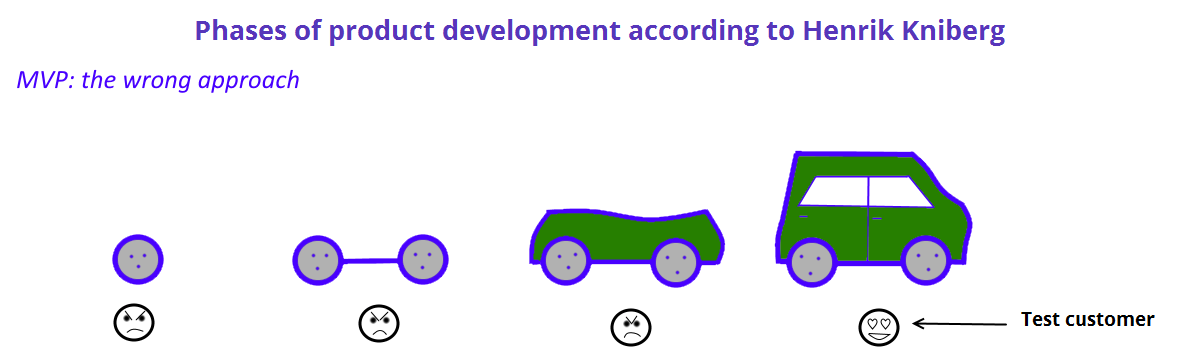
The illustration above shows how the MVP is often misunderstood. Instead of using the Build-Measure-Learn method, developers follow their own prescribed approach in which the end result should be a car which the customer loves. Essentially, they follow the typical approach for a large product launch. Little by little, they add new functions to the product until it is fully ready for use. They only test it internally. Alterations are rarely made and when they are, they are usually made on a large scale. In terms of resources, they put all their eggs in one basket.
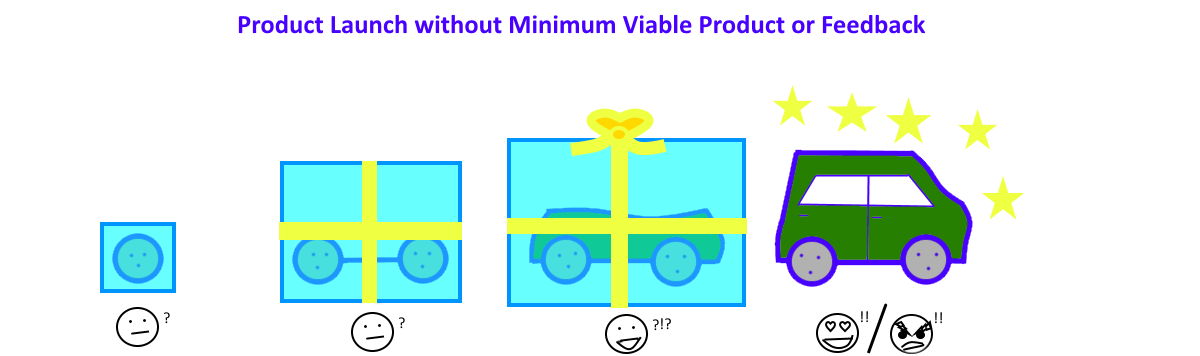
The illustration of a product launch without an MVP is similar to the first example shown of a product development process. Only the end of the chain has a usable product. Pre-launch marketing efforts are intended to generate customer interest. As the launch date draws closer, the marketing team tries to drum up even more interest. The product team hopes to have satisfied customers. However, if the product does not meet the expectations set by its marketing, there will likely be a negative customer reaction.
The misunderstood concept of a Minimum Viable Product is different from launching a product without an MVP in that the developers for the latter want to sell the very first wheel to customers. However, this does not satisfy the customers’ needs as they are looking for a means of transportation. The subsequent two product launches also do not solve the problem, as they still do not offer a working vehicle. Obviously, they also did not take customer feedback. If they had, the second version (the one with just the vehicle undercarriage) probably would have had at least a seat or a means of propulsion. Ultimately, they do produce a finished product. However, the happy smiley below it is more likely to represent the optimistic expectations of the developers rather than the reality. This is because, as a start-up without regular customers, they would not have provided the target group with even a moderately satisfactory product at its initial launch. Usually, customers will not stick around for a company’s fourth attempt to see whether or not it will launch a usable product. Instead, they will give up on the company.
MVP: How to do it right
When developing a Minimum Viable Product, you should focus on the basic product idea and the customer’s needs: to move forward, you will need a vehicle. It is risky for start-up founders to invest a lot of time and money in a product which customers might not be interested in. So, you should test your product idea for a means of transportation using the most cost-effective solution possible. For example, the skateboard in the illustration is a working vehicle. It performs the basic function of a means of transportation.
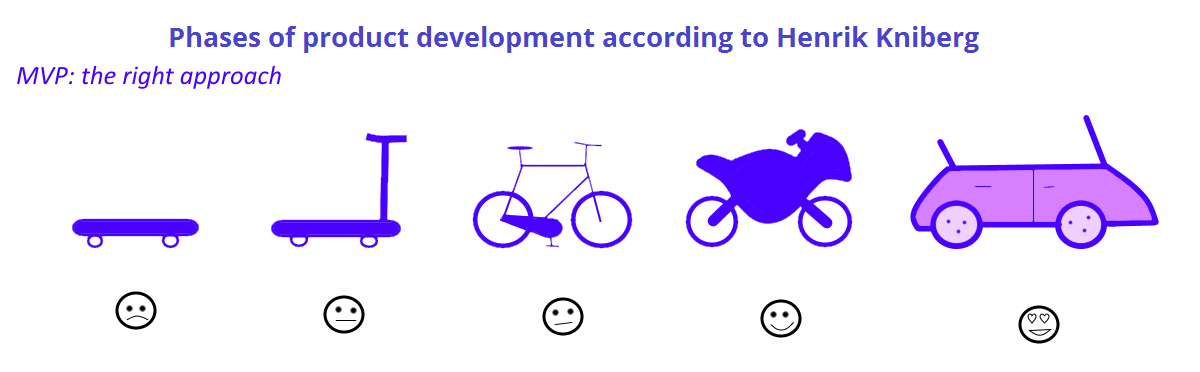
In this scenario, you have an idea for a product. You deploy a product with minimal development and manufacturing costs. Some early adopters and a select group of test customers will then provide you with feedback. You use this feedback to help adjust and further develop the product. In the illustration, there is a scooter. What can we learn from the feedback related to this change to the product?
- The customers accepted the basic idea (i.e. a means of transportation with wheels).
- Some of them felt unsafe on the skateboard.
- Some had difficulty with steering and braking.
- By adding a basic handlebar with a handbrake, you improve the safety, comfort and stability of your product.
In the subsequent development stages, you improve your product’s design. Customers can travel faster and with less effort on a bicycle than on a skateboard, since they pedal and transfer this energy to the wheels via the gears. The motorcycle is even faster and more comfortable, as the riders themselves no longer have to use any of their own energy to accelerate. A new feature is added to increase comfort: the seat.
The feedback loop supports the basic idea that "customers want to travel quickly and safely”. This is why you improve the product’s propulsion in every new version. The vehicle’s speed does not rely on how many wheels it has. The motorcycle satisfies the basic idea–it is fast and comfortable. The smiley underneath it represents satisfied users. Thanks to your test customers, you have identified additional unique selling points. After all, anyone who wants to impress the market as a company needs to deliver more than just a working product.
In the illustration, the last image you see is a car. The green car (in the illustration showing the incorrect approach) meets customer needs for speed and safety. It also offers enough space to seat several people. The pink car (in the illustration for the correct approach) meets the same criteria.
Not all differences could be represented in the illustration: Your customers wanted more speed. That means you have to make sure to have an aerodynamic design and install a turbocharger. Your feedback shows that your customers want more space and increased safety, but they do not want to lose out on the feeling of freedom that they get when on a motorcycle. So, you stabilize the vehicle by giving it four wheels. Additionally, a car provides more space for passengers or luggage than a motorcycle. Customers can leave the top down to enjoy the summer weather. Since a product’s esthetics and individual design is important to your regular customers, you launch a product with a selection of several different finishes and high-quality fittings. The result:
- Test customers have developed a relationship with the brand.
- Customer feedback provides data which you can use to develop new ideas for the product.
- The insight gained from this data can help you decide whether to keep or discard a basic idea.
- People want something new but not so different from what they know that it seems strange.
- Therefore, making many small changes throughout the development process increases customers’ willingness to embrace innovations in the subsequent iterations.
- The Minimum Viable Product requires fewer resources. Making smaller changes is less financially risky. Customers are more likely to accept gradual increases in price than large spikes.
Agile product development using the MVP
The Minimum Viable Product is a part of agile product development. During the development process, the product is constantly being evaluated. Agile product development is known for having a changeable process, which means that the development team can change course at any time. This usually involves small changes. Agile product development is defined by the following characteristics:
- It is iterative, so it is constantly repeating itself.
- It is incremental, so it changes little by little.
- It saves time and resources through short development stages.
- It makes it possible to get immediate feedback.
The Minimum Viable Product: a question of definition
The Build-Measure-Learn concept with a feedback loop is not only used by start-ups. Large companies also use agile project management to reduce the risks involved in resource-intensive projects. Ultimately, these approaches are only selected because large companies usually have an existing customer base and a well-known brand name. Unlike start-ups, they have an edge in terms of resources and customer loyalty. It is important for start-ups to design a Minimum Viable Product which meets current standards because consumers are expecting a product which at the very least can perform its basic function well.
The meaning and use of the term “Minimum Viable Product" have changed over time. Since the main goal is to create a product which appeals to the customer with minimal effort, this concept may not be applicable in all cases (because if there is strong competition, the customer may not be satisfied with just basic functions). As a result, some management experts are now talking about the minimum awesome product or the minimum lovable product.
Maslow’s Hierarchy of Needs can show which needs a Minimum Viable Product has to satisfy. For a customer to buy a product, it must satisfy a need. First of all, the customer must feel that something is missing. When a person’s basic human needs (e.g. food, sleep and safety) are satisfied, they tend to long for more (e.g. recognition or luxuries). What we require from products and services can be represented in a hierarchy of needs.
Using a hierarchy of needs in product development
A product should meet a customer’s needs. In order for the product to do this, it needs to be functional. If you are thirsty, you buy a bottle of water. This basic need is easy to satisfy. One could thus assume that a single product would be able to satisfy the market.
Nevertheless, there is a large market with different types of water (e.g. non-carbonated or carbonated, infused with fruit or tea), bottles (e.g. glass, plastic, various sizes) and tops (e.g. crown caps, screw caps or caps for sports bottles). In a supermarket, the water section can easily take up a whole wall of shelves. Each individual supplier tries to find a unique selling point while simultaneously satisfying customer needs. To do this, they analyze a hierarchy of needs which specifically reflects the customer's expectations of a product.
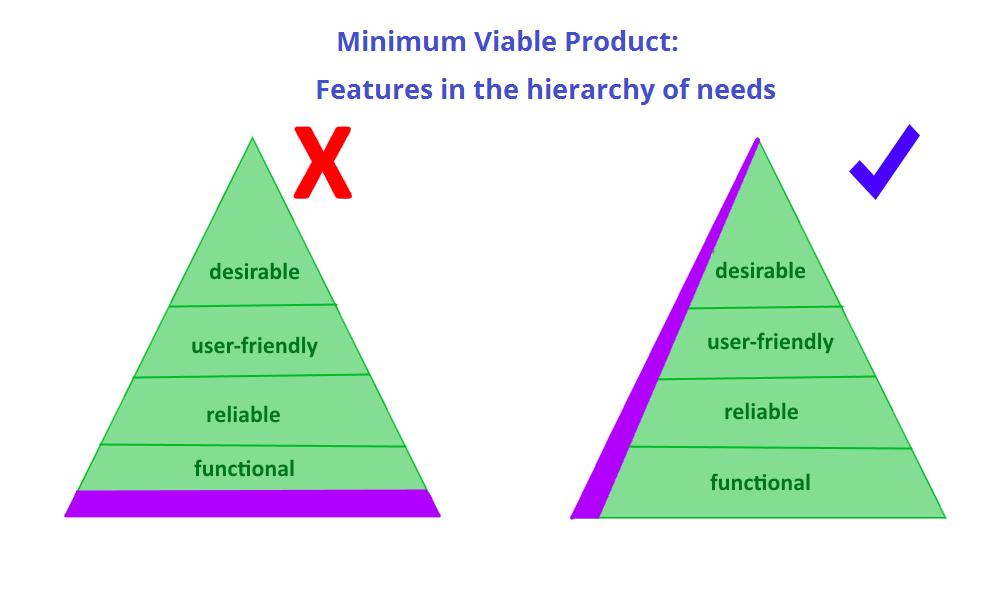
According to the old definition, the Minimum Viable Product only needed to satisfy the customers’ basic needs so that their feedback could be used to test their product idea. Advocates for this approach like to cite the streaming service Spotify as an example.
The Swedish company was founded in 2006 during the heyday of music piracy. Back then, many users were downloading music illegally, often from virus-infected websites. Long loading times further reduced people’s enjoyment of music. Spotify found a way to stream music, thereby reducing download times. The theory is that people do not necessarily have to own music physically as long as they can listen to it on the internet. Spotify’s website looked very empty in 2008. Its website only provided a download link for the beta version of the Spotify player and explained how the service worked. Over time, the service grew and offered more and more features.
Advocates for the Minimum Viable Product approach often fail to mention a few things when talking about this example.
- In 2006, internet services and data transfer rates were not as advanced as they are today. Even downloading simple images often took several minutes.
- Spotify was a pioneer in streaming, so there was practically no competition.
- In addition, many consumers found streaming to be much more convenient than downloading illegally which sometimes took hours. Spotify was also cheaper than official music download platforms which charged one to two dollars for a single song.
- Spotify expanded its library on its own and improved its algorithm for music selection.
- The service’s operators (a team of six) quickly and effectively responded to error messages and questions.
First comes market analysis, then comes the MVP
As this example shows, a Minimum Viable Product is not necessarily the product that can be produced and launched with the least possible effort. Before you act on your product idea, you need to analyze the market situation.
- Is there a gap to fill in the market or is it over-saturated?
- What strategies do market leaders in this sector use to stay on top? Do they force out newcomers using similar offers, do they buy them out or do they actually outshine their competitors with their innovations?
- Does the product satisfy a niche need or a general need?
- What are the most popular products in the target market and why? (Esthetic appeal, price, ease of use and functions)
- What functions do customers normally/at the very least expect? (e.g. simple login using existing services, such as Google and Facebook being used to log into gaming websites, or having an anti-lock braking system and air conditioning in a car)
Certain rules apply in established markets. If you want to be successful in these markets in the long term, you need to understand the rules. Even disruptive business models are ultimately bound by these rules.
The term disruption is used for a sudden development in the market. This involves an innovative business model entering the market and disrupting existing structures. For example, video streaming services have rendered brick and mortar video stores virtually obsolete.
The Minimum Viable Product should always be considered a part of the agile development process. While it is important to work out exactly how you are going to design your product so that you can answer questions about your product idea later, you should also offer customers something which promises to provide an innovative solution. Back in 2006, music-loving early adopters of Spotify found its simple website to be perfectly acceptable. Nowadays, it would very likely disappear as we have streaming services run by AI with dynamic websites and mobile downloads. Expectations have gone up. How to inspire early adopters:
- Use (influencer) posts on social media to generate desire.
- By having a user-friendly design, your MVP will receive positive reviews on consumer websites. This in turn generates interest among new consumers.
- Shine a spotlight on your project idea.
- Having a good design makes it more attractive.
As with the classic hierarchy of needs, the needs related to a product also fall into a hierarchy. Therefore, you should put most of your energy into these aspects:
- Functionality
- Reliability
- User-friendliness
If you advertise your product as being impressive and innovative when it really only has the basic expected functions (illustrated in the pyramid on the left in the image above), you will likely be ridiculed by your initial testers and customers.
The hierarchy of needs on the right uses the purple marking to show how you should weigh the various needs related to the Minimum Viable Product. If all expectations and needs are satisfied (but not exceeded), it is referred to as a minimum awesome product. In the Build-Measure-Learn process, the purple area in the hierarchy of needs will ideally increase with each iteration.
The Minimum Viable Product is more than just a functional product. When used in conjunction with the Build-Measure-Learn method, this concept helps minimize risk for start-ups. It is also the basis for agile development. Before producing the first iteration, develop a basic idea which can be used to meet customer needs. Then use feedback to work on its reliability, user-friendliness and attractiveness in order to satisfy high-level needs.
Click here for important legal disclaimers.