

PESTEL analysis

In marketing theory, we differentiate between a microeconomic and a macroeconomic business environment, also known as the micro- and macro-environment. The micro-environment refers to the immediate business environment: the particular industry, competitors and all stakeholders of a company.
Microeconomic business environment factors cannot always be directly controlled, but they can always be influenced. In this sense, they are differ from macro-environmental factors which also affect the company but cannot be controlled or influenced by it.
Researching the micro-environment usually involves analyzing the stakeholders, competition and industry. A popular method for researching the macro-environment is PESTEL analysis.
In the following article, you will discover what PESTEL is all about, what the acronym stands for and what sorts of factors you should consider when conducting PESTEL analysis.
What is PESTEL analysis?
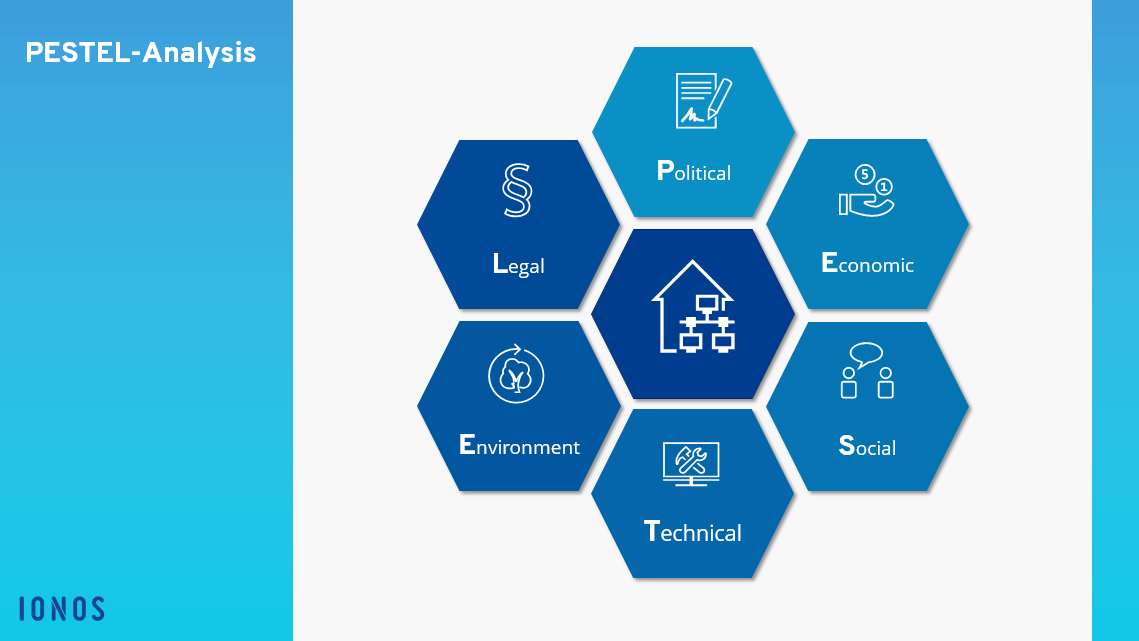
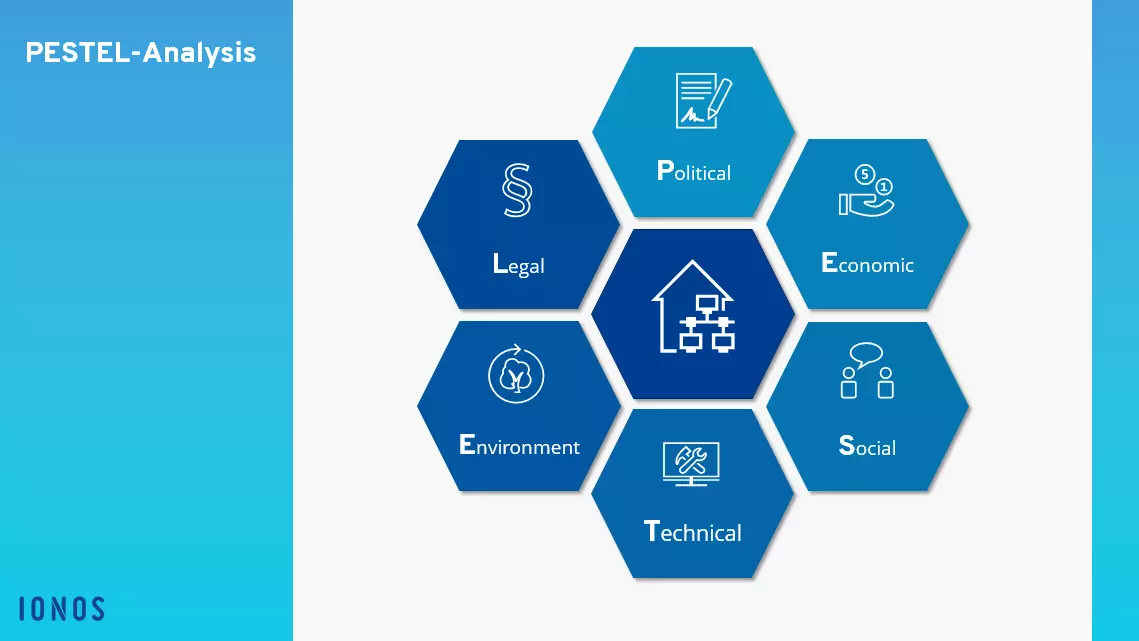
In PESTEL analysis, you develop a detailed description of a company’s macro-environment in terms of political, economic, socio-cultural, technological, environmental and legal factors as well as their effects.
In practice, analyses based on the PESTEL model are used in conjunction with studies on the micro-environment as part of the overall environmental analysis. Their objective is to identify any opportunities or risks which may arise from the business environment.
This risk-reward catalogue compiled from the environmental analysis can then be compared with the company’s internal strengths and weaknesses through a SWOT analysis. This helps to determine the scope of action and to develop measures for strategic management.
SWOT analysis is key to making a business plan which might be prepared for a startup or for a company repositioning itself, just to give a couple of examples.
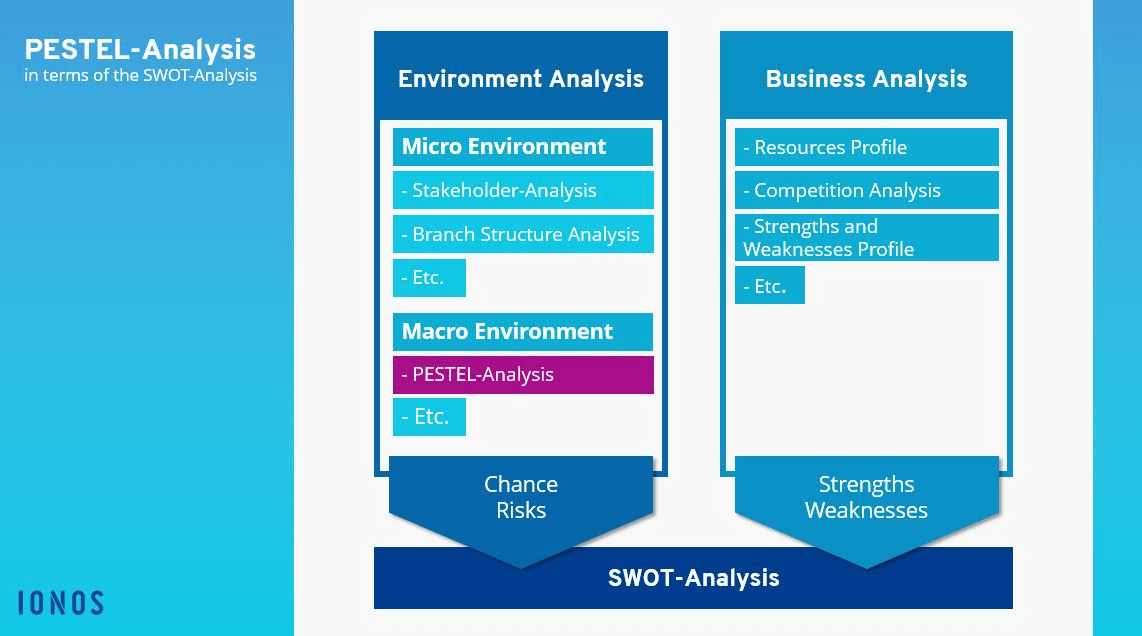
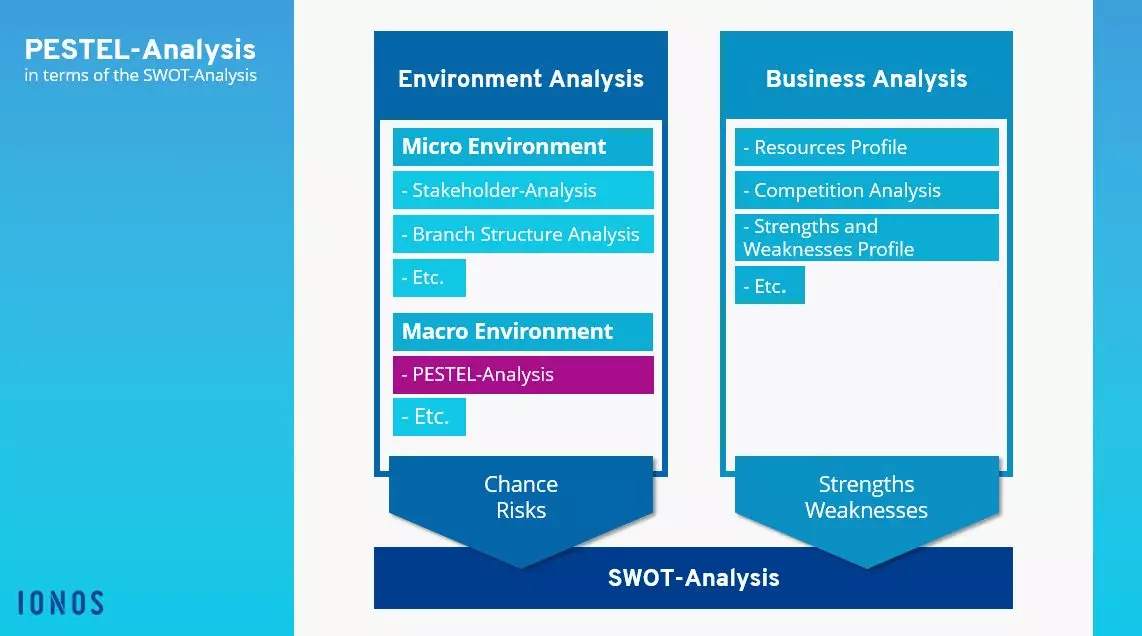
PESTEL analysis allows you to take a closer look at your company’s macro-environment. The objective is to identify factors from all significant areas of society which have a direct or indirect impact on your company and its activities on the market. This analysis results in a risk-reward catalogue which is used as the basis for further analyses for strategic marketing.
PESTEL analysis factors
PESTEL analysis is an extension of STEP analysis. While STEP refers only to
- socio-cultural,
- technological,
- economic and
- political
factors, PESTEL analysis adds to that
- environmental and
- legal factors
PESTEL can also be written as PESTLE. Both acronyms refer to the same analysis method.
Political factors
PESTEL analysis’s political factors include all governmental aspects which directly or indirectly affect your company’s business activities. These factors include but are not limited to:
- the country’s economic system,
- current and future foreign policy,
- bilateral relations,
- the stability of the political system,
- freedom of press,
- the level of bureaucracy and corruption,
- lobbying,
- security policy,
- trade policy and
- governmental regulation and deregulation.
Analyzing political factors mainly helps identify tariff and non-tariff trade barriers which might make it more difficult for you to enter a target market, posing risks to your business model.
The tariff trade barriers which might affect how you are allowed to run your business operations include but are not limited to:
- customs policy (import and export duties),
- export subsidies and
- tax guidelines.
Examples of non-tariff trade barriers include:
- import surveillance measures,
- bans and restrictions on exports and
- setting minimum import prices.
Additionally, political factors which affect the economic development of the market can also be an opportunity for companies, such as with:
- funding and
- subsidies.
Economic factors
Economic factors can provide insight into the economic development of the markets your company is interested in. These factors include but are not limited to:
- economic growth,
- gross domestic product,
- population,
- production conditions,
- consumer behavior,
- capital flow,
- import/export,
- stock market trends and
- credit availability.
These factors can have a significant impact on your company’s performance and profitability. The following factors can pose economic risks:
- interest rate fluctuations,
- price fluctuations,
- recessions,
- exchange rate fluctuations,
- inflation,
- the unemployment rate,
- rising labor costs and
- resource scarcity.
The following economic factors can lead to economic opportunities:
- rising average income,
- an increase in investments in the target sector and
- rising demand.
Socio-cultural factors
When describing the socio-cultural factors, you should first consider demographics:
- age distribution,
- social classes,
- life expectancy,
- population growth rate,
- language,
- wealth distribution,
- level of education and
- family size and structure.
Standards, values and attitudes can also have a significant impact on your business activities. Examples of this include:
- health consciousness,
- shopping habits,
- understanding of one’s role (gender roles),
- religion and
- trends.
Technological factors
Technological developments can also lead to both opportunities and risks for your business model. The technological factors you should consider in a PESTEL analysis include:
- government expenditure on research and development,
- the level of innovation,
- access to new technologies and
- disruptive technologies.
Environmental factors
The second “E” in the acronym “PESTEL” stands for environmental.
The environmental factors include physical and geographical features such as:
- climate,
- topography,
- country size,
- infrastructure and
- the availability of natural resources (raw materials, mineral resources).
More and more companies are also focusing on environmental aspects when making business decisions. The following factors play a key role:
- environmental pollution (emissions, waste),
- environmental awareness,
- pressure from NGOs,
- adoption of sustainable products and
- recycling standards.
Legal factors
Your company’s scope of action in a targeted market largely depends on the legal system of the country in question as well as the legal awareness of the general population. In a PESTEL analysis, you will examine which of the following factors, among others, impact your company:
- competition laws,
- antitrust laws,
- environmental regulations,
- consumer protection laws,
- occupational health and safety requirements,
- merger and acquisition laws,
- data protection,
- copyright and patent laws,
- liabilities,
- manufacturing standards and
- labeling regulations.
Applying the PESTEL analysis
The factors described above are sometimes interconnected. A change in an environmental factor, such as an increased environmental issues in a region, usually also has legal or socio-cultural implications, such as environmental regulations being imposed and a growing environmental awareness among the population. Technological developments as well as political decisions also often influence the economic scope of action.
Nevertheless, you should examine the previously mentioned factors separately in the PESTEL analysis and determine the status quo as well as current trends. What changes should be expected and when? Can you identify the driving forces which will bring about these changes? Also, what are the opportunities and risks for your business operations, such as in terms of demand or the market behavior of customers, suppliers and competitors?
Both primary and secondary sources of information are available for use in the PESTEL analysis. You can obtain a great deal of information free of charge from government institutions and trade associations.
| Primary sources | Secondary sources |
|---|---|
| Surveys | Official statistics |
| Interviews | Government publications |
| Expert interviews | Trade association publications |
| Observations | Economic research institute reports |
| Industry reports | |
| Market research institute publications | |
| Scientific studies | |
| Business reports | |
| Information from international organizations |
You should limit your analysis to only include environmental factors which actually impact your company and its operations. This is the only way to ensure that you will be able to develop practical strategies and action plans from the risk-reward catalogue you drew up during the SWOT analysis.
The following video was produced through a collaboration between Leiden University, Delft University of Technology and Erasmus University Rotterdam. It illustrates the connection between PESTEL and SWOT analysis in three and a half minutes.
 To display this video, third-party cookies are required. You can access and change your cookie settings here.
 Click here for important legal disclaimers.