

The four stages of the product life cycle

When you launch a new product on the market, you are sending it on a journey. In most cases, its performance is neither constant nor linear. So, how does it evolve? Scientists have observed the evolution of how products perform on the market and in doing so have identified different stages which virtually every product will go through. If you want to be able to predict how a product will evolve, how it will perform on the market and how its profits will change over time, you should be familiar with the product life cycle model.
Being able to predict a product’s life cycle and its different stages enables companies to plan more reliably and even sometimes avoid unpleasant surprises.
What is the product life cycle?
The product life cycle is a business administration term which is applied more generally rather than to individual products. It is not about the longevity of a single item but rather about how a product group or service will evolve on the market over a long period of time. Products go through four stages from their introduction onto the market to their decline.
The product life cycle has a strong effect on revenue and thus also on a company's profits. Therefore, it is important to address this before launching a product on the market. In addition to management and controlling, the product life cycle also affects the company’s marketing. When you are familiar with the different stages and know which stage your product is in, you will be able to allocate your resources more effectively. The product life cycle should thus also influence which marketing tools a company chooses to use during the different stages.
The product life cycle stages
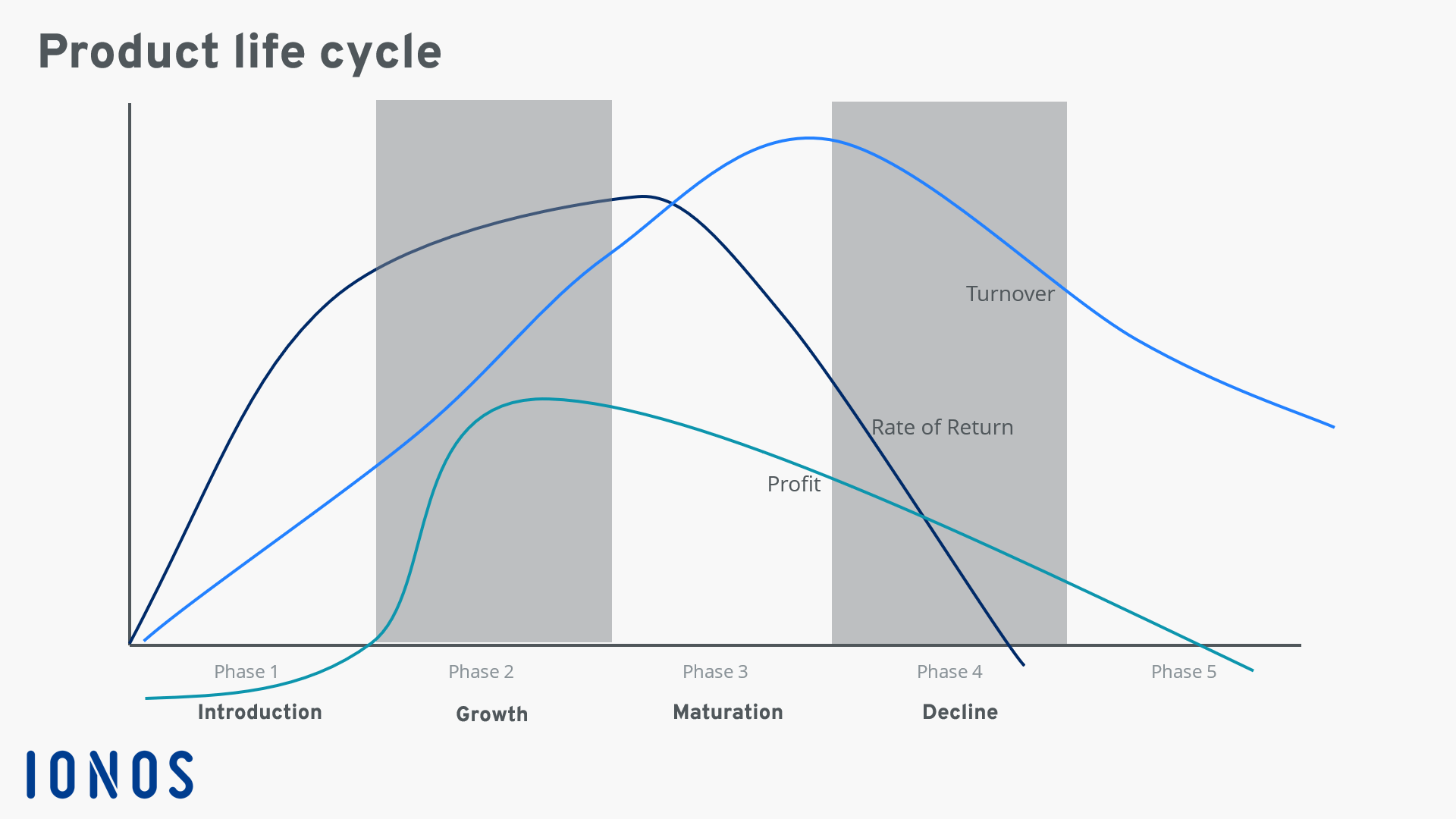
You can also expect to see differing profit margins for each stage in the product life cycle. However, there are no set timeframes for how long each stage will last. This depends on the product, the market, the competition and the industry. Some products have very short life cycles (especially those arising from trends and fads), while others have very long life cycles on the market.
Introduction
A new product’s introduction on the market begins on the date when customers can purchase it. This means that only a few, if any, potential customers have heard of the new product. Therefore, the focus of this stage is increasing awareness. This also means that the company must allocate the necessary resources (i.e. budget and personnel) to make the launch as successful as possible.
As a result, launching a product on the market is quite costly. In addition to spending a lot of money on marketing, the new product usually won’t generate much revenue during the introduction stage meaning little to no profits. So it’s important to obtain pre-financing. Typically, the price of the product is kept relatively low during this stage to appeal to more customers.
. When the revenue from the product’s sales exceeds its costs of production, the product has reached the growth stage. If this point is never reached, the product launch is considered a failure, and it will disappear from the market, sometimes along with the company.What happens if nobody is interested in the product? To minimize the risk of a total failure, startups focus on the minimum viable product (MVP). They first put a very simple version of the actual product on the market as a trial run to evaluate customer reactions.
Growth
After the product’s introduction on the market, it enters the growth stage. During this stage, there is a steady increase in the quantity sold and therefore in revenue. As a result of the marketing done in the first stage, a growing number of people have learned about the product and are now buying it. However, you must not rely too much on the impact made by the initial marketing. Even in this stage, the product needs to continue to be strongly promoted so that its growth does not slow down too soon and so that the rise in its performance curve is not too flat.
Meanwhile, competitors are usually becoming aware of the product during this stage. This leads to two different problems:
- Price wars: Competitors with similar products on the market lower their prices to minimize their loss of market.
- Imitations: The new product is imitated, and the imitations compete with the original product by offering lower prices or better/additional functions.
Maturity
The product has already established itself in the maturity stage. There is very little growth in revenue, and it reaches its peak. Typically, this stage lasts the longest and generates the greatest profits. This is also when the product will have to face its toughest competition. To prevent this stage from ending too soon, companies can take a variety of measures:
- New versions of the same product can help maintain interest and give it a competitive edge.
- Marketing during this stage focuses more on product differentiation and less on actual innovation.
- They are now able to wage price wars themselves.
- Since they are already established on the market, they can use many distribution channels and win over more customers by being widely available.
Decline
Eventually, a time comes when the company is no longer making a profit from the product. This stage can often be identified by the fact that not only are their products selling less but their entire market has shrunk. At this stage, marketing is no longer effective. Alternatively, companies have two options:
- Product elimination: The obvious solution is to take the product completely off the market and focus on a new product line. Removing a product from the market is not admitting defeat. It is a calculated and necessary step. This ends the product life cycle.
- Further development: Some companies are able to introduce a completely new version of the product with other functions on the market. This might allow them to reach a new market and target group. It is possible for the new version to go through the product life cycle again.
The product life cycle is a useful planning model for both new and seasoned companies. When you can identify what stage of the life cycle your product is in, you can better assess which marketing activities are appropriate and avoid wasting any potential. Additional information regarding the market behavior of products and services can be obtained by using the BCG Growth-Share Matrix and the Ansoff Matrix.
Click here for important legal disclaimers.