

Coworking – a new way of working for modern jobs

The world of work is constantly changing. Due to technical progress, digitalization, and Industry 4.0, working possibilities have developed that no one could have imagined 50 years ago. New industries, working areas, and positions have adapted along with the needs of the workers. Many freelancers, founders, and employees are no longer tied to a fixed job. Alternatives, such as working from home, are becoming increasingly popular – especially among creative people or the so-called digital nomads, who can do their work entirely from a PC or laptop.
The workplace is therefore not as important as first thought, but in order to be productive, many would still prefer a clear separation between work and leisure time. A relatively new possibility is coworking. What is coworking, and what are the advantages and disadvantages?
What is coworking?
Coworking is “the use of an office or other working environment by people who are self-employed or working for different employers, in order to share equipment, ideas, and knowledge.” Founders and freelancers in particular use coworking as an alternative to traditional offices or working from home.
In so-called coworking spaces, individual desks are usually rented for short periods of time. Many people enjoy coworking since they feel that they belong to a community. There is a pragmatic principle behind coworking: many freelancers, startup founders, and employees want a place to work, but cannot afford anything by themselves, or it could be that they don’t want the loneliness that comes from working from home.
When coworking, you find yourself working with many others in the coworking space. What looks like an open-plan office to some, is a creative melting pot to others. You don’t just share the place you work; you can also create new ideas by sharing with other people, some of whom come from completely different industries. Whether during the coffee break or an after-work beer, the conversation gets going, and you inevitably come up with new ideas, and could maybe even find a new business partner!
History of coworking
There isn’t much history up to this point since coworking began quite recently. In 2005, Brad Neuberg first used the term when he created the San Francisco Coworking Space. People could use this space two days a week. As early as the 1990s, programmers came together in so-called hackerspaces. In these spaces, they worked side by side, supporting each other in case any problems arose, and were also able to exchange their knowledge and skills.
Coworking spaces are becoming more and more popular, especially among freelancers, who mainly work digitally. If you only need a laptop and possibly a phone, you can practically work anywhere. You can quickly pack your “office” into a bag and move your workplace to wherever you want it to be. In the larger cities that already attract startup founders and freelancers, coworking spaces are growing rapidly. From just 14 spaces in the US in 2007 to a predicted 6,219 spaces in 2022, this new way of working is showing no sign of slowing down.
In some Asian countries, it is not just a question of an attractive working atmosphere, but actually a matter of necessity. Hong Kong, China, Taiwan, or Singapore are experiencing rapid growth among tech companies, while at the same time offering very limited office space. The same applies to cities such as New York, Paris, and Berlin. It is difficult to find your own office and it can end up being quite expensive for a small entrepreneur.
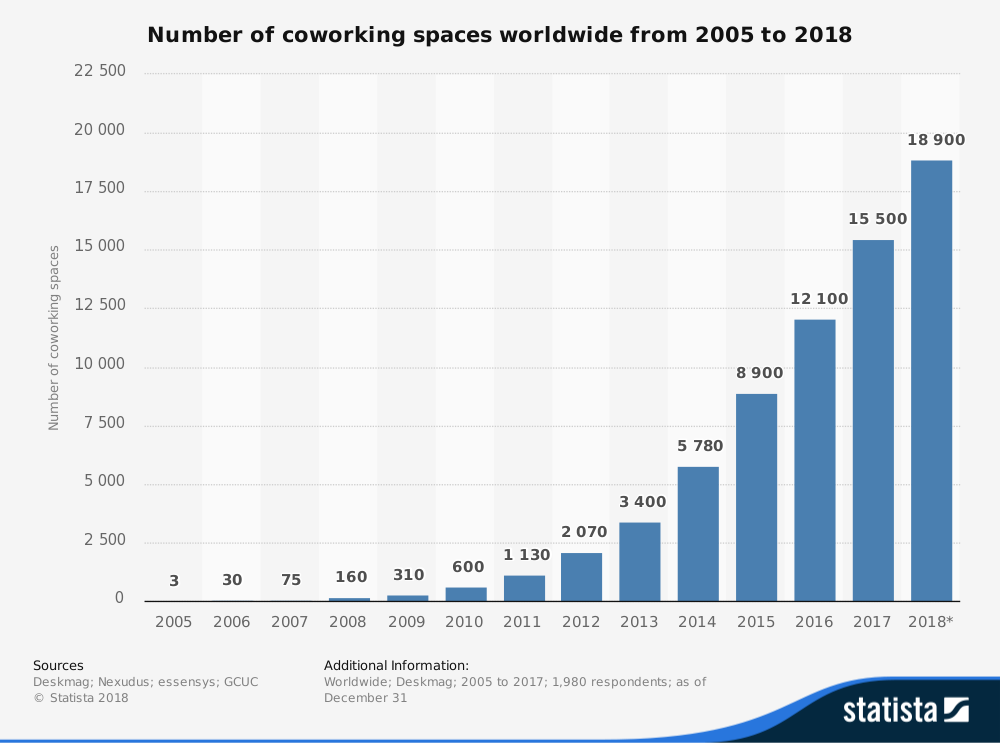
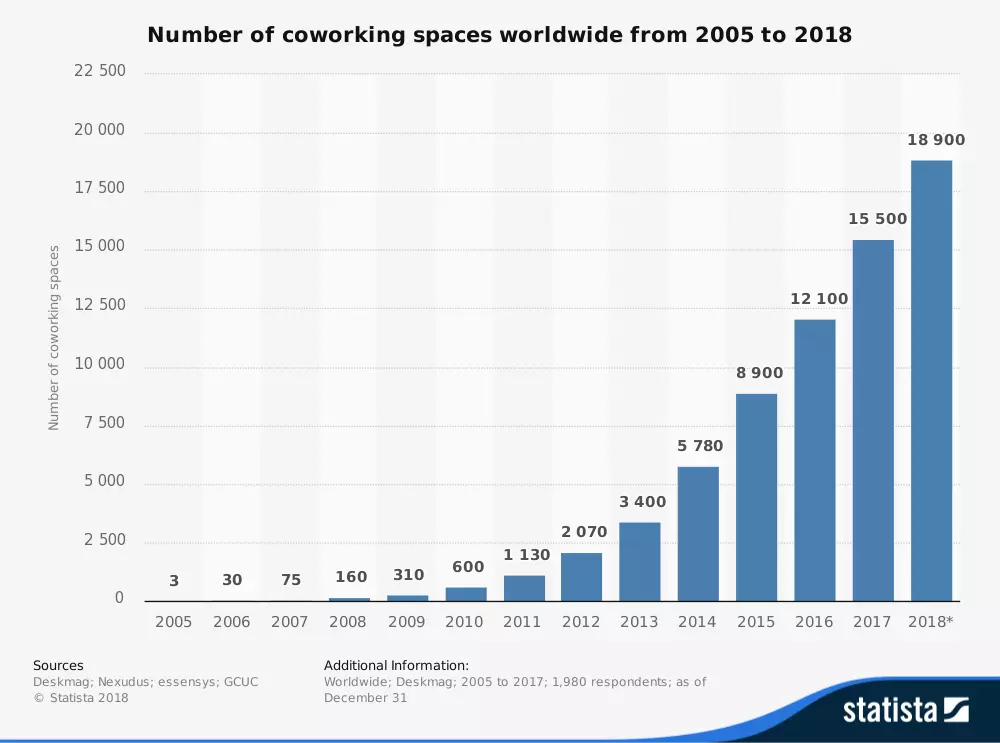
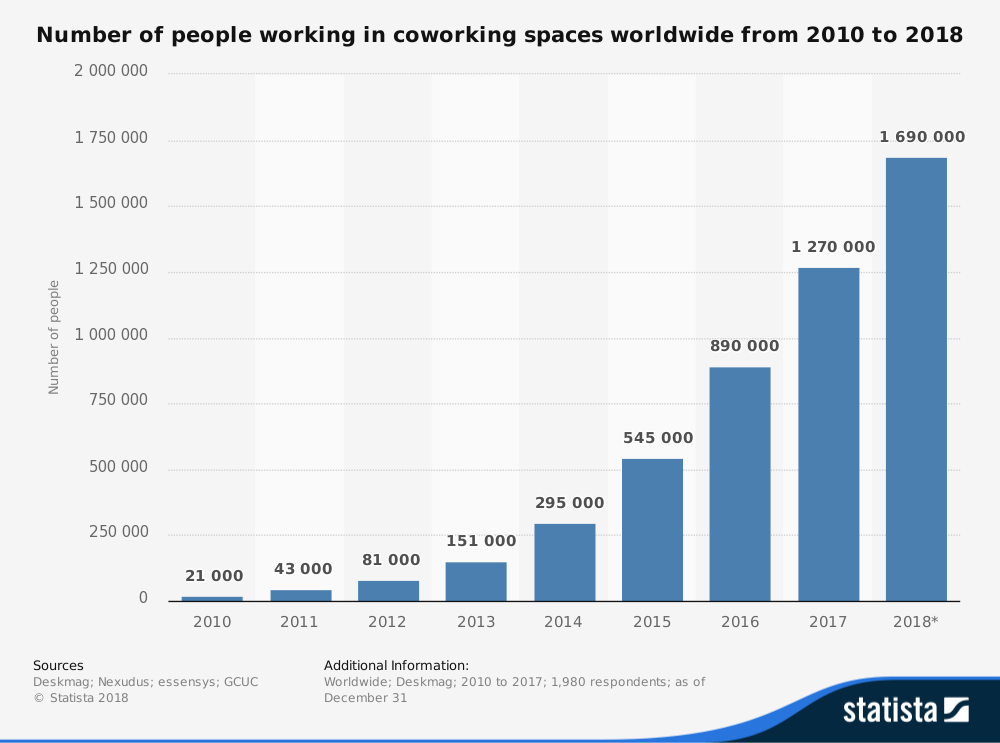
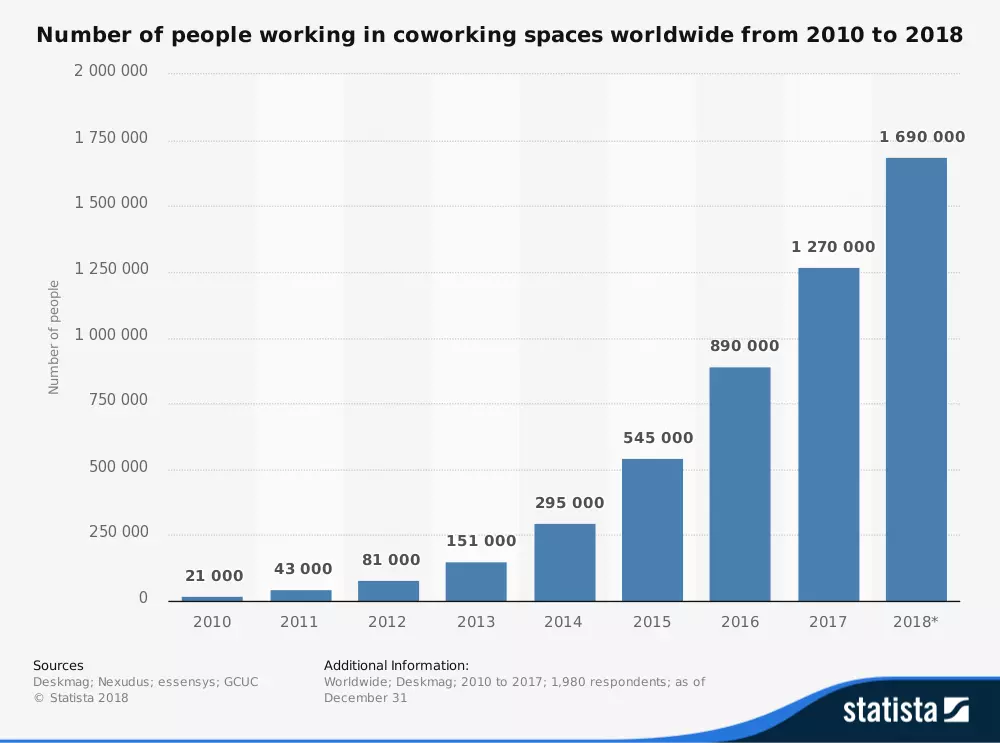
In recent years, the number of coworking spaces as well as the number of people taking advantage of them has increased rapidly. The definition of a classic working space isn’t as black and white anymore. Thanks to the internet, teams can work together even if they are spread all over the world. In addition, more and more professions are being pursued purely digitally and no longer require a fixed workplace. Coworking spaces are a response to this change in the working world and are therefore becoming increasingly important.
What do coworking spaces look like?
Photos of the first ever coworking spaces show a living room-like atmosphere. Nowadays they look more like a fusion of café and office. This can probably be explained by the fact that people who use coworking spaces today are used to working from coffee shops. On the one hand, these places have evolved into coworking spaces, while on the other, users don’t want to forego the amenities of a nearby barista. The main area therefore usually consists of an open space with many desks and a bar with additional seating.
The work stations are usually known as hot desks. These are desks that aren’t permanently assigned to people, but are instead reassigned daily. If you sat at a certain desk one day, it could be that you arrive the next day and find it’s been taken by someone else. Therefore, you shouldn’t be storing or leaving any of your belongings there. With hot desking, you pay a daily rent. Dedicated desks, on the other hand, can also be rented for a longer time. These have the advantage that you can set up your things to a certain degree and adapt the desk to your individual needs.
It is also common for coworking spaces to offer closed-off areas: workers usually have the option of selecting from different meeting rooms. If you want to have an undisturbed conversation with your team, customers, or investors, you can choose a room of the right size and with the right equipment (e.g. projector, whiteboard, etc.) in it. Some coworking spaces also have smaller cubicles where you can make phone calls. Lockers can be rented so you can safely store your personal belongings, even overnight.
Many coworking spaces have complete office space available for smaller teams. These can be rented flexibly for short periods of time. This is like a mix between coworking and classic offices.
The usual equipment in a coworking space includes:
- An open area with hot desks and dedicated desks
- Complete offices for small teams
- Meeting rooms
- Telephone booths
- Lockers
- Café, bar, and kitchen
- Community areas
- Printing and scanning options
- Reception
- Mail service
Besides very general coworking spaces like these, which can be used by anyone who has a desk job, there are also more specialized offers. For example, coworking spaces with workbenches, milling machines, saws, and drills, have been set up for the more artisan sectors. 3D printers are also becoming more and more popular. The advantage is very clear: a young company does not have to pay the large acquisition costs if, for example, it only wants to create a prototype first. Similar offers can be found for other industries. Spaces like these are known as maker spaces, which are like a DIY area where you can let your creativity flow with all the materials and tools on offer.
The cost depends on the provider of the coworking space. While some want you to pay from day to day, others offer a more flexible member system. Different subscriptions are often available, depending on the needs of the people working there. Additional services are then booked separately. Since there are now also internationally operating companies, members may even be able to work in different places around the world without major problems.
Who uses coworking spaces?
Coworking spaces were primarily created to offer an alternative to freelancers who would otherwise work from home. Due to the spread of useful laptops, it was no longer necessary to use a fixed desk. If you work exclusively digitally, you can theoretically do it anywhere. Especially freelancers in tech and media fields are drawn toward the idea of coworking. Even for the self-employed, who often work for several different companies, it’s often not worthwhile to rent an office space permanently.
Coworking also plays a role in the lives of digital nomads. This group of freelancers rarely stays anywhere for very long and is on a constant journey around the world. The work is done on the road, wherever internet access is available. Coworking spaces can therefore function as a temporary home for digital nomads.
In addition, startup founders have discovered the concept of coworking. Especially at the beginning, it is not yet clear how the company will grow. In classic office situations, it’s difficult to plan how big the office should be, since you don’t know whether the company will be successful or not. Coworking spaces are flexibly scalable: if another employee joins the team, another workplace can be booked without any problems. Some of the well-known companies that started as startups in coworking spaces include Uber and Instagram.
In recent years, however, larger companies have also discovered communal workspaces for themselves. In some cases, individual teams or entire departments are outsourced. The reasons for this vary; flexibility, for example, plays a role. Often, however, you also want the benefit of exchanging ideas with other workers; the change of working environment should therefore ensure more creativity. In addition, large companies take advantage of the fact that they do not have to invest their finances in real estate in the long term. Finally, the administration of the premises (e.g. cleaning and repair work) is taken over by those providing the coworking space.
Advantages and disadvantages of coworking
Depending on how and for what purpose you use a coworking space, the concept has several advantages, but also some disadvantages. Since people have different working styles, you have to decide for yourself whether it can work for you.
For many, the advantages are quite tangible when it comes to costs. In order to commit yourself permanently to one or more offices, you must have financial security. Self-employed people, who haven’t found their feet yet, cannot take the risk of owning their own premises. This is why they often work from home. This, however, doesn’t work for everyone: some people would prefer to separate work and leisure and therefore prefer coworking spaces. Others, on the other hand, cannot tolerate environments like these: the constant restlessness in an open-plan office with many unknown people is seen as a disadvantage by some.
Coworking is therefore also a question of personality: fans of the concept repeatedly mention networking and being part of a community as advantages. In a coworking space, extroverted people, especially, can quickly become acquainted with one another, which helps them privately and professionally. Others need the seclusion to be able to concentrate and find it difficult to meet strangers openly from the beginning. For the latter group of people, coworking will be a temporary solution at best until they can afford their own office.
| Advantages | Disadvantages |
| Flexible workplace | No fixed workplace |
| Scalable at any time | Often restless atmosphere |
| Get help from the community | |
| Networking | |
| Office supplies provided |
Click here for important legal disclaimers.