

Job posting: how to create appealing job advertisements

The search for new employees is often more difficult than anticipated. Market competition is fierce and, after all, you don’t just want a competent employee, you also want the chemistry between the new employee and the company to be right. To complete the search successfully and quickly, you should write a job advertisement that is as accurate as possible and describes not just the field of activity, but also your company profile. Just like advertisements, you also have to attract the attention and interest of the target group when looking for employees. However, what information actually belongs in a job posting? And what formalities should one pay attention to when creating and designing a job posting?
What is a job posting?
A job posting or job advertisement is a personnel management letter that informs candidates about the job available. A job advertisement might offer one job in a specific location, or advertise several jobs available within a company, or offer a job that requires a regular change of location.
Job ads can be posted either internally (internal only) or externally (to the public).
Job advertisements are the start of the recruitment process – they are intended to provide potential applicants with both information and incentives. Whether it is a private law contract or a public service post, it is common practice to prepare a vacancy notice for it. However, there is no legal obligation to advertise a vacancy, as is the case for some civil servant jobs, when it comes to employment relationships governed by private law. There are only a few individual requirements – like the obligation to formally advertise professorships at scientific universities.
A separate type of vacancy notice is the “sham” notice. These provide information about seemingly vacant positions, which in reality have already – at least unofficially – been awarded. These job postings can often be seen in universities, which are obliged by their works council or donors to issue invitations to tender. The requirement profile is then so detailed that it can only be fulfilled by the desired candidate who has already been determined in advance. Private enterprises sometimes also issue sham notices. The job postings are used as a means of publicity, in order to suggest success and company growth and impress competitors and investors.
What information should be included in a job posting?
The be-all and end-all of a good job advertisement is content. Before you get into the design and distribution aspects, you need to clarify what information must be included in the ad. It is also important to give the content an appropriate structure and length so that potential applicants are ready to deal with the ad. It is also important to filter out information that isn’t relevant to the achievement of the objective (readers who match the advertisement profile apply according to the desired application information).
In principle, you have a lot of freedom when designing a job advertisement. Nevertheless, be sure to take the areas presented in the following sections into account when you create a job posting.
Introducing your company
Before you talk about the job itself in your job advertisement, you should use the first few lines to introduce your company to potential new employees. To stop the company presentation getting out of hand and taking up more space than the job description, you should carefully consider how you can highlight aspects like business and location. A compact, exciting briefing that outlines your business area and highlights the corporate values and advantages of the location is perfectly sufficient for attracting readers’ attention. Typically, the current number of employees is also mentioned. Some of the features that should be highlighted are:
- Company history (for traditional companies)
- Connections to schools, universities etc.
- Supraregional activities
- Partnerships and cooperations
- Awards
Many job postings, and company descriptions in particular, lack creativity and unique selling points. Keywords like “successful,” “innovative,” “worldwide,” “leading,” or “passion” are often used in a similar inflationary way as “interesting,” “exciting,” or “varied.” When creating your job advertisement, make sure you use these terms sparingly or look for more appropriate alternatives.
Job description
After you have introduced your company, describe the vacancy that needs to be filled. It is your job to inform potential employees as thoroughly as possible about what they can expect in your company. So, name the available position on the one hand, and explain which activities and goals are linked to it on the other. Depending on the job, applicants may also be interested in who or which departments they will work with. It is also important to know whether the job is full-time or part-time and where the applicant would be working.
It is not necessary to go into every detail of the job description. The job advertisement should only give a first impression of the activity, which can then be expanded upon in an interview. As a general rule, the more specific your job description and the associated objectives, the higher the risk that new employees will become too fixated on these requirements.
Requirement profile
The requirement profile is extremely important for companies and potential employees alike. It gives them the opportunity to make concrete specifications about the training or education required for the position, which in turn shows the candidate whether or not they have the necessary qualifications for the job. You also need to indicate whether you have any special requirements regarding foreign language or IT skills. If it is relevant to the job, also specify whether or not a driver’s license is required or advantageous.
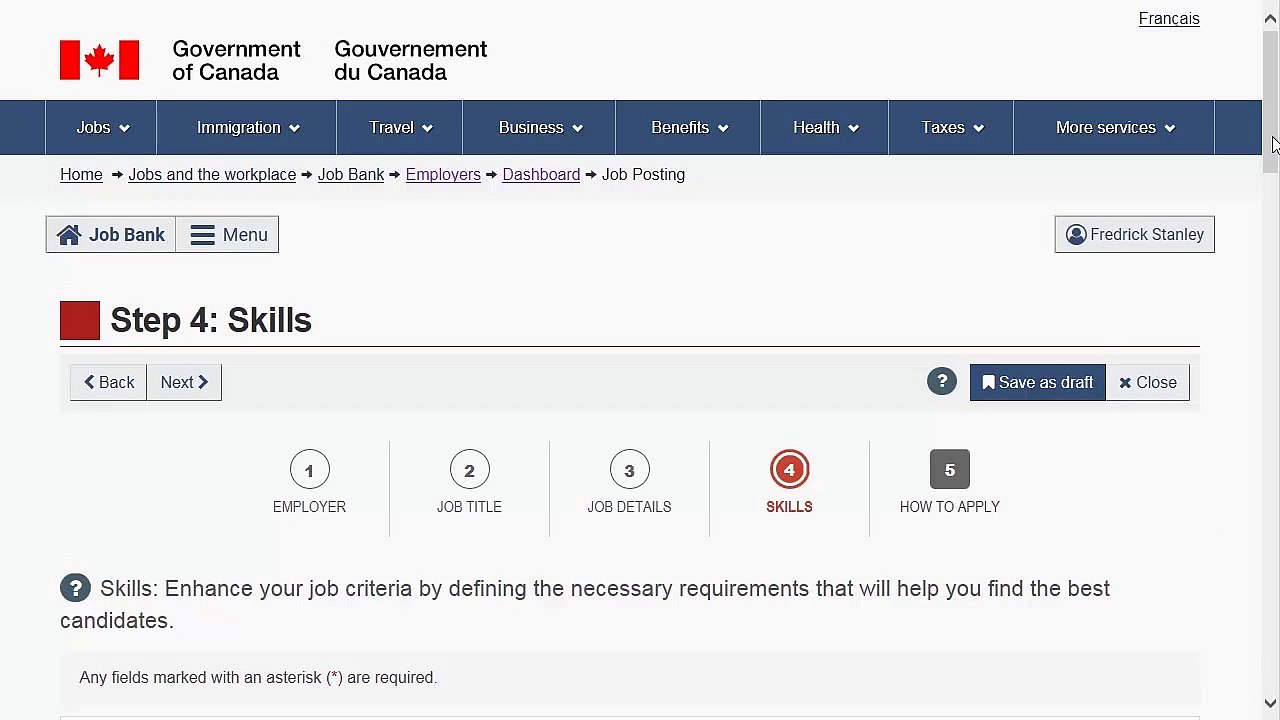 To display this video, third-party cookies are required. You can access and change your cookie settings here.
 The requirement profile often also contains a list of social skills that future employees should bring with them. However, you should not resort to vague descriptions like “candidates must be flexible and able to work under pressure.” With these phrases, the applicant can only guess what qualities you are actually looking for, and in the worst case, may even cause them to forego an application. If you are “looking for an employee who can come up with creative solutions to problems and keeps a cool head during critical situations,” state your wishes clearly.
Requirement profiles often convey the feeling that companies are looking for machines, not people. It is not uncommon to find job advertisements where university graduates are being sought, but they also need to have years of professional experience. However, it is unlikely that you will find the right candidate with these exaggerated requirements. Be sure to draw a realistic picture of the requirements in order to have as broad a group of applicants as possible later on.
List of services offered
In the previous section of the job posting, you have already made it clear what you expect from your potential future employee. Now, they want to know what you can offer them in return. This is less about the “attractive salary” you pay, because no doubt your competitors will offer the same. Consider which additional conditions and achievements you can impress applicants with, since in this regard you can stand out from other companies. Here are some services you can offer to make your company stand out from the competition:
- Flexible working times
- Good career opportunities
- Training and further education opportunities
- Voluntary benefits
- Healthcare expenses
- Canteen or food subsidies
- Relocation costs
- Company cars, bicycles, etc.
Application modalities
When you create a job posting, you should try to gather as much feedback as possible. In order to get this feedback, the job advertisement should also contain all relevant information for the application process. You should therefore always answer the following questions:
- Can I apply by post, e-mail, or both?
- What postal/e-mail address should the application be sent to?
- Which application documents are required (letter of application, resume, certificates, etc.)?
- What is the latest date that applications can be submitted by?
- Who can I direct any questions to?
In the event that interested candidates can apply electronically, you should specify what the desired file formats are. Please indicate in the job advertisement whether you would prefer to receive the documents in PDF format and the maximum size of the files submitted.
Job postings often end with “We expect your application documents by…” or similar. You can also round off your job advertisement with a more friendly “We look forward to receiving your application.”
Creating a job posting: language, style, and layout
As previously touched upon, it is important to make sure your advertisement text has some life to it. Creative formulations are an important building block that can help you stand out from your competitors. Think about which target group you want to reach with your ad in order to find the right language and style. A teaser-like introduction, rhetorical questions, or mental images, for example, will help you to involve the reader and loosen up the text. Also, a concrete request for action is often a good way to reach applicants.
If you have placed your job advertisement online and are providing your own application form, you should make sure that candidates can access it through a link and a request for action.
Despite any stylistic sophistication, however, you should never lose sight of the legibility or comprehensibility of the advertising text. Avoid complicated sentence structures, abstract formulations, passive constructions, nominal style, and empty phrases. With clear language and a comprehensible structure for your job posting, potential applicants will be able to understand quicker which qualifications are important to you and what distinguishes your company. Also, use gender neutral language to appeal to both men and women.
Finally, you should visually highlight the text by giving the job posting the appropriate layout. If you seamlessly arrange the different text blocks without any optical or topographical highlights, a large chunk of text might deter the reader despite the high quality of content and language. Therefore, just use as much text as is actually necessary and highlight important information – especially the name of the advertised position – by using larger type or boldface. Subheadings and paragraphs also make it easier to read the job ad.
The use of pictures – illustrations or photos – as eye-catchers and to loosen up the text, is also extremely important.
We recommend taking and using your own photos, rather than using stock images for your job advertisement. By taking professional photos of your team, the office, or any aspect of the business, your job advertisement will look authentic and unique.
What to pay attention to when creating a job posting
Apart from content and structure, there are some legal requirements you should bear in mind when creating your job posting. These include the Civil Rights Act of 1964, the Equal Pay Act of 1963, the Pregnancy Discrimination Act of 1978 and the Family and Medical Leave Act of 1993, to name but a few (more information on anti-discrimination laws can be found here. Employers may not discriminate against candidates for the following reasons, thanks to federal and state anti-discrimination legislation in the US:
- Race
- Ethnic origin
- Gender
- Religion
- Disability
- Age
- Sexual Identity
This law also applies to job advertisements (as well as the entire application process). Consequently, you must ensure that your job advertisement is free from this kind of discrimination. For example, if you include in your advertisement that you’re looking for “young workers” or “young support for a committed team,” older people are unlikely to feel welcome to apply and may feel discriminated against.
Ultimately, the advertisement should do the position justice
If you create a job posting taking into account the tips mentioned in this article, there is a good chance that the vacancy can be filled appropriately. Whether the newly recruited employee will be part of your company in the long term also depends to a certain extent on the job advertisement. As the first point of contact with your company, the posting creates expectations for the position and for you as an employer. If they are disappointed, for example because the activities do not match those described in the advertisement, a long-term commitment of the new employee is unlikely. An over-or under-description of the assigned tasks also often leads to the new employee quitting faster than you would like.
In order to prevent this kind of scenario, the content of the job advertisement should be as realistic as possible while primarily being an advertisement. The better the job advertisement reflects your company and your expectations of the job to be filled, the greater the probability or finding not only the best candidate for the job, but also a satisfied employee for the long-term.
Click here for important legal disclaimers.
Click here for important legal disclaimers.