

The Eisenhower Matrix: sort by importance and urgency

In companies, it is important that tasks are processed as quickly as possible. But it’s also crucial to set priorities so that urgent matters aren’t forgotten because in everyday life – be it at work or at home – less urgent tasks often cost unnecessary time, which could be used for something more urgent. With the so-called “Eisenhower Principle,” you have a basis for setting sensible priorities and optimizing your time management. This enables you to meet more goals more quickly.
What is the Eisenhower Principle?
The Pareto Principle states that 80% of planned results can be achieved with 20% of the total deployment. However, the problem is that employees busy themselves with the other 80% of tasks, which only lead to 20% of the results.
This problem was also recognized by the American general and US president Dwight D. Eisenhower. He developed a time management method in which a matrix is used to classify the tasks that need to be undertaken. Eisenhower distinguishes between the importance and urgency of tasks.
How does the Eisenhower box work?
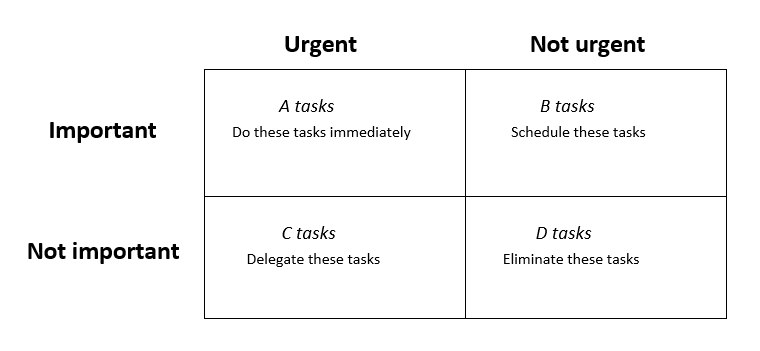
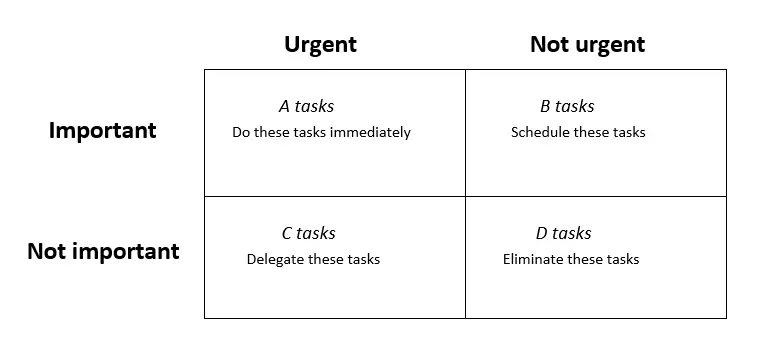
Using this simple matrix, which consists of four quadrants in total, ensures greater productivity in the long term. If you make use of the Eisenhower box, you first perform the tasks that are important and urgent, and then devote yourself to those projects that are also important, but are less urgent. Less important tasks, on the other hand, are delegated to others or sometimes even discarded. Here’s an overview of the four quadrants:
- A – important and urgent: These tasks have the highest priority and must be completed immediately. Otherwise, the goals set cannot be achieved.
- B – important, but not urgent: These tasks must also be completed so that you can achieve your own goals. However, it is quite possible to postpone these tasks for a while.
- C – urgent, but not important: These tasks should be completed quite quickly. However, the tasks are of minor importance, which is why Eisenhower recommends delegating these as much as possible.
- D – neither important nor urgent: These tasks are the last on the list of priorities, as they are not relevant (or are hardly relevant) for achieving the objectives and do not have to be completed particularly urgently. If there is little time available, these tasks can often simply remain unfinished.
Download the PDF template for the Eisenhower Matrix for free.
What are the advantages and disadvantages of the Eisenhower Principle?
The Eisenhower Principle helps you to improve your time management. By setting priorities in a clear and unambiguous way, the most important projects can be completed first. The model is particularly practical for people in management positions, as their time is usually particularly valuable and they can easily delegate less important tasks to their employees. This, in turn, has the advantage that employees are more involved in the company's work processes.
However, the Eisenhower box also has some disadvantages. For example, it is often difficult to classify the importance of a task correctly. As a result, it can happen that important tasks are delegated to the wrong employees and as a result are not fulfilled sufficiently. Urgency, on the other hand, can usually be determined by deadlines. If no deadline is set, the employee must use their own integrity to decide if it’s urgent or not.
Another problem can be the uneven distribution of tasks. This is because often the tasks that need completing only concern a few people or departments, since important tasks are usually urgent and urgent tasks are rarely unimportant. Consequently, tasks like these cannot be delegated or put to one side.
Using the Eisenhower Principle: an example
An employee is sitting in their office in New York at 9am. After checking the morning e-mails, they read a newspaper article. At 11am, their boss is expecting a potential customer to come for a meeting. Then the employee's telephone rings. The boss informs them that they suddenly have to go to an appointment in Ohio at short notice to take the place of a sick colleague and therefore can’t make it to the meeting. The employee now needs to schedule a new appointment as well as organize the trip to Ohio. The boss also needs certain documents for the trip.
If the employee is following the Eisenhower Principle, they would proceed as follows:
- They supply the documents that the boss needs for their trip (A task, urgent and important)
- They arrange a new appointment with the customer (B task)
- The employee delegates the task of buying a flight ticket to Ohio to the department of the company responsible for this e.g. the event department (C task, A task in the event department)
- Reading the newspaper article is a D task that is neither relevant nor urgent and can therefore be postponed or abandoned
Non-urgent and unimportant tasks – where to put them
The quadrant with the D tasks causes problems for many people. This is where the non-urgent and at the same time unimportant tasks end up. In order to free your desk from these tasks, there are the following possibilities:
- Compost heap: All documents that do not contain any daily informational value for work should be placed on a pile – the so-called compost heap. This pile is only processed when there is actually time for it, because there are no more urgent tasks to be done first. Every few months, the employee throws at least one fifth of the stack into the trash – without having to leaf through the stack again. Some tasks may already have been completed by then anyway.
- Wastebasket: Material that is neither important nor urgent can be put in the wastebasket immediately. This may take some courage, but the employee feels much freer afterwards and saves time.
- Filing: The third option is to file the documents in a filing system. In contrast to a compost heap, however, the employee checks the documents every few months and then decides whether to process them or throw them in the trash.
Simplifying the Eisenhower Matrix: the ABC analysis
In addition to the Eisenhower Matrix and the Pareto Principle, ABC analysis is another method designed to make time management more effective. ABC analysis is quick and easy to use:
- A tasks: extremely important and urgent
- B tasks: important, but not urgent
- C tasks: less important, routine
It is often the case that the C tasks are the most time-consuming, but bring the least profit. The A tasks, on the other hand, have the greatest benefit in that they need the least time. The purpose of the ABC analysis, the Pareto Principle, and the Eisenhower Matrix, is to focus on the A tasks. These should preferably be performed when the concentration and productivity of the employee is at its highest. C tasks, on the other hand, are often routine tasks. Therefore, they should be performed at times when the ability to concentrate decreases somewhat. C tasks are only due once the A and B tasks have been completed.
The difference between the Eisenhower diagram and the ABC analysis
The main difference is that the Eisenhower Matrix covers a larger time window, whereas the ABC analysis is more focused on a single day. The aim of ABC analysis is therefore to prioritize daily tasks within a to-do list in order to efficiently complete projects over a day. The Eisenhower diagram, on the other hand, is suitable for long-term projects and can also help to structure your own everyday life – whether at work or privately.
Click here for important legal disclaimers.