

Employee motivation: better working atmosphere, higher turnover

Employee motivation is an economic factor that should not be underestimated. Motivated employees achieve more and therefore bring their company more revenue. Motivation is strongly related to the commitment of the employee to the company. A lack of commitment is sometimes clearly noticeable.
Small and medium-sized enterprises – which make up the majority of the US economy – in particular, have structures that enable them to motivate employees at a low cost. However, most of them lack effective strategies. Only those who correctly understand motivation as a psychological concept and apply motivating methods in practice can lead their employees and subsequently, their company to success.
What is motivation?
Employee motivation is an economics term, while the concept of motivation comes from psychology. With regard to employees, it has also been a topic in economic circles since the 1890s, because it plays an important role as a growth and innovation factor. In order to talk about employee motivation, the term “motivation” must first be clarified.
Definition: motivation in psychology
Motivation cannot be measured or directly observed. The concept describes a state of being that causes people to invest their strength and time in pursuing a goal. The higher the motivation, the more likely it is that the person will work towards the result with constant or increasing strength. Motivation is therefore the force that triggers behavior and keeps it on course.
The degree of motivation depends on how effectively a person views their chosen action. Whoever sees themselves as unlikely to achieve their goal may lose motivation. Action can either move towards or away from a goal. The respective action is therefore chosen according to whether one wants to achieve a positive goal or avoid a negative state. Reward and punishment partly influence motivation.
Over the years, two explanatory concepts have been used to explain the causes of motivation. A biological deterministic approach is based on the assumption that instincts and external influences control people. The opposite thesis declares man to be a completely free being, who is able to control their motivation only by their ability to act. Both basic ideas cannot fully cover all aspects of the subject. In modern psychology, therefore, both approaches are usually used, depending on which ones make sense in the given context.
Not to be confused with motivation is motive. As a term in psychology – in contrast to motivation – it does not stand for a changeable state, but for comparatively stable characteristics of the human personality. It is assumed that motives usually control the general tendencies in the subconscious that shape a particular way of life. Motives are either innate (biogenic) or acquired (sociogenic).
Motivational factors can be extrinsic or intrinsic.
Intrinsic motivation
Intrinsic motivation comes from within. The acting person does not need any external incentives to work towards a result. The action itself moves the person to continue with this activity. Intrinsic motivation is therefore in the execution of the action itself. Whatever their own motive may be, the person interested in this particular activity might be having fun or just curious about what the result will be.
Employees often already have an intrinsic motivation for their work. The cornerstones of intrinsic motivation are:
- Expectation of success
- Curiosity
- Positive emotion towards the work as an incentive
A person applies for a job or takes on a task because they imagine that they can carry out an activity regularly, and to a good standard. For example, a young IT graduate chooses a trainee position as an IT auditor because they like to work accurately and find mistakes. They therefore have positive emotions about their work and are curious about the challenges they face. The trainee position is a good place to start, since the expectation of success of learning something new and being prepared for higher positions can be fulfilled.
A sense of effectiveness is important for intrinsic motivation. If an action has an end result for someone, they will likely have a feeling of achievement, of having affected change (for themselves, but possibly also for others). Feelings of powerlessness (no matter what you do, nothing changes) or senselessness (no matter what you do, nothing matters) hinder intrinsic motivation. In extreme cases, they can lead to burnout.
Extrinsic motivation
Extrinsic motivation means giving external incentives to perform an action. A distinction is made between positive reinforcement, i.e. rewards, and negative reinforcement, i.e. punishments. Whether these reinforcements actually lead to a motivated action depends on whether the person concerned responds to these stimuli. In addition, the stimuli must be tailored to the individual. The person in question must be able to recognize the stimuli as valuable.
For example, if a child at school is given a sticker in their homework diary for positive behavior to proudly show their parents, the reward will serve its purpose: the child will be motivated to continue participating in class. While praise can also be a positive reinforcement for adult employees, many of them would feel patronized when using a smiley system, and question its value.
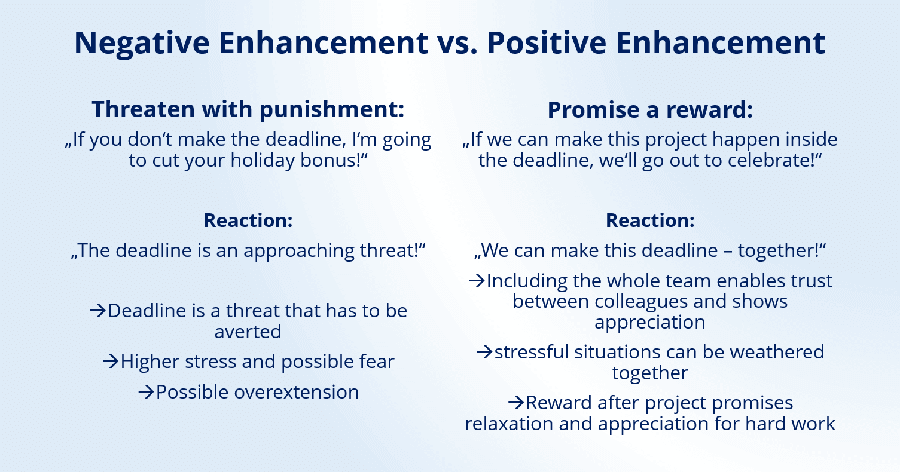
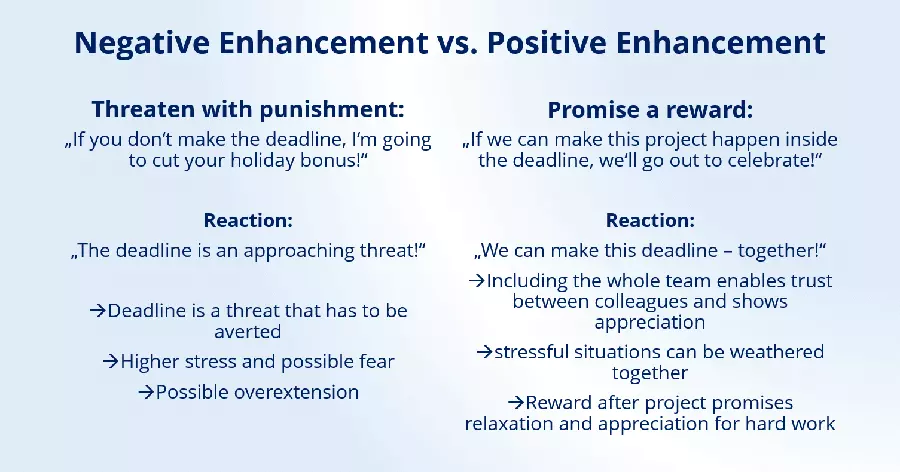
Extrinsic motivation is a factor that superiors can influence. Negative reinforcement, however, should only be used in cases of misconduct. It would not be expedient to threaten employees with holiday cuts as a precaution if they don’t manage an important project within a deadline. Instead, an appropriate reward like a trip together or an extra day of vacation is a better incentive. After all, intrinsic motivation must be maintained, and this is achieved through positive feelings about the job. The threatening punishment promotes fears and can lead to a defensive attitude.
Intrinsic and extrinsic motivation intertwine
Reinforcement by external stimuli can only happen for a small while. Anyone who tries to motivate employees with bonuses will see that their behavior will only change for a short time. Punishments can prevent misconduct by deterrence. For example, a threatening warning can motivate an employee to be punctual and avoid lateness. However, punishment does not tackle the problem at its root. Why does the employee often come too late? The person probably lacks intrinsic motivation. This can be damaged by external stimuli. This happens when certain basic needs are not met.
Instead of then threatening with punishment, it might be more sensible to deal with the individual. If the work atmosphere is bad because the supervisor does not allow employees any freedom or does not show any recognition for the work they have done, their motivation drops. This is where extrinsic motivation and intrinsic motivation mix. Honest recognition, i.e. an external stimulus, gives the person the feeling that their actions are valued. If the action itself has a stimulus for the person, they can maintain their intrinsic motivation. However, even the most hard-working employee is demotivated when they get the feeling that their effort is worthless and their manpower contributes nothing to the company.
Extrinsic motivation is the means of influencing, which superiors and management can actively use to strengthen the intrinsic motivation of their employees. Experts in employee motivation now assume that a lack of intrinsic motivation in most cases results from mistakes in leadership style. Whether it is a lack of transparency, recognition, or creative freedom: demotivation is often due to external factors. The good news: as managing director or a superior, you have the power to shape the work atmosphere so that your employees feel comfortable and motivated.
Employee motivation, defined
Employee motivation is a term used in industrial and organizational psychology. Occupational psychology analyzes activities psychologically in order to evaluate them and design work processes accordingly. The aim is to promote competence and the ability to act in the best possible way.
In this context, there are parallels to the concept of work motivation. It deals with the basic needs that have to be met in order for employees to be motivated.
Employee motivation, on the other hand, is the active exertion of influence on employees in order to ensure both their well-being at work and their enthusiasm to reach the company’s goals. This can be achieved by maintaining or increasing performance. Changes may need to be made if the performance of certain employees shows negative results.
Employee motivation includes any and all actions of a company that aim to positively influence the willingness of employees to perform. The optimal result is an increased or constantly high level of employee productivity, as well as them feeling solidarity towards the company’s goals. As a rule, this goes hand in hand with the fact that the employees should feel comfortable in their workplace.
However, employee motivation is a contested term. In itself, it is considered to be positive. However, experts continue to disagree on how best to motivate employees – or at least stop them from becoming demotivated. Various studies suggest that employees usually begin their jobs feeling motivated. Employees only develop into people who just work according to the rules or have given up internally when their direct superiors and management demotivate them through faulty management methods. This is one common thesis:
“In the vast majority of cases, a lack of emotional employee loyalty can be attributed to weaknesses in the corporate culture and deficits in personnel management. Motivated people become conscientious objectors when their central needs are ignored at work” – Marco Nink, Senior Practice Consultant at Gallup Germany, in a press release on the study State of the Global Workforce.
According to Marco Nink, motivation can be lost if certain basic employee needs are not met. Employee motivation measures will only be fruitful if these basic needs are satisfied. According to the 2016 Gallup study, things are looking good in this respect. Most employees rated their jobs as secure (49%) or safer (41%) than a year ago. 77% of respondents said they would continue to work even if they no longer had to work because of a substantial inheritance.
Nevertheless, fewer employees feel a close bond to their employers. The vast majority feel little to no ties. In times where more and more flexibility is being demanded of employees, many of whom are self-employed or in temporary employment, this is not surprising. However, a lack of commitment to the company shows a correlation with a lack of motivation. Employees often cite the same reasons for both situations.
- Poor communication
- Lack of transparency
- Reduced job mobility
Employees with little or no commitment to the company are often at a lower level of motivation. Experts differentiate between three levels.
- With heart and hand: Highly motivated, close ties
- Service by the book: Motivation as high as the salary and as long as the contractually agreed working time – not a minute more
- Internally resigned: Very unmotivated, hardly any notable work performance, behavior can harm themselves or the company (example: bored and rude in important discussions with customers); no loyalty
In 2016, the number of employees with little company loyalty was on the rise. Instead of being highly motivated workers, they only work according to their contractual obligations. Although employees might not have had concerns about job loss, they lacked the basic prerequisites to keep their intrinsic motivation high. The problem often lay with their superior’s leadership qualities. Those who want to do things better and inspire their team should pay attention to the individual needs of their employees.
Employee motivation: people count
Motivated employees with a strong sense of company loyalty are more willing to perform, more innovative, and less likely to become stressed. In the end, this will lead to higher sales – on average about 10% more for your company. There are three levels at which employers or superiors can influence employee motivation:
- Material values and intangible benefits: Measures and means directly related to work, like working hours, salary remuneration, safety, and workplace cleanliness or health services
- Psychological influences: Behavior that influences the work atmosphere, like management style, team makeup, anti-bullying measures
- The private sphere: Enabling worklife balance, facilitating leisure activities, taking family into account
The most important aspect of employee motivation is the focus on the employee as an individual. As previously mentioned, people only regard incentives as valuable if they recognize them subjectively. In addition, different kinds of people have different basic needs and expectations of their workplace. The current level of motivation and its direction (warding off disaster or pursuing positive goals) also vary.
Employee motivation: basic needs to create a good work atmosphere
It is still common practice to motivate employees with incentives – bonuses, company cars, gym discounts, or canteen privileges. Incentives of this kind will certainly increase employee well-being. However, the actual organization of work is key when it comes to strengthening intrinsic motivation. The US economics magazine Inc.com quotes studies from the 1950s which already showed that jobs with monotonous, simple work – e.g. on the assembly line –strongly reduce employee motivation and productivity. In addition, there is increased absenteeism and employee turnover. These findings resulted in measures called “Job Enlargement,” and are still being used today.
Job design: intrinsic motivation through work design and organization
Job enlargement is one of the four approaches that assume that by structuring work activities, you can increase productivity or motivation. This method is known as job design. The way work is distributed among individual employees and how much wiggle room and variety the activity allows, influences the subjective value employees assign to this work. This increases the likelihood that they will do the task for their own sake (because they actually want to do it) and therefore strengthens intrinsic motivation.
Job enlargement aims to motivate employees by giving them variety in their work. Individuals work on a combination of different activities. The opposite of job enlargement is job simplification. Employees specialize in a standardized task that they perform repeatedly – including, for example, assembly line work. Machine-executable tasks experience increased productivity. People who work in these monotonous environments suffer more often from work-related illnesses and are generally less motivated.
Job rotation is often used in apprenticeships and internships. The employees change their activity at regular intervals. This gives them a holistic picture of a company. This method is also intended to prevent exhaustion, especially during physical activities.
Job enrichment is a suitable method for particularly determined employees. They see the value of their work when they feel like they are striving for something great. By giving them more responsibility, they feel more valued and challenged. Those who do less when they are underchallenged may flourish with additional tasks.
These methods enable a targeted workplace and a good work structure. The following methods will concentrate on leadership styles. These are the most important building blocks for positive employee development:
Allowing independence
Empowerment is a human need that makes people strive for higher goals. Employees should feel that their work is important and valued. If, however, they do not have the power to decide on their area of responsibility, their subjective assessment of their achievements will deteriorate. If a manager or boss is constantly micromanaging, employees will not feel like they are being taken seriously. If the employee then is held responsible for a bad result, they will feel frustrated. If you trust your employees to make their own decisions and grant them the necessary resources, their critical faculties and willingness to learn will increase.
Using teamwork productively
Teamwork can be a curse and blessing when it comes to motivation, depending on how the team is structured. A badly organized team gives employees who have internally checked-out a chance to hide behind their more productive colleagues. A clear distribution of tasks helps to ensure that nothing is forgotten and nobody is overburdened. Your different team members will also influence productivity. If employees slow each other down, this is definitely an issue that should be addressed.
Projects usually require several people to work together. However, some tasks are easier to complete on their own. Additionally, there are employees who prefer to delve into a topic and work on the fine details. Use a mixture of teamwork and individual projects. Appreciate your employees’ respective contributions accordingly and draw on the potential that your employees generate in the various groups.
Recognition
Recognition for good work is one of the cornerstones of employee motivation. It is important for self-confidence, but it can only come from someone else. Employees need confirmation from other people. They show that they appreciate someone’s work by showing respect for their opinions in daily meetings. Your employee is more than the sum of their abilities, they are a person you should recognize and appreciate as such. If you want to show your appreciation, a well-considered feedback discussion will help.
Praise
Praise, as opposed to recognition, is selective and should be formulated in concrete terms. Appreciation and spontaneous praise, as long as it is meant honestly, are good ways of rewarding motivation. However, some superiors confuse praise with recognition. Managers who are constantly treating their employees negatively should not expect praise they may give to be effective. It will likely be regarded as dishonest instead. If you regularly show your employees recognition, then praise will also assist with their motivation.
Transparent communication
A feeling of powerlessness leads people to resign and avoid challenges at work. If employees are simply given instructions and results without knowing the reasons for decisions, they will eventually become frustrated. Additionally, a lack of transparency encourages company whispers. Small bits of misinformation quickly lead to major unrest among the workforce.
Constructive criticism and error culture
Criticism should always be expressed in private and in a fair manner. Criticizing someone in front of others can produce a variety of negative emotions like shame and antipathy, as well as possible loss of respect and demotivation. This in turn leads to a bad work atmosphere. Instead, you should foster a constructive, positive error culture. Mistakes are inevitable, and should be learned from. However, this is only possible if you develop strategies to deal with them beforehand.
You can optimize feedback by mentioning the employee’s positive characteristics, as well as criticism. Take an example of how the person’s talents can compensate for possible points of criticism, since it is usually easier to promote positive qualities than to work on bad ones repeatedly.
Creative ideas that motivate employees
Since employee motivation is largely about the interpersonal, companies with a manageable number of employees can implement flexible motivation strategies.
Team activities that weld employees together
Teamwork has to be learned. One of the most effective ways to learn is through play. Give your team a common task or goal to achieve and reward teamwork, not individual members. Some train together for a charity run, others create a work of art together. A bit of friendly competition is also possible, by setting up teams and letting them compete against each other during a sports day, for example. It is important that management include themselves in these activities. Informal situations like this allow you to get to know your employees better.
Making recognition and praise tangible
Being paid well provides a certain basic confidence in one’s own work. Nobody is going to refuse a bonus either. However, various studies suggest that simple, timely, and individually valuable signs of recognition motivate people better. Pizza for the whole team when a project is completed, for example, can work wonders. Managers who make sure that vegans or people with dietary restrictions in the team are also provided for show interest and consideration for their employees. Other superiors may praise their employees with handwritten notes, sometimes even with a personal birthday greeting, including flowers, which they need to send to their home address.
A good example is Four Pi Systems (now a part of HP): Jennifer Wallick, a software developer and excellent employee, was treated to an appreciation day by her department. Every 15 minutes, someone came by to say thanks and provide small tokens of gratitude for her hard work, like flowers and congratulations.
Job design
If the work itself is fun, inspires curiosity and seems valuable, employee motivation increases. But how exactly can this theory be put into practice? Some employers not only give their teams a lot of leeway to make decisions, they also give them control over a project budget. At Chaparall Steel, the error culture was based on the principle that innovative ideas can only be implemented with a certain risk of error. According to an application study described in the publication “Demystifying Organizational Learning,” a team designed new machines for the Texan company for $60,000, far below the budget of the old machines which was $200,000.
Bottom line
Employee motivation is an easy to implement, cost-efficient means of promoting a work atmosphere. Recognition and praise hardly require a budget. However, it is not so easy to create an optimal work atmosphere, especially when self-assessment and external perception of managers diverge. A good leadership style needs to emerge first. The first step is personal communication with the employees. If you know what drives them and what your company needs, you can start in the right place. Transparent decisions and clear corporate values that create an identity increase the bond between motivated employees and the company. Let your employees enjoy their work and celebrate their successes. If you have motivated employees, you will be motivated too.
Click here for important legal disclaimers.