

Net Promoter Score (NPS)

According to the American economic strategist Fred Reichheld, customer satisfaction surveys can be broken down to an “ultimative question”:
How likely is it that you would recommend the company/product/service to a friend or colleague?
According to Reichheld, this question makes it possible to work out the relationship between supporters and critics, and to derive how customer groups relate to companies, brands, products, and services. The Net Promoter Score (shortened to NPS) is a method of depicting customer satisfaction or dissatisfaction. It was developed by Reichheld in cooperation with Satmetrix Systems and Bain & Company. Benchmarks for various industries are available as orientation. Businesses that use NPS include industry leaders such as Siemens, E.ON, Philips, General Electric, Apple, American Express, and Intuit.
NPS (Net Promoter Score) is an instrument of customer experience management that makes it possible to depict the level of customer satisfaction as a quantifiable variable.
We explain how the customer satisfaction survey is conducted according to Reichheld and which formula is used to calculate the New Promoter Score.
How does the NPS survey work?
An NPS survey is very simple. In order to obtain customer feedback, the question about whether the customer would recommend to others is placed at as many touchpoints as possible. Customers usually answer by rating the question from 0 to 10.
The customer satisfaction can refer to an individual product or service, to a brand, or a company as a whole.
Here is an example:
The owner of the bike store, Wheels4U, wants to find out how satisfied customers are with his business. He asks the question “How likely is it that you would recommend the company/product/service to a friend or colleague?” to every customer that buys one of his bicycles, brings one in to be repaired, or asks for advice. The customers give their answer in the form of a questionnaire that contains a rating scale of 0 to 10.
Alternatively, he could just measure customer satisfaction separately for each product or service offered.


How is the Net Promoter Score calculated?
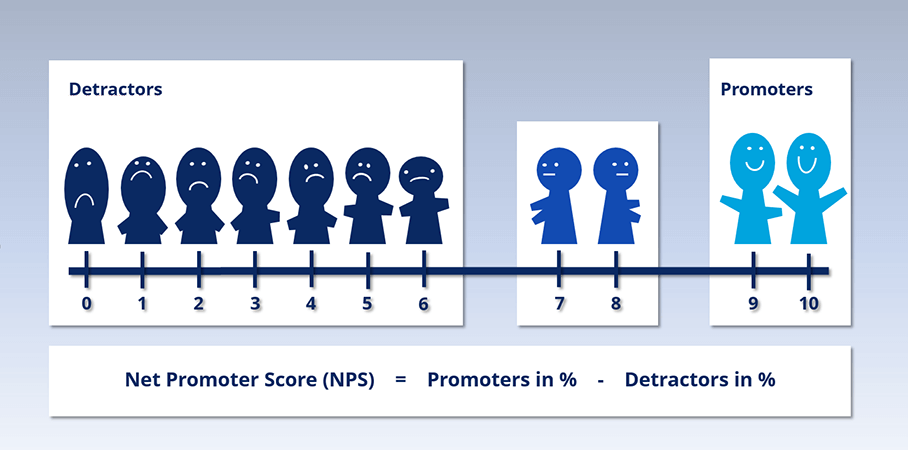
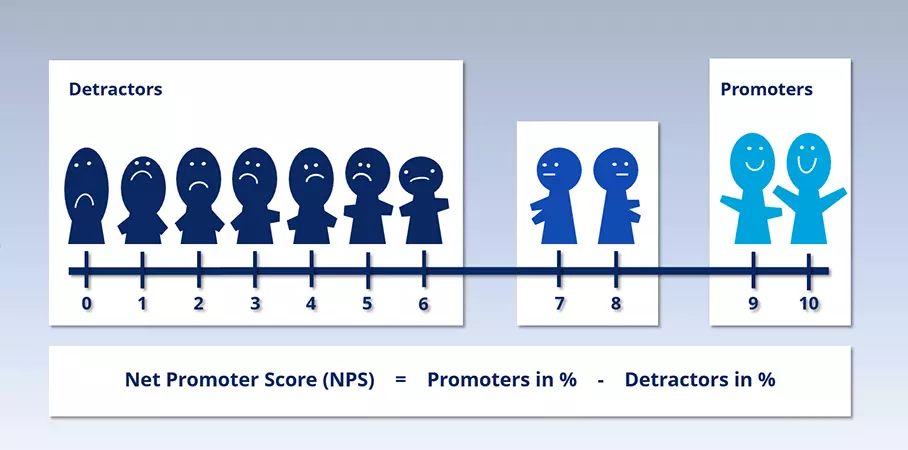
In order to analyze the NPS survey, the surveyed customers are divided into three groups depending on their answer.
- 9–10: Customers who indicate their willingness to recommend with 9 or 10 are considered “promoters”
- 7–8: All answers of 7 or 8 are considered indifferent
- 0–6: Customers who give a score of 0 to 6 are considered “detractors” (critics)
The Net Promoter Score is then calculated using the following formula:
NPS = Percentage of all promoters - percentage of all detractors
The result will be a value between +100% and -100%.
Here is an example:
The bike store, Wheels4U, found that 50% of the customers surveyed gave 9 or 10 as their answer as to whether they would recommend the store to a friend. Only 10% gave a value of 6 or less.
The owner can therefore classify 50% of customers as promoters and 10% as detractors. The remaining 40% count as indifferent participants.
The Net Promoter Score of the bicycle store is calculated like this:
50 % - 10 % = 40 %
But what does this result actually mean?
Analyzing the Net Promoter Score
According to research by the management consultancy, Bain & Company, the NPS correlates directly with a company’s success. The company, which specializes in strategy consulting, reports that companies with long-term profitable growth generally achieve a Net Promoter Score twice as high as average companies. According to Bain & Company, the top performers (regarding ranking) grow more than twice as fast as the competition. However, these results could not be replicated in independent studies. Nevertheless, many consider the correlation between NPS and growth as enough proof.
According to Reichheld, when analyzing Net Promoter Scores it wouldn’t be unusual to assume that companies with a positive double-digit NPS will grow profitably. With a value of 40%, the owner of Wheels4U doesn’t have to worry for the time being. How well the store actually performs, however, can only be estimated if you know the values of its direct competitors.
If no other bike store in the city reaches an NPS of more than 10%, Wheels4U can sit back and put its feet up. If the competition averages 80%, the owner should consider investing more in customer satisfaction in the future.
However, the assessment of the NPS is not only dependent on competition, but also on the market and industry. For example, companies in the banking sector generally achieve negative values, meaning that a Net Promoter Score of 0% in this sector could actually be regarded as a success.
The respective cultural environment can also have an impact on the ranking. In Asia, for example, companies tend to achieve worse values than in the American market.
How the NPS has developed over time is also interesting.
Criticism of the NPS
Due to its simplicity, the NPS is a popular tool for obtaining customer feedback on a broad basis. However, it is only used to access overall customer satisfaction. The NPS alone says little about customer loyalty. Companies that use the Net Promoter Score receive an index that shows customer satisfaction and can be compared with the general benchmarks. Business owners learn nothing about the relationship between cause and effect – the influence of company performance on customer attitudes.
According to critics, the NPS therefore misses the mark. There are numerous methods that can be used to map customer satisfaction as an index – in some cases even with a stronger correlation to company growth. The one used basically plays a subordinate role when it comes to identifying room for maneuver for optimization.
Reichheld therefore recommends NPS users to get customers to elaborate on their rating by asking why they gave that particular rating. Only those who know why customers become promoters or detractors can identify opportunities and obstacles and initiate the right measures to improve their offering.
However, while a rating on the NPS scale enables simple, automatic analysis, it isn’t the same with answers to these open questions. Open questions always leave room for interpretation – regardless of whether they are analyzed manually or by a computer. Reichheld doesn’t reveal how answers can be analyzed without being biased and with as little effort as possible. As a compromise, companies often add questions with rating scales or predefined answer options to the NPS.
In order to get as much as possible out of the collected data, business owners who have determined customer satisfaction via NPS would have to approach detractors specifically in order to win them over. Promoters, on the other hand, can serve as reference customers if required. The prerequisite for this is direct contact with the customers. However, this is usually only possible if the surveys are not carried out anonymously. However, this usually reduces the willingness to participate.
Summary: advantages and disadvantages of the NPS at a glance
The following table provides an overview of the advantages and disadvantages of the NPS in customer loyalty research.
| Advantages | Disadvantages |
| ✓ NPS provides an overview of customer satisfaction | ✗The Net Promoter Score represents only a small part of customer loyalty research (pure index determination) |
| ✓ Surveys to record Net Promoter Scores are easy to implement and easy to replicate | ✗Many companies only use the NPS and completely exclude the causal analysis |
| ✓ NPS is used as a standardized test by leading companies worldwide | ✗With an NPS, the reason for a rating can’t be analyzed effectively |
| ✓ Users are seduced by certified benchmarks for various industries | ✗The particularly strong correlation between a company’s NPS and its growth postulated by Reichheld is questioned by critics |
The Net Promoter Score is a good introduction to customer loyalty research, but doesn’t contribute much to improving customer loyalty without a subsequent root cause analysis.