

Pomodoro technique: How to resist distractions and increase productivity

Working in a focused manner has become a challenge in many industries: The to-do list gets longer every hour, phone calls, meetings, new e-mails constantly landing in your inbox; add to this the endless temptation of checking social media and the news, or going to the kitchen for a chat – there are many reasons why our work keeps getting interrupted. However, the result is always the same: productivity suffers.
Anyone who would like to boost their productivity and get more work done in less time ought to give the Pomodoro technique a try. This method of time management has attracted lots of new followers over recent years – and with good reason.
How does the Pomodoro technique work?
The Pomodoro technique was developed back in the 1980s by the Italian, Francesco Cirillo – hence its Italian name. It is derived from the Italian word for tomato (pomodoro), and is a reference to the kitchen timer that Cirillo used during his first experiments with the time management method. It was designed based on a tomato.
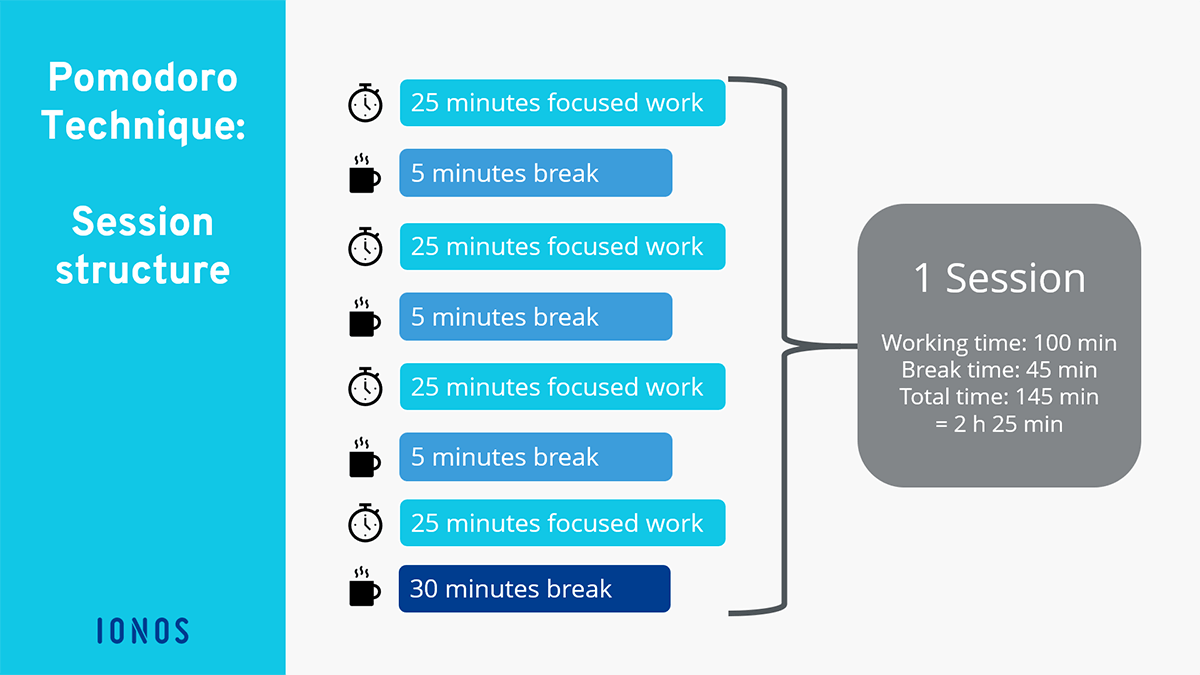
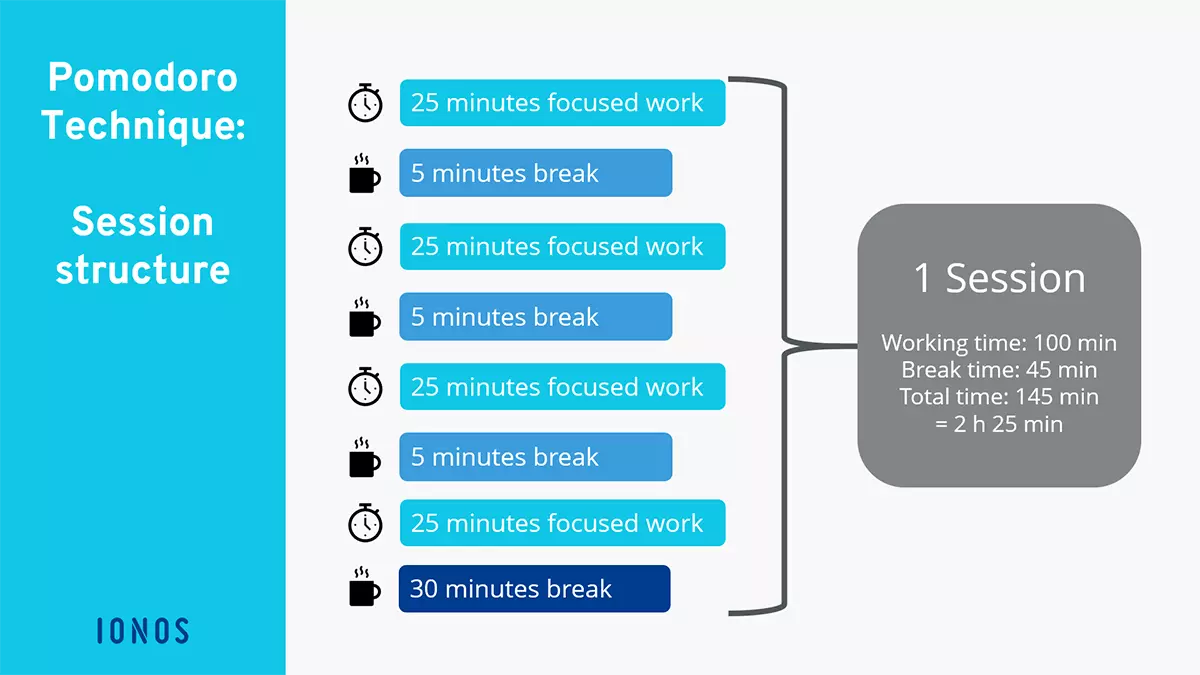
The Pomodoro technique is a time management method in which tasks are broken down into 25-minute blocks. Regular breaks between work intervals have a positive effect on mental performance and facilitate concentration over many hours.
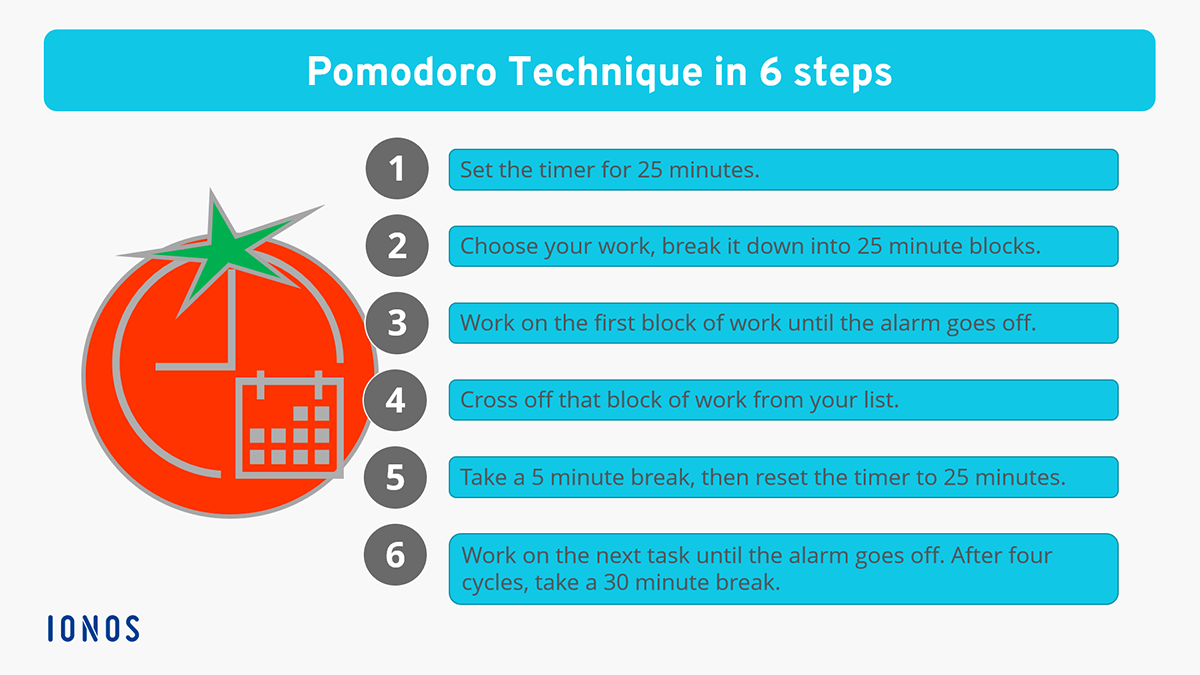
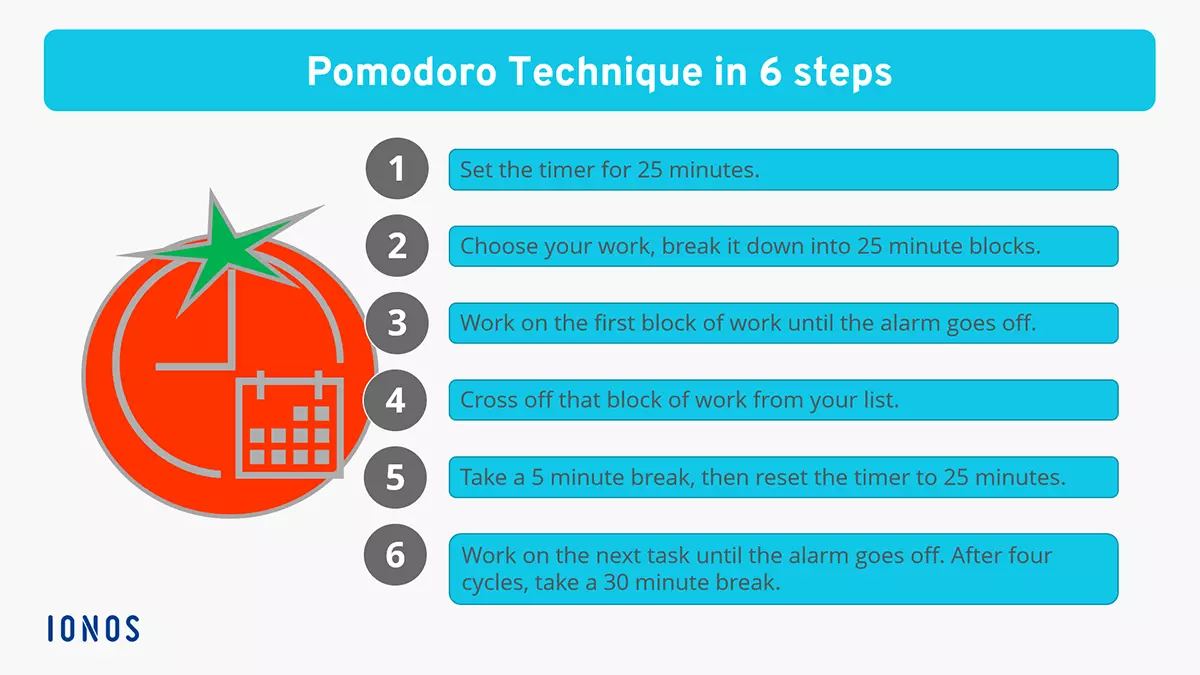
The technique can be explained quickly: You divide your tasks into 25-minute blocks. You take a 5-minute break between each of the first four intervals, and after the fourth work block you take a longer break of 20 to 30 minutes. In this method, a work interval is called a “Pomodoro”.
Variants have been developed in the meantime that propose work intervals of 50 minutes. The original method always uses four 25-minute Pomodori, however.
Advantages: What are the benefits of the Pomodoro method?
The fact that the Pomodoro technique has gained more and more followers in recent years is certainly due to its simplicity. All you need is an alarm clock or a watch, and you’re good to go. In an increasingly complex world, we can appreciate every simple solution.
But the more important reason for its popularity is probably the change in the way we work: We are increasingly exposed to internal and external distractions, and it’s therefore increasingly difficult for us to concentrate on a single thing for long periods of time. It’s not possible to establish an undisturbed working process – but that’s exactly what is needed for good results to be achieved efficiently. And it’s precisely in this respect that the Pomodoro method promises to help.
External distractions: Colleagues who just want to ask a quick question, the phone ringing, numerous meetings that interrupt the work process.
Internal distractions: The impulse to read incoming e-mails immediately, taking a look at your preferred social media platform out of curiosity and procrastination, distracting thoughts.
The Pomodoro method helps keep distractions, interruptions and multitasking in check and increases productivity.
But that’s not all. In many ways, it can have a positive effect on your own everyday work:
- Greater self-discipline: People who regularly use the Pomodoro technique train their ability to concentrate and control impulses. This is an important prerequisite for productive working.
- Better results: The probability of finding innovative or good solutions increases enormously if we concentrate on one thing over a longer period of time.
- Longer performance curve: Sensibly alternating between concentration and relaxation keeps mental performance high. The brain can recover in the meantime and as a result, we are able to work productively for many hours at a time.
- More leisure time: As productivity increases due to single-tasking – i.e. the successive and focused processing of tasks – people can complete their work sooner. Ideally, they can also finish work earlier and enjoy more leisure time. If this is not possible for operational reasons, then they at least create room to maneuver because they create additional time for other urgent tasks.
- Objective evaluation: By recording the number of Pomodori completed in each working day, we get a good overview of our productivity. Depending on how detailed we keep the statistics, we also gain an insight into activities that are easy for us to perform and circumstances that increase or decrease our productivity. This is all information that we can use to shape our working day, so as to achieve better results.
Another reason why the time management technique is so popular: Due to the division into 25-minute work blocks, the entry hurdle is low. With little effort, even the biggest social media addicts can usually manage not to be distracted for 25 minutes.
Francesco Cirillo developed the Pomodoro technique during his time at university. It was difficult for him to concentrate on what he was trying to study, and so he divided the learning time into short blocks. He turned his kitchen timer to 25 minutes and stayed on the ball until the bell rang.
Disadvantages: When does the Pomodoro technique not help?
The Pomodoro technique has no real disadvantages. Nevertheless, it does pose a challenge: You must learn to assess how much work you can do in 25 minutes, and structure your work so that the timer does not ring just when you are in the middle of a task. Otherwise, the Pomodoro technique would disturb your workflow and achieve exactly the opposite from what it is supposed to.
It makes sense to bundle small tasks together – for example, to reserve a Pomodoro exclusively for replying to several e-mails. Larger tasks, on the other hand, can usually be subdivided into subtasks. Examples of this would be evaluating certain key figures for a comprehensive monthly report, writing a single paragraph for this report or reading a technical article as a part of the research involved.
Which tools do you need for the Pomodoro method?
The Pomodoro technique does not require any special tools. All you need is a device that will remind you to take a break after 25 minutes.
Devices you can use to measure Pomodoro time:
- With a kitchen timer (like the original)
- With a smartphone (every smartphone includes a timer function as standard)
- With an alarm clock (manually set the alarm time to 25 minutes)
- With an hourglass (there are special Pomodoro hourglasses that time 25 minutes and even have a decorative appearance)
Those who prefer digital solutions can choose from a range of Pomodoro apps and Pomodoro software. Since these tools really can motivate you to try out the new technology, it’s worth testing some of them and investing a few dollars if necessary. However, many of the Pomodoro apps are also free to use.
Selection of some Pomodoro apps
- Tomato Timer (web)
- Tomato.es (Web – with statistics and a feature that allows you to see how many Pomodori you have completed yourself as compared with other users/colleagues)
- Pomodoro Timer Software (download software, free of charge)
- Focus To-Do (Windows, Mac, Android, iOS – combines Pomodoro with task management)
- Pomotodo (Web, Mac, Android, iOS – combines Pomodoro technique with Getting Things Done)
- Engross (Android – combines Pomodoro and task management, users can find out at which times they are most productive)
- Flat Tomato (Mac, iOS)
What sort of people is the Pomodoro method suitable for – and who is it not suitable for?
The Pomodoro method is based on short, manageable work blocks and a strict system of work intervals and breaks. Critics find this system too inflexible and, particularly when it comes to larger tasks, they see it rather as an obstacle.
For example, if you are writing a fairly long text, you might have just gotten into your writing flow when the 25 minutes are up. According to the Pomodoro technique, you would have to take a break. However, this can interrupt the creative thought process and have a counterproductive effect. In these cases, it may be useful to experiment with longer intervals, for example 50 minutes.
Also, not everyone manages to keep enough time free to actually finish four Pomodori in a row. For example, if you want to work undisturbed on a project for only about an hour after your other colleagues have gone home, you will only be doing half a Pomodoro session and, strictly speaking, are no longer following the Pomodoro principle.
Others criticize that the limited time and the ticking timer create additional stress factors. Instead of working in a more concentrated way, some people might be tempted to glance at the hourglass or the app more often. In this case, the Pomodoro technique itself creates a permanent distraction.
While the Pomodoro method can increase productivity and help overcome distractions and multitasking, it does not work for everyone or in every context.
To find out if you benefit from the method, you should take a few days to become familiar with the system. The good news: If you find that you can’t cope with the Pomodoro technique, there are plenty of other productivity techniques, such as the ALPEN method or the Eisenhower matrix which you can use to improve your working processes.