

Unsolicited application: Commitment leads to success

Many companies don’t officially advertise all their job openings. First, they look for suitable candidates internally and in their networks. This is often due to the high effort involved in advertising job openings – and can be a stroke of luck for applicants. With these openings, you have the opportunity to land your dream job with an unsolicited application. But it’s not that easy. When you send in an unrequested application it has to be especially convincing.
Take the initiative with your application
The term “unsolicited application” makes it clear what this kind of application involves. You apply of your own accord and not as a reaction to a specific job opening. For applicants, it presents an opportunity to get their foot in the door for jobs that are often only circulated internally or filled with the help of headhunters. Companies often try to make the process as simple as possible, and first look at the candidates that have already put themselves forward.
This is a lot more common than you might think. Especially more challenging positions, that require specialist knowledge in very specific fields, are increasingly being filled this way. Generally speaking, we can assume that the higher up the corporate ladder, the greater the possibility that the position will be not advertised publicly. Companies try to keep the number of unqualified applicants as low as possible, so that they reach the most suited candidates from the get go. In this way, they not only diminish their workload but also save costs.
Unsolicited applications are sent with hopes of finding the job of your dreams. At the same time, the probability of being rejected is also far higher than with a normal application. That’s why an unsolicited application requires particularly thorough preparation. It has to convince HR straight away, and show them that the applicant is a perfect fit for their company.
Information is everything – how to prepare for an unsolicited application
The cover letter of an unsolicited application is the most important part. It has to make clear that you’re familiar with the company, and that you can benefit the company with your qualifications and your professional experience. You can convey this by referring to company-specific details and by tailoring your cover letter to the company.
These sources will help you in your preparation:
- Company website: The online presence of a company is a good starting point to get information on specific job areas, the structure and organization of the company, as well as the names of key contacts.
- Job openings: Many companies advertise job openings on their website. This can help you find out more about the requirements set to employees, and what formalities are valued in an application.
- Business news: Industry-specific news portals and magazines provide neutral background information on companies, as well as their competition. You can get a feeling for the direction in which the industry is going, and what skills might be needed to bring their vision for the future to life.
- Call the head office: In case the website doesn’t clearly state to whom the application should be sent, it’s worth calling the head office. Find out who your point of contact is in the HR department, as well as who is responsible for the department that you want to send your application to. If you get the opportunity to speak with the person in charge and tell them about your application, this can work in your favor.
A cover letter that’s individually tailored to a specific contact is the differentiating factor between an unsolicited application and a normal application. The terms are often incorrectly used interchangeably. A normal application is a standardized cover letter that includes a general salutation, which hardly changes when sent out to various companies.
A step-by-step guide to an unsolicited application
Once you’ve collected relevant information, it’s time to get down to work – writing the cover letter and compiling your application documents. As you’re applying of your own accord, you can decide for yourself how and with which documents you do so. It gives you the freedom to apply in a more unconventional way than is normally required. The stronger the (positive) impression your application makes, the greater the chance that you’ll land an interview or that you’ll be contacted later, as soon as there’s a job opening.
Cover letter
Keep in mind that what’s at stake is not a specific position, but an interest in the company. In an unsolicited application, the cover letter must make this clear, which is why it’s also by far the most important part. The structure is similar to that of a regular cover letter; if it fits the industry, you can go for a more unusual style. Especially in the creative industries, this is often appreciated.
Since you’re not referring to the specific requirements of a job ad, it’s important that you make a connection between the company (its core business, innovations, possible expansion plans etc.) and your professional expertise (hard skills). In an unsolicited application cover letter, this should happen right at the start. Contrary to regular cover letters, your expertise and your worth for the company take center stage. But don’t go over the top; it’s important that you paint a realistic picture of yourself.
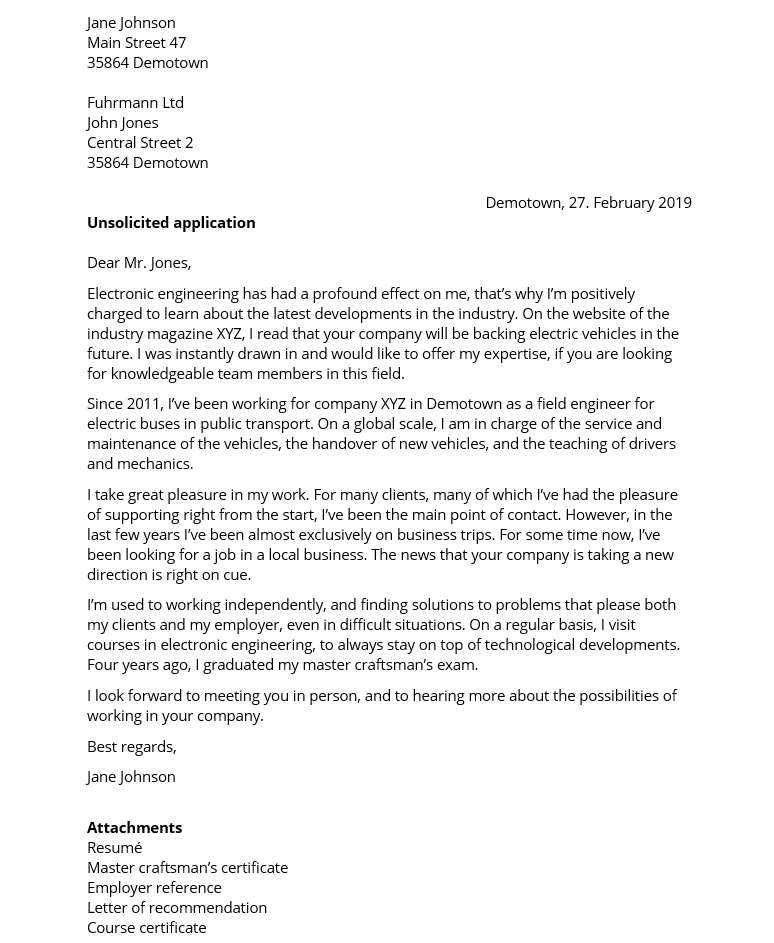
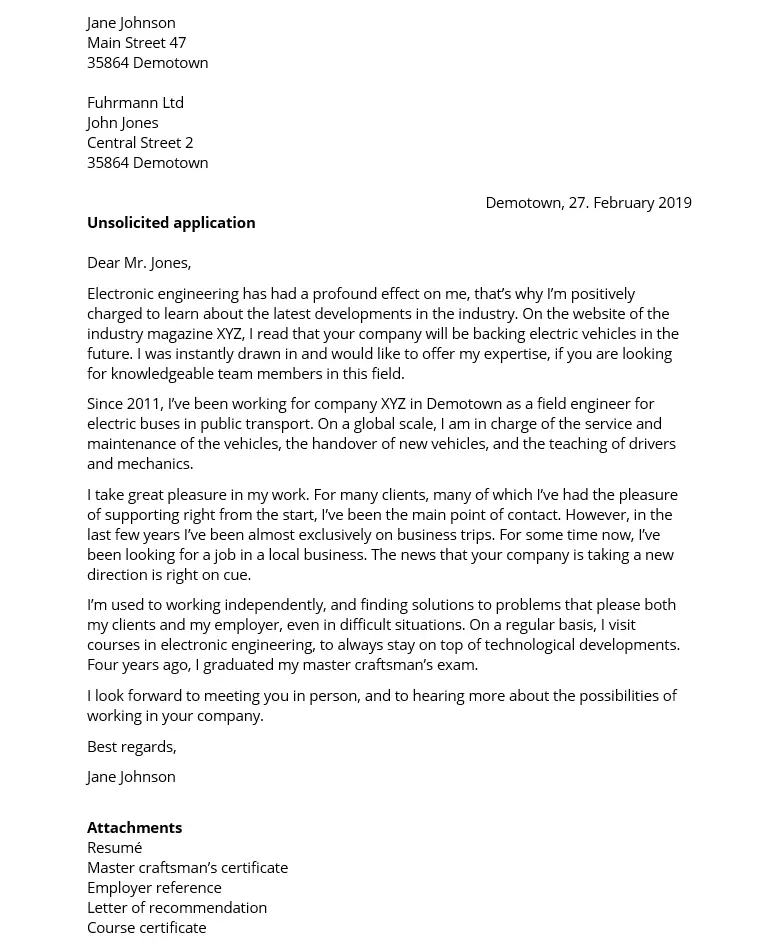
You can get a feel for how to write an unsolicited application cover letter with these templates, which you can also download.
Example 1:
Example 2:
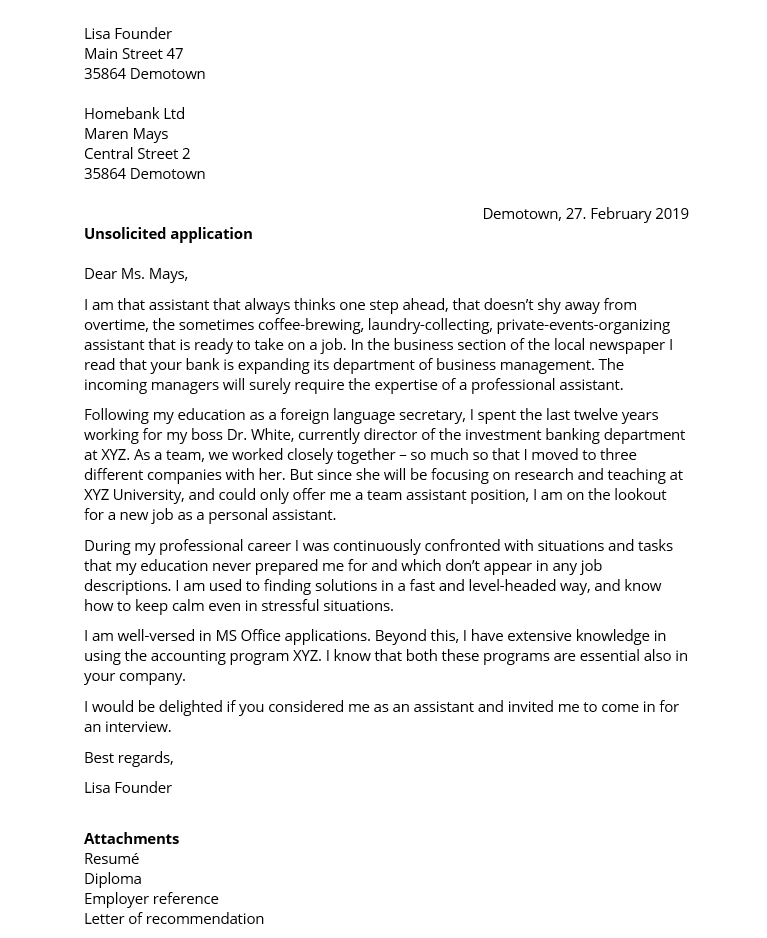
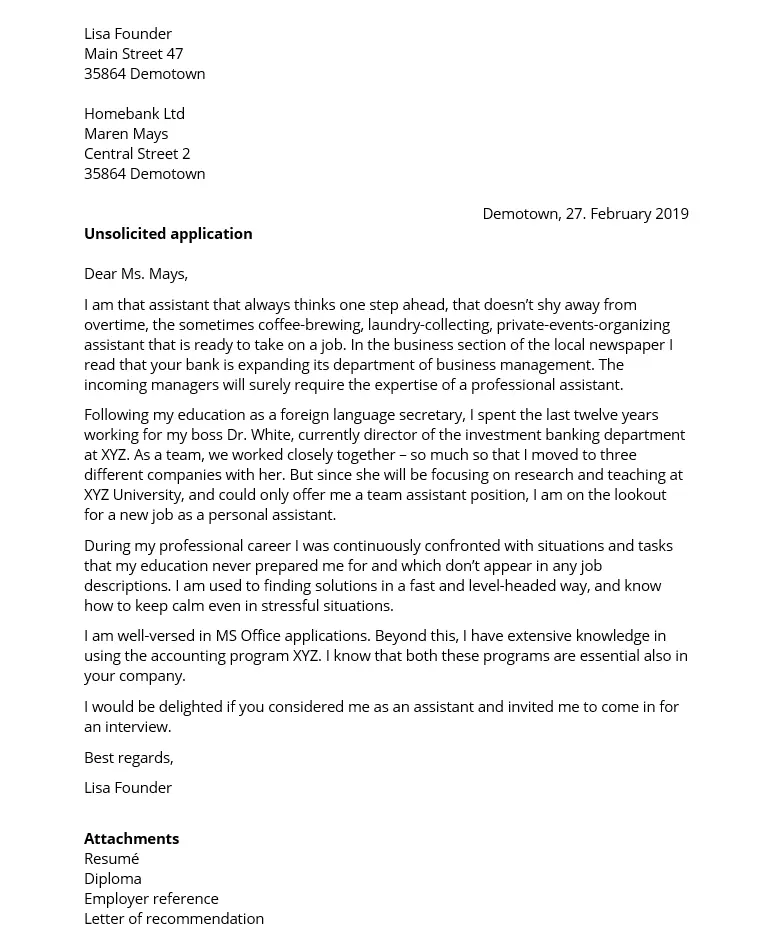
When it comes to unsolicited application cover letters, it’s incredibly important that your cover letter stands out. What motivated you to send your application to this particular company needs to come through. That’s why you should never just copy a template – you should only ever use them as inspiration for your own application.
Resumé
When sending your unsolicited application, you can also send your regular, tabular resumé. If you like, you can describe your professional experience and soft skills that are of particular interest to the company in a little more detail or just emphasize them a little more.
What’s even more important, though – and this applies to all application types – is that your resumé doesn’t have breaks in it and that it’s up to date.
Grades, references, certificates
You can decide for yourself if you want to send your cover letter and your resumé (short version) only, or all your application documents at once. Besides key school reports and grades, a longer version might include employer references and certificates in further education or additional qualifications.
If you decide to send all of your documents, you should be smart when it comes to the selection, as they should be relevant to the job you want. HR doesn’t need to see your internship certificate as a yoga instructor from 20 years ago, which you did in your spare time (unless there is a direct connection to the company). Concentrate on the documents that reflect your professional strengths in relation to the company you want to work for.
Click here for important legal disclaimers.