

WOOP Method: Achieving Success Despite Obstacles

Focus on your goal and you’ll succeed in achieving it – productivity gurus have been teaching this principle for decades. But this prescribed optimism doesn’t work for everyone. Doubts and potential problems can’t always be ignored. WOOP goal setting takes a different approach: It includes potential obstacles in its plans. What’s more, scientific studies show that the WOOP technique works. What is WOOP and how can you use this technique?
Why You Can Achieve Your Goals More Effectively with the WOOP Strategy
Practically everyone has wishes and goals for their private and professional life. But how can we really achieve them?
“I want to lose weight.”
“I want to improve my relationship with my parents.”
“I want to convince my boss to promote me.”
Oftentimes, these good resolutions fail at the first hurdles. Those who don’t take the necessary time for their plans will lose sight of their goal in the stress of everyday life, or they won’t have enough willpower and energy to persevere and overcome their fears.
Many productivity experts and motivational coaches advise us to focus as intensely as possible on the desired goals, rather than waste energy on thinking about obstacles and potential problems. Visualizing the ideal future and positive affirmations are intended to help sustain motivation. But many people fail with these strategies.
That’s not because they don’t want to achieve these goals or they’re doing something wrong. On the contrary: their experience corresponds with findings of research in the psychology of motivation, which has meanwhile established that a positive focus is not sufficient.
A range of scientific studies have found that positive thinking and dreaming can even be counterproductive when it comes to achieving our goals. In various studies, positive thinking had a sedative effect on study participants. They appeared to gain enough positive feelings simply from their idea so that they no longer took action in real life to actually implement the changes necessary.
Conversely, those who become aware of what might hinder them from achieving their goal can paradoxically improve the likeliness that they’ll achieve it – provided they still consider it feasible. This technique is called mental contrasting and it plays a key role in the WOOP method.
Other studies have shown that people who define their goals and approach in writing have success more often than test subjects who only took a decision internally. Simply formulating a plan increases the probability of success by 50 percent. Plans following the if-then model worked particularly effectively.
What is the WOOP Method?
The WOOP method encompasses a range of scientific insights into a step-by-step strategy that is easy for anyone to apply. It involves combining mental contrasting with if-then plans. The technique is referred to as “Mental Contrasting with Implementation Intentions” (MCII) in a scientific context.
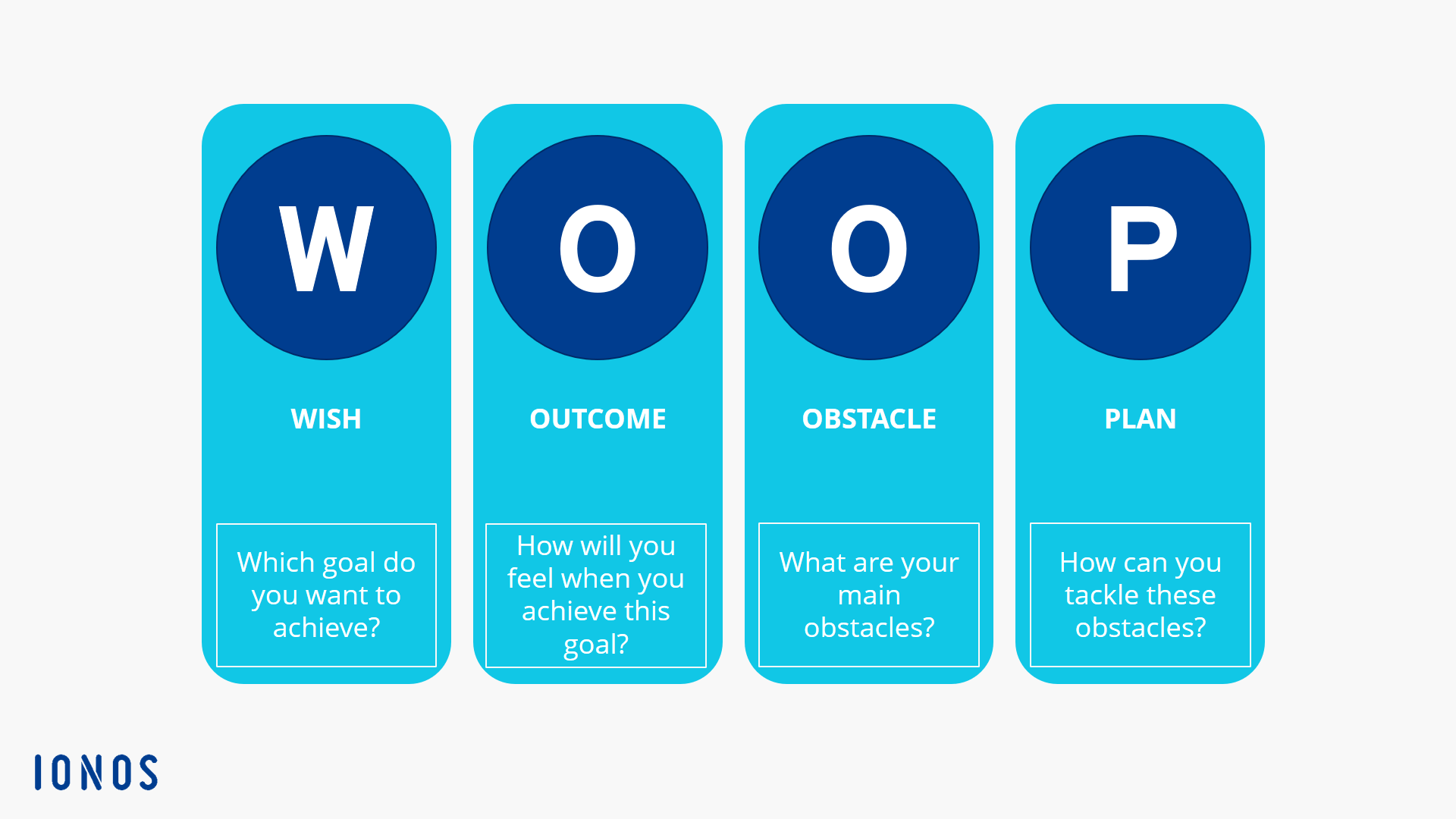
The WOOP acronym is broken down into four steps:
- Wish
- Outcome
- Obstacle
- Plan
What are the Benefits?
The benefits of the WOOP strategy compared to other methods for achieving goals primarily relate to its everyday suitability. The method is easy to learn, takes just a short time to apply, and can be used in any area of life. Plus, it has been evaluated scientifically.
There’s now even an app that guides users through the WOOP technique.
WOOP is generally suitable for:
- Clarifying your own wishes
- Setting priorities
- Strengthening your willpower
- Confidently overcoming obstacles
The WOOP technique also helps you to be productive at work. It can support proven time management methods.
Quick Guide: How to Apply the WOOP Method
But how can you implement the strategy? It’s important to set aside at least five minutes of time, when you can relax and think without disruptions. Have a pen and paper or other writing utensil to hand. Switch off all distractions and concentrate on yourself and the method.
- Wish: First, think about a specific wish. It should be challenging for you, but also appear doable. Try to free yourself from the expectations of others and ask yourself what you really want.
- Outcome: After you’ve identified a wish, you should imagine what it’d be like to make your wish reality. How would you feel? What would be the best possible outcome? Paint a vivid picture of the future in your mind. Imagining this situation is a key step in the process; it’s essential for the technique to work.
- Obstacle: Next, honestly reflect on what your biggest internal obstacle is that’s stopping you from achieving your goal. What’s getting in your way? Here too, you should try to imagine your obstacle in your mind as tangibly as you can.
- Plan: Now think about what you can do to overcome this obstacle. What could be helpful thoughts? Which actions could you take? Finally, prepare a concrete if-then plan in case you actually face the obstacle you imagine: “If ___________, then I will ___________.”
The Developer of the WOOP Method
WOOP was developed by psychology professor Gabriele Oettingen. She teaches at New York University as well as the University of Hamburg, and has been researching self-regulation and future-oriented thinking for many years. In her book, “Rethinking Positive Thinking” (2015) she summarizes her findings and offers steps that anyone can take to achieve their goals.
Click here for important legal disclaimers.