

How to write the perfect cover letter for a job application

So, you want to apply for a job? Normally, application documents include a resume, any relevant certificates, work portfolios, and possibly also a motivational letter. However, the actual application itself takes place in the cover letter, where you address the recipient directly and explain why you are interested in the advertised position and what qualifications you have. In the past, these documents were filed in an application folder. Nowadays, most applications are made online, either via e-mail or an input page on the company’s website.
However, regardless of whether you apply by mail or online, some rules apply to every type of application: while the resume, which consists of pure facts, is structured according to standard guidelines, the cover letter has more freedom when it comes to form, while also adhering to a loose structure. More freedom, however, often means more effort. If you want to score points with your cover letter, you have to focus it much more on the position in question, rather than your resume. Ideally, your cover letter should take into account the company you are targeting, the industry, your motivation, and the individual job advertisement. The cover letter is usually the first impression a manager, recruiter, or HR manager gets of you, which is why it is so important to try and impress as much as possible with this opening text. It is not enough to rely on samples, examples, and templates when writing a cover letter – even if they can be found everywhere on the internet. What you have to consider in detail when formulating a cover letter can be found in this article.
What’s a cover letter?
Job applicants use cover letters to signal their interest in the job to a potential employer. After reading the cover letter, the recruiter should know what your qualifications are and why you are interested in the job. Ideally, the cover letter should give them a precise impression of you as a worker – even without having to leaf through the rest of your documents.
For classic applications with multiple documents, the cover letter is the first page. If you design your cover letter convincingly and set the right priorities, the recipient will be more willing to deal with your application in more detail. Otherwise, your application will be put “ad acta” without being properly perused.
Do not confuse a cover letter with a motivational letter. Although the two documents are similar in some respects, they differ in their focus. While the cover letter briefly outlines all the points that are important in an application, in a motivation letter you primarily describe your personal goals and motives that prompted you to apply. Letters of motivation also give the author even more freedom with regard to formulation and structure than cover letters. For the latter, a certain structure is now standard.
How is a cover letter structured? What should a cover letter contain?
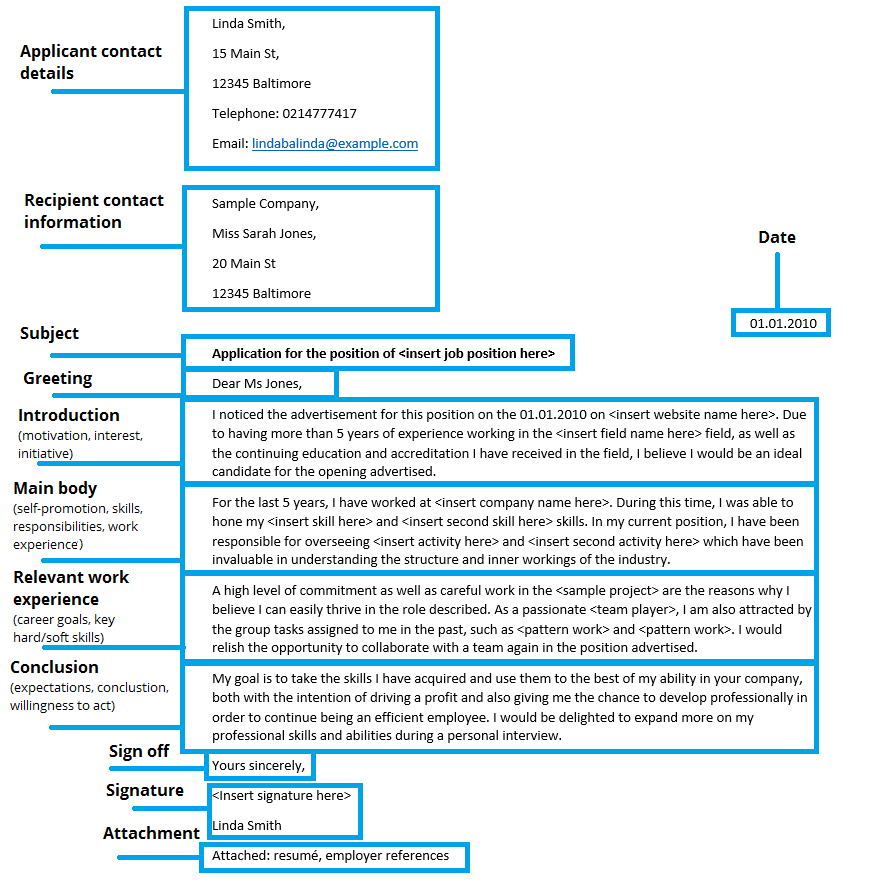
A certain structure has been established for cover letters which is worth adhering to. The reason for this is the function of the text: It should provide the person responsible with the most important information about your motivation and work qualifications as concisely and precisely as possible. It is not about individual creativity. If you structure the contents of your letter according to the usual structure, the HR manager will quickly know where to find what information in the document. The following graphic shows the basic structure of a cover letter:
Below are some explanations for those sections that are not completely self-explanatory:
Sender/contact details
List your contact details at the top of the document. Provide the recipient with multiple contact options by including a phone number and a legitimate e-mail address in addition to your home address.
Subject
There’s no need to experiment here either. The recipient should be able to see immediately what kind of document they have and what position you are applying for. Make the subject a short title instead of using whole sentences like “I would like to apply for position X” or “I am applying for the position of X”.
Greeting
If you know your contact person, you can address them by name. If this person has a title, you should use it – if there are several titles, the highest title is sufficient (e.g. “Prof.”, even if the full name contains “Prof. Dr.”). If you do not know your contact person, write “Dear Madam/Sir”. However, it is advisable to research who the contact person is, and address them personally in the cover letter.
Introductory remarks
The introduction is about arousing the reader’s interest in only 3 to 5 lines so that they do not immediately reject your application. You can do this as follows:
- Briefly state your motivation for the application. Ideally, you can use the introduction to highlight that your interest in the position results from your previous work experience and that the advertised job position fits optimally to your interests and qualifications. However, limit yourself to a few sentences.
- State the main argument for your application. This can be specific knowledge and skills, your professional experience, studies and training, or previous successes. Be sure to concentrate on the essentials. More detailed descriptions should only take place in the main body of the text.
- A leading sentence rounds off the introduction. For example, you can emphasize your willingness to perform.
Main body
This section is about selling yourself as a worker and person as convincingly as possible. The main section should cover the following points:
- Name the most relevant hard skills you possess for the job. Be sure to include the skills that are explicitly required in the job posting. Don’t just list these skills, but explain how you acquired or used them by referring to your previous work experience or education.
- Also list your outstanding soft skills. At many workplaces, certain soft skills are particularly in demand, e.g. the ability to work in a team, problem-solving competence, and resistance to stress. Soft skills are usually more difficult to prove, but some soft skills are automatically associated with specific positions or industries. If an applicant mentions their experience in a marketing agency, it is quite credible for them to draw attention to their communication skills. However, avoid too many personal soft skills that are difficult to prove (e.g. knowledge of human nature, empathy), or those that are not of any use for the desired position.
- The main part of your skills should relate as much as possible to the job you’re applying for. In this way, you can explain why your skills make you the ideal candidate for the job. It is also an elegant way to move on to the next section.
Corporate reference
In this section, you will answer the following questions: How can I enrich the company and why did I choose this company as my employer? You should give the reader the impression that you are the perfect candidate for the position. Not only do you need to relate your skills to the professional position, but you also need to explain why you as a person fit into the company. You can achieve this in the following way, for example:
- Describe the job as your next career step. This will give you the impression that the job you are aiming for is the logical next step in your career.
- Briefly outline the reasons why you find the company interesting. Highlight the positioning of the company within the industry. Explain why it is your personal goal to work in this company.
Ending
The last impression is one of the most important. However, if the reader has held out to the end, the cover letter has probably already been interesting enough so you will only have to do a little persuasion work. However, always express your wish for feedback. Also signal your willingness to appear personally in the company for a job interview. If an earlier starting date is also possible for you, this is a plus point that you could attach at the end. This can be particularly helpful if the company wants to fill the position promptly.
In some job advertisements, specifications of salary expectations is required. This is often difficult to place in a continuous text like a cover letter. However, the final part is well suited for small sentences like “My salary expectations are between X and Y”. Put the sentence in the middle of the final part before offering thanks. In this way, you will avoid your salary expectations being at the center of your application.
Tips & tricks for your cover letter
If you invest enough effort and time in your cover letter and adhere to the structure described above, you have already done a lot to make your application stand out. In addition, you should also take the following points into account in order to write a cover letter that is as convincing as possible.
Read the job advertisement carefully
Your cover letter should contain as many references as possible to the job advertisement and the position you are looking for. The basic requirement for this is that you read the advertisement carefully beforehand. What requirements does the employer place on the applicant? Which hard and soft skills are explicitly mentioned in the advertisement? Which strengths and weaknesses do you have with regard to the required qualifications?
It is best to take notes: for example, write down the 5 most important points in the job advertisement that you would like to include in your cover letter.
Explain gaps in your resume
Unexplained gaps in your resume seem unprofessional and give the impression that you quietly hope they will not attract attention. In your cover letter, mention a gap lasting several months (including unemployment). Experienced personnel will notice gaps in your resume and will definitely ask you about them during an interview.
Maximum one A4 page
Follow the unwritten rule that a cover letter should not be longer than one A4 page. Many personnel managers put applications with overly-long cover letters directly aside and don’t even read them. One page should be completely sufficient to deal with all the important points. If the employer is interested in a longer draft, they will ask for additional documentation like a motivational letter. The rule of thumb for online applications is that you should be able to read them without having to scroll much. If you send your cover letter online as a PDF file, simply use the A4 format for the printed version.
No format experiments
Do not experiment with format either! For a written application, you should use a legible font like Calibri or Times New Roman. Separate the individual sections with blank lines or paragraph spacing. Avoid unnecessarily complicated elements like tables and subheadings. Basically, you can’t go wrong with your writing program’s factory settings. This also applies to e-mails for which you should completely dispense with special formatting (depending on the mail program, these may not be displayed correctly to the recipient).
Short and easy to understand
Avoid overly long sentences in the cover letter. Do not build complicated subordinate clauses. Avoid excessive use of foreign words or pictorial language. Also, avoid anything that unnecessarily stretches the text: frequent use of passive voice, repetition, and auxiliary verbs. Instead, provide the reader with all relevant information in as concise a form as possible.
A well-known guiding principle for effective cover letter writing is the “K.I.S.S. principle” – “Keep it short and simple!” Keep your writing short and simple. You won’t impress anyone by wasting space with many complicated sentences in your cover letter.
Have someone proofread your cover letters
Ideally, you will know someone who is experienced in proofreading. Have this person look over your cover letter and ask them for feedback. Often, you won’t notice any volatility or typing errors if you have worked on a text for a long time. It may also help to have your own text read to you by a text-to-speech program or a screenreader. If the language software reads the text aloud, you will notice your own errors more clearly.
Be confident (call-to-action)
Restrained letters do not stand out from the crowd. By explicitly inviting the reader to carry out an action in your cover letter, you show self-confidence and encourage the reader to react. You can do this, for example, by writing in the final section that you are looking forward to the interview (even if you have not yet been invited!).
You can also note in the final part that the employer is welcome to contact you for further information and refer to your telephone number or e-mail address. However, you should not use this “call-to-action” style in an inflammatory manner, otherwise you will appear obtrusive or even desperate. One or two sentences in this style can, however, enrich your cover letter in many cases.
If you have had a job interview, you can start with one follow-up e-mail to signal commitment.
Frequent errors in cover letters
Recruiters and HR professionals work their way through a huge number of applications in the course of their careers. Accordingly, these people have to pre-sort applications according to certain criteria so that the hiring process runs as fast as possible. The cover letter alone can contain mistakes or unreasonable statements, which could lead the HR manager to ignore your application. We will tell you which errors appear particularly frequently in cover letters so that you can avoid them in a targeted manner.
Distracting elements
Pictures, tables, eye-catching frames, strange fonts – all this and much more shouldn’t be in a cover letter. The purpose of the cover letter is to present professionally relevant information concisely and precisely. Unnecessary design elements distract from this – if the cover letter is too lavishly designed, personnel managers could also get the impression that you want to conceal weak points in content or missing qualifications within the design.
Copy-paste letters
In certain phases of your life, it might be the case that you are sending dozens of applications in a short amount of time. Of course, it is time-saving to write a single cover letter and simply change the name of the recipient in each application. It can be useful to use certain formulae in more than one cover letter. However, you should not use an almost completely unchanged cover letter for every application. At least adapt it slightly to the respective advertisement.
If you don’t do this, an experienced HR specialist will notice within a few seconds in the worst case that they have a copy-pasted cover letter. For example, in the final section you may address the wrong company or your qualifications hardly match those required in the advertisement. Ideally, you should not copy at all, but write a separate cover letter for each application. If you do copy your wording, it is important that you make at least some adjustments afterwards.
Paraphrased resume
The cover letter should not be a textual version of your resume. However, many applicants make the mistake of merely formulating information that is already in their resume. However, unlike your resume, your cover letter serves to establish a personal link between you, the job you are looking for, and the company. In addition, you only highlight information that is relevant to the job in question, while your resume lists all career stages. Although your resume can serve as an orientation guide for formulating your cover letter, you should never use your resume as a 1-to-1 template for your cover letter.
Why wait for a job advertisement to apply for a position? Use your initiative and send out an unsolicited application. You’ll find some tips in our article on the topic!
Repetition and digressions
In your cover letter, mention each piece of information just once. If not, the reader will get the impression that you have to stretch the cover letter artificially because you have too few qualifications to fill an A4 page.
You shouldn’t stray from important content. Ask yourself whether each sentence of your cover letter fulfils a certain function: Does this sentence help me get the job? For example, many applicants make the mistake of writing too extensively about soft skills, which actually only become clear in the interview. In particular, if certain knowledge or qualifications are required in the job advertisement, you should first present them before giving too much room to your soft skills.
Flattery and exaggerated enthusiasm
One last piece of good advice: don’t rely on obvious flattery. This applies in particular to the section on company relations, where you make a personal connection with the company you’re aiming to be hired by. There, you run the risk of attracting negative attention through excessively exuberant statements. If you write in a cover letter for a start-up company that it is an established player in the industry and that it would be an honor to work there, the HR manager will discard your application with a smile. Be reasonable.
If you flatter yourself, you look unprofessional and desperate; as if you have to try to cover up weak points in your application with style. Also don’t mention too often how much you want to be invited for an interview – once or twice is enough. You don’t want to look as if you have to beg for the job.
Examples and templates for cover letters
On the web, you will find numerous examples and templates for cover letters. In principle, however, we recommend that you write cover letters yourself. Most HR professionals have already had contact with numerous templates and are therefore able to recognize immediately when they have a cover letter based on a template in front of them. As a rule, this is interpreted in such a way that the company was not worth an individual cover letter from you.
If you adhere to the standard text structure described above and create your own cover letter, you are on the safe side. Patterns and examples can, however, be used for initial orientation or comparison.
- Resumegenius.com offers a wide range of different cover letter templates. The majority of these are free of charge.
- Livecareer.com offers a free-of-charge cover letter builder tool, which can assist you with every step of writing a cover letter.
- Microsoft Office offer a wide range of Word-compatible cover letter and resume templates on their office.com website.
If you absolutely want to use a sample or a template for your cover letter, you should at least change the sentence structure. A good application requires time and effort; you should not save on both when applying, because your contact person will notice this immediately. The carefree use of samples or templates for your cover letter is the quickest way to the trash can!