

Empathy Map: The Quick Way to Understanding Customers

Companies need to know the needs of their target group—the more accurately, the better. Only then are they able to develop solutions to problems and needs that actually exist. There are many different methods for better understanding customers and including them in the company’s focus. One such method is the empathy map.
What is an Empathy Map?
An empathy map is a simple, yet effective tool for businesses to compile assessments on the perceptions and feelings of their target group.
In recent years, the creation of buyer personas has become a standard method for clearly aligning a business offering to the needs of a target market. For the method to work, however, an extensive quantitative and qualitative market analysis is required. After all, the buyer persona needs to be based on facts and data, rather than subjective notions. The method is therefore relatively costly and time-intensive.
But customer empathy maps are different. Here, data plays a subordinate role. The aim instead is to step into the shoes of a prototypical customer and to identify their feelings, thoughts, and actions. The focus is on empathy, rather than data.
The method is applied in a team so that different perspectives can help build a sharper picture of the customer. Normally, an empathy map is created in a meeting.
Empathy Map: An empathy map is an overview created by a team that covers the thoughts and feelings of an envisaged target group (customers, users or stakeholders). The map improves awareness of the customer perspective and helps direct business activities.
Applications of the Empathy Map
The applications of the empathy map are largely identical to those of the buyer persona. An improved understanding of the target group is obtained with both methods.
The insights provided by the map are valuable for any business area:
- Content marketing
- Product development
- UX design
- Sales strategy
You should use the empathy map as a guiding vision for aligning your daily work more closely to customer needs.
How is an Empathy Map Structured?
Meanwhile, there are several variants of the empathy map. The customer perspective is often explored regarding the following aspects: seeing, hearing, acting, thinking, and feeling.
To complete the map properly, you should define a context in which you’d like to map the customer’s perception. Should a potential customer’s situation be considered more generally? Or should the map relate to the experience on your website or a certain decision situation within the customer journey?
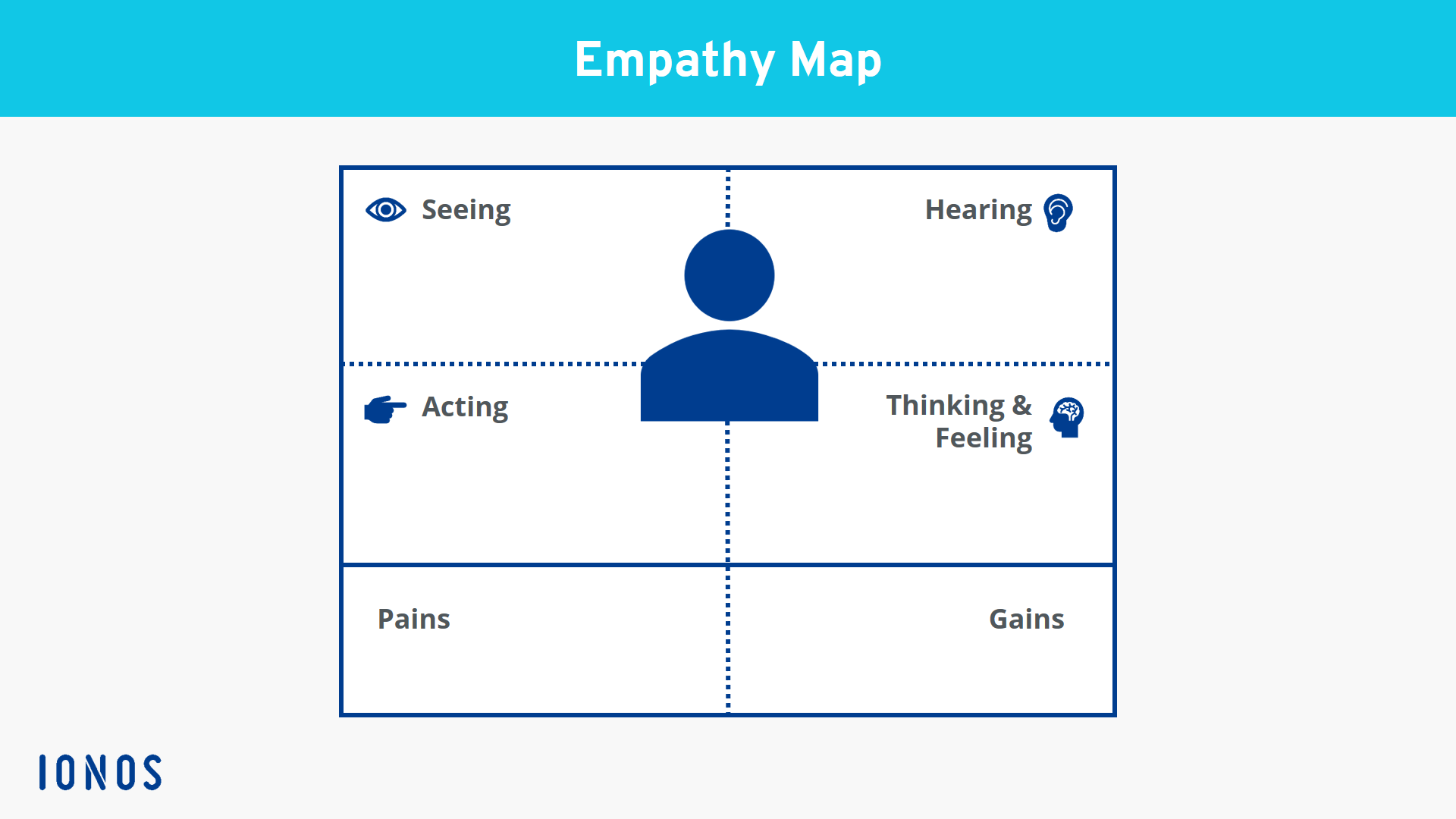
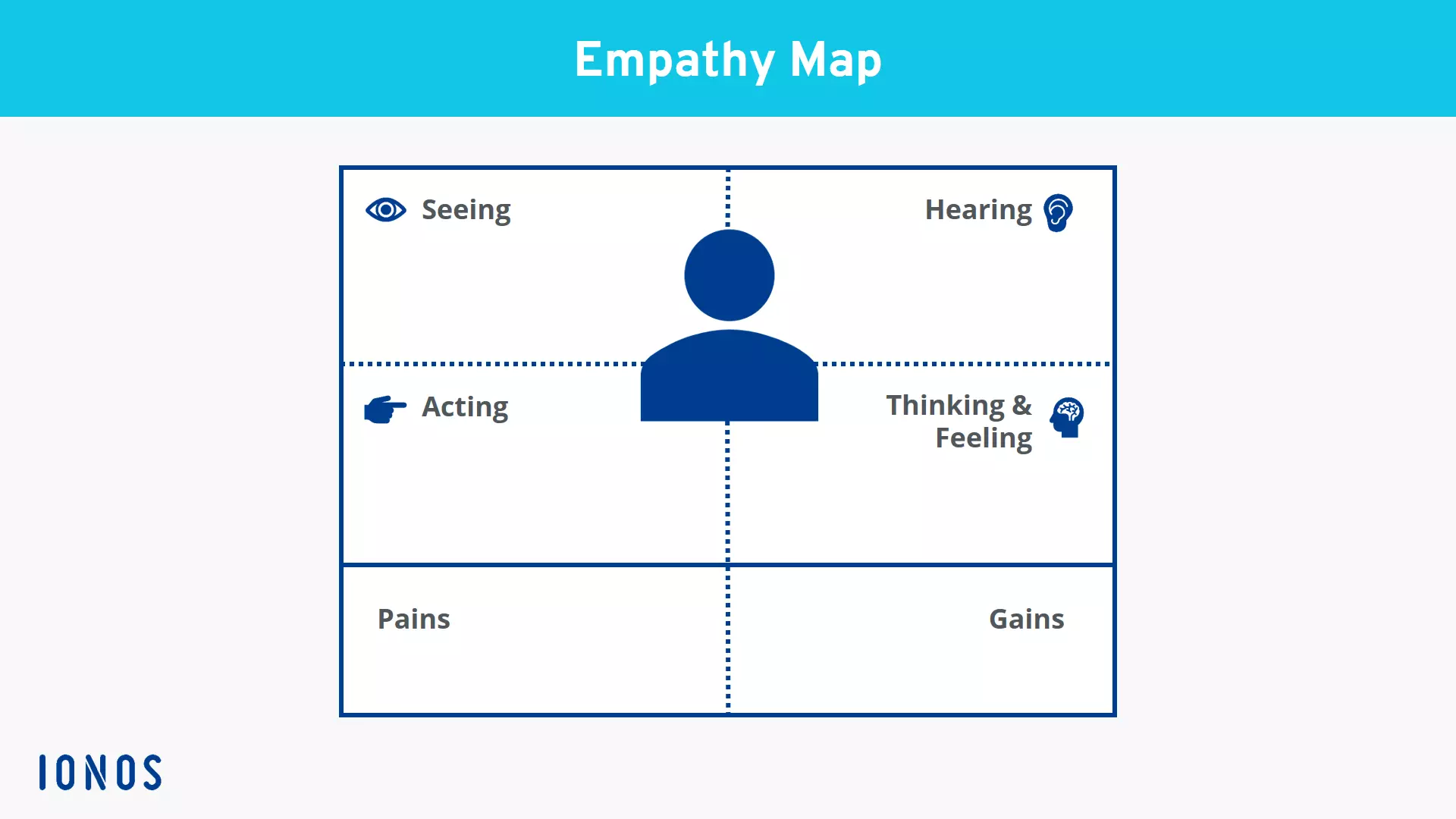
Seeing: What does the person see on a typical day? What do they see in the specific situation? What do they see when they look at the market of possible solution providers?
Hearing: What acoustic impressions does the person hear in the situation (sounds, voices, background noises etc.)? What does the person typically hear from others in their environment? What information are they exposed to?
Acting: What does the person do on a typical day? What do they do in the defined situation? What are typical things for them to say?
Thinking and feeling: What does the person think and feel on a typical day or in the specific situation?
Two more aspects can be included in the classic empathy map: pains and gains.
Pains: What are the person’s pains, worries, and problems?
Gains: What are the person’s wishes, dreams, and needs?
Empathy Map Example: Best Practice
Ideally, you can create an empathy map during a team workshop in order to gather as many impressions as possible.
David Gray, the developer of the method, expects it to take around 20 minutes to create an initial empathy map. So, the method doesn’t take too much time. However, it requires the participants to have at least a rough understanding of the relevant target group. If you have helpful data such as web analyses or user surveys available, you should share them with your team beforehand.
At the start of the workshop, you can define in which context the target group should be considered with the empathy map.
It’s important to draw the empathy map big enough on a whiteboard or flipchart. Together, you can then gather thoughts on different aspects, engage in discussion, and finally place post-it notes on the map, for example.
Alternatively, the empathy map could be developed in small groups and the results discussed within the full team afterwards to create a final overview.
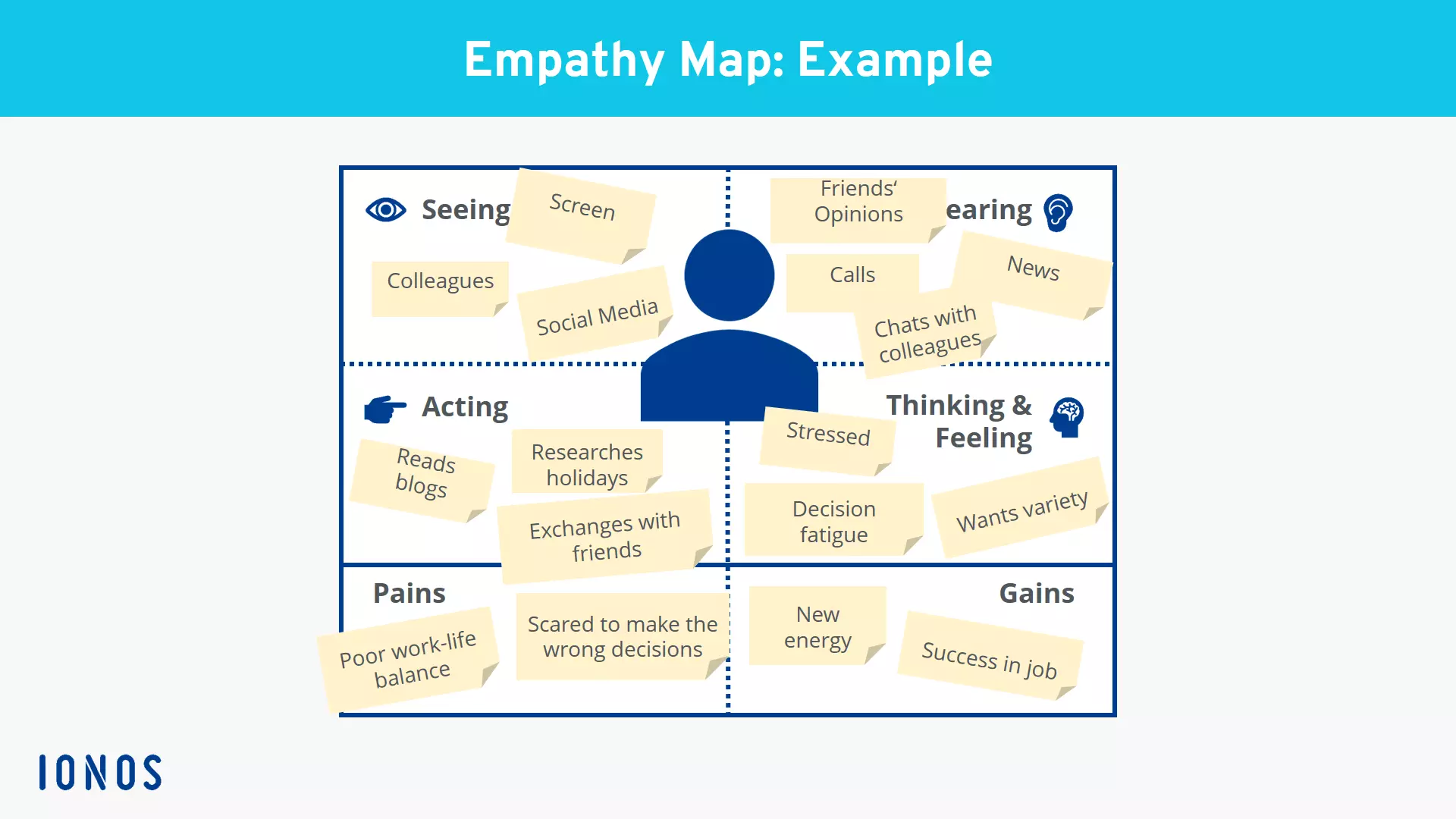
Below is an example of an empathy map:
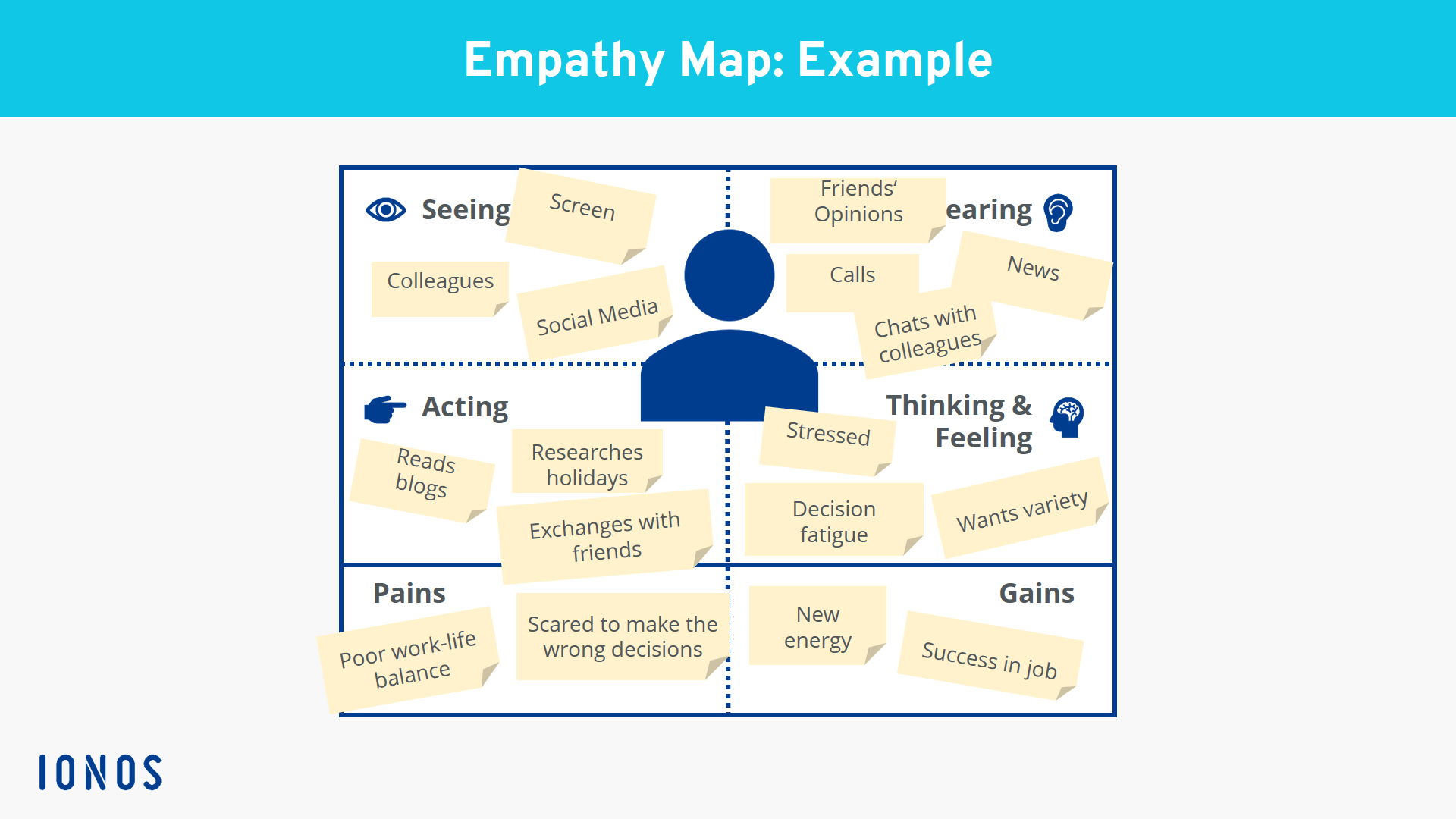
If you work with a remote team, you could also use a shared document instead of a workshop, where each team member can enter their own ideas onto the empathy map using OneDrive for instance. Afterwards, you could discuss and finalize the map in a video call.
Strengths and Weaknesses: Not a Method for All Cases
The empathy map is an effective tool for getting an emotional impression of the target group. But the method has weaknesses that you should consider when using it.
The empathy map is ideal for obtaining a feeling for the target group in a certain situation, for example if you only want to look at a segment of your customers more closely or develop a user story.
In agile projects in particular, it’s not practical to perform weeks or months of market research. Here, the empathy map is a suitable alternative to the buyer persona.
However, if you’re working on your business model and want to gain a detailed understanding of your target group, creating an empathy map is not sufficient. It’s important to collect objective data in order to familiarize yourself with your target group’s needs, thought patterns, and behaviors as well as life context. The empathy map is a useful addition for better understanding the buyer persona from an emotional perspective, but it’s no substitute for market research.
Click here for important legal disclaimers.