

Vero – True Social: a closer look at the hyped-up network

Most hypes follow their own rules – especially on the internet. This is no different to the social network 'Vero – True Social'. The sudden enthusiasm for the Vero app led to a rapid increase in users from a meager 150,000 to an impressive 3 million. But then came the controversy and server failures, discussed in numerous blogs, vlogs, podcasts, tweets, and in the news. But even this negative publicity contributed to Vero’s popularity, making it well-known in the social media sector. Many companies are already jumping on the bandwagon since they see great marketing potential in the platform.
Checked out the new Vero platform. Took a few minutes to explore and how to do stuff. I like the concept. As a digital marketer the opportunity is interesting. As a content play it will take some getting use to. Good work overall Vero product team #vero
— Ray Starck (@raystarck) March 11, 2018
Who else is on #Vero ,cause I’m this close to deleting app. Hard to find suggestions, people are using every hash tag known to man in every post so can’t weed out what you like to follow.
— Chadnv (@chadnv) March 17, 2018
But what is 'Vero – True Social'? What makes this social network different from big names such as Facebook and Instagram? Is the hype justified, or is Vero likely to fade into oblivious soon? We explain how Vero – True Social works, and critically analyze the app from several perspectives in our review. Regardless of whether you’re already banking on Vero being the new social media star or whether you think the app is just a flash in the pan: it’s worth taking a closer look at its features and innovations. But keep in mind that there is also some controversy surrounding Vero.
Development of the 'Vero – True Social' app
Vero is a social network that users reach via the Vero – True Social app. The app is available for Android and iOS – a web or desktop application is not currently being worked on. Vero was released in August 2015 in beta version 1.0 (which is still the current version). As of March 2018, it is still free of charge. However, according to the operator himself, a monthly subscription charge is planned to finance Vero. Unlike Facebook and Instagram, Vero doesn’t have any advertisements on its timeline. This is the main difference between this app and other social media platforms – and is Vero’s unique selling point. Although this means that the company, Vero Labs, has to manage without advertising revenues.
Ayman Hariri is the mastermind behind the developing company, Vero Labs, Inc. The founder is the billion-dollar son of former Lebanese Prime Minister Rafiq al-Hariri. Vero’s public perception and judgment is therefore closely linked to the reputation of the Hariri family. And unlike many other modern start-ups with inspiring success stories, Vero doesn’t necessarily have a sympathetic founder behind it. Many believe that the hype around Vero has been exaggerated and the founder has pushed the app forwards using his billions.
What makes Vero stand out?
Vero is advertised with the slogan 'True Social'. This refers to there being no ads on Vero like on Facebook and that there is no algorithm that messes up the user’s timeline. Vero promises a chronological feed, similar to what Facebook had before it became an advertising platform. Users only see posts from those actually connected to the network. In other words, 'pure social networking' where the newest post is always at the top.
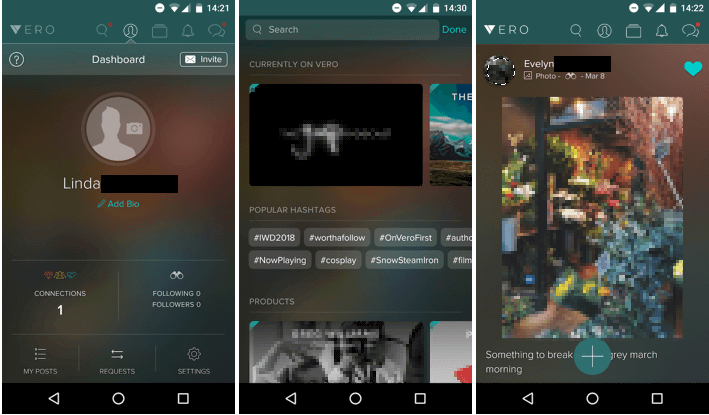
Of course, Vero has to be financed somehow – and advertisements aren’t an option as a source of income for Vero. Originally, the financing was to take place via a user subscription, whereby the first million users were promised a free account. However, this limit was quickly lifted due to the pressure, which means that Vero is currently (as of March 2018) completely free of charge. This could be a reason for the quick increase in popularity, since people thought: “I’d better create an account now before the app becomes too popular and I have to pay for it.”
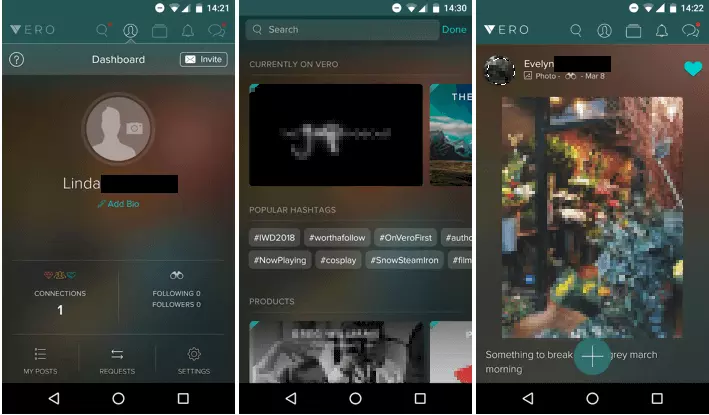
A positive feature of Vero is the elegant design. Vero’s darker display is very different from Facebook’s blue and white coloring. In our test, Vero proved to be very easy on the eyes.
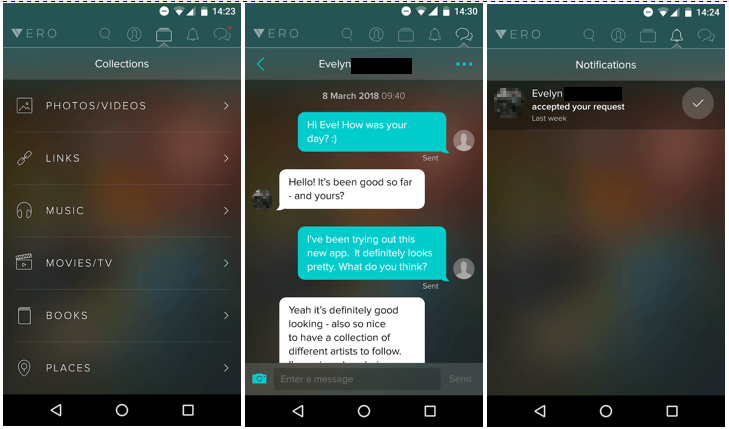
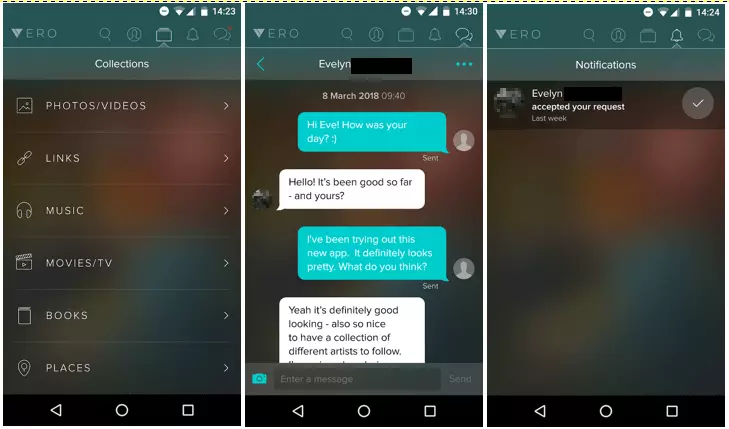
The interface is also easy to operate. The functions are clearly arranged and should be familiar to those who use other social networks. From a functional point of view, Vero hasn’t attempted anything new. Instead, the concepts and functions, which have proven to work well in other social networks, have been implemented here too. The principle “The user comes first!” applies with Vero. User-friendliness takes priority over optimization for the benefit of advertisers. The principle of categorization is also interesting. Vero collects posts for the user and categorizes them into so-called “collections” according to the medium (e.g. photo, video, song, image, or link). Text-only posts are usually not possible, since each publication usually contains a link, song, or something similar. This keeps the feed colorful and full of media. The only exceptions are comments on other posts, which may be text-only. This multimedia approach is modern and promising. With Vero, you have the possibility of adding contacts as “close friends,” “friends” or “acquaintances.” You can chat with friends, but this isn’t possible with acquaintances. Therefore, this works as a useful filter, even though the difference between “friends” and “close friends” could lead to some problems. This is definitely a plus point for the social network. Vero also has the principle of “followers” like on Twitter. You can follow public people, groups, or companies and their posts will then appear in your feed. Similar to Facebook’s “like page” feature, you can then unsubscribe from them. Depending on whom you follow, it could mean that you get their advertising in your feed. Unlike Facebook, however, you will only receive advertising from people that you voluntarily follow. Vero will suggest products and people for you in the search function. This means that there is a kind of advertising on Vero, and not just on the timeline.
Criticism surrounding Vero
Every hype on the internet is always accompanied by a counter-hype, and Vero is no exception: Negative reports have been shared via other social media platforms under the hashtag #deletevero. This is because the company behind Vero has a dubious reputation. In addition, the sudden rise of the network in February 2018 also resulted in some conspiracy theories: Many influencers are said to have been paid by Vero to hype up the app. After all, Vero has been around since August 2015, so why did it suddenly become so popular three years later? Many believe it’s because it was produced artificially and had a lot of money pumped into it.
Another point of criticism: Vero only works if the user enters their phone number. The app then sends a four-digit code to the user in order to activate the account. Referring to the competitor, WhatsApp, Vero argues that they have this step to block out bots and keep the network free of advertising programs. In theory, however, stopping bots could also be done by other means, without asking for the user’s phone number. Those wanting to register must therefore provide confidential information in order to use Vero. The fact that Vero’s servers are located in England, and should therefore not be subject to EU data protection guidelines once Brexit has been implemented, doesn’t exactly help strengthen confidence in Vero’s data protection.
After the sudden increase of users, Vero has also had to contend with various server failures and performance problems. As a result, many users were temporarily unable to create an account. In our test, the code caused problems because the app rejected it. It only worked on the third attempt with the call-me function. Vero doesn’t seem to have got this problem under control yet.
In our test, the Vero app also proved to be a battery-drainer. Ten minutes of testing resulted in an energy loss of about 8%. This is a clear indication that the app is consuming an enormous amount of resources. Mobile data volume is also likely to suffer from using Vero. The app relies on the user sharing media, so if these are uploaded using mobile data and not while connected to WiFi, this will use a lot of data volume. Users with small data packets and/or weak smartphones won’t be that impressed with Vero, since it’s only really optimized for modern devices and powerful networks.
From a functional point of view, there is a surprisingly little to criticize about Vero. What is noticeable, however, is the absence of emojis. For some users, this could be advantageous if they want to escape the annoying sea of yellow faces. But the popular yellow emojis don’t fit the rather somber style of the app anyway. These missing emojis are more a question of taste rather than a criticism. When it comes to categorization, however, important categories such as video games and comics are also missing. Also, the fact that you can’t post without attaching some kind of media could be a downside for some users.
Much of the criticism is directly related at Vero’s founder, Ayman Hariri. The controversies surrounding his person have led to moral concerns among many critics as to whether his app should be used at all.
I want to like Vero and the idea behind it but can we trust Ayman Hariri and is he as shady as the media reports? #Vero #aymanhariri
— Mike Broadwater (@capturedvisions) March 5, 2018
I don't know what CEO did but why #DeleteVero . I mean look we are living in the country of Trump. Does it matter who the owner is #Vero #FixVero #RemoveCEO
— (@fanboyy_1) March 12, 2018
But what are the reasons for the negative attitude towards Hariri? On the one hand, the Lebanese billionaire was also the founder of the construction company, Saudi Oger. This company went bankrupt in 2016 after thousands of employees hadn’t been paid for months.
Hariri is the son of notorious former Lebanese Prime Minister Rafiq al-Hariri, who was assassinated in 2005 following numerous allegations of corruption. Today, Ayman’s brother, Saad, occupies the prime minister’s office, while Ayman tries to stir up the social media sector with Vero. This history of the Hariri family is closely linked to corruption and scandal – the inhuman treatment of their own employees still shapes this family’s reputation today. Many online users refuse to give Vero a chance because they do not want to support the family and their practices. Mark Zuckerberg, CEO of Facebook, looks like a hero compared to Ayman Hariri.
A social network’s success is strongly dependent on its user base. If Vero continues to grow, the app could become a major player in social media. If users shun the app, Vero will disappear. This is exactly what has happened to some networks in the past: For example, ello and Mastodon. These both promised a new concept for social networking and set out to try and de-throne Facebook. They offered innovative features and great design ideas. Nevertheless, both of them developed into niche products. This fate also threatens Vero if the influx of users diminishes too quickly.
However, until recently, users had problems deleting their Vero accounts and could only do so by contacting e-mail support. The waiting time for account deletion varied. In the meantime, Vero has integrated a delete function and promises that the account will be deleted within 24 hours. This shows that the operator reacts quickly to criticism. At the end of the article, there are step-by-step instructions on how to delete your Vero account.
Overview: advantages and disadvantages of Vero
| Advantages | Disadvantages | |
|---|---|---|
| Currently completely free | Highly controversial operator | |
| Rapid user growth, including many influencers and people of public interest | Paid subscription to be introduced | |
| Advertising-free, strictly chronological timeline | Registration only possible with telephone number | |
| Categorization of media posts | User risk: many new social networks have already disappeared into insignificance | |
| Elegant design | No posts allowed without media attached | |
| Good functionality | Currently many server problems | |
| Hierarchical classification of contacts improves privacy | No emojis | |
| Proven follower principle | Missing categories for individual media (e.g. video games) | |
| Operator shows tendencies to rapidly improve the app when needed | App consumes a lot of resources (battery power, data volume) | |
| Account deletion can take up to 24 hours | ||
| Server located in England i.e. questionable from a data protection point of view |
Summary
At the moment, people are quite divided when it comes to Vero. On the one hand, the app has a great design, is intuitive, and runs smoothly. The idea of an ad-free social network is attractive: After all, many users long for a network that differs from the established social media giants that are increasingly developing into gigantic advertising platforms. Vero takes a different path, which is worthwhile noticing. The question is: Is an ad-free platform worth paying a monthly subscription for?
On the other hand, the numerous controversies can’t just be ignored: If you decide to use Vero, you’re supporting the founder, Ayman Hariri, and his family, which have a history of corruption. Many therefore decide against Vero for moral reasons. Data protection is also an important issue when choosing digital products today. As long as Vero continues collecting phone numbers for unbeknown reasons, alarm bells are going to keep ringing for those worried about data protection.
Regarding the technical side, Vero has room for improvement. The performance problems and continuing server failures are poison for a “flourishing” social network. The fact that the Vero app eats up an enormous amount of resources will not impress users either. But the numerous “teething problems” are likely to be eradicated at regular intervals, since Vero reacts quickly to problems. The developer is quite understanding when there is justified criticism. So, there is hope that Vero will become an attractive app regarding its technical talents in the future.
Vero – True Social has lots of potential. But to get the most out of this, the developers must act quickly before they lose the masses of new users again. Improving the technical side would definitely be a step in the right direction to achieving this goal. However, the bad reputation of founder Aymar Hariri and his family could stay with the brand and damage the network’s reputation. In any case, it will be interesting to continue observing Vero’s development.
How to delete your Vero account
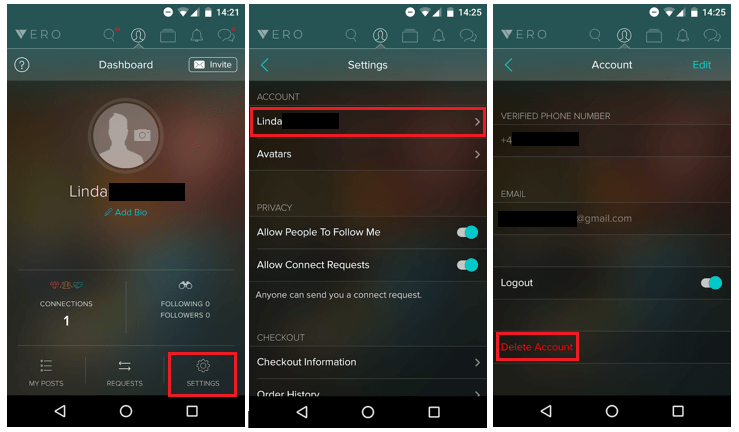
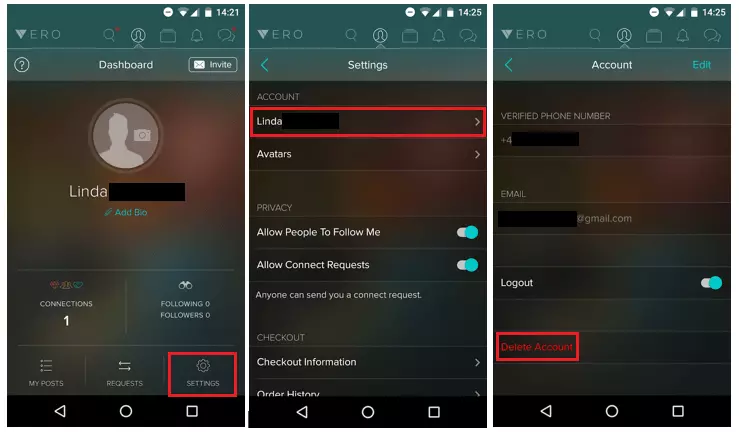
- Click on “Dashboard” via the top menu.
- Go to “Settings” in the bottom right.
- Now select the account you want to delete.
- If you scroll down, you will find the option “Delete Account.”
- A dialog box opens in which you can confirm you definitely want to make the deletion.
- Vero will log you out and you will no longer have access to the account.
- According to Vero, the account will be completely deleted within the next 24 hours.