

What is sentiment analysis and how does it work?

Sentiment analysis is a natural language processing technique aimed at identifying the sentiment or attitude in texts. It is used to automatically evaluate opinions on social media, customer reviews, or surveys.
- Intuitive drag and drop editing
- AI-powered text generation
- Multiple templates to choose from
Why is sentiment analysis needed?
For the success or failure of a brand, not only the direct sales figures, which can change in the short term, are decisive, but also customer opinions. It’s primarily about how potential customers talk about the brand—regardless of whether they have already bought the product or not.
- Does a brand fit the current trend?
- Is the brand perceived positively or negatively by the desired target group?
- Is the brand completely ignored?
- How is the brand received by influencers?
These are important questions a company should regularly address through targeted monitoring of social media channels. Sentiment analysis is also conducted by stock market specialists to estimate the course of stock prices based on investor purchase behavior and overall sentiment.
How does sentiment analysis work?
Sentiment analysis, also known as “emotion detection,” is based on the automated evaluation of user comments to determine whether a text is intended to be positive or negative. It uses methods of “text mining” (see also data mining), which involves the automatic analysis of texts written in natural language.
The main challenges in sentiment analysis include:
- Natural language is not simply a list of positive and negative words — its meaning shifts depending on the context.
- Analysis methods that rely on precompiled, topic-specific dictionaries to identify positive or negative terms offer only a very rough picture.
- The frequency of supposedly positive or negative words says little about a person’s actual opinion of a product.
- On social media, opinions are often expressed in ways that do not follow standard English grammar.
- Depending on the target audience, language patterns such as slang or emerging trends can also influence interpretation.
These difficulties can be illustrated by two different customer reviews:
| Customer review | Number of positive words | Human evaluation |
|---|---|---|
| “I’m thrilled” | 1 (“thrilled”) | Very good |
| “Pretty good, serves its purpose.” | 2 (“good”, “serves”) | Average |
For successful sentiment analysis, artificial intelligence tools are increasingly being used. Machine learning methods help train tools that closely understand the target audience and the environment of the product to be analyzed. In the long run, this improves the quality of the results.
What is the purpose of sentiment analysis?
The most important task of sentiment analysis is to determine a general sentiment about a product or brand within a defined target audience. It’s useful to search through product reviews on your own website or major online stores, as well as thematically relevant posts on Facebook, Twitter, and other social networks.
Sentiment analysis aims to detect the emotions behind the written text and also capture what the author of the text actually meant.
However, sentiment analysis is not a tool for responding to individual opinion pieces or product reviews. In such cases, it is better for a human to write a personal reply.
What are the advantages of sentiment analysis?
Sentiment analysis offers businesses numerous advantages in the areas of marketing, customer service, and brand perception. The automated evaluation of large text quantities allows for targeted analysis and use of customer opinions, attitudes, and emotions.
✓ Early detection of negative customer sentiment: Professional text analyses enable the quick identification of sentiments within a target group. This allows businesses to respond promptly and counteract with appropriate measures, such as adjusted communication or targeted campaigns.
✓ More targeted marketing: By analyzing customer comments, positive customer experiences can be identified. This information can be used to offer personalized advertising or promotions—ideally exactly where the target audience is active.
✓ Strengthening customer loyalty: Understanding your customers better allows for creating more tailored offers and addressing their needs. This strengthens customer loyalty and increases satisfaction in the long term.
✓ Reputation management: Sentiment analysis helps keep track of the brand’s public perception. This allows for early crisis detection and minimizes reputation risks.
When is sentiment analysis used?
Sentiment analysis is used in many areas where opinions, reviews, or sentiments play a role. Companies, in particular, use it to gain insights into customer behavior and respond more quickly to trends. The following areas of application are particularly popular:
- Advertising campaigns on social networks: Here, potential customers respond immediately to the company’s statements and sometimes even communicate with each other—often much more honestly than they would with the company.
- Adjusting campaigns: If a negative sentiment emerges or a wrong impression of the advertised products arises, the respective campaigns can be adapted on short notice and then re-evaluated.
- Response to product or brand adjustments: Even after a new, possibly improved edition of a well-known product or visual changes to the brand, sentiment analysis is helpful to assess how the realignment impacts customer satisfaction and possibly the behavior of new customers.
- Finding relevant content: Besides filtering out spam, it is also about finding texts and excluding them from the analysis if they are only indirectly related to one’s own product.
- Sorting feedback: Relevant comments on one’s brand should be categorized or filtered according to further criteria—for example, whether they are actual product reviews or if criticism is more about customer service or packaging, thus containing many negative terms.
- Measuring success: Sentiment analysis can be used to measure the success of marketing campaigns, for instance, when terms or phrases from the current advertising appear frequently in comments along with positive words.
Example of a simple sentiment analysis
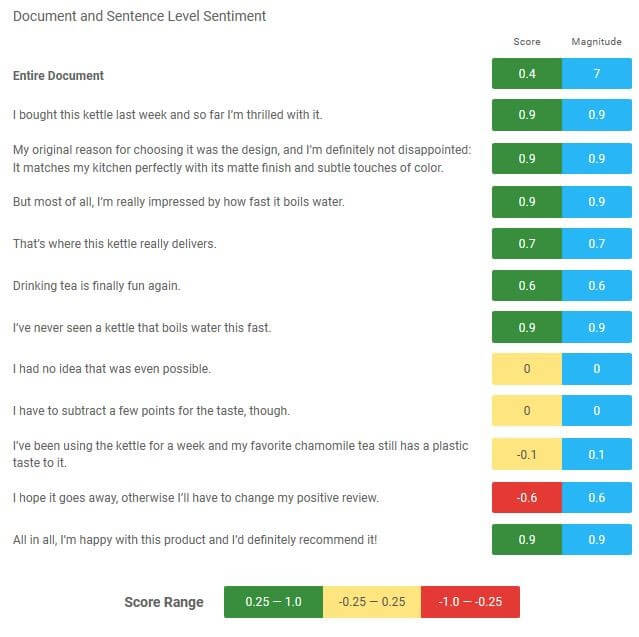
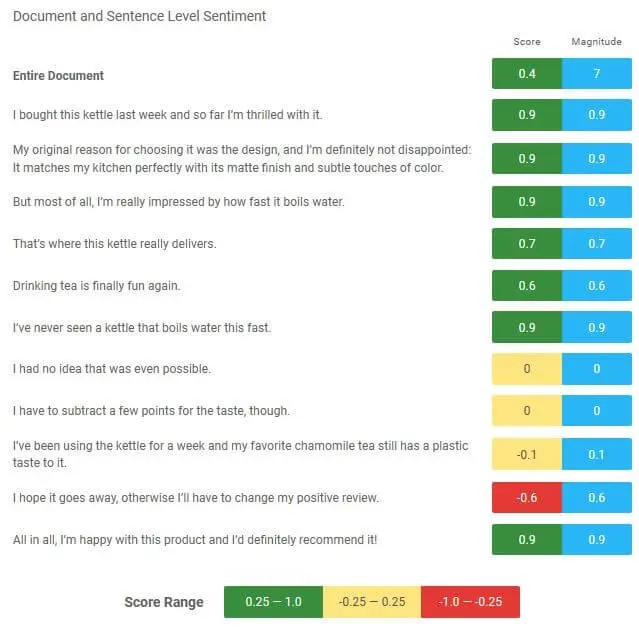
Google’s Natural Language API is a programming interface that, among other things, supports simple sentiment analysis methods and can be integrated into your own programs. Google allows everyone, not just software developers, to test this API. You only need to copy a text into the input field of the Google Natural Language API and you will receive various options for text analysis, including the “Sentiment” selection.
Each sentence is evaluated individually and receives a rating between -1 and +1, with -1 representing “very negative” and +1 representing “optimal.” A cumulative result for the text is derived from the ratings of individual sentences according to a predefined hierarchy of values.
In the example below, we use a fictional review of a kettle to illustrate the limitations of automatic text analysis. The lowest-rated sentence includes the negative phrase “no idea.” Yet, when the entire review is read in context, it becomes clear that the user is actually expressing praise in that part of the text.
Since such expressions and irony in reviews are exceptions, even a simple sentiment analysis can be suitable to at least obtain a general mood picture from large amounts of text.
What tools are available for sentiment analysis?
In addition to the aforementioned Google Natural Language API, there are other professional analysis tools that can evaluate large amounts of text. It is important to ensure that the tool contains word lists and databases developed by native speakers with typical expressions in semantic contexts. Every language, especially when considering colloquial language, has its own nuances that an automatic translator cannot capture without distorting the sentiment of a text.
Hootsuite
The AI-powered sentiment analysis in the Hootsuite dashboard automatically evaluates all major social media channels, news sites, popular blogs, and forums to determine the general sentiment of internet users toward a product brand. The comments used for the analysis can be filtered by various keywords and typical demographics.
In addition to sentiment analysis, the tool includes other features useful for businesses. It offers AI assistance for content creation and suggests the best times for posting. Plans start at $99 per user per month.
IBM Watson Natural Language Understanding
IBM Watson Natural Language Understanding is a powerful AI tool for text analysis that can detect sentiment, emotions, keywords, and topics. It enables detailed content evaluation in multiple languages. The API can be flexibly integrated into existing systems and provides detailed insights into the sentiment and intentions of texts. You can try the IBM tool with the free trial version.
Clickworker
Clickworker takes a different approach. Here, a large network of users works on texts through micro-jobs. This way, you get a sentiment picture through targeted simple questions instead of an automatic text analysis.
The benefit of this approach is clear: Human reviewers can assess the sentiment of a text in full context, rather than relying solely on the connotation of individual words. With three to five Clickworkers evaluating each text and results determined by majority vote, the findings are highly reliable.
- Improve your Google ranking without paying an agency
- Reply to reviews and generate social media posts faster
- No SEO or online marketing skills needed