

How to use Creative Commons

The works of photographers, musicians, and writers are copyrighted, meaning they can’t be freely used or distributed by others. The artists themselves can choose to what extent their work is available to others without users having to ask for permission every time. Through the use of various Creative Commons licenses, media content can be shared for anyone to use. The complicated legal work behind copyrighting can be avoided through these standard licensing agreements.
Different types of Creative Commons license
Creative Commons offers a range of licenses – from some that are very restrictive, to others that are quite relaxed; including one that gives the public full access to use and republish the artwork without any restrictions (known as a CC0 license). There are three basic questions to help an artist decide which license is best suited to their needs:
- Should the creator of the worker be named?
- Is the work available for commercial use?
- Can the work be modified, and if so, should the new work be subject to the same license terms?
The basic principle of Creative Commons
Creative Commons (CC) is a global charitable organization based in the US that offers different license contracts. Artists can define the public usage rights of any individual piece of their work through one of these Creative Commons licenses, choosing the license that reflects the restrictions they want to impose. CC licenses are available for a variety of media types, including images, texts, music, videos, and more. The best-known example for the use of Creative Commons is the photo portal Flickr.
The CC licenses
Following on from the three questions above, there are four basic terms of use. The whole thing works on a modular principle: There are four basic modules available, each concerning obligations and prohibitions, and they can be combined.
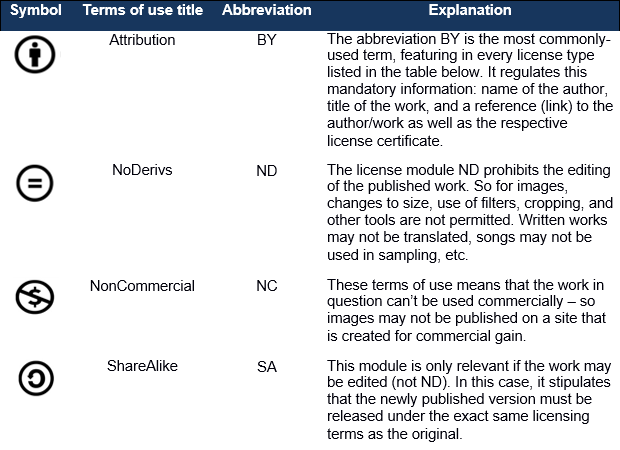
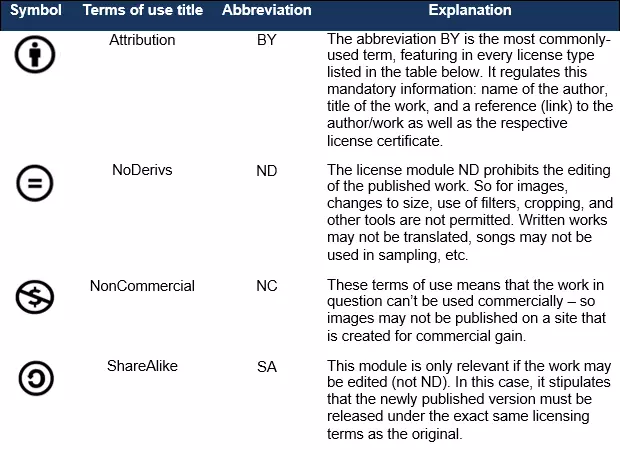
Combinations of license modules
There are six Creative Commons licenses to choose from that use combinations of the different license modules mentioned above:
- CC BY: CC BY grants unrestricted access (for commercial as well as non-commercial purposes)–but users must include a credit for the name of the creator (BY).
- CC BY-SA: This license grants distribution and revision of works for commercial and non-commercial purposes. Along with a credit for the rights holder, a CC BY-SA license stipulates that any new creations stemming from the original are licensed under the same exact terms. This means that a user may choose to edit a CC BY-SA-licensed image and subsequently redistribute it, but this edited image will also be free for others to edit and redistribute under CC BY-SA conditions.
- CC BY-ND: This Creative Commons license allows both commercial and non-commercial redistribution, but the work is not allowed to be edited in any way. The author must also be credited.
- CC BY-NC: Artworks registered under a CC BY-NC license may be edited but only for private purposes. The new images must be credited to the original creator and remain non-commercial.
- CC BY-NC-SA: The Creative Commons license BY-NC-SA permits users to edit works, provided they do so non-commercially, credit the original creator, and license their new work under identical terms to the original.
- CC BY-NC-ND: CC BY-NC-ND has the most restrictions of the Creative Commons licenses. Users may obtain and share work, but they must credit the creator, make no changes, and only use the work for non-commercial purposes.
CC0 license – public domain
The License CC0 is a special case among licenses – it marks a work as public property. The property creator and owner waives every right they have to the work, meaning that it can be used, shared, edited, and republished without restriction – even for commercial purposes. If an author or artist publishes work under a CC0 license, the work is simply released into the public domain. This unrestricted license is usually used for public databases, like image databases Pixabay and Unsplash.
How do I add a CC licensed work to my website correctly?
For website operators looking to include free images or texts on their website, it’s crucial to follow the correct procedure for including licensing information. The mandatory information in all BY licensed photos, for example, is:
- Name of the creator
- Title of the work
- Link to the work or the author
- Reference link to the particular license
Where possible, this information should be placed directly under the work. But a reference in a separate sources or photo credits section is also accepted.
An example of a correctly referenced image:
The following image on Flickr demonstrates a photograph published under a CC license. It has no restrictions on public access for sharing, editing, and even using for commercial gains, under the sole condition that the author and license are referenced publically (license CC BY). This would look as follows:
- Link to the photo (photos tagged on Flickr with Attribution 3.0 Generic (CC BY 3.0))
- Link to the author
- CC-BY 3.0
The code 3.0 explains which license version is in operation. Some languages still operate under the 2.0 version, but versions are compatible with each other.
What are the advantages of Creative Commons?
The Creative Commons concept offers many advantages for bloggers, website operators, or webmasters in their daily work.
- Legal clarity and security: Creative Commons removes the complicated legal matters for users. CC licenses mean complete legal clarity, without the need for complex usage negotiations.
- Control over copyright: if you’re publishing work under Creative Commons licensing, you still retain control of the copyright terms. The artist decides in which context the work may be used, and can ban the work from being used on questionable sites (e.g. pornographic sites).
- Room for adjustment: CC licenses aren’t set in stone. There’s always the option to enter into individual negotiations with artists. For example, if you want to use a work commercially but it’s registered with a BY-NC license, you can contact the artist directly and negotiate your own private terms of use.
- Large diversity of media: thanks to the simplicity of these free CC licenses, the pool of available work is rising steadily. Today, there’s a vast selection of images, songs, texts, and more to choose from.
Risks of using CC licensed works
Despite the many advantages of Creative Commons licenses, there are certain risks attached to using free works published under these terms.
- Violation of image rights: this risk is highest with photographs, because even free images aren’t always free to use – especially when third parties are involved. A photographer only has rights to his work, not the motif in the image. For more on this, refer to our guide to image rights online.
- No liability of licensor: the licensor bears no liability whatsoever when it comes to rights violations. For example, if a user selects a photo of a model but the model holds their image rights, then the user is prosecuted, not the CC licensor.
- Only full licenses: an incomplete or invalid license means no license. So if you’re using Creative Commons images on your site, you should check the licensing meticulously and be sure to use the image correctly to avoid trouble.
- Documentation: works and their corresponding licenses must always be documented precisely. For example, if the artist removes a CC license on their work and claims that they never released the work under one, it’s the user’s responsibility to be able to prove that this isn’t the case.
Conclusion: Even free work should be used conscientiously
Free works–be they music, images, or texts–are an important part of the (online) media landscape. They provide diversity, and thanks to the simplicity of Creative Commons licenses, there’s a large pool of free work available that anyone can use, regardless of finances. But when using CC licenses, you should always be conscientious. The artist has made their work available to use for free, so you should stick to the rules; in other words, comply with the license agreement, include all mandatory information, and protect yourself from the risk of a lawsuit. And even if an artist releases their work into the public domain with a CC0 license, it’s still recommended to show your respect with a name credit and link to their other works.