

AVIF – the license-free image format

File compression is a key technology for digitization, as it can sustainably relieve the resources of network-based infrastructures. The new image format AVIF aims to make data traffic more efficient and replace the widely used JPEG format in the long term. Compared to JPEG, AVIF compresses files more efficiently and provides higher image quality. Major global corporations in the digital industry are interested in the implementation of the new image format.
- Simple registration
- Premium TLDs at great prices
- 24/7 personal consultant included
- Free privacy protection for eligible domains
What is AVIF?
A consortium of leading digital economy players was founded in 2015, tasked with the improvement of image file compression. The Alliance for Open Media (AOMedia), whose members include Amazon, Cisco, Facebook, Google (including YouTube), Mozilla, Microsoft, Netflix, Intel, AMD, Tencent and Apple, focuses on data traffic online. Because images use up over half of the average bandwidth of a website, improved image compression not only benefits the performance of individual websites, but the overall performance of the web is optimized because smaller files accelerate data traffic, reduce energy consumption, and use less storage space.
For the new technology to become established as a standard, it should not incur any licensing fees and should be freely usable as an open source format. In March 2018, AOMedia published the specification of a new free video codec. Since then, a final first version of AOMedia Video 1 (AV1 for short) has been officially launched.
The industrial consortium’s efforts have resulted not only in a license-free, open video codec for moving images, but also in the AV1 Image File Format (AVIF) for still images. AVIF combines the efficient compression algorithms of the AV1 video codec with the container technology of the HEIF format (High Efficiency Image File), that has been used by Apple for some time now. The HEIF container format provides a uniform and standardized basis for the exchange, storage (e.g., specifications for metadata) and transmission of AV1-coded image content.
In that sense, there is some overlap between AVIF and HEIF. The image formats use different compression methods for the coding of image data. Instead of AV1 compression, the HEIF format predominantly uses the HEVC (High Efficiency Video Coding) video format. Occasionally the video compression standard H.264/MPEG-4 AVC is used.
The HEIF container technology used by AVIF is a special version of the basic media file format ISOBMFF. The ISO/IEC Base Media File Format (formally also called ISO/IEC 14496-12) specifies, for example, how metadata is created and stored and how individual images and image sequences are processed (e.g., as nested image information for efficient streaming). The ISO standard provides a general and generally binding structure for multimedia and container files, for example, important prerequisites for the interoperability of an image format (the ability to work with other systems and technologies). ISOBMFF was defined in 2001 by the Moving Picture Experts Group (MPEG).
AVIF combines high quality compression with functional variety that aims to meet the requirements for a contemporary image format. Lossless and lossy compression are both possible. In an alpha channel, as with other image and graphic formats additional information on transparent image areas are stored. Objects released by transparency data are used in user interfaces, collages, or company logos, for example.
In addition, AVIF supports extended color spaces (Wide Color Gamut, WCG) and functions such as graininess, color undersampling, and HDR (High Dynamic Range). HDR technology is the basis for high-contrast images that enable uniform brightness and strong colors and contrasts. AVIF is ideal for HDR, as it can go beyond the usual 8-bit color depth of standard dynamic range images (SDR) (10-bit, 12-bit and higher color depths are possible). Not only HDR information, but also information on the color gamut can be shared via metadata. Animated sequences – similar to GIF animations (Animated GIFs) – are also possible (support of multi-layer images for image elements and image sequences).
Overview of the advantages of AVIF
AVIF offers many advantages. Among its major ones are:
- The AVIF format is supported by big players of the digital economy which drive its continued expansion.
- AV1 and AVIF formats are open source codecs. There are no additional costs for using AOMedia technology. This doesn’t just benefit the big players, but the entire open source community.
- The fact that AVIF is free of charge is a major advantage over the HEIF format, which is currently still a preferred format for Apple.
- The AVIF format meets the requirements of a modern image format by combining high image quality (especially for HDR images with greater color depth than 8 bits) and many functions (similar to HEIF, the format is superior to the JPEG format in this regard).
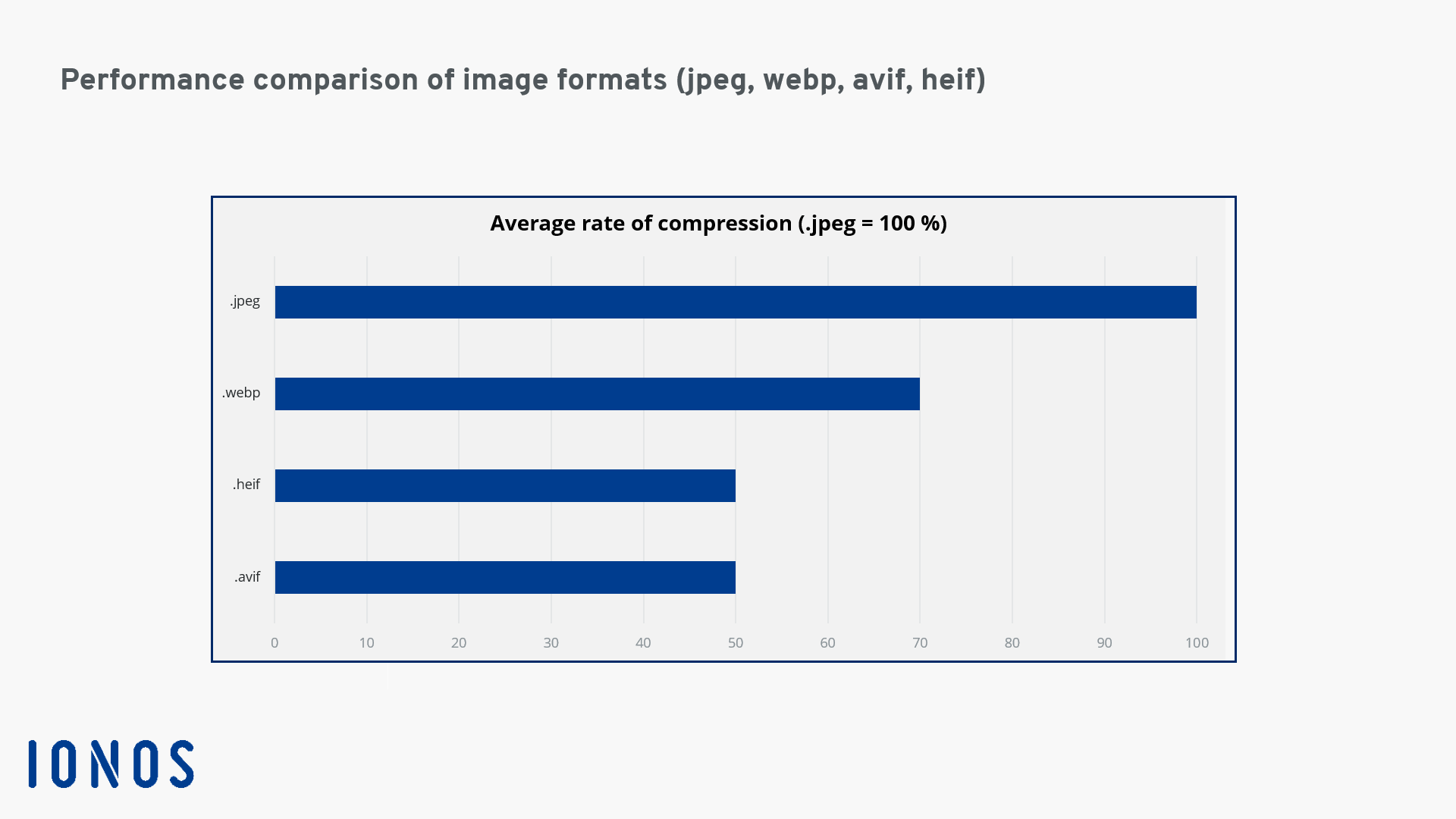
- Compared to the established JPEG format, AVIF currently reduces the image size by an average 50 percent (similar to the comparably efficient HEIF format). In addition, AVIF is more efficient than its competitor WebP, which has failed to establish itself.
- Highly efficient AVIF compression reduces the load times of websites, conserves network bandwidth, and reduces data streams for video-on-demand, cloud, and web space providers.
- Many AVIF advantages extend beyond its online use. Image archives, photographers, printers, etc. can also benefit from the format’s development to receive higher resolution images that relieve available resources.
Current support for AVIF
Compared to the popular JPEG format, which has been around since the early 1990s, AVIF is a relatively new file format for static images. The newcomer has yet to prove itself in practical tests. It is therefore difficult to reliably predict the future of the image format. However, due to its many advantages, the chances of a nationwide implementation are high.
Since the image format and video codec are still in development, further optimizations are likely, for example, in terms of playback quality and the reduction of file sizes. Presumably, the demands on the hardware will be reduced through code optimizations. AVIF is just as demanding as HEIF in terms of encoding (transfer or conversion of an output file into AVIF format using an algorithm) and decoding (decoding of encoded file information, e.g., for operational image processing or image display on the screen).
The video-on-demand provider Netflix is an important pioneer in the application of the new technology. The streaming specialist is currently testing the AVIF format in order, for example, to convert the platform’s user interface from SDR to HDR (e.g., to improve previews). A gradual introduction of the format is planned, whereby it is used for a continuously increasing number of content and platforms.
Browsers and operating systems are also getting used to the new technology. Opera (as of version 71) and Google Chrome (as of version 85) already support the format natively; Apple Safari does not yet support it. With Mozilla Firefox (as of version 77), manual configuration is necessary. Once you set the flag image.AVIF.enabled in about:config (in the address bar of the browser) to true, Firefox can display individual AVIF files. Microsoft Edge continues to struggle with the new image format. Because the current version (version 86) uses the Chromium engine by Google, AVIF support for the Windows 10 browser may only be a matter of time.
Windows 10 users can already work with the new image format and convert AVIF files in its Paint program. The corresponding free AV1 Video Extension is available for installation from the Microsoft store. The paid Paint.NET app has already integrated an AVIF file type plug-in. Windows users can open AVIF files and even save image files in the format (e.g., for the website). The free image processing software GIMP supports the AVIF format as of version 2.10.22.
You can already integrate AVIF images into your website today. A temporary solution that integrates AVIF into websites as an alternative to the standard JPEG requires only a bit of HTML code. The HTML tag <picture> is used to this end. It serves as a container that holds several image sources (<sources>) for one image (<img>). If the browser does not support images in WebP or AVIF format, the lowest image element is read out as a so-called fallback option. You can then specify a JPEG version of the image, which is supported by all common browsers:
<picture></picture>
	<source srcset="img/mypicture.AVIF" type="image/AVIF">
	<source srcset="img/mypicture.webp" type="image/webp">
<img src="img/mypicture.jpg" alt="Description of picture">- Store, share, and edit data easily
- Backed up and highly secure
- Sync with all devices
Summary – a promising successor of JPEG
AVIF has all the prerequisites to establish itself successfully and define a new image standard online to replace JPEG. Once the remaining technical hurdles are resolved (e.g., slow and resource-guzzling coding processes), the multifunctional image format and the AV1 video codec offer high quality. Finally, this is also an important step towards sustainability, as AVIF conserves energy, and network and storage resources.