

Blue Ocean – more success with the right strategy

As an entrepreneur, it is very important for you to make your company more profitable in the long term. To achieve this, you sometimes have to go into unknown waters - the so-called blue oceans. Instead of getting entangled in an eternal competitive struggle in which each market participant can only achieve small successes, larger profits could be waiting for you in a completely new market. With the Blue Ocean Strategy and innovative, new products, you will make higher profits - if you correctly attack the market.
Blue Ocean Strategy – what is it?
The term Blue Ocean Strategy was coined in 2005 by the two economists W. Chan Kim and Renée Mauborgne. In their book “Blue Ocean Strategy: How to Create Uncontested Market Space and Make the Competition Irrelevant” they distinguish “blue oceans” from “red oceans”. The latter refer to highly competitive markets that are - figuratively speaking - blood-red in color due to predators attacking. The blue oceans, on the other hand, are untouched and completely free of competitors.
The idea behind the Blue Ocean Strategy: Successful companies do not orient themselves to the competition, but go their own way.
In order to open up a market that no one else is working on, you have to create a completely new one. For this you need one thing above all else: innovations. A new market can only be created with completely new products that consumers do not yet know. Anyone who takes this step can achieve undreamt-of benefits:
- no competition
- new target group
- new demand
- no price war
- new cost structures
In a red ocean, you define yourself primarily through the price and can therefore gain market share from other participants, but this pressure does not exist in a blue ocean. If a company manages to develop a blue ocean, it can completely escape from the competition and make the highest profits.
Of course, you won’t be alone in the market forever. Imitators find each other relatively quickly and attack the new market. The competition will try to take your shares. In a study conducted by Mauborgne and Kim in the run-up to their book, however, they found that companies with a Blue Ocean Strategy were able to maintain their dominance in the new market for an average of 10 to 15 years.
How does the strategy work?
Innovation must be the beginning of your efforts: You cannot enter a new market without a new product. However, the new product does not necessarily have to be related to a new technology, which is certainly the first and most obvious thought. In fact - as you can see from the successful examples - it is also possible to place existing technologies in a new context and therefore create an innovation. Above all, an approach to creating innovations has proven to be promising: Change an existing product so much that it appeals to people who were previously not interested in the original product.
So that the Blue Ocean Strategy is successful, it is therefore advisable to analyze the wishes of the target group: What do consumers expect from a new product? The findings can be presented in a so-called value curve. Here you arrange different characteristics of a product on one axis and symbolize the importance or the degree of development on the other axis. Now you can enter the consumer data within the coordinate system. In addition, you also analyze the offerings of competitors within the industry. In this way you can present the changes required in comparison to the existing products in order to develop an innovation in line with the Blue Ocean Strategy.


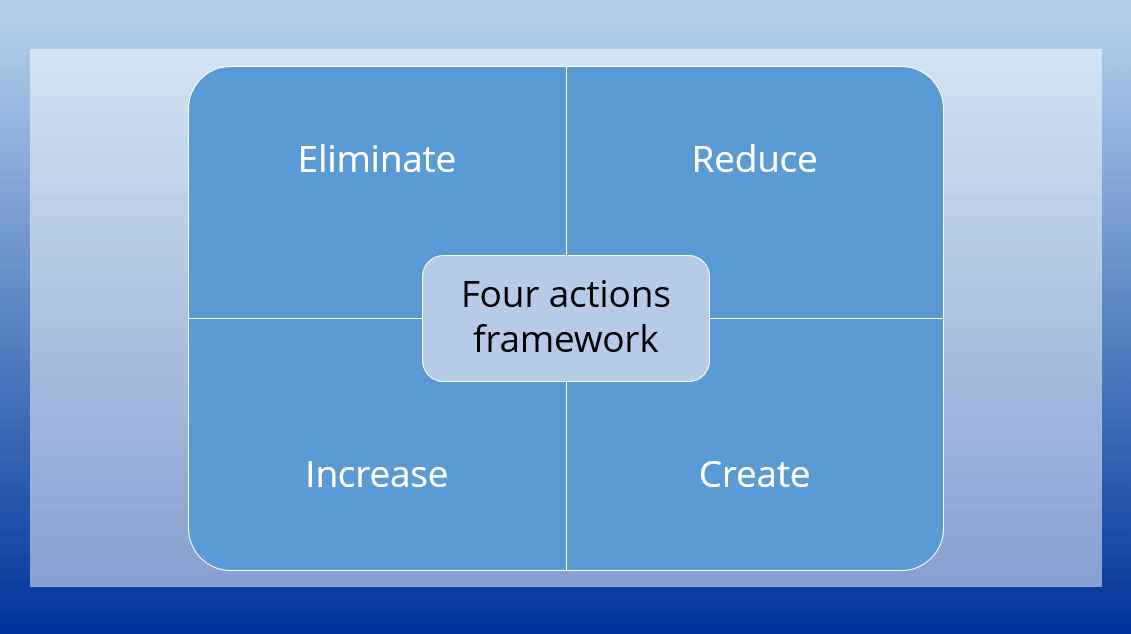
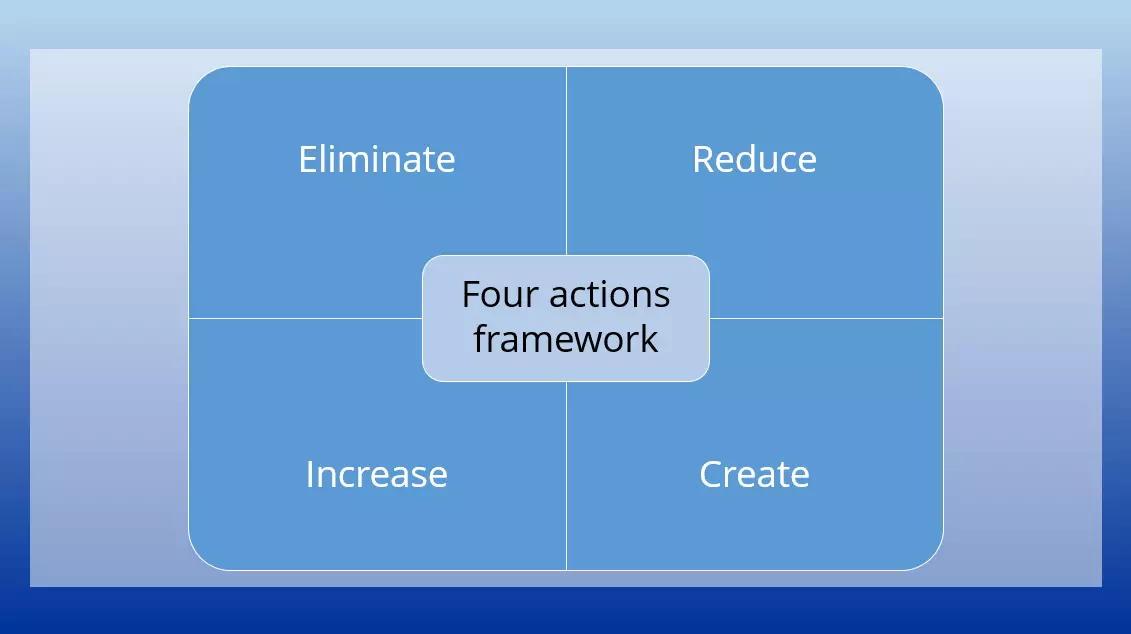
It is now a matter of implementing the findings. The four actions framework is used. The method provides four levers with which you can adjust the product to develop a successful innovation and create a new market:
- Eliminate: Remove factors that customers find annoying.
- Reduce: Reduce features that aren’t important to the target group in order not to overburden the customer base.
- Increase: Increase the most important characteristics beyond the industry standard.
- Create: Develop new factors that are not yet known in the industry to create a new product.
Now you have created a new product for a completely new market (a blue ocean). You don’t have to worry about competition at least at the beginning, and since you invented the market, you will also dominate it in the coming years.
So the Blue Ocean Strategy does not seem to be the right thing for your company? There are other methods that can boost growth: Both the Ansoff Matrix and BCG Matrix have already helped a wide variety of companies to become more successful.
Red Ocean Strategy: what does the other side look like?
The traditional way to be successful as a company is to enter an existing market. There, companies fight for a more or less limited circle of consumers through cost and price reduction as well as marketing efforts. In doing so, you always take a look at the competition: at what price are the other market participants offering their products? What differentiating features can be identified?
The traditional way to be successful as a company is to enter an existing market. There, companies fight for a more or less limited circle of consumers through cost and price reduction as well as marketing efforts. In doing so, you always take a look at the competition: at what price are the other market participants offering their products? What differentiating features can be identified?
Three example of a successful Blue Ocean Strategy
Countless companies have created innovations and therefore a new market in the past. Especially in the first years after industrialization, this had to do with the fact that ground-breaking inventions created completely new industries - such as the automotive industry. In recent decades, however, many industries have become stuck in red oceans. Particularly interesting are therefore the cases in which a blue ocean could be claimed within their branch of industry.
Yellow Tail Wine
A red ocean has stabilized in the wine producer sector: Beginners therefore find it difficult to claim significant shares. That’s why Australian producer Casella Wines has changed course with its Yellow Tail product. Instead of entering into a protracted battle with the established competition, a target group was developed consisting of people that hadn’t previously been wine drinkers. Beer and cocktail drinkers were asked what they didn’t like about the existing wine range. The bitter or sweet taste, the unclear and too complex range as well as the snobbish image attached to the wine were criticized.
Equipped with this knowledge, the wine producer used the four actions framework. The complicated wine terminology was removed from the bottle and the vintage wine was even ignored. Also the maturing process and storing it in barrels for a long time, was eliminated. The simple and modern design of the label made it possible to reduce many factors that the target group found annoying, such as the snobbish image. In addition, the range was reduced to two wines: one red and one white.
Instead, Casella Wines increased the simplicity of taste. Neither too sweet nor too heavy, the Yellow Tail wine appeals to people who don’t actually like the taste of wine. After all, the company has created a wine that is perceived as simple and playful. Through these adjustments, Yellow Tail was able to create a blue ocean: former non-consumers all over the world have bought the product.
Nintendo Wii
At the beginning of the 2000s, the very lucrative market for game consoles was divided mainly between the two providers: Sony (with Playstation) and Microsoft (with Xbox). The manufacturer Sega, which was still successful in the 1990s, had meanwhile withdrawn from the business, and Nintendo, once the most popular supplier of game systems with Gameboy and (Super) Nintendo Entertainment System, was losing more and more market shares. The two major suppliers defined themselves primarily through the performance of their consoles and were involved in a red ocean battle for the best graphics and computing performance. Nintendo decided to try something new with the Wii and appeal to consumers who were not really into video games.
The development of motion sensors enabled Nintendo to establish an innovative control concept. Instead of interacting with the usual controllers consisting of buttons, pads and joysticks, players hold a control device in their hands that resembles a remote control. By simply moving the controller, you can move the figures on the screen: the entry level is therefore very low for people who have not previously used game consoles. In addition, the Wii forgoes many of the features that define the competition, so the cost of the device has been kept low.
This Nintendo game should also appeal to players who only want to use the technological toy occasionally and preferably together with friends or family. Learning curves are flat, the look playful and no lengthy gaming sessions are necessary: Party games attract both younger and older people to the game console, meaning that the Wii has created a blue ocean.
Cirque du Soleil
The Canadian entertainment company Cirque du Soleil was founded back in the 1980s, and found a way out of the sinking red ocean of the circus industry. The numerous market participants fought for an ever-smaller customer group. Certain features, which had been the hallmarks of a successful circus decades earlier, were no longer up to date, and more and more spectators were stopping visiting the classic circus tents. Above all, animal cruelty deterred visitors. Cirque du Soleil therefore removed animal attractions from its portfolio. Instead, the range was extended to include highlights from other entertainment areas - above all dance and live music.
At the same time, a concept that was particularly appealing to families was abandoned and admission prices increased. In addition, the programme is changed regularly to encourage people to repeat their visit. Since Cirque du Soleil does not only perform in one place at a time, but also has several events worldwide with mirrored programmes, costs can be reduced and profitability increased. Cirque du Soleil used the Blue Ocean Strategy - before it was even established - to develop a concept that avoided the doomed battle in a red ocean and achieved huge success in a blue ocean.
Click here for important legal disclaimers.
Reviewers

Anne-Laure Wolber
Anne-Laure has been part of the IONOS Digital Guide since its inception in 2016. As an expert in the startup category, she focuses primarily on the strategic integration of SEO, GEO, and conversion rate optimization. Over the years, she has also gained extensive experience in related performance disciplines such as lead generation and native advertising. As a polyglot, she leverages her multilingual background to develop content strategies with precision and impact for international audiences.

Christian Heldmaier
Christian Heldmaier is an experienced online marketing and SEO specialist from Karlsruhe. He has been working as an SEO Manager at IONOS since July 2020.