

Setting up a general partnership: The path to a partnership-based business

Do you want to start a business with several partners? Then perhaps the general partnership is the right choice for you. In this type of partnership, each partner can participate independently in the day-to-day business (unless the partnership agreement or articles of association states otherwise). It is the simplest form of company after a sole proprietorship. Continue reading to find out how to set up a general partnership.
Prerequisites: Who can start a general partnership?
The general partnership as a legal form describes a commercial enterprise run by several personally liable partners. Depending on the size of your business, you may be required to prepare additional financial statements. Partners do not necessarily have to be natural persons, they can also be legal entities (e.g. another company). In this (uncommon) case, the legal form may be required to change or the business may be required to include the legal entities’ names in their own business name.
When it comes to the structure of the general partnership, there are no restrictions as to who can become a partner in the business. There is also no legal minimum amount of share capital required to become a general partner.
However, there is one very important prerequisite for general partners if you want the business to be successful: a sense of mutual trust. After all, each partner involved is liable, not just for themselves, but also for all the other partners involved in the business. The risk of internal conflicts should therefore not be taken lightly.
General partnerships are commonly used in the USA, predominantly among small and medium-sized companies.
How do you start a general partnership?
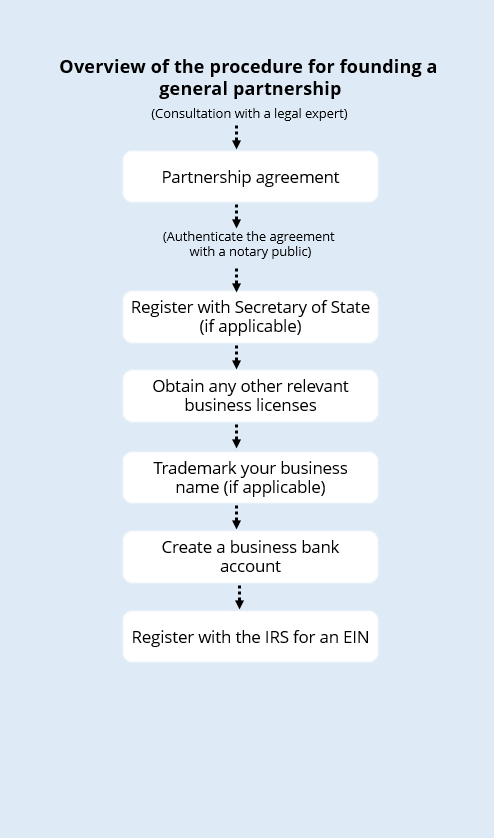
The formation process of a general partnership can be broken down into four steps.
The articles of association
Every general partnership needs a statute in the form of binding articles of association. In contrast to many other legal documents, the structure and format of the articles of association is not subject to any legal regulations. However, it should at least be set down in writing (whether a verbal contract is legally binding is disputable). In order to prevent disputes within the company, it is advisable to specify a number of points. These include:
- Company name (freely selectable as far as possible, with the addition of general partnership at the end)
- A registered office
- Business purpose (should be compatible with the characteristics of a commercial enterprise)
- Names and addresses of the partners
- Deposits (amount and terms of payment are freely selectable)
- Type of management (individual or overall management)
- Distribution of profits and losses among partners
- Resolutions on the termination and continuation of the company in the event of a partner quitting or dying (e.g. to prevent succession problems if the capital share of a deceased partner is transferred to the other participants)
A general partnership will require notarization if real estate (land, buildings) is brought as initial capital into the partnership as a contribution in kind by one of the partners. However, you should not shy away from consulting a legal advisor in the event of ambiguities, who will advise you when drawing up the articles of association. As soon as the contract has been signed, your general partnership will initially be regarded as a partnership under civil law. Outwardly, the company becomes effective as a general partnership as soon as it begins trading, and has been registered with the local Secretary of State.
Sample contracts for a general partnership can be found free of charge online to download, such as from Law Depot.
Registering with the Secretary of State
General partnerships must register with their local Secretary of State before they can begin trading. In some states, this registration procedure is not formally required, but general partnerships will probably still be required to obtain the necessary business licenses and fictitious name certificates. The vast majority of businesses will have to connect with their Secretary of State on some issue or another when setting up their general partnership.
For example, registering your general partnership with the Secretary of State in the state of California is a straightforward process, although not obligatory. Should you choose to register, simply fill out a Statement of Partnership Authority form. This form has a filing fee of $70.
In the state of Vermont on the other hand, general partnerships are required to register with the Secretary of State and must renew that registration every five years. Registration can be done online here or through the mail using this form. The filing fee is $125.00.
Regardless of what state your business is in, the necessary forms will ask for the following information:
- Name and address of each partner
- Company name and registered office address
- Contact information for the business’s registered agent
Once you have received the relevant certifications and confirmation of fee payments, your general partnership is legally open and ready for business. Remember: from now on, every document of business correspondence you produce must contain your company name, the legal form “General partnership,” and the location of the registered office. You are also responsible for notifying any changes like the withdrawal of partners or a new official office address immediately with the Secretary of State.
Registering for state trade licenses
Depending on what kind of business you are operating, you may be required to register for a trade license. Different states have different business registration and licensing agreements. You can find out more information about what kind of requirements your state has by visiting the Small Business Association’s website.
Further steps
In addition to opening a business bank account, into which you can also pay cash deposits, you now have the typical administration procedures involved in setting up a business. As previously mentioned, you will need to register with the Internal Revenue Service (IRS). Once you have registered, you will receive your Employee Identification Number (EIN) through the mail. You will also be registered for the appropriate business taxes.
General partnership start-up costs
One of the most attractive aspects of choosing a general partnership as your business structure are the low costs associated with it. There are no minimum capital contributions required of partners, and a formal partnership agreement is usually unnecessary, so there aren’t the usual legal fees associated with company formation.
However, it is worthwhile to have a partnership agreement formally drawn up by a legal professional, just to ensure that the interests of all partners are protected. While it might be an inconvenient up-front cost, the legal fee required to create a partnership agreement is a one-off fee and may end up saving partners a tremendous amount of money later on if business disputes arise. Depending on the length and depth of the agreement, as well as the area costs and individual lawyer rates, general fees for a partnership agreement draft will set you back between $500-$2,000.
On top of this, there may be additional fees for filing with your Secretary of State, and for obtaining business and trading licenses, but these will vary depending on your state’s fees and requirements.
Duties once the general partnership has set up
Once the company has been founded, there are certain obligations that both the business and the partners must meet. The law provides information on this, but this information only applies to the extent that the partnership agreement does not stipulate otherwise.
Accordingly, each partner is entitled and obliged to manage and represent the company individually. This applies, however, only to the usual day-to-day business (i.e. the purchase of goods, sales, talks, etc.) and is not binding. Transactions beyond this will require the consent of all parties involved. If a partner exceeds their stipulated duties when conducting business, is it still legally effective. However, the other partners may then be entitled to financial compensation.
All partners must share the profits and losses of the business equally, unless stated otherwise in the articles of association.
Profits of a general partnership are not liable for direct income or corporation tax. Instead, it is a “flow-through” entity, which means that each partner must pay income tax on their share of the profits. However, your company may still be required to pay state sales tax and/or payroll fees for any additional staff they may employ.
To what extent are the partners in a general partnership liable?
As mentioned previously, the partners of a general partnership are liable with their entire assets for any financial obligations the general partnership has, namely:
- Primarily and directly
- Unrestrictedly
- Jointly
This cannot be mitigated by agreements with third parties. Due to the primary, direct liability, a general partnership creditor may even address their claim against the general partnership partners without first having to claim against the company. Joint and shared liability means that each partner is jointly liable for their colleagues. If a partner cannot settle an invoice, the debt is distributed among their partners. However, these partners can then demand compensation in return. This full liability extends after a partner has left a general partnership, or the general partnership has been dissolved (unless otherwise stated in the partnership agreement).
Click here for important legal disclaimers.
Do you want to start a company but don't know what to name it? Get inspiration from the free IONOS Business Name Generator and find ideas for your concept in just a few clicks.