

The Kano Model: Customer Satisfaction Guaranteed

In every company, customer satisfaction is a high priority. However, there is rarely clear guidance on how to please customers. Don’t worry though, there are tools that help companies set up and implement a higher customer satisfaction system. For example, the Kano analysis tool. It can be used for small or large companies and applied in all industry operations. This system from Japan has particularly proven itself in web development.
What is the Kano model?
Developed in 1978 and named after its inventor Noriaki Kano, the Kano model helps companies increase customer satisfaction. In order to achieve this, the Japanese scientist analyzed customer requests and found that customers have different types of requirements for a product or service. He found 5 different types of customer requirements in his research. What they all have in common is that the customer always compares a target state with an actual state. If the idea moves too far away from the actual situation, dissatisfaction arises.
The Kano method is very similar to Frederick Herzberg’s Two-Factor Theory. You can compare the threshold features of Kano with the hygiene factors of Herzberg, and the performance and excitement features correspond to the motivation factors.
Dividing into different features also explains one of the fundamental ideas of the Kano model: Absence of dissatisfaction does not automatically lead to customer satisfaction. Whether a correlation occurs depends on what kind of feature is being discussed. Which means: just because a particular feature of a product is particularly well-defined, does it also lead to a particularly high level of customer satisfaction?
When you understand this distinction and can judge your product in terms of the five feature types, the Kano model directly assists in optimizing customer satisfaction. This is because companies can use this method to quickly identify the right adjustments to make. At the same time, the division into different categories helps to gain competitive advantages: if you establish new functions in the right feature category, you can often outperform the competition.
How the Kano model works – with an example
The Kano model distinguishes five different requirement types. The fulfillment of customer requirements provides varying degrees of increase in customer satisfaction from area to area. To illustrate how the model works, we will use the example of developing an online store.
Threshold (basic) features
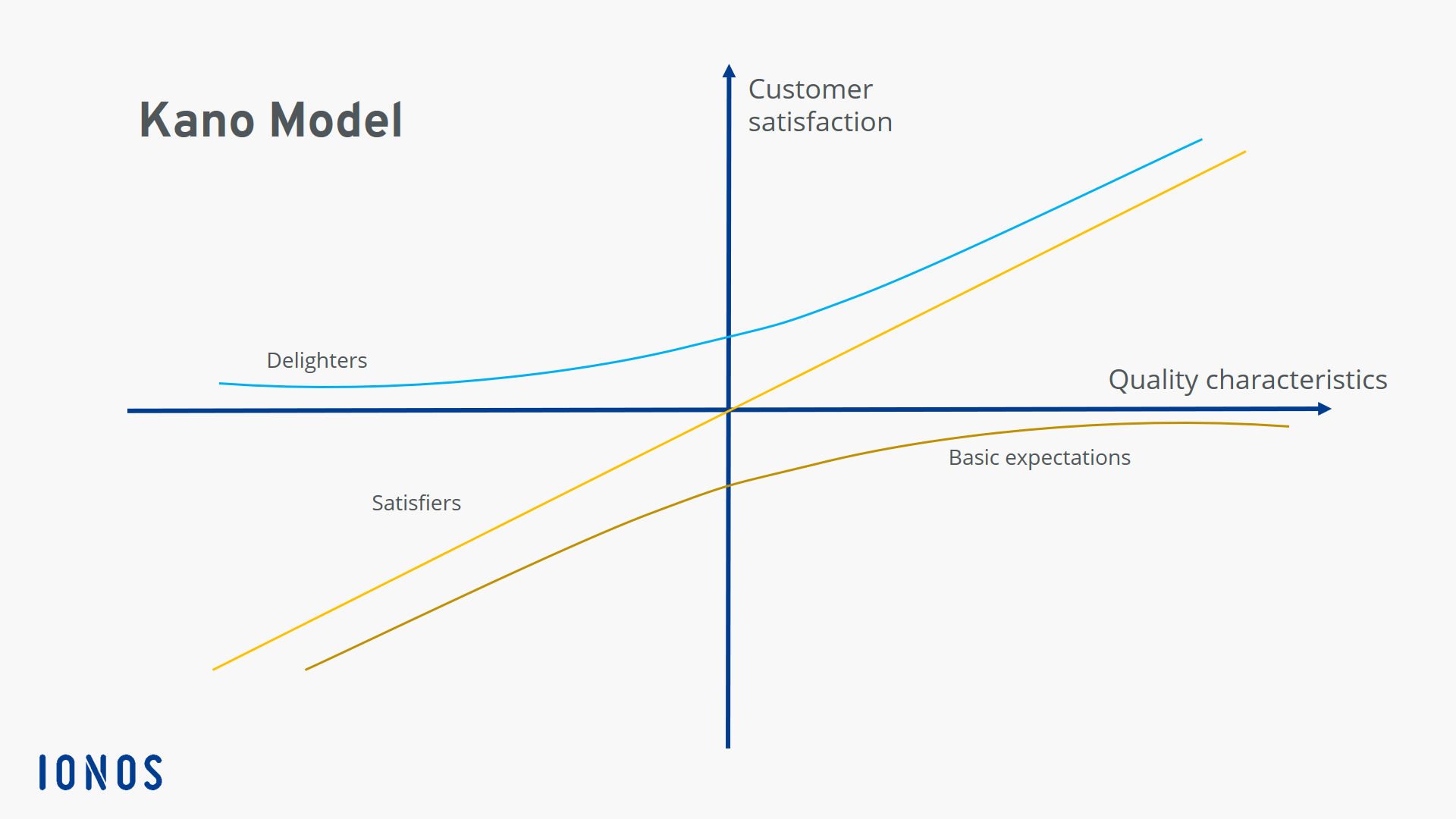
Threshold features are practically self-explanatory functions. Every customer choosing a product assumes that these kinds of functions are there. This means the mere existence of the features is barely noticeable to the customer, but their absence will lead to strong dissatisfaction. For companies, this means that satisfying these requirements does not provide greater customer satisfaction. However, if the requirements are not met, customers are very dissatisfied.
An example of this: The fact that the user can access the online store in their browser does not lead to particular satisfaction. They take this for granted. However, if the site does not load because, for example, the server has gone down, they immediately notice this feature and it causes immediate dissatisfaction.
Performance features
The customer consciously notices functions classified as performance features. They have a certain idea of what features or characteristics a product or service should offer. The absence of functions also leads to dissatisfaction in this area. In contrast to threshold feature requirements, you can also earn plus points in this category. This is because, if you meet the requirements unexpectedly well, customer satisfaction increases.
To go back to our example, each online store offers its own payment system. If you offer the user several options to pay for their purchase, they will be pleased. But if, for example, you only offer one option, it’s not necessarily bad. However, if this option fails then the customer will leave having had a dissatisfying experience.
Excitement features
The excitement category includes features that customers do not expect. They don’t even know that these features are a possibility, and their absence doesn’t necessarily lead to dissatisfaction. However, if you surprise customers with a special, innovative feature, satisfaction increases. If you introduce unexpected product features, you can also gain a competitive advantage. The difficulty, however, is discovering these functions. Because, just like for the customers, impressive features aren’t self-evident for product developers—they require special effort in the product or service design.
Adding automated delivery via drone to our sample online store could be seen as an exciting feature. The customers do not expect this kind of service and this secures an advantage over the competition.
Insignificant features
Not every feature of a product or service is relevant to customer satisfaction. Often, a feature is not irrelevant for the customer per se, but the presence or absence of the feature has no or very little impact on satisfaction or dissatisfaction.
For example, you could address registered customers personally in your online store. This feature certainly has benefits, but it doesn’t really increase customer satisfaction. Users do not expect this feature, so they are not dissatisfied if it does not exist, but don’t usually acknowledge the personal salutation with excitement.
Reverse features
Conversely to the threshold features that are first noticed when they are missing, the reverse features only have an effect when they occur—and often, a negative one at that. So, their absence is considered the normal status. In most cases, these are faults or conditions that the manufacturer did not intend. But even functions that help the company, but also burden the customer, are considered to be reverse features.
If we think of our online store in the example, then a possible reverse feature would be, for example, a registration option for spam emails when buying an item. The customer doesn’t expect to receive annoying emails as a result of the registration process, and as soon as the first of these emails arrives, they will definitely be dissatisfied.
Evaluation of feature types
In order to sustainably improve customer satisfaction using the Kano model, the features of a product or service must first be allocated to the correct categories. Once this is done, you can see what areas it makes sense to further invest in. For example, trying to improve threshold features does not increase customer satisfaction.
The graph below illustrates the Kano model and shows how improvements in the various types affect customer satisfaction. Only the first three categories are represented in the graph, as these are the most important for corporate decisions.
Some functions can’t always be clearly assigned to just one feature category, or their status may change over time. Through familiarization, for example, features that were initially considered to be excitement features eventually become performance features and, after a few years, are considered satisfiers. What impressed customers when introduced will increasingly be perceived as standard throughout the process (especially when other market participants are also picking up on the innovation), and develops to become the norm.
The Kano model is a good way to better and more effectively channel investment into products and projects. Further tools help to plan product development even better, such as the House of Quality.