

What is brainstorming and how does it work?

Brainstorming is a very common group method for finding new ideas, which is based on spontaneity and unfiltered creativity. Training the human brain to trigger a “storm of ideas” and to subsequently put those ideas on paper is the fundamental concept of brainstorming, which was formulated by the American author Alex F. Osborn in 1939 and further developed by management theoretician Charles Hutchison Clark. All brainstorming methods aim to collect raw ideas in a quick fashion, whereby participants are asked to simply express their ideas out loud.
Brainstorming is a method of finding new, raw ideas by group members, which are firstly collected without any prejudice or any special order and then assessed and evaluated one by one.
As a discipline, brainstorming encompasses various different forms, stages, aspects, and dynamics. As soon as you learn more about brainstorming techniques and their respective advantages and disadvantages, your next brainstorming sessions will begin to have bigger and better effects. What makes the concept of brainstorming so appealing is that it does not entail any complicated rules. However, not all brainstorming sessions automatically end with all members collaborating successfully. Read on to find out what rules and aspects are connected to a good brainstorm, what techniques pay off, and how you can prepare yourself to carry out brainstorming sessions in the best possible way.
The 4 main rules of any brainstorm
- Quantity over quality: Brainstorming is all about collecting large amounts of ideas. One of the collected ideas should be then deemed as the most appropriate for whatever project or any other group-oriented endeavor that the brainstorming members are pursuing. The constant flow of ideas is therefore key to this concept, even if most of the ideas are either nonsensical or simply weak, as they can be later contrasted with good ideas and eliminated from the process. Team members must therefore rest assured that each one of their small contributions is recorded.
- No criticism, arguing, or negative comments during the sessions: To make sure that the flow of ideas is not disturbed, does not break down in any way, or that it simply does not come to a halt, the above rule must also be put into practice. In other words, contributions should only contain new ideas. Any other content should be pointed out in the subsequent evaluation of ideas.
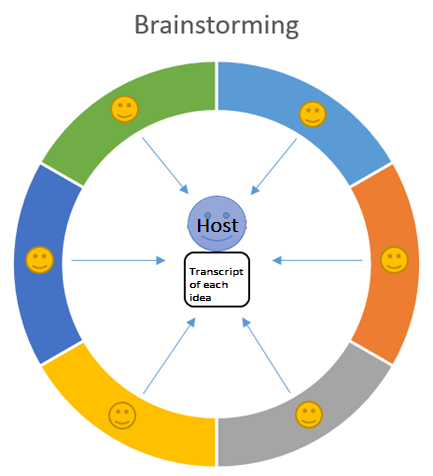
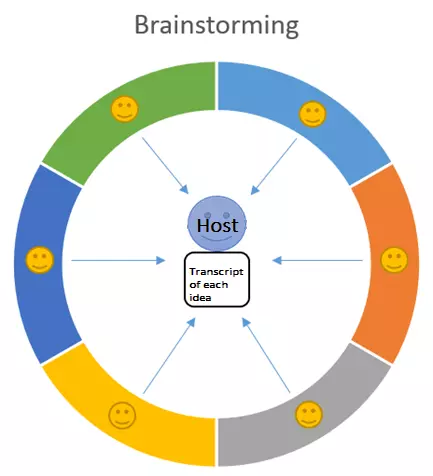
- Complete log of all ideas: It is only upon recording all ideas that one can guarantee an unfiltered brainstorming session, which can then move onto its next phase – namely evaluating the collected ideas. What is important here is to determine who is going to be the host of the brainstorm, i.e. the recorder of ideas. This person should hold back from any contributions during the sessions. If ideas are disregarded and not written down, participants might often feel demotivated.
- Think outside the box and inspire each other: Though the so-called “storm of ideas” usually constitutes a collection of conceptually unconnected ideas, nothing should stand in the way of taking up a thought that has already been mentioned, as it can be developed into a completely new idea. Brainstorming usually entails its own form of group dynamics, which leads to ideas being pushed to one specific conceptual sphere or condensed to a single strand of ideas during one brainstorm session. Participants should neither shy away from developing ideas, nor from mentioning ideas which lead to a completely new conceptual direction. Both the former and the latter intensify brainstorming as a group technique and often result in positive outcomes.
Step-by-step guide: how to carry out brainstorming sessions
Brainstorming is characterized by its minimalist planning process as well as minimalist mid-session procedures. Having said that, you, as the host of the discussion, may contribute favorably to the end result of the sessions by implementing several measures. For every good brainstorm, there is always a good host (who is less active than the participants of the discussion but by no means less prepared).
Preparing for a brainstorm
Each brainstorming session will vary from group to group and you, as the host, must plan each session separately. If needed, answer the following questions with the help of your co-workers:
- How many participants will there be in the brainstorm? Although there is no optimal number of participants set for brainstorming sessions, including too many people poses a risk to the flow of ideas, as people might feel intimidated by crowds. On the other hand, a group which is too small bears fruit to very few ideas. Finding the right balance is crucial. It is therefore worth analyzing the right size of the group for your projects in your work setting.
- How are the participants chosen? Has personality, sex, work position, nationality, native language, or area of expertise been the decisive factor when selecting participants? Since brainstorming is at its best when each participant actively takes part in the discussion, you should consider finding the right balance here as well. Some may express themselves more openly and be more dominant than those who shy away from any form of action. Weighing out members according to personality and sex therefore limits unwanted interfering patterns. The same applies to various work positions. If you build a team of five people, four of which are full-time employees and one being an intern, it is highly likely that the latter will take little part in the brainstorm. You should therefore arrange participants in such a way that they do not inhibit each other.
In a multinational setting, it is important to consider the various language barriers if you plan on doing an international brainstorming session. Generally speaking, English is the first choice. However, it is also worth noting that allowing each participant to express their ideas in their mother tongue will get the most out of them. Translation of the ideas can then be done during the evaluation phase.
Lastly, you should not forget that people brainstorm better when they are already considered experts in the field under investigation. However, experts can also quickly take full control over the brainstorming session and leave the unexperienced out of the picture. On the other hand, people who are not considered specialists can also come up with fresh, innovative ideas, which is the desired result of any brainstorm.
- Who is the opinion leader? In many groups, it is rather easy to identify dominant opinion leaders of whom an active participation during each brainstorming session is generally expected. Though people with a motivating personality are always needed, too many contributions coming from one person can either act as a demotivating factor for other participants or can be seen as seizing the chance of the less open people to have any say in the matter. If you have identified such a person, a one-on-one conversation in which you highlight the problem should take place before the session. Naturally, you also avail of the chance to cleverly get others more involved during the brainstorm. The more you know about the group and its opinion leader, the easier it is to carry out the above steps.
Think about an appropriate introduction, in which you present the problem in a short and precise way without going too much into detail. Otherwise, you subconsciously risk having too much influence on the upcoming ideas of your participants. To make sure that each participant is aware of the various brainstorming methods, take time to explain the general conditions (time limit, ways of participation etc.) and the rules (quantity over quality, no criticism policy, letting everyone express themselves etc.). Most importantly, however, the actual question of the brainstorming session should be answered as creatively as possible. You should therefore ideally pre-formulate your introduction. Here are some examples of “brainstorming cheat sheets”:
Task: “A new slogan for our drink”
Rules:
- Put out new ideas or refine already existing ones – no need to raise your hand before you speak out loud
- Criticisms and thematically irrelevant comments are not allowed
- Keep contributions short, each should preferably consist of slogans ONLY
- ALL slogans will be written down on the whiteboard by the host
- Time limit: 30 minutes
- Final evaluation of ideas and open discussion (approx. 1 hour), only one slogan can win
Tips for the host of brainstorming sessions
In each session, the constant flow of ideas is the decisive factor. Ideally, brainstorming should be all about collecting as many ideas as possible and refining the ones that look most promising. For this to happen, contributions must come out in quick successions, in various forms, and on top of that, from as many participants as possible.
It is often the case that brainstorming sessions either generate their own, uncontrolled dynamism or come to a quick halt. Even though the main objective of each brainstorm is to simply collect ideas, various groups also tend to get caught up in a certain idea and, rather than moving on, decide to continue tinkering with it. Sometimes, groups come to a complete standstill, which can be the result of many factors. It is then up to the host to set the session on the right path once again and to drive the participants forward with their ideas. Below are some tips on how to control brainstorming sessions:
- Address those who have not managed to make any contribution. Sometimes, all it takes is to say their name out loud. If anything, it could be that this person has not yet dared to share their idea. If, however, the person has no idea whatsoever, you must not put them under pressure. Remember that people who have not come up with anything should not feel at fault.
- Refer to any nicely formulated ideas and ask around if participants would modify them in any way.
- When an appropriate occasion arises, give praise (preferably not just by praising the idea itself, but rather the contribution as a whole). Reward mechanisms often activate a greater sense of creativity and loosen the atmosphere in the room. It is possible that people might feel more inclined to share their ideas afterwards.
- When the flow of ideas comes to a complete standstill, if is often good to take a small break. You, as the host, should leave the room for a short while to reduce the tension levels among group members. When the session resumes, participants often feel as if new energy has been injected into them or that, in the meantime, they have perhaps come up with a new idea that they would like to share immediately.
- Note down the idea so that all participants can lay their eyes on the progress. The sole fact that ideas are written down and noticed by everyone often has a motivating effect. Write legibly. If your handwriting is not up to scratch, consider handing the writing task over to a team member or a co-host.
- Do not underestimate the importance of the room in which brainstorming takes place. An optimal brainstorming environment is quiet, and the room structure should in no way resemble any hierarchical split. Round tables or setting up the chairs in a circle are the ideal option. If is often helpful to move the brainstorming session away from the workplace. Going to a nearby park with your group can activate higher levels of creativity and can make your co-workers think outside the box. A simple group stroll can also work wonders. However, you must also be able to note down all the ideas while you’re away from the office (with a notebook or a recording device).
Evaluating brainstorming outcomes
When brainstorming, the principle of “business before pleasure” is reversed. Since sessions are all about having fun and enjoying yourself, the evaluation of the collected ideas should involve picking out and discussing the most useful ideas in an objective and sober manner. At this point, creativity and freedom of thought must inevitably give way to reason and strategic reflection, with which ideas are rated according to their plausibility and usefulness for future projections. At no point during the brainstorming session should you exclude any team member from further participation or process the outcome by yourself or only with a selected person.
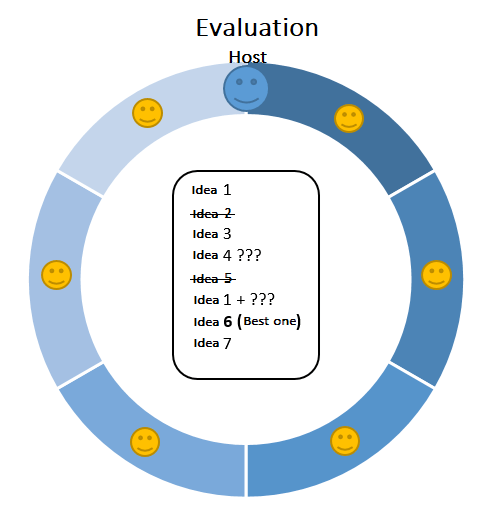
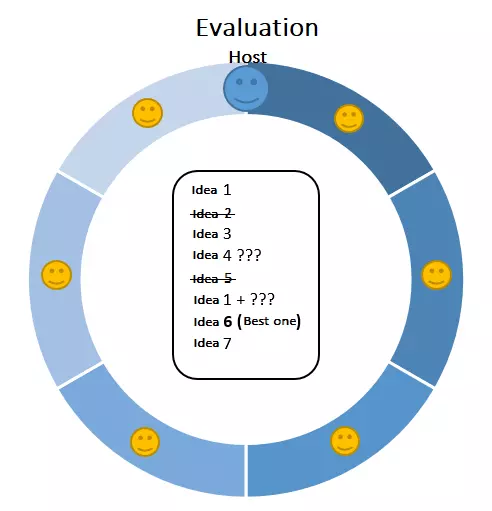
Lastly, by picking up on the energy released during the brainstorming session, an open discussion should take place and involve all participants. While keeping in mind that a sense of objectivity should now prevail, you must also give the participants a chance to discuss the generated ideas a bit more to let them clarify the concept behind each. Preferably, it should be the person who gave rise to a good idea during a session that should think one step further and give valuable contributions at this point of the evaluation. A joint evaluation of a brainstorm is therefore an essential component of the whole process.
The so-called process of elimination is yet another popular evaluation method, whereby ideas are eliminated one by one until there is only one winning idea on the table, which is naturally put into practice at a later stage. The style of the discussion is rather argumentative and comparative. The ruling out of ideas can be done either by a simple vote or a show of hands. This method brings at best a playful, if not a competitive element into the discussion and generates a sound, motivating atmosphere. It is for this reason that brainstorming is seen as a technique which brings excitement, because, technically speaking, each idea can end up winning regardless of the rank and status of the person behind it.
Brainstorming variants
According to Osborn and Clark, brainstorming traditionally presupposes a group which gets together and comes up with a creative storm of ideas by means of as fewer rules and obligations as possible. Nevertheless, the term “brainstorming” is nowadays interpreted rather loosely and often signifies a type of spontaneous search for ideas regardless of whether it is done in a group or alone with pen and paper.
Modern working environments have also created new brainstorming variants. To exchange ideas and perhaps to develop them even further, offices are making use of software and online platforms at an increasing rate. Group work tools are also becoming increasingly elaborated on and offer the likes of chats and content sharing for a more collaborative and productive exchange during group projects. The ease of use of such tools makes it ever so appealing for workers to share their ideas in chatrooms, which consequently allows for quick feedback (especially enabled by the casual style on these platforms). It remains debatable whether such types can be classified as brainstorming tools. Below, we present other examples of variants which, according to Osborn and Clark, move away from the fundamental concept of brainstorming.
ABC brainstorming
This variant supplements the classic brainstorm with an additional rule, which states that each session should follow an ordered pattern. ABC brainstorming attempts to assign each letter of the alphabet to corresponding ideas beginning with one of the letters. You can either go by the alphabetical order or apply no order whatsoever to the process. This method is very common when groups find it difficult to think of new ideas. It is, however, especially suited for situations, in which the aim of the group is to think of a name or a slogan.
The danger of ABC brainstorming lies in the fact that participants become too focused on the letters and are therefore limited in their creative thinking. After all, there are many more words and ideas which begin with the letter “E” than “Y,” but for each, only one idea is needed. ABC brainstorming therefore substantially restricts the thought process of your participants, which contradicts the very purpose of an unfiltered, raw storm of ideas which hides behind the term “brainstorming.” Generally speaking, the more rules that are applied to a brainstorming session, the smaller the chances of creating original ideas.
Electronic brainstorming
Digitally-oriented brainstorming functions at its best with collaboration software such as Slack or with similar alternative platforms. Such programs bring co-workers together, enabling quick requests for their ideas in the form of short posts. When setting deadlines at short notice, workers are forced to react spontaneously. With electronic brainstorming, it is possible to avoid entering into the open conversation culture of face-to-face interactions, and sacrificing the main advantage of classic brainstorming for the benefit of comfort of use. If members of a work group can’t simply meet up, it is often the case that you are left with no other choice but to avail of such electronic brainstorming methods.
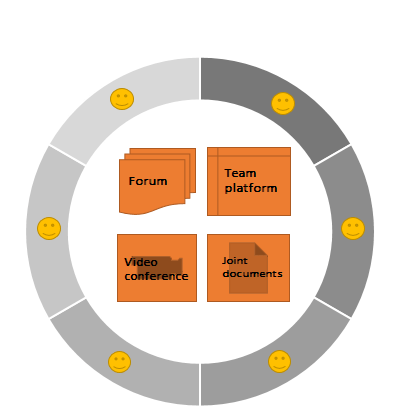
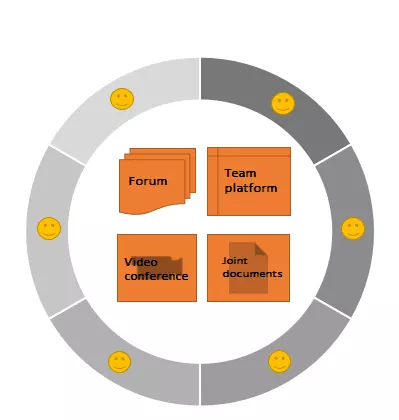
Using video chat programs such as Skype, is known to mirror the effect of real brainstorming sessions. Since this is a real-time brainstorming method, there is also space for spontaneous creativity. Nevertheless, a video chat cannot fully replace a face-to-face interaction, which can potentially cause a mental barrier between the two participants. In this brainstorming variant, it is the host who is also more involved and has to cope with various requirements and technical obstacles that video conferences usually entail – connection failures, poor transmission quality, or the lack of technical affinity, which only turns the co-worker’s attention away from the actual brainstorming session or even makes it completely impossible for the session to take place.
Brainwriting
Contrary to a classic brainstorm, brainwriting involves the writing down and the subsequent collection of individual ideas to the detriment of spontaneity and team dynamism. After a given time, the host collects what each person wrote down and the notes are then reviewed and evaluated. Ideas are often anonymized, hence no personal references are made. Brainwriting is considered a useful method when some participants are unable to engage in classic brainstorming due to language barriers, personality clashes, or when an on-site meeting is not possible (distance between participants, no designated meeting room etc.).
One of brainwriting’s main strengths is the participant’s ability to not be influenced by the rest. A classic brainstorm aims to clearly assign each idea to the person that expressed it. However, depending on the group set-up and various group dynamisms, this form can also have negative effects on the session. Brainwriting is therefore a gateway into the session for those who are shy or unsure of their ideas. In this way, ideas, which would have possibly never come to light in classic brainstorming settings, are expressed more freely by participants, offering equal opportunity to all team members.
Brainwriting has one more important advantage – it encompasses a thorough documentation of all ideas. From time to time, even the most experienced hosts of brainstorming sessions can forget to jot down ideas, which eventually get lost in the debate. Brainwriting makes sure that each idea is written down and takes part in the brainstorm. However, this method also has its disadvantage, namely that the ideas are in danger of bearing no relation to each other or that they can repeat more than once during a session (possibility of submitting multiple answers). During a brainstorming session, good ideas that are developed further, whereas during brainwriting, ideas evolve by means of numerous steps in a much longer overall procedure.
Thanks to its wide range of programs, Microsoft 365 is guaranteed to lighten your workload. Get the package that best suits your needs now from IONOS!
Brainwalking
Brainwalking is yet another trendy variant of brainstorming, which activates the creativity of its participants as they individually place posters and little notes in an agreed area (on one of the office walls for instance). The aim of such notes is to allow team members to inscribe their own ideas, which eventually results in a collection of thoughts. Brainwalking disengages from any restrictive frameworks which are usually seen during meetings or in chatrooms, and is rather more concerned with the participant’s ability to spontaneously jot down and share any thoughts during a normal work day.
The term is nevertheless often associated with casual staff events involving integrational exercises and brain-teasers. Here, it is all about brain training, which activates centers of creativity and improves both the memory and perceptual capacities. In this case, the term is more a mental fitness test than a brainstorming method. It is nevertheless possible to integrate small brainstorming sessions with such activities. After all, productive movement exercises can improve creative thinking.
Blank notebook method
Notebooks are ideally suited for brainstorms which need a significantly longer time for full completion. In this brainstorming method, you would ideally need a blank notebook, which is then passed on from person to person at your workplace. Upon receiving the notebook, workmates can jot down their ideas and comment (either anonymously or by name) on ideas which have already been inscribed. This variant combines the positive aspects of both brainstorming and brainwriting. Just like in the latter’s case, this notebook is meant to form a kind of portfolio of ideas, which offers groups a chance to discuss and select respective ideas. The method depends on the size of the group, is costlier and more time-consuming than the classic brainstorming method, but can nonetheless be integrated more easily in everyday work life.
For the notebook, it is recommended that you lay down some rules. It is often the case of setting a time limit for each participant (one day, for instance), after which the notebook is passed on to the next person. As well as that, it is worth specifying how much each person can write (one page per person is the most common limit). This not only allows for a better overview of ideas but also prevents a situation in which the more creative workers steal the limelight from the less creative. Co-workers could otherwise experience a sense of demotivation if the ideas of predecessors impress more than the ideas of those who obtained the notebook afterwards.
We must also ask ourselves to what extent this method should be associated with real brainstorming. After all, it is not only the aspect of spontaneity, but also a substantial part of group dynamism that is being omitted here. Since brainwriting and its prioritization of anonymity counters spontaneity, we are left wondering whether it outperforms the blank notebook method. The latter, it seems, encompasses the disadvantages of both methods, and its comfort of use is the only real advantage. Nevertheless, depending on your company type and your work environment, the blank notebook method can prove highly effective.
Overview: advantages and disadvantages of brainstorming variants
| Brainstorming variant | Advantages | Disadvantages | Suitable for |
| Classic brainstorming | Highly creative and spontaneous, efficient, playful elements, good team-building method | Highly dependent on time and place, lengthy preparation period on part of the host, high possibility of failure, not in any way anonymous, opinion leaders can become too influential | Small and medium groups with no complex hierarchical structures |
| Electronic brainstorming | Independent of time or place, optional anonymity, easier for introverts, keeping record of progress is much easier | Less space for spontaneity, irregular flow of ideas, technical obstacles | Larger groups, groups with shy participants, international groups |
| Brainwriting | Independent of time or place, optional anonymity, easier for introverts, keeping record of progress is much easier, is also suited for long-term projects | Less space for spontaneity, irregular flow of ideas, ideas bear no relation to each other, multiple answers per person are possible | Medium and large groups, groups with shy participants, international groups |
| Brainwalking | Independent of time, optional anonymity, easier for introverts, keeping record of progress is much easier, is also suited for long-term projects, ideas can bear relation to one another, diverse portfolio of ideas, easily integrated into the work day, visual elements (diagrams, sketches) | Dependent on place, less space for spontaneity, irregular flow of ideas, lengthy project period, comparatively higher planning costs, higher material costs | Medium and large groups, groups with shy participants, international groups Creative sectors Projects with visual components (design, company logo etc.) |
| Blank notebook method | Independent of time, optional anonymity, easier for introverts, keeping record of progress is much easier, is also suited for long-term projects, ideas can bear relation to one another, diverse portfolio of ideas, easily integrated into the work day, visual elements (diagrams, sketches) | Independent of place, less space for spontaneity, irregular flow of ideas, lengthy project periods | Medium and large groups, groups with shy participants, international groups Creative sectors Projects with visual components (design, company logo etc.) |
Brainstorming and its scope of application
When in need of short and concise ideas, brainstorming can prove to be a very effective technique. This is why brainstorming methods are so popular among advertising agencies, which always count on the creativity of their workers. Above all, such brainstorming methods have long been applied to areas in which a constant flow of fresh and innovative market-oriented ideas is relevant to everyday work (for example, presented during meeting, conferences, or at team platforms). The method used depends largely on the group set-up, organizational costs, and the work environment.
Marketing/advertising
In marketing and advertisement sectors, brainstorming is an essential technique for finding new ideas. Slogans, visual elements, strategic alignment of campaigns, and many other similar projects based on creativity have their origin in brainstorming sessions, during which workers participate in a search for ideas with only one winning idea as the end result. “What is our new slogan?,” “Why do people buy our product?,” and “New advertisement campaign designs” are just some of the suggested ways to begin a brainstorming session. Aside from the classic brainstorming, brainwriting is often taken into consideration when a redevelopment of visual elements such as product logos needs to take place. Since advertising aims to attract the attention of clients, it must make products stand out. The most original ideas therefore come from successful brainstorming sessions in which many creative people have taken part.
Project planning/design
Creativity and keeping up with modern trends are not the only important things when making new product ideas and product ranges. Lateral thinking is also needed. Here, brainstorming attempts to activate the creative centers of its participants to attain the most original collection of ideas, which will strike the potential clients by making respective products stand out from their direct competition. Since the exchange of ideas is made simple by means of visual elements, many brainstorming variants are suited for the design sector. Electronic brainstorming, however, is suited to compiling design proposals, which can all be later presented with the aid of a portfolio. Brainwalking is also a perfect match for design ideas, because participants and their cooperative attitude make the collective image of their ideas possible by means of a simple wall poster. Similar to this is the blank notebook, in which ideas can also be put on paper and made visible to all members.
Event management
Event planning encompasses many aspects – equipment, music, theme, food, or even the seating arrangement. Depending on the event type and its circumstances, applying creative elements is sometimes what is needed to succeed – whether we go through ideas for a birthday party with our friends or ponder on how to make formal events more interesting in our working environment.
Further areas of application
Generally speaking, brainstorming techniques are most suited when creative, fresh, and innovative ideas are needed. The video game industry feeds on constant innovation and development of new concepts, with the aid of which new games can be produced. After all, innovation is what the majority of gamers value most. In this sector, creative thinkers from all walks of life are always in demand. Whether individual group members specialize in graphics, music, or plot-making, it is the difference between them which contributes towards a wild mix of ideas during the brainstorming sessions. It is often the case that people who work in the industry in question are also gamers themselves and are therefore aware of the changes that need to be made.
Creative solutions are also highly sought after in the television industry, whereby innovative concepts for new series or improvements to existing ones are always in demand. Since television has been highly endangered by competition from the triumphant entertainment forms found on the internet, it cannot afford to let innovation and creativity sink into the background. Young target groups will otherwise turn their backs on entertainment forms which are not up to speed with current trends. In recent times, it has become increasingly obvious that television aims to build an intergenerational bridge by adapting its new concepts to YouTube or Twitch. In such branches, the presence of creative thinkers in brainstorming sessions is therefore always in high demand.