How much does an AI answering service cost?

Opting for an AI call answering service only makes sense when the costs involved are clear and easy to calculate. In practice, that’s not always easy because the market includes a wide range of pricing models, different per-minute pricing rates and hidden fees. This article breaks down AI answering service costs in detail, so you can accurately assess their real financial impact on your business.
What pricing models are available for AI answering services?
When businesses decide to automate customer service, an AI answering service is often the solution of choice. That decision, however, quickly raises practical questions: what are the costs involved, which pricing models are available and how do they differ in practice? Most providers rely on three core pricing models, each with its own advantages and risks. SaaS subscriptions offer clear monthly pricing, while pay-per-use models provide full flexibility but can quickly become expensive as call volumes increase. Enterprise solutions, by contrast, are custom, high-performance models, meaning they typically require a large initial investment. Which pricing model you choose directly affects how predictable your costs are and how high your total spend will be.
SaaS subscription (predictability)
An SaaS subscription model offers clear monthly costs and a high level of predictability. You pay a fixed amount that typically includes licensing, a base usage volume and support to get up and running. This model works well for businesses that need predictable monthly costs. Additional features can also be added whenever you need them. The SaaS provider handles operations, updates, and maintenance, which reduces the workload for internal IT teams. This model is especially common among small and medium businesses as well as companies with a steady volume of incoming calls. Cost transparency is its main advantage: you know exactly what to expect each month.
Pay-per-use (risk)
With a pay-per-use model, you only pay for what you actually use, usually per minute or per interaction. This can seem cost-effective when you’re automating a small number of calls to start with. However, problems begin to emerge when call volume suddenly increases. As usage grows, so do costs, making monthly spending harder to keep under control. This means pay-per-use models work well for businesses that want to test out individual workflows or handle seasonal spikes in call volume. Although there are no subscription fees, maintenance costs may still apply. Pay-per-use providers tend to advertise very low per-minute rates, yet total costs often end up being higher than SaaS subscriptions. This makes this model best suited for low call volumes or ones that remain easy to manage.
Custom enterprise solutions (high initial costs)
Enterprise solutions are aimed at large organizations with complex automation requirements. They involve high one-time costs largely driven by custom development work, system integrations, model adjustments and dedicated infrastructure. In return, businesses receive a fully customized AI assistant that is tailored to their processes, compliance requirements and scalability needs. Monthly operating costs are also higher, since these solutions use dedicated resources that aren’t shared with other customers. For large enterprises, this can still make sense when meeting the highest quality standards is a priority. This model offers maximum control, but at the cost of flexibility and scalability.
How AI answering service providers compare to one another
AI answering service providers differ not only in the technology they use, but also in how they price their services. To compare costs, you need to look at fixed fees, variable per-minute rates and the risk of unexpected cost increases. Depending on the pricing model, cost predictability ranges from stable SaaS subscriptions to purely usage-based billing, where costs are harder to predict.
SaaS subscriptions for transparency
SaaS providers such as IONOS offer clearly structured monthly subscriptions. Fixed costs typically include licensing, a set of basic features and support. Most plans also include a set number of calls. Additional minutes or packages have clearly defined prices, which makes budgeting straightforward. This model is well-suited for businesses with predictable call volumes that want full control over costs. Because billing does not involve complicated retroactive calculations, the risk of unexpected charges is low. On top of that, regular updates and feature improvements are usually included in the subscription. This makes it one of the most cost-effective options for SMEs.
Pay-per-use
Pure usage-based billing is common among cloud providers such as Twilio as well as generic voice gateway providers. These offerings usually come with little to no base fee. Instead, charges are based almost entirely on call duration, with some providers setting a minimum monthly spend. The main advantage is the low upfront commitment, since you only pay when calls actually come in. The downside is that costs can rise quickly when call volumes grow or spike during busy periods and no price caps are in place. Longer or repeat calls also make spending harder to predict, which means companies need to forecast call volumes very carefully. This model can work well for testing or very low call volumes but is risky budget-wise in live production environments.
Bundled call plans
This model is commonly used by industry specialists, such as NexHealth, Solutionreach or Phreesia, as well as other niche SaaS providers. Businesses receive a fixed monthly allowance of calls or minutes and once they exceed that allowance, additional packages or higher pricing tiers apply. Base costs stay reasonable with stable call volumes, but once usage goes beyond the included allowance, costs can increase quickly. This model strikes a good balance, however, between predictability and flexibility but costs aren’t as predictable as a full SaaS subscription. As a result, bundled call plans work best for small specialized teams with clearly defined call volumes.
Enterprise solutions
Enterprise providers like Kore.ai and Amelia focus on fully customized solutions. Costs typically include high setup fees, model training and integration work, as well as dedicated support. Per-minute pricing often plays a secondary role and varies depending on how the system is deployed and how much traffic it handles. This model offers full customization but is difficult to compare price-wise. It also tends to offer more than what SMEs need. For large enterprises with complex processes and dedicated contact centers that place a strong emphasis on service quality, enterprise solutions can be the right fit. The main financial risk lies less in variable usage costs and more in the high initial investment.
Cloud phone platform add-ons
Cloud phone platforms often offer AI features as optional add-ons. The phone system itself remains the foundation, while the AI module is billed separately, typically per call. Because the AI feature is added to an existing phone system, integration is usually straightforward. However, businesses often underestimate the total cost once AI usage is layered on top of the standard phone charges. This means costs are predictable to a degree but heavily depend on the specific add-on.
Provider comparison at a glance
| Provider example (type) | Fixed monthly costs | Variable costs | Cost predictability and risk |
|---|---|---|---|
| IONOS (SaaS subscription) | ++ | + (includes a call allowance, set charges for additional calls) | High predictability, low risk |
| Usage-based providers (pay-per-use) | + (low or none) | +++ (charged per minute or per call) | Low predictability, high risk during spikes in call volume |
| Industry specialists (bundled call plans) | ++ | ++ (fixed call or minute bundles) | Medium; works well for steady volumes, costly when limits are exceeded |
| Enterprise solutions | +++ (high) | ++ (usage-based charges per minute or token) | Medium; high upfront costs, predictable once live |
| Cloud phone platforms | ++ | ++ (some minutes included, additional calls billed per minute) | Moderate; dependent on add-ons and number of extensions |
Scale: + low, ++ moderate, +++ high
Which AI answering service costs should you consider?
Along with the monthly base fee, there are several other cost components that need to be factored in when choosing an AI call answering service. It’s important to understand setup and ongoing costs early on, since unexpected charges often only show up once the system is in use.
One-time setup costs
One-time setup costs typically cover integrating the AI assistant into your systems. You may also need to adapt the language model if your business uses custom workflows or specialized terminology. Enterprise solutions, in particular, usually involve higher costs because they require custom setup and integration. Self-service SaaS setup costs are much lower by comparison. Depending on the provider, onboarding or initial training fees may also apply. As a result, these one-time costs play a major role in determining how quickly the investment pays off.
Ongoing costs
Ongoing costs for an AI answering service include licensing fees, usage-based charges (such as for per-minute or call billing) and costs for maintenance and updates. With SaaS providers, many of these components are bundled into the subscription. Pay-per-use models, by contrast, come with low fixed costs but higher and more variable ongoing expenses. Additional recurring fees may apply for support services or premium features such as analytics. Costs related to the phone system itself also need to be taken into account. Over time, they can make up the largest share of the total costs.
How do AI and human staffing costs compare?
To assess how an AI answering service performs financially, it’s useful to look at it alongside the cost of human call handling. A good place to start is your existing phone support’s cost per contact (CPC). This includes wages, payroll related costs, onboarding, sick leave coverage, coverage during staff breaks and the tools and systems agents need to do their work. Human staffing costs are largely fixed and don’t scale well when call volumes increase.
An AI answering service, by contrast, scales in a predictable, near-linear way as call volumes increase. It does this without increasing personnel costs and can operate 24/7 without overtime pay or capacity constraints. As more routine requests are handled automatically, average handling time (AHT) drops significantly. At the same time, wait times and call abandonment rates decrease, which improves customer satisfaction. AI doesn’t necessarily replace human agents, but it takes a lot of routine work off their plate. This allows teams to focus on complex cases where human judgment adds real value.
When does investing in an AI answering service begin to pay off?
Return on investment (ROI) shows whether an investment makes financial sense. For an AI call answering service, ROI is primarily driven by lower staffing costs, shorter handling times and additional revenue from 24/7 availability. To calculate the ROI, you need to compare the AI’s setup and operating costs with the monthly savings it generates. The biggest drivers are a lower cost per contact (CPC) and the removal of capacity bottlenecks that previously led to missed calls or lost business. By handling the majority of repetitive tasks, the AI answering service significantly reduces AHT. At the same time, it eliminates the need to add staff during peak periods, which would otherwise increase fixed costs. The standard formula looks like this:
ROI = ((Savings – Costs) / Costs) x 100Example: Let’s say you save $3,000 per month in staffing costs by using an AI answering service, and the service itself costs $1,000 per month. You can calculate the ROI as follows:
ROI = ((3,000 – 1,000) / 1,000 ) x 100 = 200%This means the investment typically pays for itself within a few months. How quickly that happens will largely depend on your call volume.
ROI example in practice using IONOS
The IONOS AI Receptionist uses a clear SaaS pricing model with predictable monthly costs and no hidden fees. This helps businesses plan and manage their spending more effectively. Let’s assume you choose the Flex Pro plan for the IONOS AI Receptionist, which costs $69 per month and includes 100 monthly calls.
If the average call lasts 3 minutes and staffing costs are around $0.90 per minute, handling those 100 calls using your staff would cost $270 (100 × 3 × $0.90).
The ROI would then be:
ROI = (($270 – $69) / $69) x 100 ≈ 291%This means the investment typically pays for itself within a few months. How quickly that happens largely depends on your call volume. For many small and medium-sized businesses, this makes AI answering services a financially appealing option.
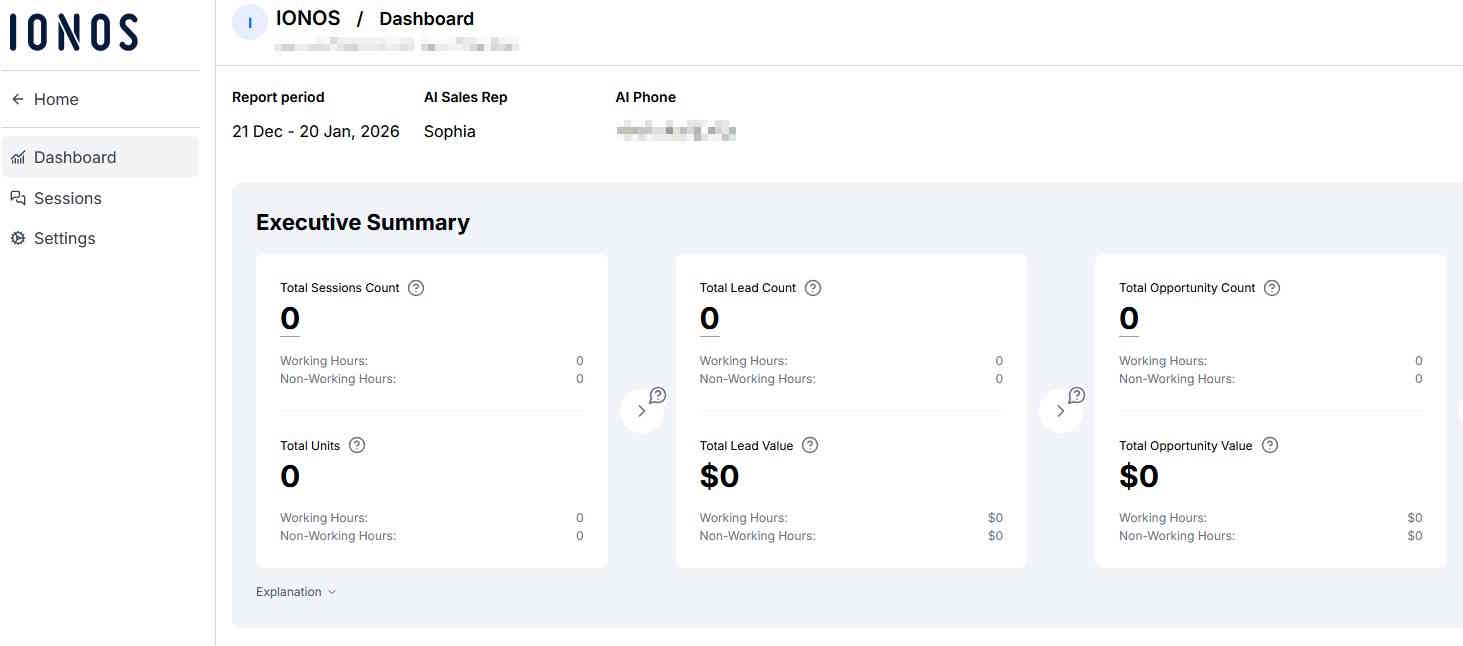
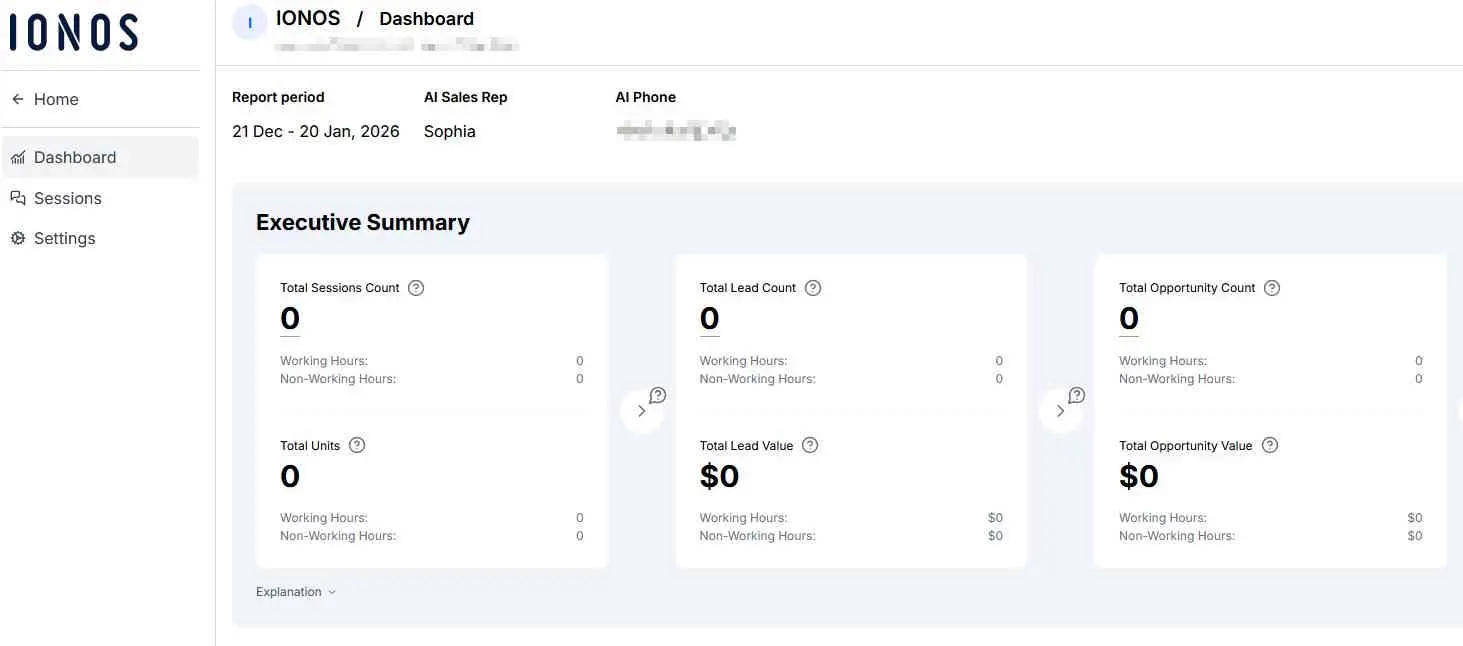
- Live in under 5 minutes
- Works with your existing number
- Sounds natural and professional
Why value ultimately matters more than cost
Deciding whether to use an AI answering service or not shouldn’t be based on cost alone. What really matters is the overall value it delivers: reduced workload for your team, predictable scaling, 24/7 availability and reliable cost planning. Using a SaaS model with fixed pricing and no hidden fees helps reduce uncertainty and makes costs easier to manage over time. At the same time, AI improves service quality by reducing the number of unanswered calls and the resulting loss of business. As a result, total costs go down while the value delivered continues to grow.
Reviewer

Jeanna Raffa
With over 18 years of experience in online marketing, Jeanna Raffa possesses extensive expertise in digital marketing. Since 2020, her focus has been on providing practical information regarding email, office, and cloud storage solutions.