

Programmatic Advertising: An Efficient Method for Placing Online Ads

Anyone working with online marketing has probably come across the term programmatic advertising. However, even though the method has been a somewhat trendy topic in the advertising industry over the past ten years or so, there are still companies that do not take advantage of what these advertisements have to offer. One reason is that the definition of programmatic advertising isn’t clear to many users.
What is Programmatic Advertising?
Since the turn of the millennium, programmatic advertising—at least in the USA—has increasingly replaced traditional online advertising processes.
Via special online platforms, advertising spaces are sold in fully automated, real-time auctions (real-time bidding). In the process, user data is taken into account so that advertisers can determine when and where specific advertisements are being displayed to specific users. This enables them to reach their target customers in the most efficient way possible. This real-time bidding with targeted advertising utilizes big data and algorithms, and was not conceivable in earlier advertising processes. Real-time bidding is an essential distinguishing feature of programmatic advertising in comparison with other forms of display advertising.
Programmatic advertising is a method based on AI and machine learning that is utilized to book online advertisements in real-time auctions via specialized platforms, to display these ads efficiently and to optimize them. This is why this method of display advertising is also referred to as real-time advertising (RTA).
A Historical Overview: From CPT to Programmatic Advertising
In the past, companies booked online advertising space according to their own negotiations with the website operator (publisher). Advertising prices were typically billed in CPT, the cost-per-thousand price. This manual process demands time and personnel. Targeting a specific customer demographic was not possible. An ad was displayed on the advertising space regardless of which users visited the website.
Later, advertising networks emerged that displayed ads directly across many different websites that were represented in the network. These primarily offered remaining advertising spaces that had not been sold via direct negotiations. Instead of offering spaces at a fixed price, networks, for the first time, made use of auctions. But targeted advertising was still not possible.
Programmatic advertising has been in existence for nearly 20 years. It emerged at the end of the 1990s in the USA, geared toward fully-automated stock exchange trading, which at that time had long been standard practice. Google’s acquisition of the DoubleClick 2008 advertising network is considered a milestone in programmatic advertising. It was through this acquisition that the method went from being a niche practice in the US to becoming a mainstream one. Over the last ten years, it has come into focus for advertisers and online marketers worldwide and is becoming increasingly more important.
For Whom is Programmatic Advertising Relevant?
Programmatic Advertising is of interest to all companies that want to place online (desktop and mobile) ads as well as media agencies that undertake the online marketing for these companies.
Programmatic advertising is especially suitable when only partial segments of a brand’s own target group are targeted with an ad. Because various criteria can be used to clearly determine which user is shown a specific ad, as well as when and where, the impact of personalized advertising is significantly higher than with other methods through which an ad is placed for the entire target audience.
How Do Programmatic Advertising Auctions Proceed?
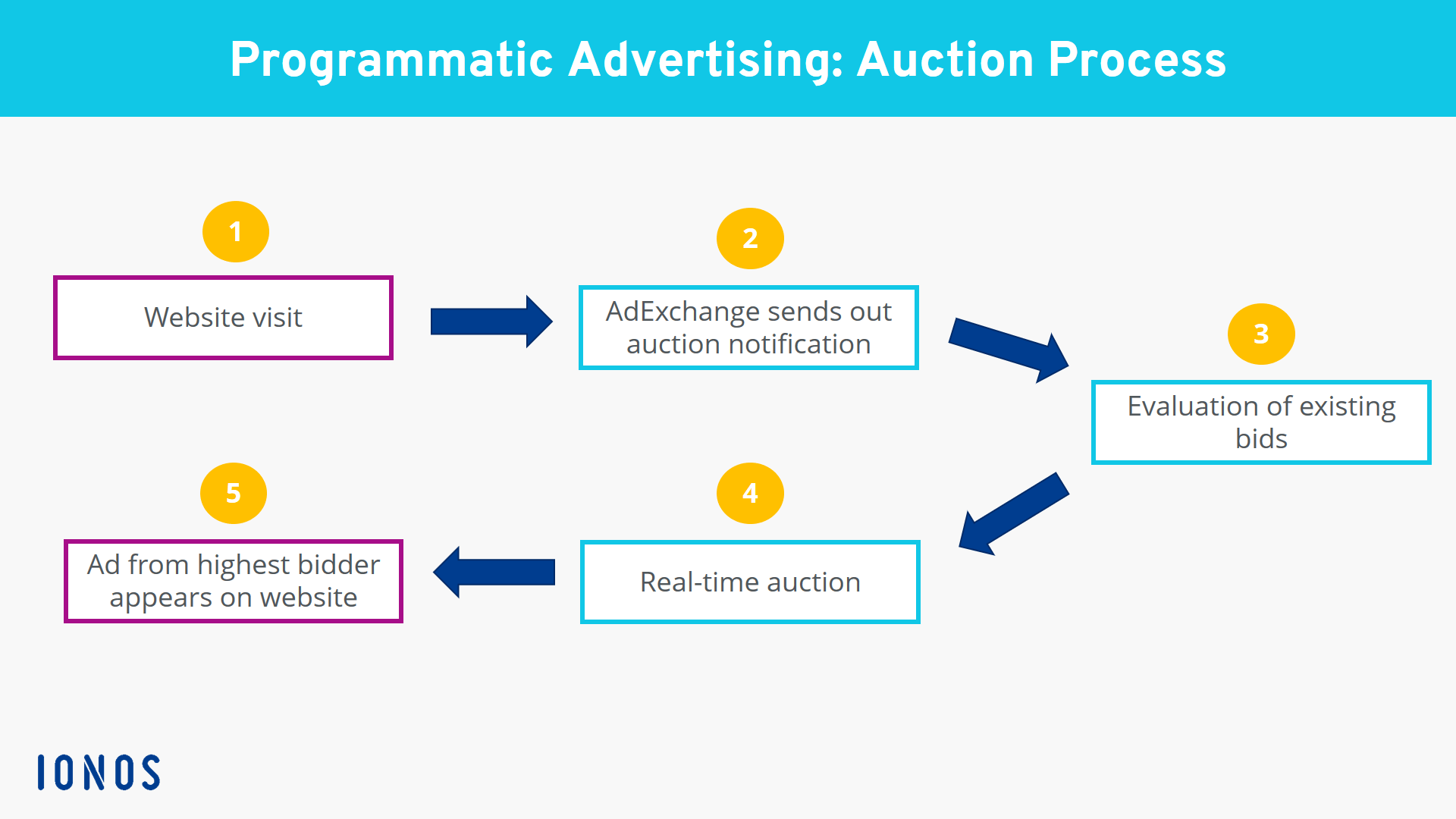
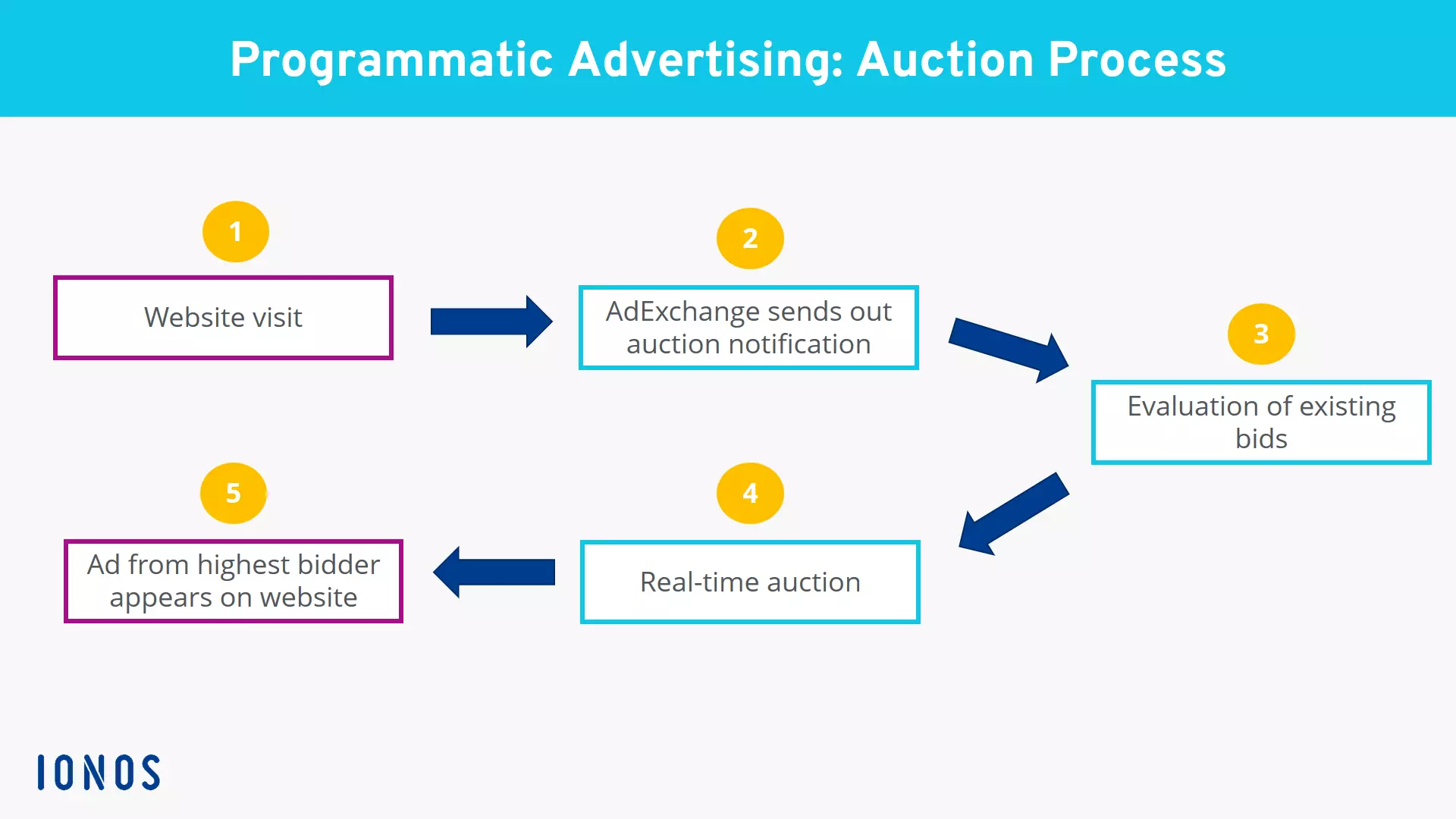
Should a user visit an online store, for example, the user data is sent to AdExchange (a platform for buying and selling programmatic advertising). There, the data is collated with advertiser criteria and a real-time auction takes place. These processes occur within milliseconds while the website loads. The average loading time is 2.6 seconds. An auction normally lasts between 50 and 100 milliseconds.
The highest bidder may then display their ad on the website’s advertising space. The price for placing an ad observes the second-price auction principle. In other words, the bidder pays one cent more than the second bidder.
If the advertiser indicates, for example, that they only want to place ads for women between 30 and 50 years old, and the user is 60 years old, then they will not be shown any of the advertiser’s ads (but probably another instead). However, the requirements can also be more far-reaching.
Should the user leave the online store’s website without purchasing anything and then sees an ad for this same shop the next time they visit a news site, the advertiser has provided a criterion like this for their ad: “Show the specific ad to all website visitors who leave our site without making a purchase.”
Programmatic Advertising vs. Real-Time Bidding
Sometimes the terms programmatic advertising and real-time bidding are used synonymously. This is not quite correct, however. Real-time bidding is a central aspect of programmatic advertising, yet it only describes the technical aspect of the real-time auction. It refers to the pricing method.
Processes and technical structures for the automated and dynamic modulation of individual advertisements, such as the demand-side platform (DSP) and supply-side platform (SSP), are not included with it.
Targeting Methods: What Criteria Can Companies Establish?
There are various targeting methods that advertisers can use to reach their intended website users via programmatic advertising platforms. The most important methods include:
Contextual targeting: Here, ads are placed based on keywords and semantic context. For example, financial service providers can decide to place ads exclusively on business magazine websites. In doing so, specific keywords don’t have to appear on the website, but they should be semantically similar.
Keyword targeting: Advertisers define specific keywords. As soon as these keywords appear on a website with advertising space, the advertising option is bid upon.
Data targeting/Behavioral Targeting: Here, ads are placed as soon as the user meets certain criteria or demonstrates a specific behavior. The required user data is gathered via cookies. For example, advertisers can only display ads to those users who have previously visited their website.
Geotargeting: It is primarily local companies that benefit from geotargeting. Ads are only displayed to users from a specific region or city.
The Technology: How Does Programmatic Advertising Work?
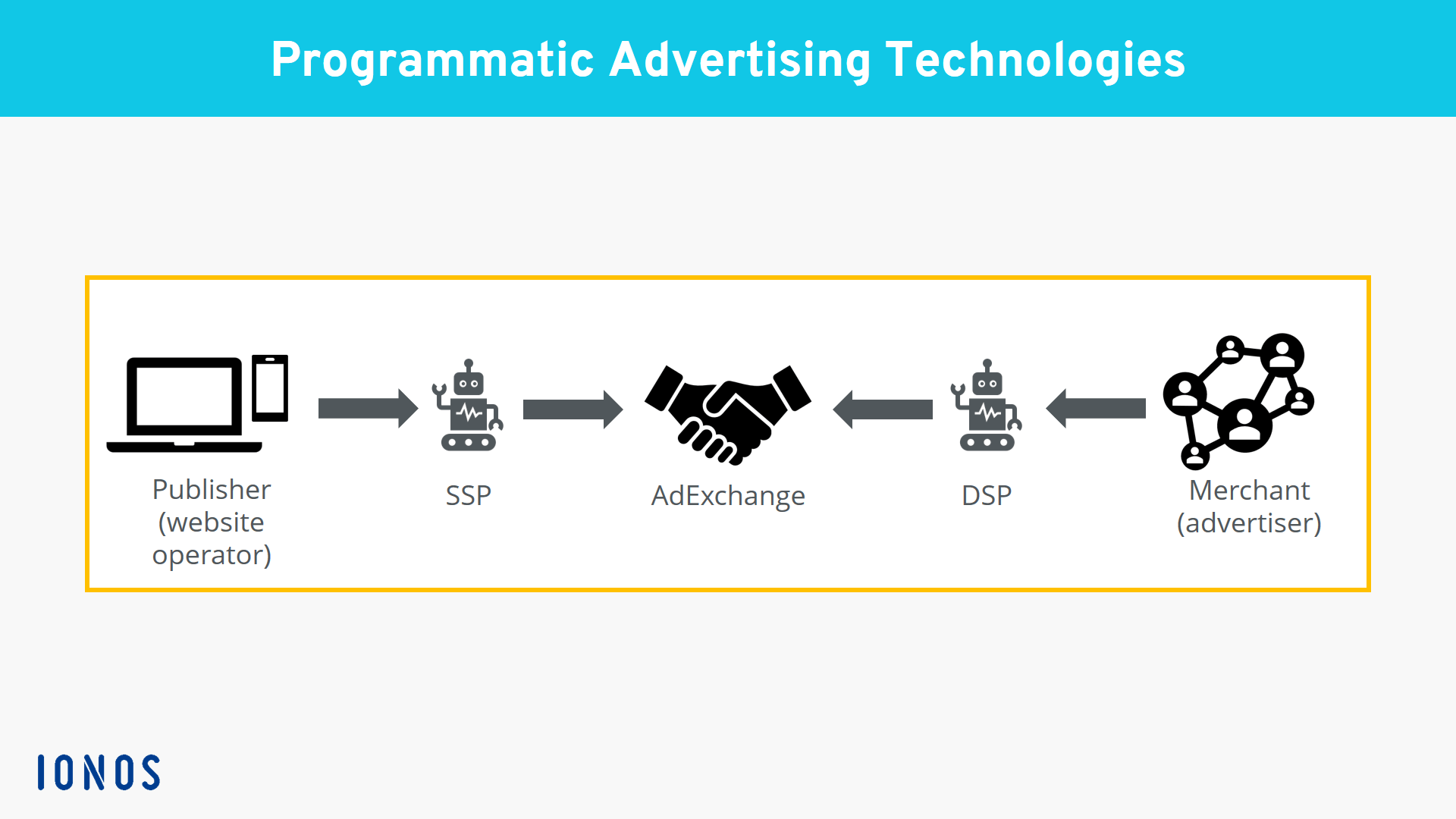
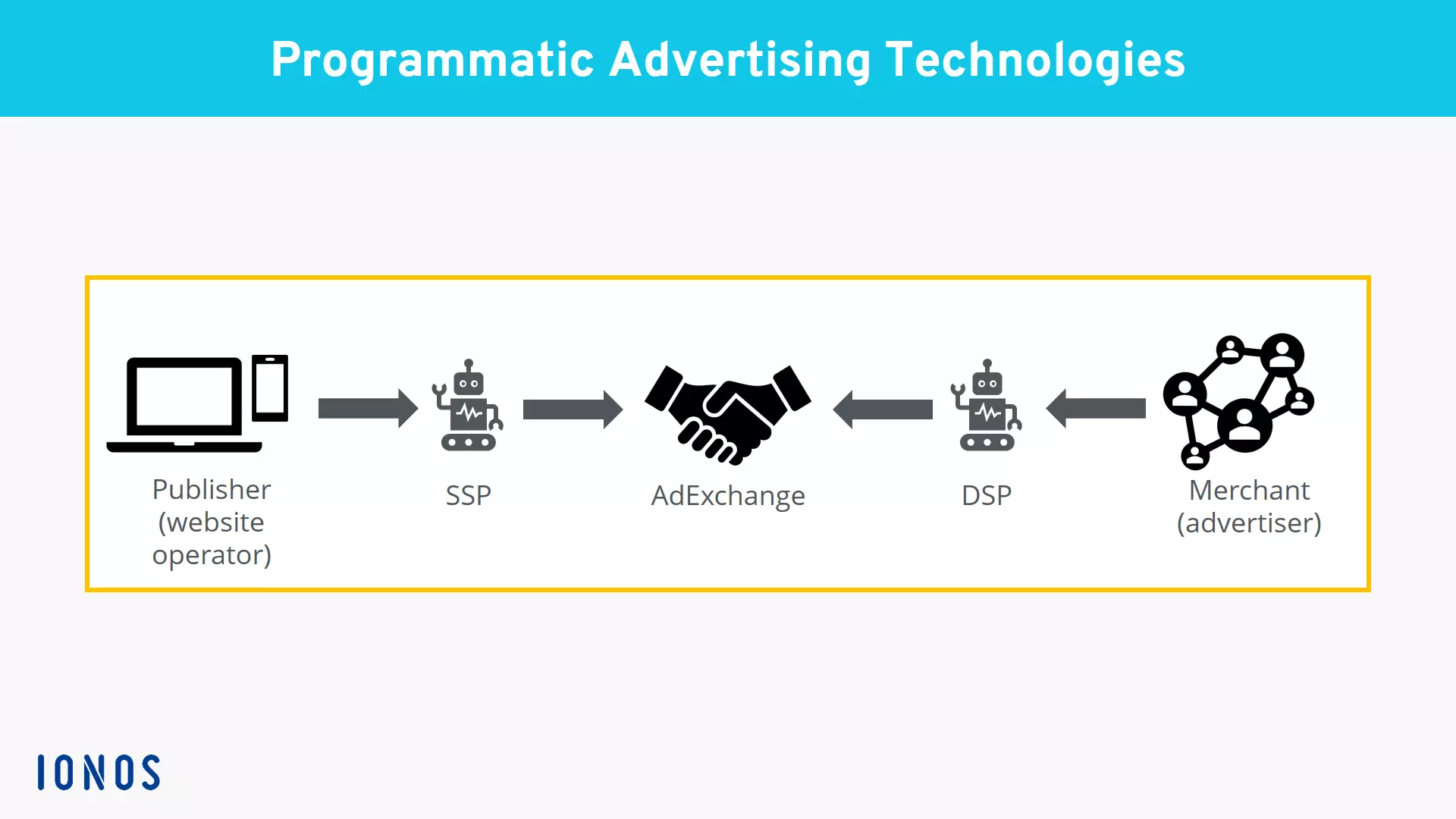
The core technological components of programmatic advertising are the AdExchanges, the online marketplaces on which the real-time auctions are conducted and via which the merchants and website operators (publishers) are to be found.
The largest AdExchange providers include:
- AppNexus
- AOL’s Marketplace
- Microsoft Ad Exchange
- Google Marketing Platform
- OpenX
Most AdExchange advertising spaces are marked for both desktop and mobile.
In order to use an AdExchange, advertisers must register on a demand-side platform (DSP). This consolidates advertiser demand. If a user visits a website that is linked to an AdExchange, the website then sends an auction signal to the AdExchange. The fully automated platform asks if the advertiser would currently like to place an appropriate ad on the advertising space. If this is the case, the DSP sends a signal to the AdExchange that the merchant is participating in the auction.
Website operators, on the other hand, register on a supply-side platform (SSP), the publisher’s DSP equivalent, in order to sell their own advertising spaces by means of programmatic advertising. In doing so, they can specify the minimum prices at which they want to sell advertising space, and furthermore set criteria for purchasers and channels. In order to get the highest price for an advertising space, SSPs can be linked to various AdExchanges.
From a technical point of view, Google Ads is a DSP. However, the advertising spaces are limited to websites in the Google Display Network. Though it’s true that the network covers a large share of the global website, it does have some blind spots. For example, no Facebook display ads can be placed via Google. This is why providers of programmatic advertising that are independent of Google sometimes offer better coverage depending on the advertising objective.
What are the Advantages of Programmatic Advertising?
One of the biggest challenges for companies in e-commerce are the customer’s complex decision-making processes when making a purchase. They arrive at the company’s website via different channels, search engines and social networks, leave it, visit it again later from their smartphone, or never return.
Instead of merely placing ads on websites that are thematically appropriate, online advertising’s waste coverage is drastically reduced through programmatic advertising. This is because it enables personalized advertisements to be displayed to the user across various channels on websites that they’ve actually visited. In doing so, specific activities or demographic characteristics are also taken into consideration.
The use of programmatic platforms and their learning algorithms leads to a considerable increase in efficiency for online marketing measures, and to a noticeable reduction in costs in comparison with the previous advertising process.
Prevalence in Business Practice and a Glimpse into the Future
Programmatic advertising is the new gold standard in display advertising. In the USA in 2018, companies spent over 80 percent of their online budget on programmatic advertising. In Europe, the method is becoming increasingly more important. According to a study by the Interactive Advertising Bureau (IAB), European companies on average allocate 65 percent for programmatic advertising. In Germany, only 48 percent of companies use this form of display advertising.
Anyone who wants to place efficient online ads can no longer avoid programmatic advertising. In a Google study, the method was already referred to as the new operating system for online marketing a few years ago. And the method’s potential is nowhere near exhausted. With the ongoing development of artificial intelligence and machine learning, advertisers will in the future have even more and better options for directing their ads—at the perfect time, on the best channel, to the right users.
Click here for important legal disclaimers.