What is a Hybrid Cloud?

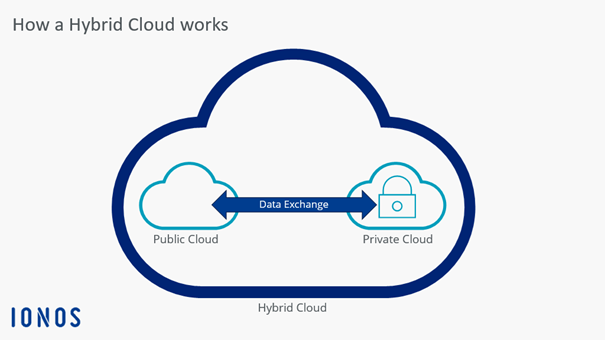
A Hybrid Cloud is an IT service that combines private and public clouds, orchestrating data and applications between both environments. This approach offers businesses greater flexibility and scalability by allowing them to keep sensitive data on-premises while also benefiting from the computing power of the Public Cloud.
Definition of the Hybrid Cloud
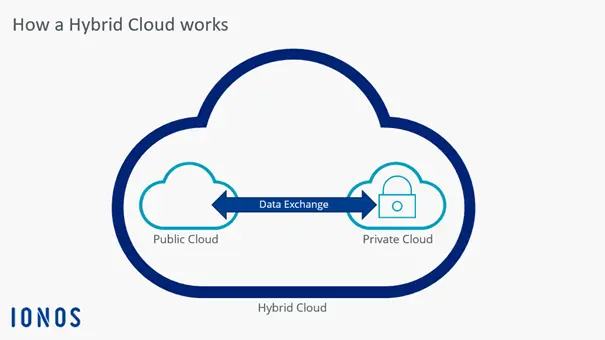
The term Hybrid Cloud typically refers to a combination of a traditional on-premises data center or an external Private Cloud and a Public Cloud. This means that some data and applications are stored and run on-site, while others are hosted on the servers of a specialized provider. However, it’s not about working with two completely separate systems—Hybrid Cloud solutions are integrated in such a way that data can move seamlessly between environments without requiring complex migrations or additional manual effort.
A Hybrid Cloud ideally connects both systems in a seamless and symbiotic way. Each company can decide which IT components are placed where. For example, privacy-sensitive files can remain on-premises, while all other data is stored on cloud servers. Some businesses may choose to keep their entire storage infrastructure in-house and outsource only the cloud computing resources. Others may do the opposite—keeping compute power on-site while storing data in a cloud storage system for easy access from anywhere.
In the context of Hybrid Clouds, on-premises data centers—also known as on-premise solutions—are often considered a form of Private Cloud. For this reason, the definition of a Hybrid Cloud is typically simplified to: a combination of Private Cloud and Public Cloud.
How does a Hybrid Cloud work?
To implement a hybrid cloud architecture, it’s not enough to simply subscribe to a Public Cloud and run it alongside your own data center. The two systems must work together seamlessly. There is no one-size-fits-all solution for this—several approaches exist. In the end, however, all integration methods generally rely on the use of management software or an API—or a combination of both. The actual implementation always depends on what exactly you want to move to the cloud and which provider you choose, as different vendors often offer different solutions.
The scope of your setup also plays an important role. For smaller needs, a single interface is often sufficient—for example, if a company uses office applications in the cloud but still stores data locally. For more complex scenarios, a hybrid cloud management software can be beneficial. When deploying comprehensive system solutions, tools like load balancers become a highly valuable part of cloud management. By efficiently and automatically distributing workloads, they help ensure uninterrupted availability of services and data.
Advantages and disadvantages of the Hybrid Cloud
At first glance, the Hybrid Cloud appears to combine the best of both worlds. However, like any technology, this concept also comes with certain drawbacks. Whether these drawbacks become relevant depends on the specific circumstances of each organization.
| Advantages | Disadvantages |
|---|---|
| ✓ Flexibly scalable | ✗ Additional effort required |
| ✓ Resource-efficient | ✗ Security depends on clearly defined policies |
| ✓ Cost-effective compared to other setups | |
| ✓ Enhanced security for sensitive data and critical applications |
Advantages
The advantage of a Private Cloud—especially when implemented as an on-premises data center—is that you retain full control over everything important. The company itself is responsible for data security and service availability, allowing for quick response times when needed. This means that anything critical to the success of the business can remain within the company’s own reach and oversight.
The advantage of a Public Cloud lies in its ability to scale on demand. Most providers of cloud solutions allow customers to quickly and easily add or remove resources, ensuring you only pay for what you actually use. This flexibility is also a benefit of hybrid cloud solutions: any areas that don’t require exclusive in-house control can be scaled up or down through the cloud as needed. Additionally, for the components that are not hosted internally, companies save on maintenance costs—since the third-party provider is responsible for managing both the hardware and software.
Just because it’s called a Public Cloud doesn’t mean anyone can freely access the data stored there. While files may reside on the same physical servers as those of other users, they are still protected against unauthorized access.
Disadvantages
Even though software can simplify the management of a Hybrid Cloud, the administrative workload is still higher than with either alternative. Part of this effort involves clearly defining which business areas should reside in which part of the cloud. Only with a well-defined plan can operational issues in a Hybrid Cloud be avoided in the long term. This plan must also be clearly communicated to all stakeholders, and an effective permissions system must be established.
This ties into the second major drawback of the Hybrid Cloud—its comparatively lower level of security. A hybrid setup does not offer the same level of protection as a fully self-contained on-premises solution. To ensure maximum data protection and GDPR compliance, a clear and robust security framework must be put in place. U.S. companies must comply if they process personal data of individuals located in the European Union. If there’s any risk of sensitive data ending up in the wrong environment, data security can no longer be guaranteed. That’s why it’s essential to develop and enforce strategies that prevent improper handling of Hybrid Cloud systems—or at the very least, minimize the associated risks.
Beyond that, every company should carefully consider whether it actually needs a Hybrid Cloud. If the organization already operates its own data center that is expected to meet its needs for the foreseeable future, moving to a Hybrid Cloud may be unnecessary and would involve additional effort. On the other hand, a company that can entrust its data to a reliable hosting provider with strong data protection standards may not need a private data center or Private Cloud at all—in this case, a Public Cloud may be the more efficient and cost-effective solution.
What’s the difference between Hybrid Cloud, Public Cloud, and Private Cloud?
In a Hybrid Cloud, private and public cloud services are combined into a unified system. The Public Cloud is what most people typically refer to when they talk about “the cloud.” On large server farms, a user—or even an entire company—is allocated a designated area, but not a completely separate physical server. This means that in a Public Cloud, two companies may use the same storage module and share the available space.
In a Private Cloud, other users do not have access to the same hardware. Private Clouds can also be rented from external providers. In this case, the servers are not located within the company itself, but in a remote data center. This setup offers many of the same advantages as the Public Cloud while providing greater data security. A self-managed, on-premises data center can also be configured as a Private Cloud. For example, servers can be set up to allow access by employees working remotely.
The Hybrid Cloud is a combination of both solutions. With this model, a company uses a Private Cloud for certain business operations while outsourcing other tasks to a Public Cloud.