

User-centered design: Develop successful products in dialog with users

Developing digital products is often a lengthy and resource-intensive process. Companies launching a new website, developing an app or producing digital content should have an in-depth understanding of the needs of their target group. Otherwise, months of work, heated debates among project team members and high budget investments may lead to nothing.
The user-centered design process has established itself in the digital sector, in particular, to ensure that companies don’t develop products the market doesn’t want, and that their products and services solve real problems, and are intuitive and pleasant to use.
User-centered design definition
ISO standard 9241-210:2019 (Ergonomics of human-system interactions) defines the basic principles of user-centered design. It succeeds ISO 13407, which described the user-centered design of interactive systems.
User-centered design is a product development and design process that focuses the development process on the needs of the user to facilitate the best possible user experience.
When developing new (digital) products and services, many companies lose themselves in their own internal viewpoint. Instead of surveying users on the layout, design, and function of products from the outset, companies concentrate on innovative technologies, their corporate goals (what can we offer quickly with our existing resources?) and attractive graphic design. The resulting applications take some getting used to. Often, they’re not intuitive to use and don’t offer the functions users expect.
The user-centered design turns this approach on its head. It focuses on users’ needs, abilities and requirements, not corporate interests and capabilities. Before the actual development, the company analyzes the users and their situation and seeks feedback repeatedly during the development process. This allows them to build products in an iterative process and in close coordination with customers.
User-centered design as a concept has been commonplace in product design since the 1990s and the user-centered design approach has become increasingly prominent in the digital sector in recent years.
User-centered design vs. human-centered design
Anyone reading up on user-centered design will sooner or later encounter the term human-centered design. Any differences between the concepts are marginal. While even experts use the terms synonymously, some see minor linguistic differences: The word ‘user’ refers to a specific target group, while the term ‘human’ is broader. As a result, they believe that human-centered design not only incorporates users, but also other stakeholders who interact indirectly with the new product being developed.
Design professor Donald A. Norman is one of the world’s leading experts on user-centered design and was one of the first to use the term. His publications reveal a linguistic change: while he used to write about user-centered design, his more recent publications feature the terms ‘human’ or ‘people-centered design’.
 To display this video, third-party cookies are required. You can access and change your cookie settings here.
 Principles of user-centered design
ISO standard 9241-210:2019 defines six fundamental principles that form the basis of the user-centered design process:
- Design is based on understanding users, their tasks and their environment: It is not enough to have a vague impression of the product’s target group. User-centered design requires deep immersion into the lives of users.
- Users are involved throughout the entire development and design process: This is one of the main differences to other approaches. Users are not just invited to assess a finished product, rather their opinions are the basis for development.
- The design process is guided by user ratings: Users evaluate every prototype and every beta version, and this feedback is used to develop the product.
- The process is iterative: The process steps in product development are performed non-linearly and repeatedly. Feedback from users can make multiple iterations of individual phases necessary.
- The entire user experience is taken into account: The aim of user-centered design is not to make using a product as simple as possible. Instead, the process takes a broader view of the user experience. Products should evoke positive emotions, offer genuine solutions and encourage users to use them repeatedly.
- The project team is multi-disciplinary: User-centered design requires close cooperation across disciplines. There is no room for silo mentalities in product development. User requirements can only be implemented optimally if copywriters, graphic designers, and programmers share their different perspectives.
The user-centered design process
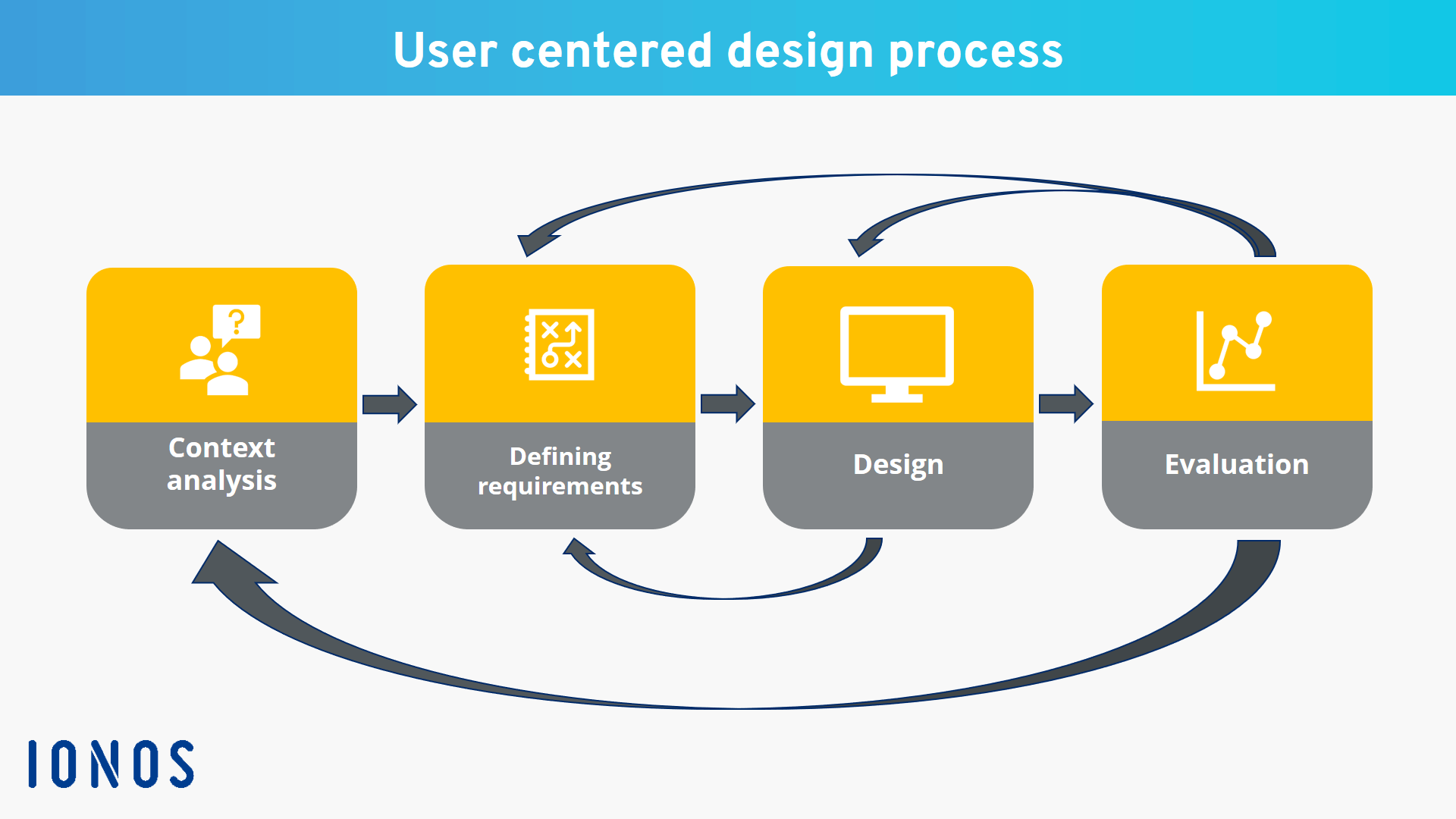
User-centered design is based on certain fundamental principles. While it is always an iterative development process, no explicit methods are specified for implementation. The approach can be integrated into a waterfall organization or an agile environment.
Irrespective of the specific implementation, four phases of the process can be defined based on ISO 9241-210:2019:
1. Context analysis
The first step is to analyze the context in which users will use the product. Who are the future users, and what are their specific applications for the product? Project teams can find answers by observing and surveying potential users.
2. Defining the requirements
The second step is to define the specific requirements for the new product. This step describes user requirements, taking corporate requirements into account.
3. Design
The actual design process doesn’t start until the requirements have been defined. In the first instance, designers will usually create a simple prototype, e.g. using paper, followed by digital wireframes, and finally produce a finished prototype.
4. Evaluation
After a prototype has been produced, the project team asks potential users for feedback. For digital applications, this is generally done via extensive user testing and qualitative surveys. Surveys and tests assess effectiveness (can users achieve what they want?), efficiency (how quickly can users achieve their objective?) and general satisfaction.
The project team returns to step 2 or 3 in the design process with the new information to optimize the product. These iterations continue until satisfactory user feedback is achieved, taking into account the corporate frameworks (time and costs).
Case study: Moneythink develops a financial app for young people
US company Moneythink developed a financial app for young people from socially disadvantaged backgrounds using the user-centered design process. Existing financial apps that are intended to encourage users to save in investment funds, synchronize their various accounts and check comprehensive statistics were irrelevant to this target group. The new app was intended to focus on the specific needs of these young people by promoting financial education and helping them use their limited budgets responsibly.
Moneythink held 90 interviews with young people across seven different schools and colleges. The team immersed itself in the everyday lives of future users. They analyzed and used other apps popular among young people (like Snapchat and Instagram) and collected additional contextual information by observing students at school and at home.
Their findings influenced the app development process. During design sprints, the team tested ways to make the app cooler and give it an Instagram factor. After the app was published and downloads did not quite meet expectations, the team made some more adjustments and collected detailed opinions from users, following the motto “what is important, doesn’t happen in the office”.
Advantages of user-centered design of products
A consistent focus on user-centered design not only benefits the user, it’s also worthwhile for companies.
- Customer satisfaction: Close integration of users in the early stages of the development process means that the end product is more likely to meet the customer’s expectations. This boosts revenue and reduces customer service costs.
- Product safety: The project team develops a product for a specific target group and a specific use case. As this information is considered in detail, the risk of inappropriate usage, which could endanger the user, decreases.
- Quality: When developers and designers get to know the needs, fears, and requirements of customers, they develop empathy. This results in more ethical and ergonomic products. Aspects that could have been neglected otherwise – like privacy or usability – become important.
- Sustainability: Because the perspective during development is shifted to the needs of potential customers, the resulting products appeal to a broader customer base. In this way, user-centered design also contributes to a company’s sustainability goals.
- Cost efficiency: The costs for alterations remain relatively low, because user feedback is considered right from the start and not only at the end of the product development phase. This enables developers to incorporate user feedback from the get-go.
- Competitive advantage: Since not all companies have made user-centered design their top priority or have had difficulty implementing it, companies that work according to an effective user-centered design process can set themselves apart from the competition.
The future of user-centered design
It remains to be seen whether the marketing sector will be talking about user-centered design, human-centered design or people-centered design in the years to come. Implementation methods are not static; they will continue to change. However, one thing is already clear: user-centered design approaches aren’t just a temporary fad, they’re already best practice in the digital sector. And they will grow in importance in the future given the volatility, uncertainty, and complexity of the market.
In order to better plan product development and to manage aspects such as customer satisfaction, technical implementation and cost-effectiveness, other techniques such as the „House of quality“ can help.