

What are ccTLDs (county code top-level domain names)?

Country code top-level domains or ccTLDs (country code TLDs) are the responsibility of the respective country. Domain guidelines define which conditions are attached to their registration. When you register a suitable ccTLD, you reveal to search engines and users who the intended target audience is.
Examples of ccTLDs
ccTLDs are top-level domains that are always made up of a two-letter code that is assigned to every country according to the 1974 ISO-3166 standard. In addition to these countries, oversea territories separated from their mainland counterparts also receive their own ccTLDs based on the same ISO standard. Following this, in addition to the Australian domain, .au, there are also distinct ccTLDs for the country’s distant territories of the Coco Islands (.cc), the Christmas Islands (.cx), Norfolk Island (.nf), or the Heard and McDonald Islands (.hm), which are Australian outlying territories.
There are also two exceptions that deviate from the standard. These are:
-
The United Kingdom uses the ccTLD .uk, although the ISO domain .gb, while registered, isn’t used.
-
Although it’s not a sovereign state (or a dependent territory), the European Union uses the ccTLD, .eu, thanks to an exemption from the standard protocol.
- Free Wildcard SSL for safer data transfers
- Free private registration for more privacy
- Free Domain Connect for easy DNS setup
What are the requirements for registering a ccTLD?
Every country has the right to determine its own guidelines for assigning its domain, which can lead to big differences between countries. In France, for example, anyone wishing to register their .fr domain first needs to have their residency or company headquarters located within France in the EU, Iceland, Liechtenstein, Norway or Switzerland. The ccTLD of Canada (.ca) is in turn exclusively available for companies and individuals domiciled in Canada.
And until 2009, Germany required all .de TLDs to be composed of at least three characters, of which at least one had to be a letter. Since the new regulation, one- and two-character addresses as well as addresses consisting only of digits are now also permitted when registering the top-level domain .de.
Many smaller or poorer countries have capitalized on these domain assignment rules by strategically marketing their ccTLDs:
-
.to: the ccTLD of the island nation of Tonga has been managed by the domain registry, Tonic, since 1997. The assignment process takes places automatically, regardless of the applicant’s actual residency. In recent years, the domain has been very popular for file sharing as well as other controversial video services.
-
.tv: the microstate of Tuvala was able to cash in on $50,000,000 when it sold its ccTLD to the company DotTV, which then marketed its purchase as a television domain. The money went to financing IT infrastructure as well as paying the admission fee for the UN. GoDaddy Registry acts as the responsible registry for this domain.
-
.ag: the top-level domain, .ag, is actually for the independent state of Antigua and Barbuda. It’s also often used by many large German businesses whose legal entities are organized as Aktiengesellschaften, or joint-stock companies.
-
.me: Montenegro’s country top-level domain has experienced a massive flood of registrations since first becoming available in 2008. .me domains, which often take on constructs like love.me, are often auctioned off upon registration. A notable example was seen in 2011 when the domain meet.me was sold for $450,000.
In addition to the over 200 ccTLDs, there’s also a host of internationalized TLDs, which contain umlauts, diacritic characters, or letters from non-Latin alphabets. These IDN top-level domains have been around since 2010. A complete list of top-level domains for countries as well as a collection of internationalized TLDs can be found in our Digital Guide article listing all ccTLDs.
What are the advantages of ccTLDs?
The different domain extensions of the individual countries offer some decisive advantages when used in the right context. For example, a ccTLD can have an effect on SEO since search engines can recognize which target market the website is relevant for if the appropriate ccTLD is used. In the best case, you benefit from a better positioning in the search results. The purpose of a ccTLD is to show regional relevance and makes it easier for users to find a suitable website. In addition, many visitors use country-specific domain extensions to determine how trustworthy a website is.
Who is a ccTLD suitable for?
Country code top-level domains are suitable for web projects of various kinds. It is important that the respective ccTLD is always used in the correct, regional context. Whether you are an individual, an organization or a company, you signal that your content is of particular interest and relevance to people from the country or from the respective language area if your web address has a country-specific ending.
If you want to serve several markets, different domains with matching ccTLDs and translated, localized content are generally a good option. However, it should be noted that here, for example, separate external linking is very important, which can sometimes prove difficult, especially for smaller companies, stores, etc. In this case, a generic top-level domain with subdomains for the various countries may well be the better choice.
Changes in the ccTLD system
Given the geographical and political background of country code top-level domains, it’s often the case that some changes need to be made. Even today, ICANN is often busy with the task of both deleting no-longer relevant ccTLDs as well as registering new ones.
Proof of just how long some of these cases can drag out can be seen in some of the ongoing cases involving country ccTLDs of the former Soviet Union. Although the USSR collapsed in 1991, it remains possible even to this day to register a domain under .su. The following domains have been successfully deleted and now count as former ccTLDs:
-
.an: citizens of the Netherlands Antilles were able to register with an .an address until the country was dissolved in 2010. ICANN accepted the domains .bq (Caribbean Netherlands), .cw (Curaçao), and .sx (Sint Maarten), which have since fully replaced .an (officially discontinued in 2015).
-
.dd: the .dd domain was originally intended for the GDR (German Democratic Republic), which still existed when the ccTLDs were first introduced. However, the domain extension was only ever used internally at Jena and Dresden universities.
-
.yu: the former Yugoslav Republic’s ccTLD and its since dissolved predecessor state, Serbia and Montenegro, was removed in 2010 after .yu website owners were able to divide the domain into .rs (Serbia) and .me (Montenegro).
-
.zr: shortly after the country code top-level domain for the Republic of Zaire was introduced, the African state changed its name to the Democratic Republic of Congo in 1997 and was assigned its new domain, .cd, at the same time. The domain ending .zr was finally deleted by ICANN in 2001.
Top-level domains worldwide
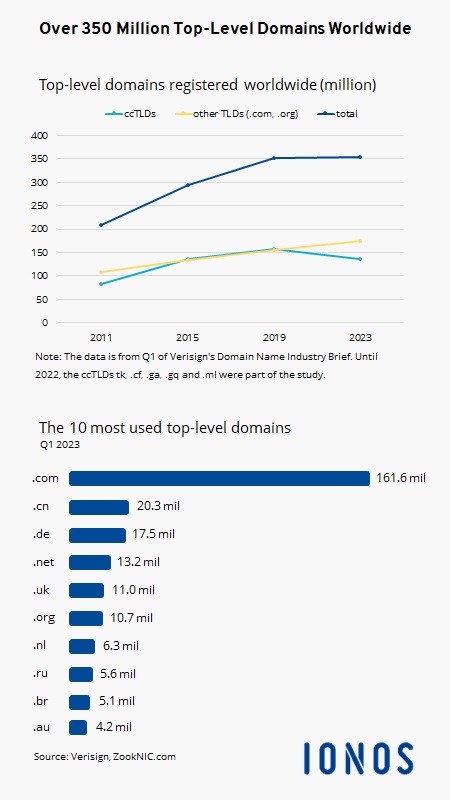
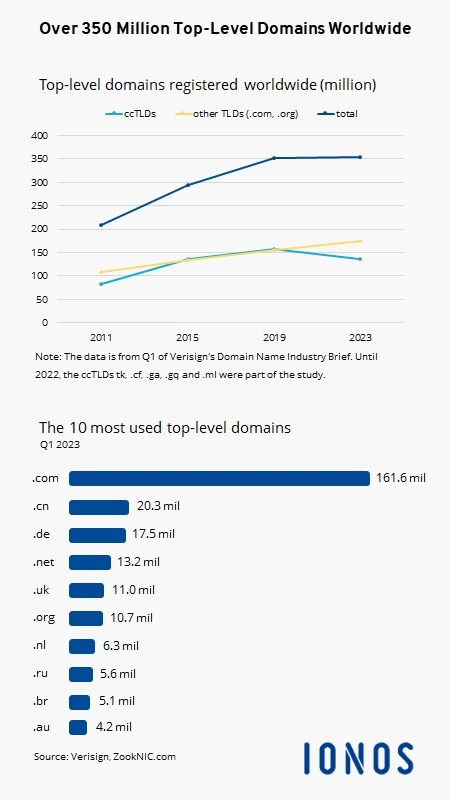
Generic top-level domains such as new top-level domains (nTLDs) play an important role in the global comparison. The most popular domain ending, which is used by over 50% of websites, is the top-level domain .com, the second is the country domain, .cn for the People’s Republic of China. According to Domain Name Industry Brief from Verisign, there are currently more than 135 million domains registered worldwide with a country code top-level domain (as of Q1 2023).
Click here, to download the infographic on top-level domains.