

What are the most popular domain extensions?

.com remains by far the most widely used domain extension, but hundreds of country-code, industry-specific and newer top-level domains are also available. Current registration and website usage data shows which extensions dominate the market and which categories are growing most quickly.
- Simple registration
- Premium TLDs at great prices
- 24/7 personal consultant included
What is a domain extension?
A domain extension, also known as a top-level domain (TLD), is the final part of a web address, such as .com, .org or .us.
The main categories are:
- Generic top-level domains (gTLDs) such as
.com,.organd.net - Country-code top-level domains (ccTLDs) such as
.us,.caand.de - New generic top-level domains (new gTLDs) such as
.xyz,.shopand.online
The IANA Root Zone Database records delegated TLDs and their registry operators. The .us extension, for example, is classified as the country-code TLD for the United States.
What are the most popular domain extensions?
There are two useful ways to measure the popularity of a domain extension:
- Website usage measures the percentage of active websites using an extension.
- Domain registrations measure how many domain names have been registered under an extension, including domains that may not currently host an active website.
These methods produce different rankings. W3Techs analyzes domain extensions used by published websites, while domain industry reports generally measure registered domain names.
Most-used domain extensions by website share
The following figures show the percentage of websites using each TLD:
| TLD | Share of websites | Meaning or market | Type |
|---|---|---|---|
.com |
43.6% | Commercial and general use | gTLD |
.org |
4.0% | Organizations | gTLD |
.de |
3.9% | Germany | ccTLD |
.br |
3.1% | Brazil | ccTLD |
.ru |
2.8% | Russia | ccTLD |
.uk |
2.4% | United Kingdom | ccTLD |
.net |
2.2% | Network and general use | gTLD |
.jp |
2.0% | Japan | ccTLD |
.it |
1.9% | Italy | ccTLD |
.fr |
1.9% | France | ccTLD |
The figures are based on W3Techs’ top-level domain usage statistics. W3Techs measures websites rather than all registered domains and excludes some sites, including domains it identifies as spam. Its percentages therefore differ from registration-based statistics.
The data highlights the exceptional position of .com. More than four out of ten websites use this extension, while no other individual TLD reaches a 5% share.
Country-code domains nevertheless occupy several of the leading positions. This reflects the importance of nationally targeted websites in markets such as Germany, Brazil, the United Kingdom and Japan.
For US businesses, .com is usually more prominent than .us. The .us extension can communicate a specific connection to the United States, but US companies commonly use .com for both domestic and international audiences. Unlike .com, .us isn’t open to everyone: registrants must meet the US Nexus Requirement, certifying a genuine US connection (citizenship/residency, a US-incorporated entity, or a documented US business presence). This makes .us unsuitable for purely international projects, and registrants should also note that .us WHOIS contact data is public — domain privacy services aren’t available the way they are for .com.
The global domain market in numbers
Registration statistics provide a broader picture of the domain market. According to the Domain Name Industry Brief, the second quarter of 2026 ended with:
| Market indicator | Registrations or share |
|---|---|
| All registered domains | 401.6 million |
.com domains |
166.6 million |
.net domains |
12.5 million |
| All country-code TLDs | 148.6 million |
| All new gTLDs | 52.9 million |
| Other legacy gTLDs | 21.0 million |
The total number of registered domains increased by 29.9 million, or 8.1%, year over year. New gTLDs recorded particularly strong growth, rising by 34.0% year over year to 52.9 million registrations.
Despite this growth, .com remains the largest individual extension. Together, .com and .net accounted for 179.1 million registered domains at the end of June 2026.
Registration figures are based on the DNIB Quarterly Report Q2 2026. Registration totals include domains that do not necessarily operate an active public website.
The figures show that the domain market continues to grow, with particularly strong gains among new generic top-level domains. The following infographic summarizes the most important market figures and the extensions that recorded the largest absolute increases.
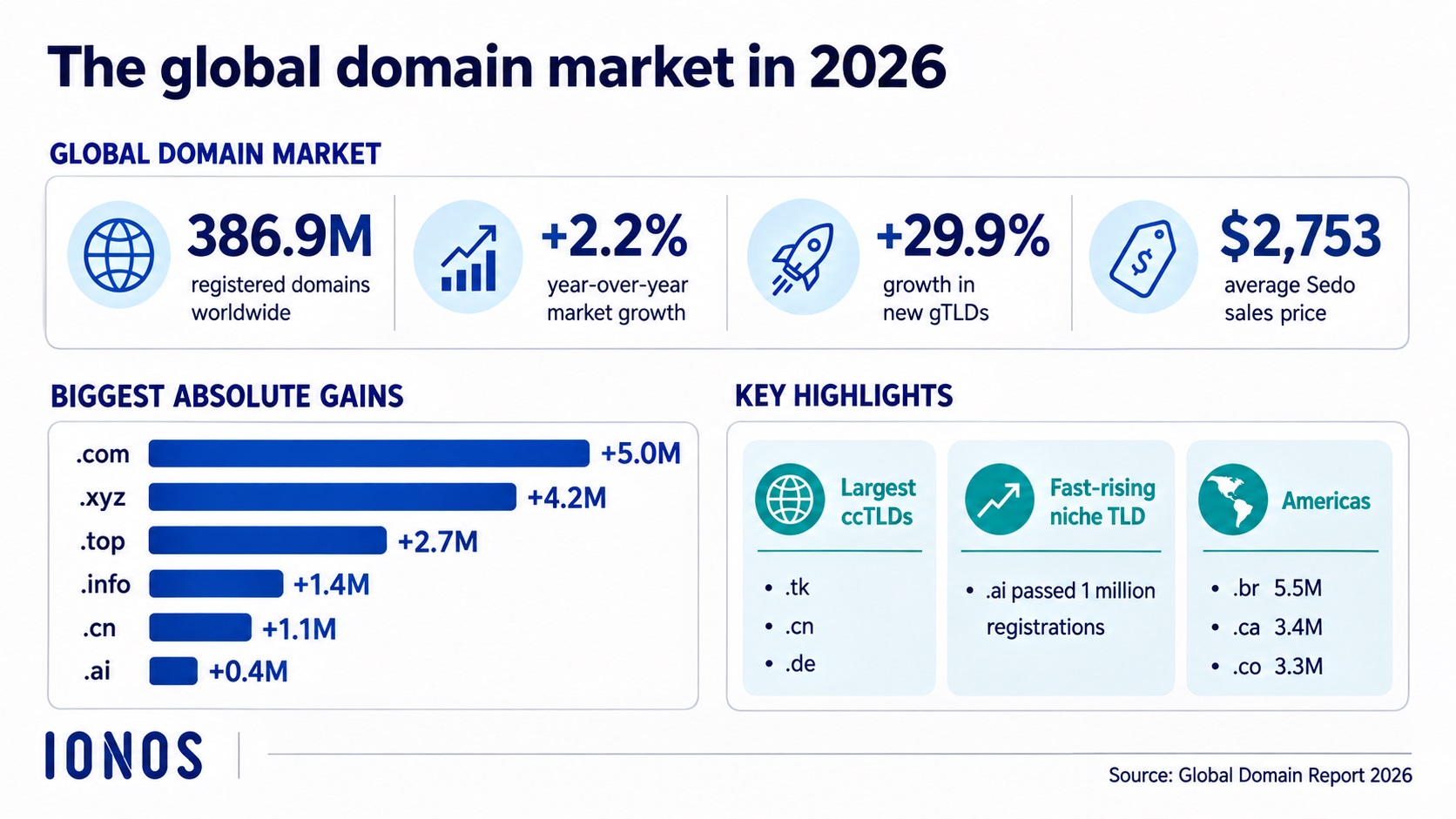
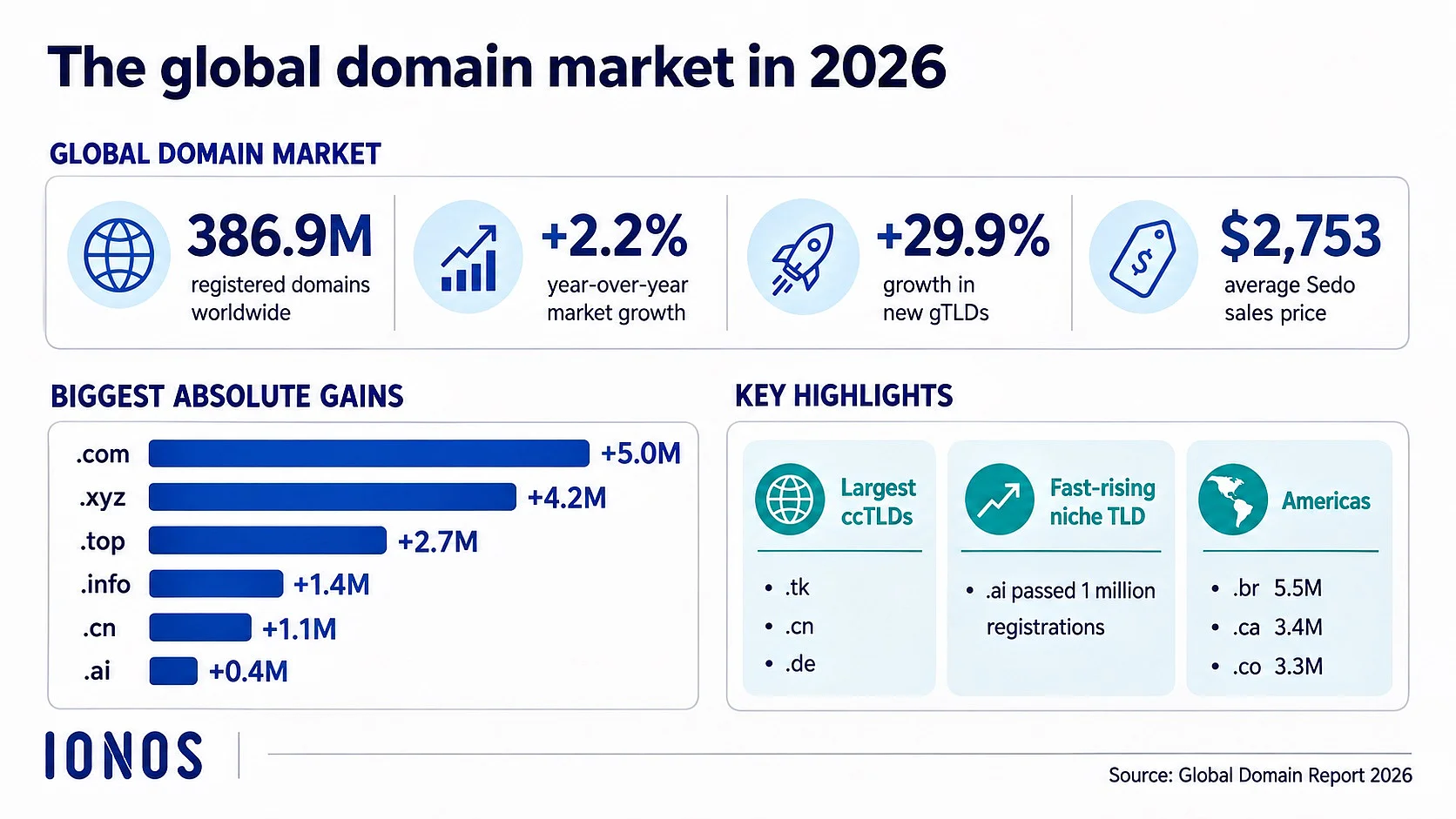
Further data, analyses and trends from the domain industry are available in the Global Domain Report 2026.
Which TLDs have the most registrations?
As of June 30, 2026, the ten largest domain extensions by reported registrations were:
.com.cn.de.net.org.uk.xyz.ru.top.nl
This ranking contains several different types of extension. .com, .net and .org are established generic TLDs, while .cn, .de, .uk, .ru and .nl are country-code domains. The inclusion of .xyz and .top demonstrates the growing registration volume of newer extensions.
Registration totals alone do not reveal how extensively an extension is used for active websites. Low introductory prices, promotional registrations, domain portfolios and redirect domains can all increase registration numbers.
What are the most popular country-code domain extensions?
Country-code top-level domains represent national or territorial markets. At the end of the second quarter of 2026, ccTLDs accounted for 148.6 million registrations, equivalent to approximately 37% of all registered domains.
The ten largest ccTLDs were:
| Rank | ccTLD | Country or region |
|---|---|---|
| 1 | .cn |
China |
| 2 | .de |
Germany |
| 3 | .uk |
United Kingdom |
| 4 | .ru |
Russia |
| 5 | .nl |
Netherlands |
| 6 | .br |
Brazil |
| 7 | .fr |
France |
| 8 | .au |
Australia |
| 9 | .in |
India |
| 10 | .eu |
European Union |
Together, these ten extensions represented 57.2% of all ccTLD registrations as of June 30, 2026.
The .us domain does not rank among the world’s ten largest ccTLDs. This does not mean that US businesses have little demand for domains. As mentioned earlier, many American companies use .com, including businesses whose operations are primarily or entirely based in the United States. A .us domain can nevertheless be relevant when a website wants to emphasize its US presence, national identity or connection to a specific American audience.
How quickly are new domain extensions growing?
New generic top-level domains were introduced to increase choice beyond established options such as .com, .net and .org.
At the end of June 2026:
- New gTLDs accounted for 52.9 million registrations
- Registrations had increased by 6.7% in one quarter
- Registrations had increased by 34.0% year over year
- New gTLDs represented 13.2% of all registered domains
The largest gTLDs included the following established and newer extensions:
| TLD | Category | Common association |
|---|---|---|
.com |
Legacy gTLD | Businesses and general websites |
.net |
Legacy gTLD | Technology, networks and general use |
.org |
Legacy gTLD | Organizations and nonprofit projects |
.xyz |
New gTLD | Technology, startups and general use |
.top |
New gTLD | General and international use |
.info |
Legacy gTLD | Information websites |
.shop |
New gTLD | Ecommerce |
.online |
New gTLD | General online projects |
.store |
New gTLD | Ecommerce and retail |
.vip |
New gTLD | Premium services and communities |
The ten largest gTLDs accounted for 88.1% of all gTLD registrations. This shows that registration volume remains concentrated in a relatively small number of extensions despite the large number of available TLDs.
Renewal rates also vary considerably. Among the ten largest gTLDs, the latest reported quarterly renewal estimates ranged from 78.7% for .net to 14.2% for .shop. A high number of initial registrations therefore does not necessarily indicate equally high long-term use.
Domain extension statistics at a glance
The latest figures show how large the global domain market has become, how strongly .com continues to dominate and how quickly new domain extensions are gaining ground.
The global domain market in 2026
- 401.6 million domains registered worldwide
- 166.6 million
.comregistrations - 43.6% of websites use
.com - 148.6 million ccTLD registrations
- 52.9 million new gTLD registrations
- 34.0% year-over-year growth among new gTLDs
- 13.2% of all registrations use new gTLDs
- 1,265 gTLD extensions delegated in the root zone
- 316 ccTLD extensions delegated in the root zone
Sources: DNIB Quarterly Report Q2 2026, W3Techs and the Global Domain Report.
Traditional vs. new domain extensions
Registration growth shows that new domain extensions are gaining ground, but traditional TLDs continue to account for most active websites and registered domains.
| Factor | Traditional TLDs | New TLDs |
|---|---|---|
| Examples | .com, .net, .org |
.xyz, .shop, .online, .store |
| Market position | Established and widely recognized | Smaller but growing rapidly |
| Availability | Short names are often registered | More naming options may be available |
| Purpose | Broad or general use | Can communicate a topic or industry |
| User familiarity | Usually high | Varies by extension |
| Typical use | Main company or organization website | Main domain, campaign page, product site or redirect |
| Registration trend | Large and relatively mature market | 34.0% year-over-year growth in Q2 2026 |
| Renewal behavior | Often comparatively stable | Can vary significantly by TLD |
A traditional extension is generally suitable when broad recognition is important. A new TLD can be useful when the extension adds meaning to the full domain name or when a suitable .com address is unavailable.
Which domain extension should you choose?
The most popular domain extension is not automatically the best one for every website. The available data nevertheless provides several useful reference points:
.comhas the largest registration base and is used by the highest share of websites.- Country-code domains are important for websites that focus on a particular national market.
- New gTLD registrations are growing rapidly but have widely varying renewal rates.
- A high registration total does not necessarily mean that an extension is widely used for active websites.
- US businesses generally rely more heavily on
.comthan on the US country-code extension.us.
For a US business serving a broad market, .com remains the most established choice. A .us domain may be appropriate when the connection to the United States is central to the website’s identity. New extensions such as .shop, .store, .tech or .online can work when they clearly describe the project and form a concise, memorable web address.
The final choice should therefore be based not only on popularity but also on availability, audience, brand fit, renewal costs and the intended use of the domain.
Reviewers

Julia Hertler
With over 18 years of experience in content marketing, Julia Hertler has deep expertise in digital communications. For the past 10 years, she has specialized in the areas of domains and hosting at the IONOS Digital Guide, making complex technical topics easy to understand.

Christian Heldmaier
Christian Heldmaier is an experienced online marketing and SEO specialist from Karlsruhe. He has been working as an SEO Manager at IONOS since July 2020.