

Registering an emoji domain – the way forward or just a gimmick?

Emoji URLs seem to fit perfectly into this day and age: they are funky, striking, and stay in your mind. The younger generation has always managed to incorporate smileys into their everyday life, since they are all over message services and social networks. After the renowned Oxford dictionary chose the laughing with tears emoji to be the word of the year, it seems the funny images are more popular than ever.
So, are emojis a logical development in written communication? They are already vital for communication among youngsters. In the meantime, they’re even popping up in browser address-bars: as emoji URLs. How do you register an emoji domain? What benefits does it have? And where does this trend come from?
From emoticons to emoji domains – the story of the digital smiley
Emojis originate from the dark times before digital communication. In 1982, the characters ':-)' were entered and that’s where everything began. The computer science professor Scott Fahlman used a bulletin board on the intranet of the University of Pittsburgh where he worked. This bulletin board could be described as the forerunner of today’s discussion forum. He created the smiley out of a series of characters and made the first ever emoticon – the basis for the emojis used today from pixels or vectors. These are visually more appealing than the plain emoticons from back then.
In the internet’s earlier years, emoticons were the only way to get a feeling across in comments, posts, or e-mails. The emoticon language quickly developed a life of its own and spread globally thanks to the emerging mobile SMS communication. Smileys were used even more frequently and became more complex in order to express more complicated emotions.
From a linguistic point of view, the emoticons’ non-verbal 'language' is particularly interesting, since it’s been possible to use faces, animals, plants, or entire image compositions to convey emotions for a long time. Since the 1990s, abstract ASCII characters have been used to create works of art, which have been spread over message boards and discussion forums. There are practically no limits when it comes to the Japanese emoticons of ASCII art e.g. Kaomoji. A prominent example of this type of art is the so-called table flip ノಠل͟ಠ༽ノ-︵-┻━┻, which symbolizes the angry turning over of a table.
Emojis – the graphical development of emoticons
The trend towards graphically appealing emoticons started in the late 1990s in Japan. The technical advancement of mobile phones and their displays made it possible to show the right smileys instead of the binary character strings that were originally used to express feelings or moods. Images started to be used to respond to short messages, because the Japanese mobile network was becoming overloaded with over 80 million manic writers. The images were therefore developed to relieve the network.
The word 'emoji' is a neologism consisting of the Japanese words 'picture' (e) and 'characters' (moji). The inventor of the modern emoji was Shigetaka Kurita, who worked on the ambitious i-mode project in the late 1990s. This was the foundation of the first large mobile internet platform for daily newsfeeds, weather reports, entertainment, event reservations, and more. Due to the modest device hardware and the limited data transfer possibilities, some limitations had to be allowed. One example is that only adjectives could be used for the weather forecast. To get around this, images such as clouds and suns could be used, and this would reduce the transmission volume of the i-mode provider.
Why were emojis developed in the first place?
One of the reasons for creating and further developing the emojis comes down to the peculiarities of the Japanese language. Without being able to have a face-to-face conversation, some Japanese phrases can end up being misinterpreted. Without being able to see gestures and facial expressions, a casual sentence can be interpreted positively, negatively, or disinterestedly. Kurita decided to attempt the task of drawing human facial expressions in a small box consisting of 12 x 12 pixels and use 176 characters to turn human emotion into mobile electronic communication.
Since the technical capabilities weren’t very advanced, the results weren’t exactly visually appealing. Many emojis could only be identified if you used your imagination and even then, the meaning wasn’t 100% obvious. Scott Fahlman, the inventor of the emoticons, came to the conclusion that the creations were 'rather ugly'. The success of i-mode, however, prompted other Japanese mobile providers to copy this emoji concept. This resulted in many different emoji systems that weren’t compatible with each other. It was only in 2012 that the different emoji systems in Japan were standardized to reduce errors when sending and receiving emojis using different providers.
Emojis have become more and more popular since they were implemented internationally on iPhone in iOS versions 5 in 2011. Afterwards, they were adapted to Android devices and other mobile operating systems. Android, however, limited itself to one emoji system. It’s difficult to imagine a time when these colorful little graphics weren’t all over Twitter, Instagram, Snapchat, and other social media platforms.
How are smiley URLs technically possible?
ICANN deemed it a technical possibility to create domain names with non-ASCII characters as early on as 2003 with its 'Internationalizing Domain Names in Applications' system or 'IDNA' for short. This was long before the first emoji URL was registered in 2011.
IDNs ('Internationalized Domain Names') can be created using Unicode, the widespread, international coding standard with over 120,000 characters from dozens of scripts and symbol sets. Virtually all web browsers already support Unicode. IDNs enable most non-ASCII characters in the Unicode repertoire to be displayed as ASCII-compatible character strings. Since the latest Unicode standard also contains many emojis, the door for emoji domains is theoretically open.
DNS uses a limited amount of the already relatively limited ASCII character set. Punycode is used to translate a domain name that contains complex Unicode characters. A Punycode string consists exclusively of the letters A-Z, the digits 0-9 and the dash symbol. Because this translation takes place in the web browser and not in the DNS, the IDNs work without further changes. Practically every conceivable character can be converted into a URL after being converted into Punycode. Registering emoji URLs is now possible.
Setting up an emoji URL– why not use .com?
It isn’t possible to set up an emoji URL on large domains such as those with .com or .net endings. For these domains, you can only use Latin characters when you register. This restriction is to limit phishing attacks on users. In fact, there are other Unicode characters that are similar to the letter 'A'. A phishing website might therefore try to imitate characters from a normal site and lead the user to a malicious website.
Newer, country-specific domains, on the other hand, are not quite as selective as the .coms and .nets of the world. Countries such as Samoa (.ws) and Tokelau (.tk) allow emojis to be used when registering domains, although this might not be the case forever. Laos (.la) initially accepted emojis, but then decided against it. It therefore makes sense to be quick if you plan on registering an emoji domain.
Setting up an emoji URL: how are smileys added?
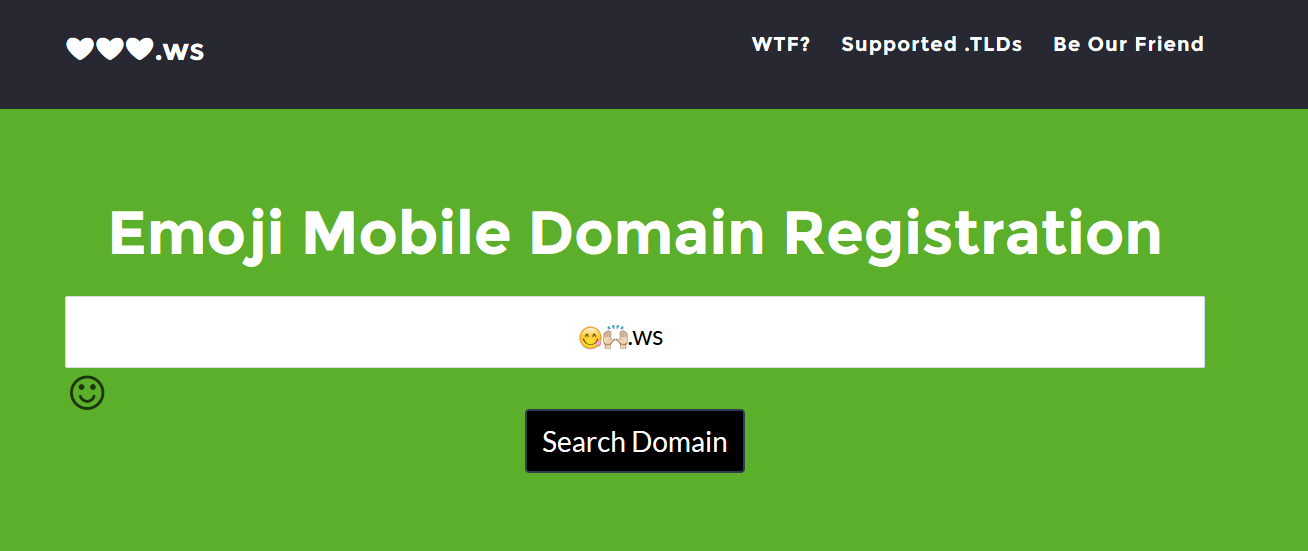
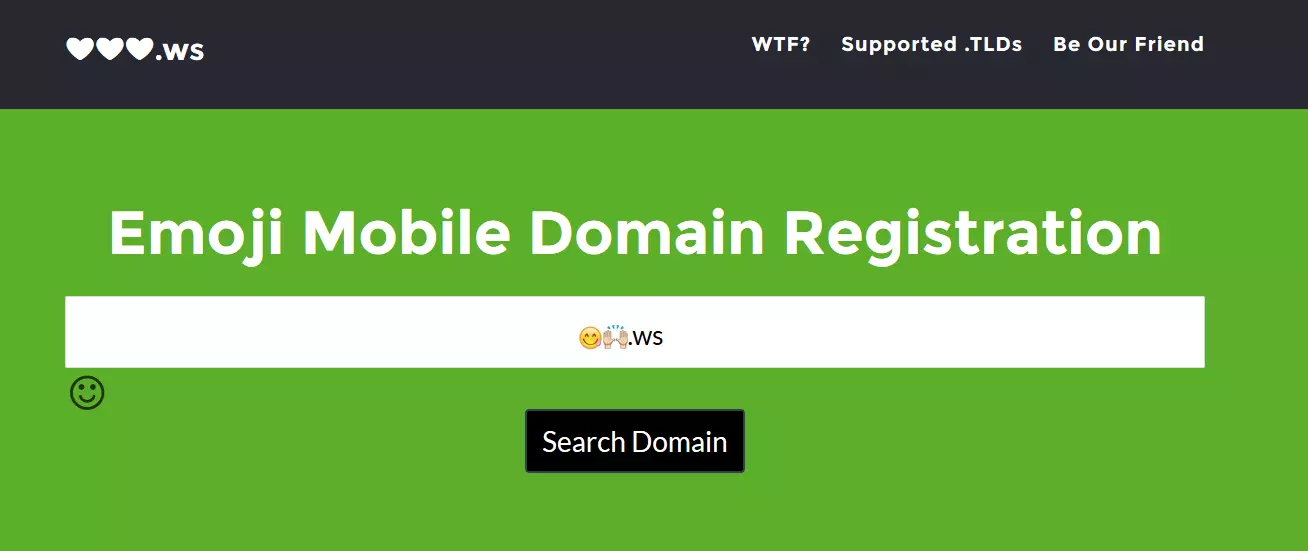
The fact that many emoji domains have not yet been registered certainly has something to do with technical difficulties encountered during setup. On most keyboards, especially desktop computers, there are no individual keys for emojis. So how is it possible to register smileys using a conventional keyboard? The solution: Punycode. Simply put, Punycode is only one of the ways to display complex characters such as emojis, accented letters, and Asian characters – using the basic set of regular Latin characters that any domain name system allows. Punycode is usually used to display Asian characters such as Kanjis and accented letters correctly. However, it can also be used to display emojis in exactly the same way as the regular special characters. Browsers see this code and insert a Unicode character, such as an emoji, in its place. You can use Punycode to translate heart smileys or any other emoji into a text string that causes the browser to display the small graphics. This is easily done by selecting the desired emoji (easier to do on your smartphone), and inserting it into a Punycode converter. The resulting string can be used to register an emoji URL with the .tk or .ws ending.
The benefits of smiley URLs
What is the advantage of buying a domain name with an emoji included in it? It could be amusing and good for usability when a burger emoji or a crown emoji is used by a certain fast food chain. If emoji domain names are also released for classic endings such as .com, .net, etc. this could be a great opportunity for companies and brands to let their creativity flow and to integrate effective emoji advertising into their marketing.
The smiley URLs also appeal to private users. Small businesses can draw attention to themselves through the original address of their web presence, but personal blogs can draw even more attention to themselves through versatile smileys.
The ICANN develops IDN solutions where complex algorithms and rules are used to make localized domain names more recognizable in character sets, such as Chinese and Arabic. The industry is already accepting these new names, and at the same time, is striving for these innovations to be universally accepted by software and systems so that there are more varied domain names.
Why emoji domain names can still be problematic
Even though the ability to combine emoji domain names with all regular internet addresses is fascinating, there are many technical and legal hurdles that need to be overcome if you want to implement emoji URLs on a global scale while maintaining the same level of security and integrity of classic internet domain names. In fact, IDNs are a good workaround for the restrictions imposed by DNS characters. With their implementing, emoji URLs wouldn’t exist. Nevertheless, there are some disadvantages associated with emoji domain names.
On the one hand, there is the problem of the most prominent endings such as .com and .net not supporting any emojis, and it is not clear whether they ever will. Instead, emoji URLs can only be implemented with certain country-specific domain extensions. Therefore, Coca Cola, for example, has already registered all its emoji names with the .ws domain extension, which is the official extension of Samoa. According to Coca Cola, the ending stands for 'we smile'.
On the other hand, browser support is still too unstable. Some browsers (or older versions of common browsers) don’t yet recognize emojis and many users don’t have an emoji keyboard, which needs to be installed beforehand. Even if an emoji domain registration is successful, many still won’t be able to access the site. This results in complicated usability, which is the biggest problem when it comes to emoji domains. While you can always enter the URL using a Puny-encoded version, the smiley URL’s playful character still comes across.
Suitable keyboards and plugins will one day be standard, but until then, emoji domains are a cool gimmick, which can be used as alternatives to the classic text URL, ensuring your website receives a lot of attention.
Find out here if your desired domain is still available and secure your domain now with IONOS: