E-commerce: features and developments

E-commerce, electronic commerce, internet, and online commerce: all these terms stand for the buying and selling of goods or services using electronic information technology. While the internet is the core technology, other forms of digital data transmission and processing are also used, such as mobile radio, electronic customer databases, or accounting software. What is e-commerce, what advantages and disadvantages does it have, and what are the current trends in online commerce?
- Get started with stunning designs
- Grow with advanced marketing and admin tools
- Sell on social and online marketplaces
What is e-commerce?
In addition to the purchase transactions itself, electronic commerce includes all processes that initiate and execute a purchase. An online shop functions as a central sales platform on which prospective buyers can not only browse the product range but also order and pay via a digital system. An electronic inventory control system registers the sold products and updates the stock. An RFID chip tracks the shipping route while CRM systems make it possible to stay in touch with the customer.
The more precise definition of e-commerce considers it as just one element of an e-business; an e-business includes all automated business processes in which electronic information and communication technologies are used. The objective of using largely automated business processes is to make work more efficient and increase sales.
Digital technologies form the basis of electronic commerce. Both providers and customers exchange data digitally as part of e-commerce, for which, many different technologies can be involved: the spectrum ranges from radio technology (e.g. Bluetooth) to highly complex systems based on artificial intelligence (AI). In addition to communication technology, such as the internet and telephony, electronic databases and text processing software are also used, social media and television serve as advertising channels, payment transactions are processed via online banking, and chat bots take over customer service. This creates a widespread digital infrastructure of wireless or wired networks. The common denominator is the fact that spatial distances are overcome. E-commerce makes it unnecessary for consumers to go, for example, to shop in a physical store, or to seek face-to-face advice. However, sometimes this completely replaces the physical contact aspect of the shopping experience.

E-commerce, also known as electronic commerce, is the term for all processes connected with the purchase and sale of goods and services that are handled via digital systems – be it the internet, computer-supported databases, or accounting software.
Characteristics of e-commerce
The purpose of online commerce is to optimize sales processes to generate more turnover for companies. The aim is to make all sales-related operations more efficient and to reduce all associated costs. With the help of the internet, many companies have gained new sales channels with online shops, marketplaces (e.g. Amazon), or auction platforms (e.g. eBay). Through social media, digital ads and newsletters, businesses can gain new customers and maintain existing ones with relatively little effort by using an automated CRM system.
Online retailers often decide which technologies and sales channels they use depending on the industry and business objective. It is by no means necessary to digitalize all processes. There is a growing trend towards multi- and cross-channel marketing, which uses a number of selected channels at the same time. A furniture store, for example, can gain customers with an online presence but should retain a stationary store, or at least a showroom, where customers can inspect their favorite kitchen line or pick up furniture ordered online themselves to save on shipping costs.
One of the key elements of electronic commerce is the strategic coordination of all channels. The electronic technologies used must be integrated as precisely as possible with the supply chain – from logistics and marketing to customer service. For example, a product advertised on the website must be in stock in the warehouse.
Electronic commerce serves to increase efficiency. For example, online commerce speeds up sales processes, as customers can easily browse through the range of products from their smartphone or computer and order at any time. By automating processes, computer-supported systems can both save time and reduce personnel costs. And if you don’t have a physical store, e-commerce means you don’t even have to pay rent. The distribution of digital offers via the internet is far cheaper than the distribution of offers via post offices or other comparable service providers. In addition, companies can also use e-commerce in order to, for example, cost-effectively open up new markets across regions.
E-commerce allows any kind of business transaction. For example, transactions can be processed in both B2B areas (business to business) as well as B2C (business between companies and consumers).
Advantages of electronic commerce
Companies can benefit from e-commerce in many ways. The advantages include the following:
- Overcoming spatial distances: the internet makes retailers independent of a fixed sales location. They can open up new sales markets across different regions or countries. Although the distribution of physical goods continues to require the expansion of logistics capacities, new locations do not need to be opened. Online communication can even eliminate the need for business trips. For online consumers, the advantage of e-commerce is that they can choose from a huge range of products and compare quality and prices directly.
- Time efficient purchasing process: e-commerce allows for instant shopping without delay. Interested buyers do not have to visit a physical shop to purchase a product. Instead, they can order items around the clock either from the comfort of their home or while on-the-go. As soon as the order has been placed, consumers will receive a confirmation e-mail via the shop system. Service providers can also offer their services online: for example, a travel agency can advise interested parties online and accept bookings.
- Electronic commerce reduces transaction costs: e-commerce may eliminate the need to open new company and warehouse locations. Inventory, cash, and shop monitoring systems automate inventory and cash flow management. This facilitates the coordination of different company departments and offers room for new business models. To increase competing power, small- to medium-sized businesses can now enter into partnerships with online service providers. Instead of using their own online shop they can opt for Amazon Marketplace or the online auction platform eBay. Here, businesses can outsource parts of their sales and at the same time, benefit from the high reach of such marketplaces.
- Simple omni-channel and multi-channel marketing: it pays to connect the online and the offline worlds and to take advantage of multiple channels. By using both an online store and social media alongside your physical store, there are more touchpoints for the consumer to decide or act upon your offer.
- High-reach advertising: social media, blogs, and a company website provide cost-effective ways to draw attention to your offer. Companies active on Facebook benefit from the network’s wide reach. Search engine marketing and online advertisements can often be successfully implemented with a small advertising budget as opposed to traditional print or TV advertisements. Additionally, online advertising is easier to personalize than traditional ads.
- More customer proximity: social media allows businesses to establish personal contact with potential customers and to improve the company image. Tracking and analysis tools are useful for businesses in order to collect personal information and create precise customer profiles. This makes it possible to plan advertising campaigns and align the product range according to demand. By taking advantage of CRM systems businesses can easily stay in touch with customers.
- High customer satisfaction: e-mail support, online contact forms, or instant chats eliminate customers’ inhibitions when it comes to seeking advice. This recent technology allows customers to make inquiries around the clock and get quick answers in return. Simplified ordering and payment processes reduce the effort for companies and customers alike.
- Focus on your business while we set up your shop
- Copywriting, SEO, maintenance and more included
- Learn how to manage your site with free training
Disadvantages of online commerce shops
Despite the many benefits of e-commerce, it can also have a number of disadvantages for companies and customers. Whether or not these arise, depends largely on which industry a business is in and what capacity it has.
- Complex implementation: building a digital structure takes time and money. Not every small retailer has the necessary know-how or the human and financial capacities to set up an e-commerce store and regularly manage social media channels.
- Effort and expertise for advertising: the extent to which online marketing saves costs depends on the industry. In highly competitive markets, companies also have to vie for attention on the web. A one-time-only ad campaign with Google AdWords simply won’t suffice. While smartphones and social media have shortened users’ attention span, professional search engine marketing, in turn, often requires expertise or more costly support from a specialized agency. In this sense, small companies often cannot compete with large corporations.
- Increased competition and pricing pressure: global online trading is increasing the number of competitors. If supply exceeds demand, the companies in question will be under enormous pricing pressure. Price comparison websites make it easy for consumers to choose the cheapest offer. In the fashion sector for example, low-cost production facilities in Asia are increasingly taking over their entire distribution operation, even without intermediaries. They often waive customs and shipping costs for their customers and offer their products on the internet at an unbeatable price. Depending on the industry, this makes it very difficult for most local companies to compete with such price wars and turn a profit.
- Lack of personal advice: not all online retailers can provide a 24-hour customer service or have the resources to integrate service chatbots into a website. In contrast to a fashion boutique, there is no direct contact with customers. In most cases, from the customers’ perspective, a sales consultation by trained personnel is more valuable and target-oriented than, for example, an online chat. E-commerce cannot replace on-site, face-to-face consultations, especially for products and services that may require a great deal of explanation, for example, with trekking equipment or medical devices.
- The demise of stores: the booming internet trade comes at the expense of the brick and mortar retail stores. According to The Atlantic, 2017 saw, amongst other things, the closure of 100 Sears’ stores, the liquidation of Sports Authority, and the bankruptcy of Payless. The continued decline of the brick and mortar stores, will leave cities desolate.
- Payment and data security: internet users tend to shy away from online shopping for security reasons and would rather not share personal information and payment data online.
Current electronic commerce trends
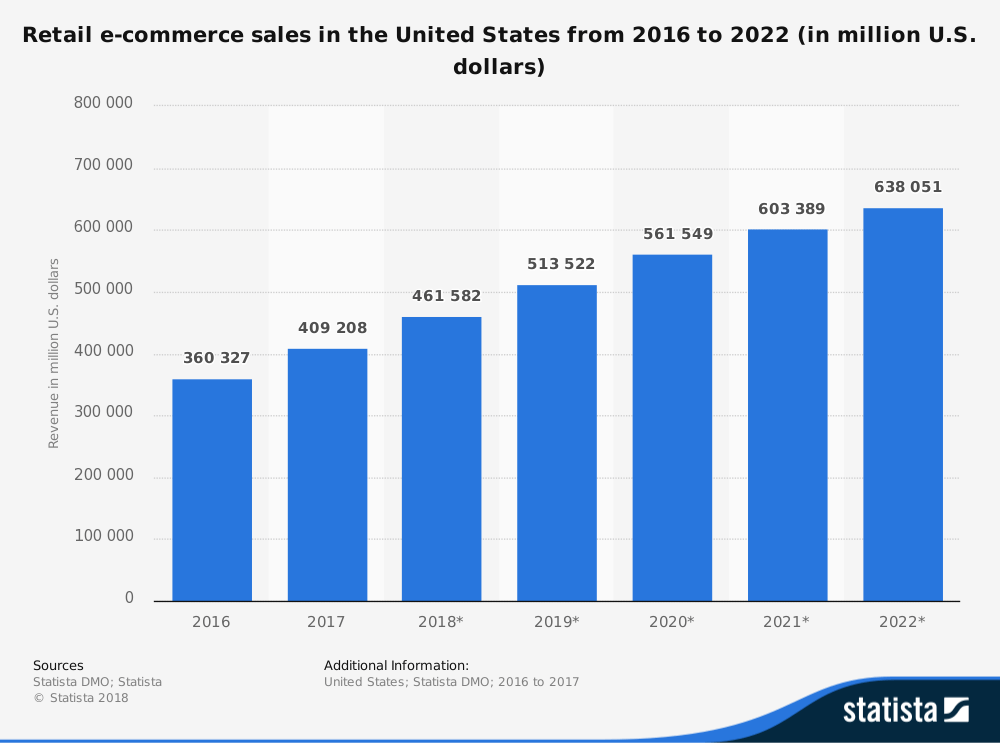
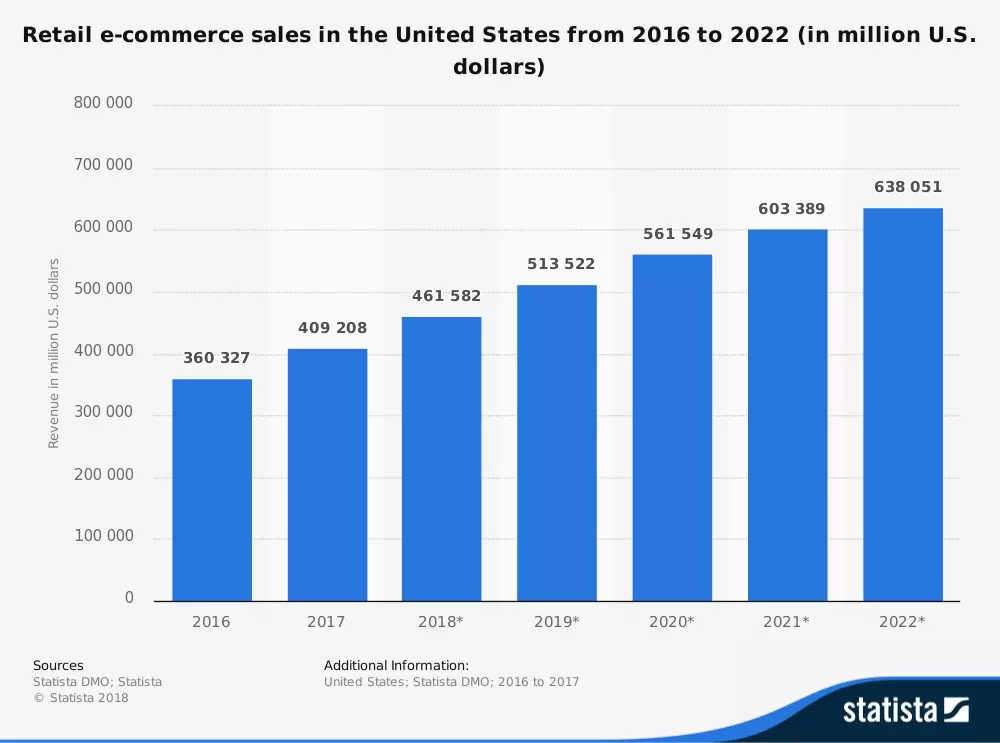
Online commerce has been booming for years and with the latest technological developments, it continues to gain momentum. Statista reported the 2017 online sale of physical goods in the United States at 409,2 billion U.S. dollars and a projected worth of 638 billion U.S. dollars in 2022. Apparel and accessories retail alone has a projected worth in 2021 of 121 billion US dollars.
Online shopping is by no means limited to the younger generation. Age differences are playing less and less of a role in e-commerce: many over 65 years of age have an affinity for the internet. According to the Bitkom survey, 79% of this age group have made at least one online purchase. With that in mind, companies that tailor their marketing strategies specifically towards younger digital natives waste a lot of customer potential. Older people buy a lot of their medication online and have it delivered to their door, but when it comes to clothes and shoes, they tend to prefer brick and mortar shops. By contrast, 14 to 29 year olds are much more likely to go on an online shopping spree.
Individualizing the shopping experience is a growing challenge for many online shops. The trend is therefore going towards personal offers and advertising. Many users want to purchase a tailor-made gift voucher or book a very special trip. Loyal customers expect discounts, an individual approach, and appropriate shopping recommendations. Analysis and tracking tools like Google Analytics make it possible to collect personal data. By registering the purchase and surfing behavior of your customers, you can personalize their next visit to your online shop. Retailers can learn more about their customers’ product preferences as well as the prices they are willing to pay for specific products.
 To display this video, third-party cookies are required. You can access and change your cookie settings here.
 There is also a lot of progress being made in the virtual reality field. This technology allows users to fully immerse themselves in a product world. One example of this is the furniture store IKEA’s immersive showroom. This allows customers, who are perhaps still undecided about certain products, put together their home furnishings virtually and, for example, test which fabric upholstery looks good on the living room sofa depending on what time of day it is.
Online shopping via mobile devices is increasing. Within a few years, the number of mobile purchases has more than doubled. To keep up with the trend, it’s important to design websites responsively, i.e. adaptable to different output formats. This simplifies navigation via the small display of mobile devices and shortens loading times. According to Statista, almost 82% of larger online shops already offered their products via mobile shops in 2016.
At times, even bad network settings can cloud mobile shopping, but with the new 5G mobile communications standard, mobile customers will continue to gain in importance. Advertising that reaches consumers around the clock in the mobile sector is becoming increasingly lucrative as a result. Geo-targeted data also improves targeting, allowing companies to make location-based offers or lure customers to the nearest store.
Despite these developments, however, the stationary trade has by no means had its day. More and more customers prefer to switch between online and offline services. Omnichannel marketing has become the order of the day. Even pure online retailers increasingly sell their fashion in outlets while others offer showrooms. The “click and collect” service allows customers to test a product, get personal advice, or pick up goods ordered on the internet without shipping charges. Stationary shops and service providers are increasingly offering the possibility of ordering over the internet or receiving advice via Skype. There are some shining examples of omnichannel brands that have seamlessly integrated numerous channels into their marketing campaign to stay ahead of the competition.
By using multiple channels, businesses can reach more prospective buyers and attain a higher level of customer satisfaction. A seamless transition between online and offline is also ensured by various innovations in the field of the internet of things. Individual products or entire product shelves are sent to smartphones via so-called beacons, which are based on radio technologies. An app registers the signal, provides the customer with exact product information, and draws customers’ attention to the appropriate shelf – e.g. for organic food.
The internet of things will open up completely new opportunities for e-commerce in the future. The number of everyday things permanently connected to the internet and smart household appliances is already increasing. For example, a smart refrigerator uses sensors to indicate when certain foods are running low and can order them independently. IoT devices maximize personalization in online shopping and advertising, as they can identify users’ shopping patterns and trends.
In warehouse management, as part of electronic commerce, goods equipped with sensors and connected to the internet facilitate work processes. They keep track of stock in real time to prevent popular products selling out.
E-commerce will therefore continue to gain in importance thanks to ongoing progress and innovative technologies.