

Lead management

The term lead management describes measures in the course or customer acquisition. The aim is on the one hand to convert potential customers into buyers and to maintain contact with existing leads, and on the other hand to analyze efforts correctly.
What is lead management?
Lead management deals with all efforts and measures related to leads (contact initiation in marketing or sales). Every non-binding contact has the potential to become a paying customer. The aim of lead management is to exploit this potential, turning a person who has shown interest in a business relationship into a paying customer.
Lead management can be subdivided into different phases, which represent certain aspects around the relationship of a company to its potential customers. At the very beginning, the aim is to win potential customers for one’s own products – usually through marketing measures. Interested parties distinguish themselves as leads by the fact that the company has contact data from them – for example, in the form of an e-mail address. However, further information on interested parties is always welcome, as this simplifies the process of making contact and allows you to successfully individualize further contact.
The next step is to expand interest with measures tailored to the customer. It is therefore an important aspect of lead management to maintain an overview and to proceed with the right degree of caution. A lack of contact with a potential customer will make them lose interest. In return, too much contact might result in the potential customer getting frustrated. In order to find the right balance, lead management relies on scoring. Leads receive a value, which can help you orient your efforts towards them.
However, analysis goes even further. The success of marketing measures can be determined by precise observation in the course of lead management. The analysis to assess the return on investment: Do the advertising measures used bring the desired success? Such findings make marketing more efficient. In the last step, the lead is passed on: It is then the task of the sales department to stimulate a purchase. In the best case, a conversion follows: The conversion of the prospective customer into a real customer.
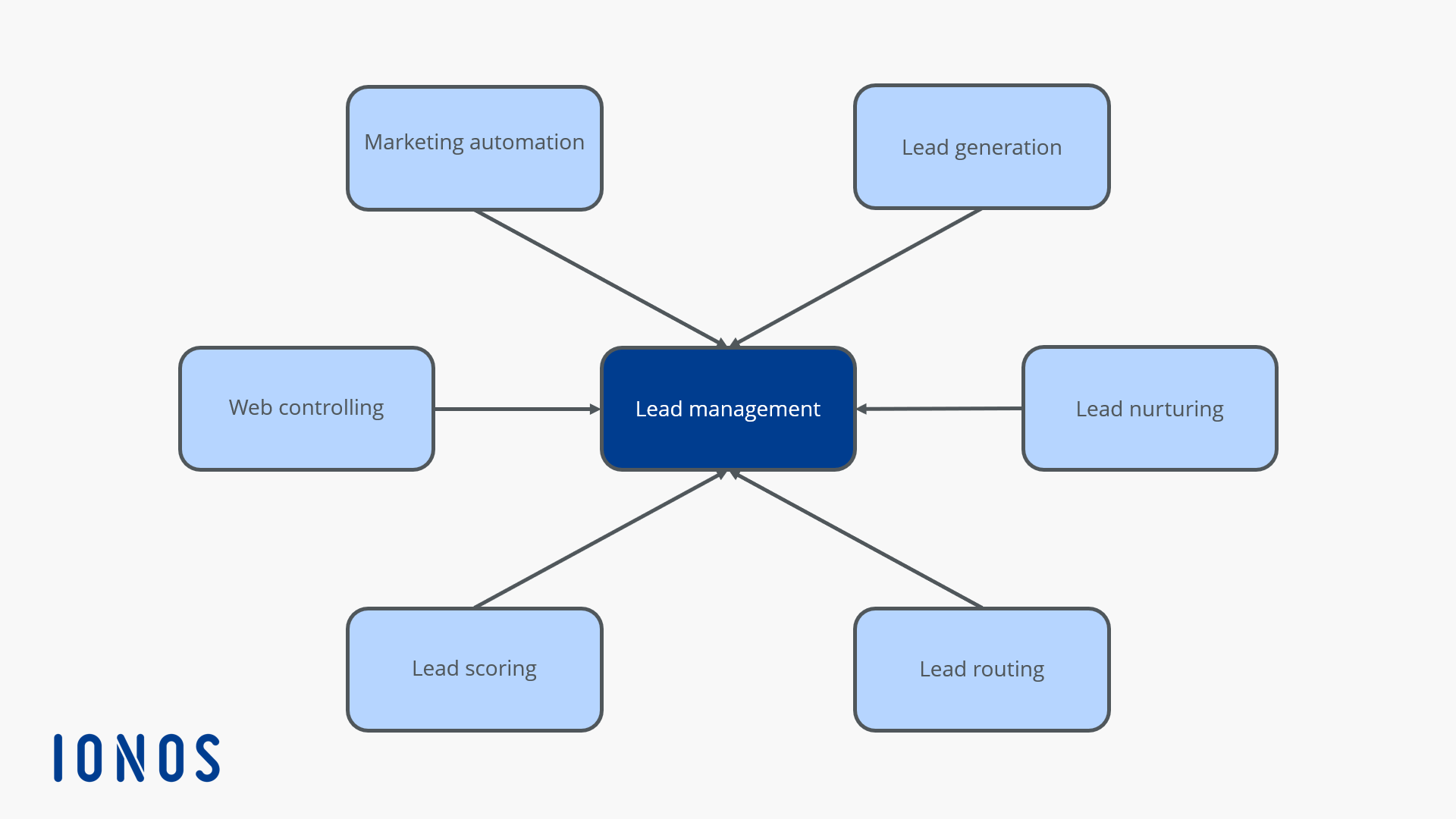
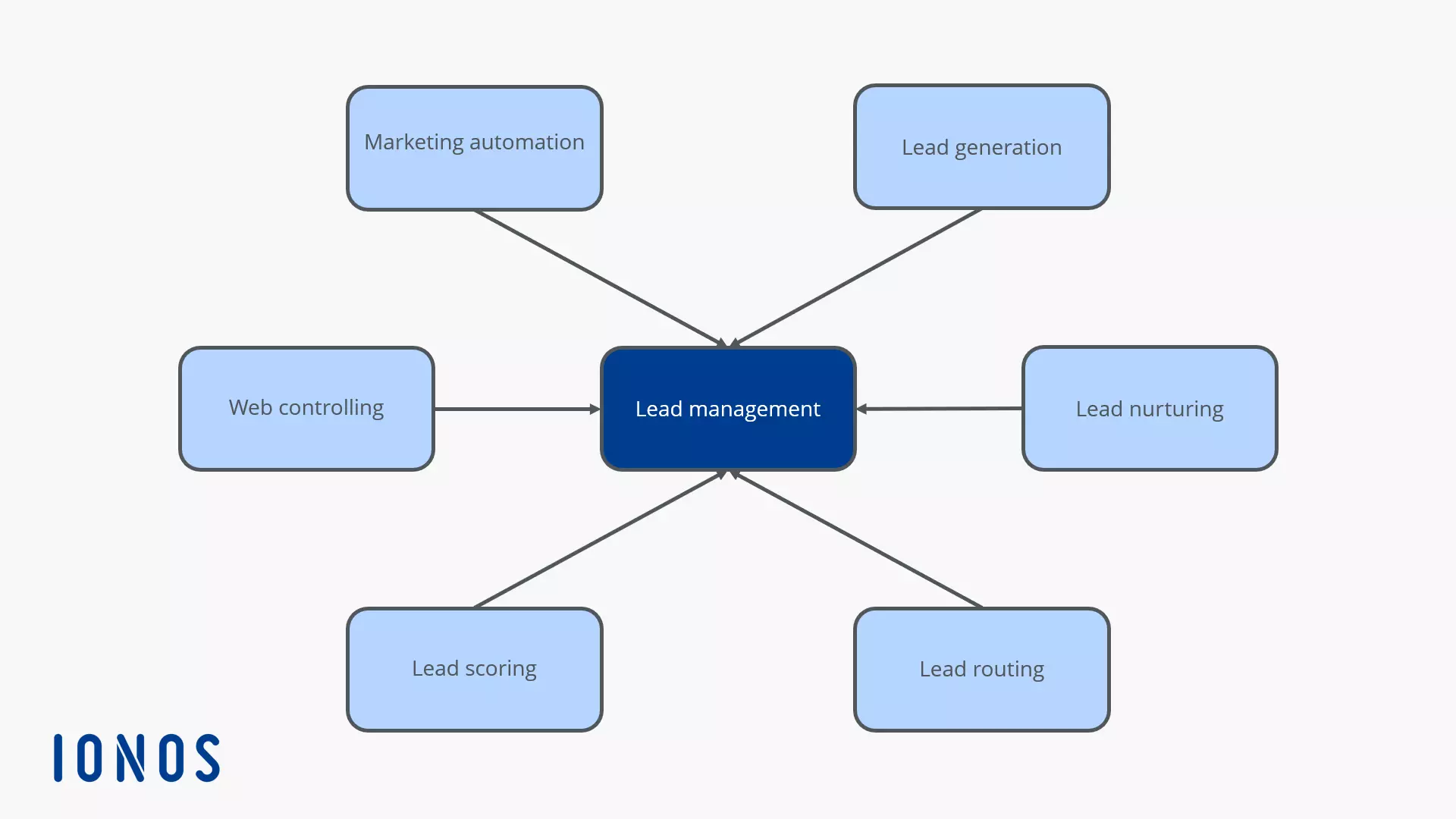
An overview of the individual phases of the lead management process:
Attracting prospective customers
Lead generation (also referred to as lead generation) means acquiring potential customers. The task of lead generation is to identify high quality leads and win them over for the company. The aim is to build up a large customer database with as much data as possible so that customers can be contacted later on. There are many ways to generate leads in online marketing. Classic lead generation, for example, occurs when you register for the company newsletter or register on a website for the first time. Incentives, such as discount vouchers, coupons, and competitions, are still popular methods of generating leads.
Caring for contacts
Lead nurturing is all about maintaining your contacts i.e. contact management. Once a lead has been successfully generated and the contact has been added to the database, the contact may still not be anywhere near to making a purchase – they need to be persuaded. This is the time to address potential customers with the right information and advertising at the right time. It is very important for the content to correspond to the respective point in the customer journey.
Lead nurturing takes places in every phase of the lead management process: when acquiring new customers, when keeping existing customers, and when winning back inactive contacts. The goal of lead nurturing is to provide more qualified leads and, above all, better qualified leads, which is why additional development of leads is important. In the end, companies expect shortened conversion processes, better conversion rates, and an optimal return on investment (ROI).
Analyzing leads
Lead scoring is when already qualified contacts are evaluated. This helps you to work out how high the chances of a successful transaction are. The quality of a contact or request is important for accessing how interesting a lead is for the particular sales target. Lead scoring usually takes place according to certain quality factors. What’s particularly important for a high lead score is how complete and up-to-date the profile is. But the response to the measures taken in lead nurturing is especially crucial.
Forwarding lead routing to interested parties
If a lead has reached a pre-defined threshold value during lead scoring, the lead is handed over to the sales department – this process is referred to as lead routing. Employees in sales need all relevant information and contact details of potential customers to adapt their sales strategy accordingly. They then initiate the measures previously decided upon so that they can successfully complete the buying process.
How does successful lead management work?
In addition to constructive and efficient cooperation between sales and marketing, the basis for good, promising lead management is especially high-quality, customized content. Offers and content must match the respective phase in the customer’s buying process. The customer should be addressed at every step of their journey and be offered concise content. Even at the beginning of the buying process (during lead generation), the right content is critical to success. During this phase, the potential customer needs to get interested, by using checklists, e-books, or white papers.
When it comes to lead nurturing, the aim is to try to transfer competence and expert knowledge bit by bit to create a trusting relationship. If you provide content with added value from the start, nothing can stand in your way of successful lead management. This way, you create a solid foundation to turn a prospective customer into a buyer. The sales staff must also make a positive impact on the purchasing decision by using convincing offers.
What can lead management do?
Lead management is about the controlled transformation of prospects into customers. Instead of leaving it to chance or the potential customers themselves to decide whether to make the purchase, lead management is an attempt to influence the decision whether to make the purchase in a targeted manner. We have clearly summarized the advantages of the individual lead management measures in the table below.
| Service | Description |
| Acquiring leads | Lead management develops functions to collect the data of interested parties. This works with online forms, for example. |
| Managing leads | Databases can be used to organize and prepare all functions neatly. |
| Expand leads | Since lead management gives you a good overview, you can make effective contact with potential customers. |
| Evaluate leads | Through the detailed analysis of leads, one can work out how likely a conversion is. |
| Check marketing | Since lead marketing is an interface between marketing and sales, the marketing efforts should be evaluated. |
| Attracting customers | The reasonable handling of leads increases the probability that they will become customers. |
| Automate actions | Lead management makes it possible to collect information that can then be used for marketing automation. |