

Marketing to go: mobile advertising

Three quarters of all mobile phones sold are capable of connecting to the internet, and the number of people who take advantage of this function to shop for goods and services online is constantly increasing. Thanks to these developments, smartphones are slowly becoming a portable replacement for the desktop computer, posing interesting new challenges for marketers. Desktop internet advertising and mobile advertising cannot be considered in the same league; the latter has transformed into an entirely separate entity with its own set of rules, defined by a smaller display space and limited options, among other things. At the same time, mobile advertising has a far greater proximity to the consumer – after all, most of us have our smartphones within arm’s reach most of the time. The real task is finding the right way to make a mobile advertisement appear both attractive and sophisticated so that it’s still perfectly adjusted to the mobile environment and is acceptable to the consumer.
What is mobile advertising?
Mobile advertising is essentially an operational marketing instrument that uses mobile communication technology to facilitate the display of online advertisements on portable devices. It encompasses all advertising techniques used for smartphones and tablets, including campaign-oriented adverts (i.e. banner ads) as well as direct lines of communication with customers (i.e. messaging services). In the last few years, the field of mobile advertising has gained immense significance with the sharp increase in the use of smartphones and mobile internet. With their improved internet access and performance, mobile devices are quickly replacing stationary PCs, leading to interesting new prospects for advertising. Meanwhile, mobile commerce has also become an important branch of online shopping. The global advertising spending forecast for the year 2019 is evidence of growth in mobile advertising:
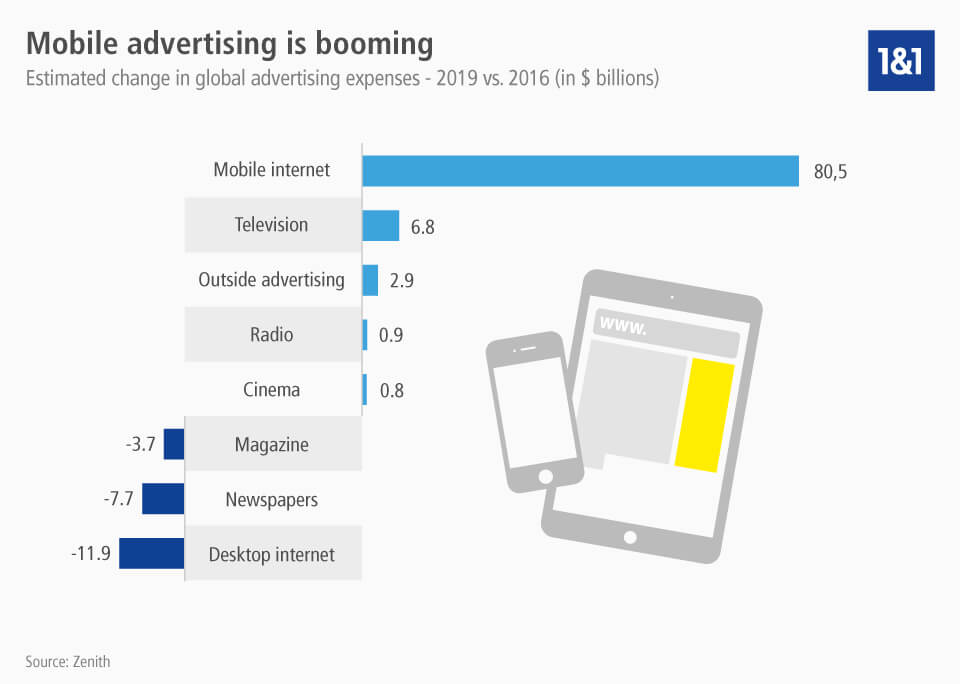
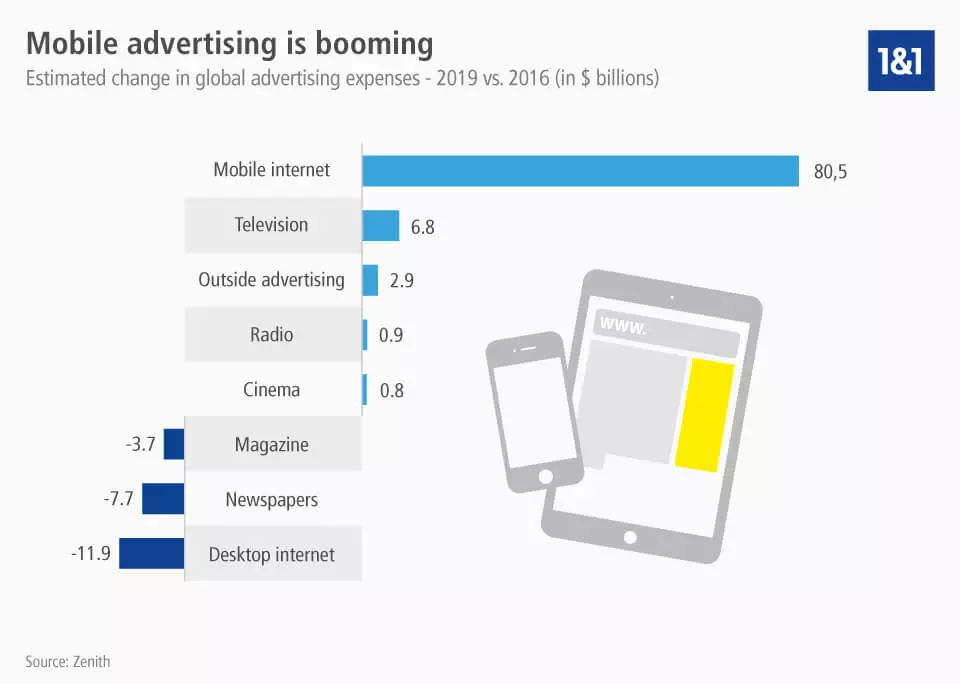
You can download the infographic for the predicted advertising spending here.
Communication channels for mobile advertising
Mobile advertising occurs over a range of different channels. Besides the obvious opportunities this presents for advertising on mobile browsers and free apps, it’s also relevant for different communication channels, i.e. instant messengers and text messages. Advertisers can also place multimedia advertisements on various forms of mobile video and TV applications.
The different channels of communication in mobile advertising at a glance:
- Mobile web
- Mobile applications
- Mobile messaging
- Mobile video/TV
- Text messages (SMS/MMS)
What different kinds of mobile advertising are there?
A typical error that many advertisers make is seeing mobile advertisement as nothing more than a mere extension of regular online advertising. An attractive advert that’s effective on a desktop won’t necessarily enjoy the same success on a mobile device; on the contrary, marketers who simply adapt their desktop ads to fit mobile formats fail to harness the advertising power that mobile ads possess.
The most important factors for successful mobile advertising:
Native advertising
The first factor is the advert’s design. Shrinking a desktop advert in order to display it on a mobile screen generally results in the ad looking cluttered, unattractive, or overpowering. Advertisers then lose the positive impact of the original ad; in fact, it then has the opposite effect. It’s better to take the ‘look and feel’ approach when designing native display formats for mobile sites and apps. This principle already works for mobile ads displayed on social media platforms like Facebook, Twitter, and Google Maps. The ‘intent-driven’ indicators employed here mean that users only see ads related to their online behavior. For example, users of Google Maps can see sponsored ads for places that they’ve already searched for. These adverts therefore don’t disturb or interrupt the user.
Using banners? Choose wisely
Overlay ads or pop-ups are perceived as a disturbance by mobile browsers; this is because disturbing the user’s activity is exactly what they are designed to do. While embedding mobile ads in editorial content isn’t obtrusive, banners appear more cumbersome and bulky, interrupting the natural flow of reading. Even if this kind of advertising is designed to appear more subtle and natural, it’s still noticed by the user. The consumer then makes a conscious decision as to whether they want to read your ad or not. You should therefore ensure the contents of your ads suit the needs of the reader.
Customized content
Given the reduced screen size, mobile ads are always far more present than their desktop counterparts; this can either come across as annoying or lead to high ad impressions, depending on the quality of your design. Effective mobile advertising is often customized (i.e. varied, adapted to suit different locations). Extracting useful information from GPS systems (i.e. geodata, weather forecasts) also allows marketers to zero in on specific regions, target groups and situations, so that their ads can be rolled out in a controlled manner that is precisely tailored to their target audience.
Interaction is key
Interaction with the target audience is a trump card in the world of mobile advertising. The different mobile devices facilitate a variety of techniques to reach out to customers directly, stimulating concrete actions. This new form of interactive advertising opens doors to unique and innovative concepts with a playful feel. This results in a strong user engagement, an increasing appeal, and positive recall ratings in the long-term.
Advantages and disadvantages of mobile advertising
When it comes to the advantages of mobile advertising, the strengths of the medium itself are plain to see. As smartphones and tablets become an increasingly integral part of our daily lives, a higher degree of accessibility is created, along with strong opportunities for customizing campaigns with relatively low scattering loss. Real-time interaction is also possible. Users can react and interact with advertisers over their smartphone with no media disruption. Mobile communication also enables an affordable kind of direct advertising.
But of course, the medium also has its disadvantages. The small screen, the private environment, and the intensive use can lead to users quickly becoming irritated with the ads. Making an effective mobile advertisement is always a balancing act of reaching out to the target audience without invading their space with annoying ads. These limitations, caused by the user interface, also have an influence on the ad’s design. It’s not always possible or logical to use large images and long texts on small, portable devices, which forces advertisers to think of creative new ways to get their message out.