

Content marketing in B2B: strategies, opportunities, and challenges

One of inbound marketing’s most important measures for winning new customers over is the sub discipline of content marketing. Meanwhile, content strategies are no longer limited to only the B2C sector: content marketing has also found its way into B2B. Target group-specific and high-quality content can also generate B2B leads. However, this is easier said than done. What are the challenges and how do the methods differ from those used in the B2C sector? Our guide gives you the answers and introduces the best practices from B2B content marketing.
B2B content marketing: is it actually worth it?
Definitely! In the past few years, it’s become increasingly difficult in the B2B sector to attract the target group’s attention and get them interested in products or services. This is why informative content has become more important in the B2B sector – this is easily proven by looking at figures: A study conducted by the Content Marketing Institute (CMI), shows that 81% of buyers inform themselves thoroughly about the product they are interested in before contacting the seller. For content marketing in B2B, it’s important to note that the majority of participants didn’t care where they got their information from, as long as the source was reliable. 24% stated that they even prefer first-hand information from the seller. Those who succeed in offering reliable information with real added value on their website have a decisive advantage over the competition. If a B2B company can provide expert knowledge, it reinforces its reputation as a specialist in a specific area and therefore creates trust even before potential customers have been contacted. However, not just any old content will do: if it’s barely relevant to your target group or communicated using the wrong channels, you can provide as much content as you like, but it won’t be well received. A well developed and documented content marketing strategy is absolutely essential in the B2B sector. Especially since the methodology of content marketing in B2B differs considerably from that of B2C – and you shouldn’t simply use measures from that area without thinking it through first.
B2B content marketing strategies and the differences compared to B2C
First of all, in order to develop a B2B content marketing strategy, you need to be aware that professional buyers make different purchasing decisions than private customers. While the latter are more likely to make emotional decisions, professional buyers in companies select products almost exclusively based on facts and concrete benefits. Entertaining, emotion-evoking content is therefore useless in this sector.
In addition, you can assume that not only the intention to buy, but also background knowledge and requirements differ significantly from those of B2C customers.
Success with personas in B2B content marketing
First of all, these are the questions your B2B content team should think very carefully about: Who is your target group? What is the position of your customers? What expertise do you have? And last, but not least: Which information is really relevant and which isn’t?
A precise target group analysis should be carried out in order to be able to answer these questions. You should create a buyer persona, which helps you understand target groups better and be able to focus on them in your marketing measures. In this way, content can be created in a targeted manner at every stage of the purchasing process and tailored to those making the decisions as well as your situation.
Creating a B2B content marketing strategy based on data
But an analysis of the target group alone is not enough: content marketing in B2B works most effectively as an engine for lead generation, as long as the efforts are data-based. This means: if you use data from previous projects and existing customer bases, and take note of any feedback given, you can tailor your own B2B content marketing strategy even more precisely to the needs of the target group. For a sustainable strategy, you should document all available data as well as the personas created based on them. This enables you to be able to determine and create concrete content types for the different phases of the purchasing process.
Determining content types
If the target group has been restricted and personas have been created based on data, you still have to find the right content types and channels. The procedure differs from content marketing in B2C: instead of entertaining content, facts and technical know-how are best used here. According to the Content Preferences Survey report from 2016, case studies, white papers, webinars, and analysis reports of relevant studies are needed when it comes to content marketing for B2B. But what’s more important than relying on trend content, however, is making sure that the content suits the target-group e.g. multimedia presentations, e-books, videos, etc. Classic infographics can be more useful in certain sectors or for certain companies. Of the above-mentioned content types, webinars and classic seminars, in particular, offer good opportunities to position yourself as a specialist in the respective industry and to generate leads. Since expertise is passed on first hand, it means that trust is created – presumably more than would be achieved from third parties. At the same time, content like this has another advantage: B2B companies establish important relationships with customers or existing connections.
Tailoring content to the different phases of the purchasing process
So that content marketing bears fruit in the B2B sector, content should not only be tailored to your target group, but also to the various stages of the purchasing process. 'External' people come across your channel through keyword-optimized blog posts or via social media. Informative landing pages are therefore important for converting visitors into leads. They should contain call-to-actions and/or forms. Leads, on the other hand, require specialist information and can, for example, become customers if e-mail marketing measures are used. They may even become long-term customers if sustainable customer relationship management is put in place. Seminars and continuously generating high-quality content give you the opportunity to turn customers into promoters for your own company once you’ve won them over. Social networks are particularly important for this: if you connect with potential customers on relevant platforms, such as LinkedIn, you will stay in their mind.
Channels for online marketing in B2B
Social media is the first port of call for customer-oriented communication. In addition, a further CMI study showed that the B2B marketers surveyed reckoned that e-mails were the most important channel for distributing content. LinkedIn came second with 71%, while Twitter and Facebook were used by 77% and 76% of the companies surveyed, but weren’t thought of as having high success rates. After YouTube and print, however, they still scored an average of 55% (Twitter) and 38% (Facebook).
It is important for companies to find channels that suit the intended target group and that customers – and potential customers – actually use them when they want to find out about products and services.
Quality is more important than quantity
The relationship between quality and quantity is often wrongly prioritized in B2B content marketing. It is true that regularly published content is necessary so that up-to-date and relevant information can be provided, but if you have a small budget, you should concentrate more on quality rather than quantity. Especially in the B2B area: Since the target group consists of specialists, the information must be correct, both grammatically and in its content. Professionals detect errors more quickly than others, because they are familiar with the topic.
B2B online marketing: the most important points in the checklist
✓ Create personas and collect information about your target group
✓ Use existing data and analyze it
✓ Define and document your B2B online marketing strategy
✓ Analyze which content your target group really needs and make yourself available as a specialist in your area of expertise
✓ Create the right content for each phase of the purchasing process
✓ Find the right channels to reach your target group
✓ Keep in mind that the quality of content is more important than quantity
✓ Converse with acquired customers on social networks
B2B content marketing: best practices
McLaren Software
A look at McLaren Software’s website McLaren Software shows how the aforementioned factors for successful B2B content marketing can look in practice. The company offers software solutions for technical document control in construction projects, plant engineering, and facility management. If you look at the website, you don’t have the feeling that you are dealing with a commercial provider. Instead, the homepage greets you with links to info videos and webinars as well as downloads for whitepapers. Even more information can be found by clicking on the 'Resources' tab: these include infographics, presentations, case studies, and other content. At the bottom of the page, there are current articles, an integrated Twitter feed, and customer success stories.
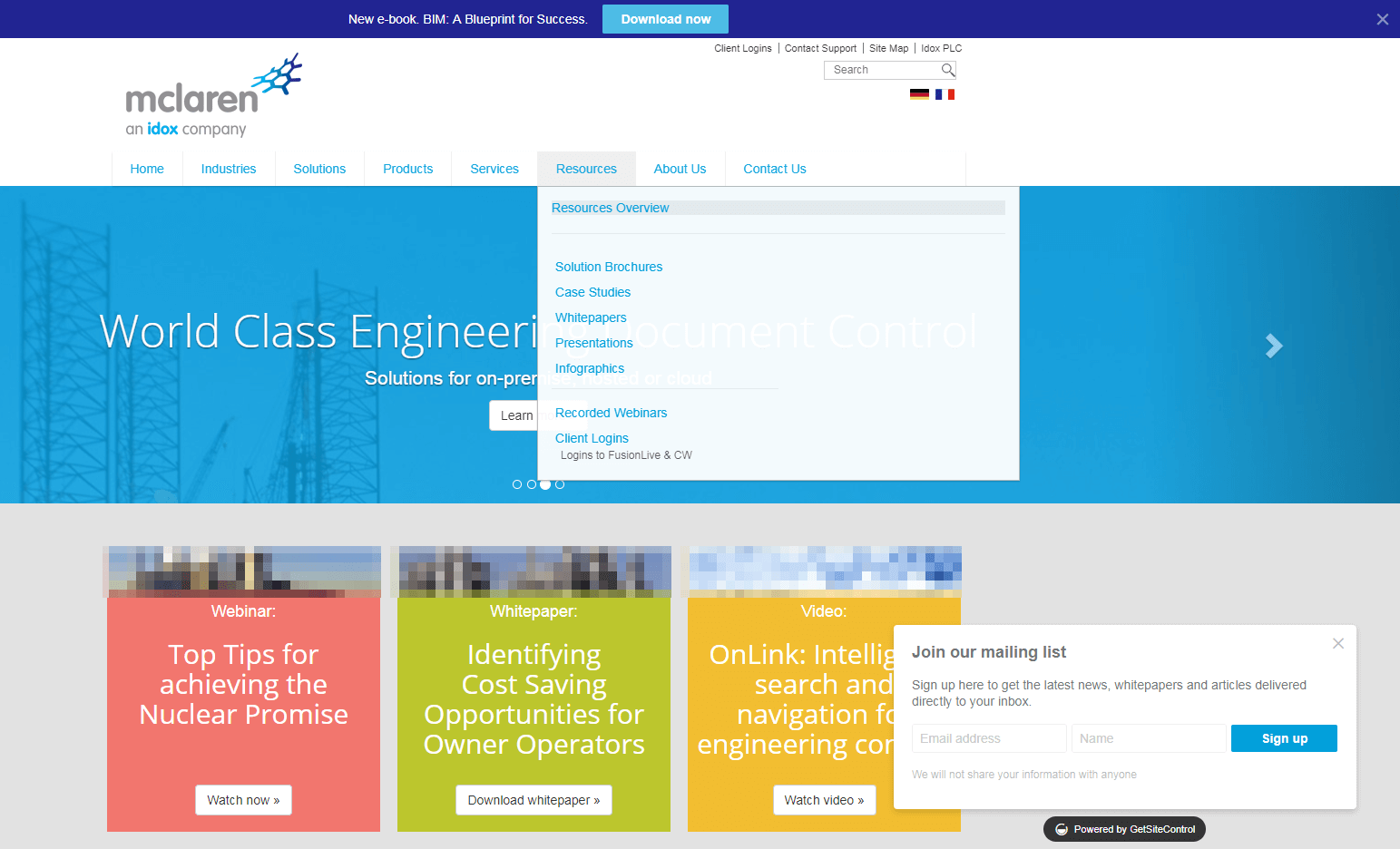
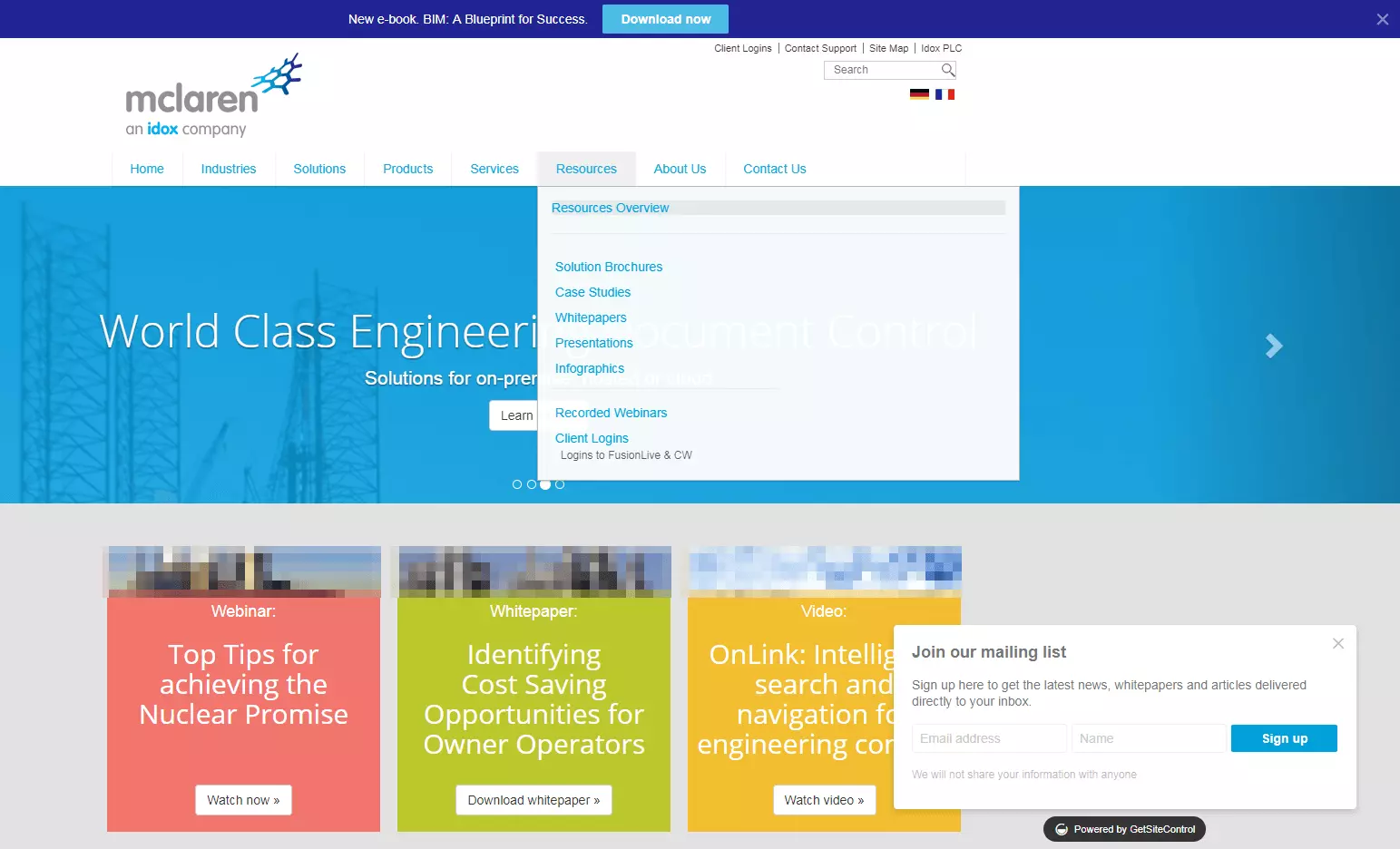
This website quickly gives the impression that it’s run by specialists. The quantity and quality of the content is impressive, which strengthens the brand and generates leads. The input mask for the mailing list has been discreetly placed at the bottom of the screen. Visitors that are interested will certainly enjoy using this service and will therefore want to remain up-to-date. The B2B company, on the other hand, has then generated a lead thanks to the visitor entering their data – one step closer to winning over new customers.
Deloitte
Deloitte is one of the 'Big Four' of the world’s top-selling auditing companies. The umbrella brand encompasses numerous individual companies worldwide that are active in the areas of auditing, consulting, risk, and financial advisory. On the website, you will find a large number of informative articles with insights, guides, and news, as well as blog articles on the brand’s topics.
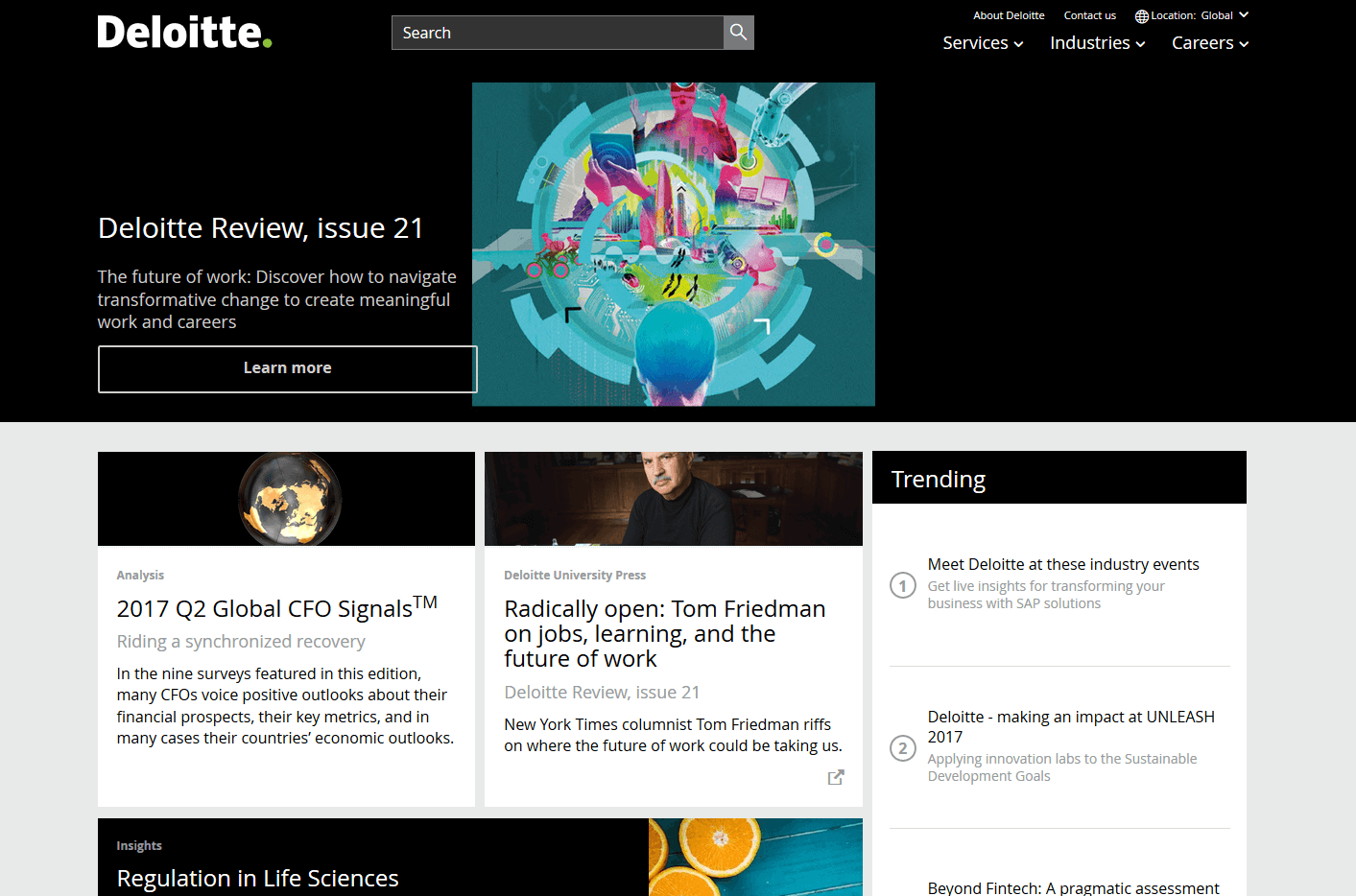
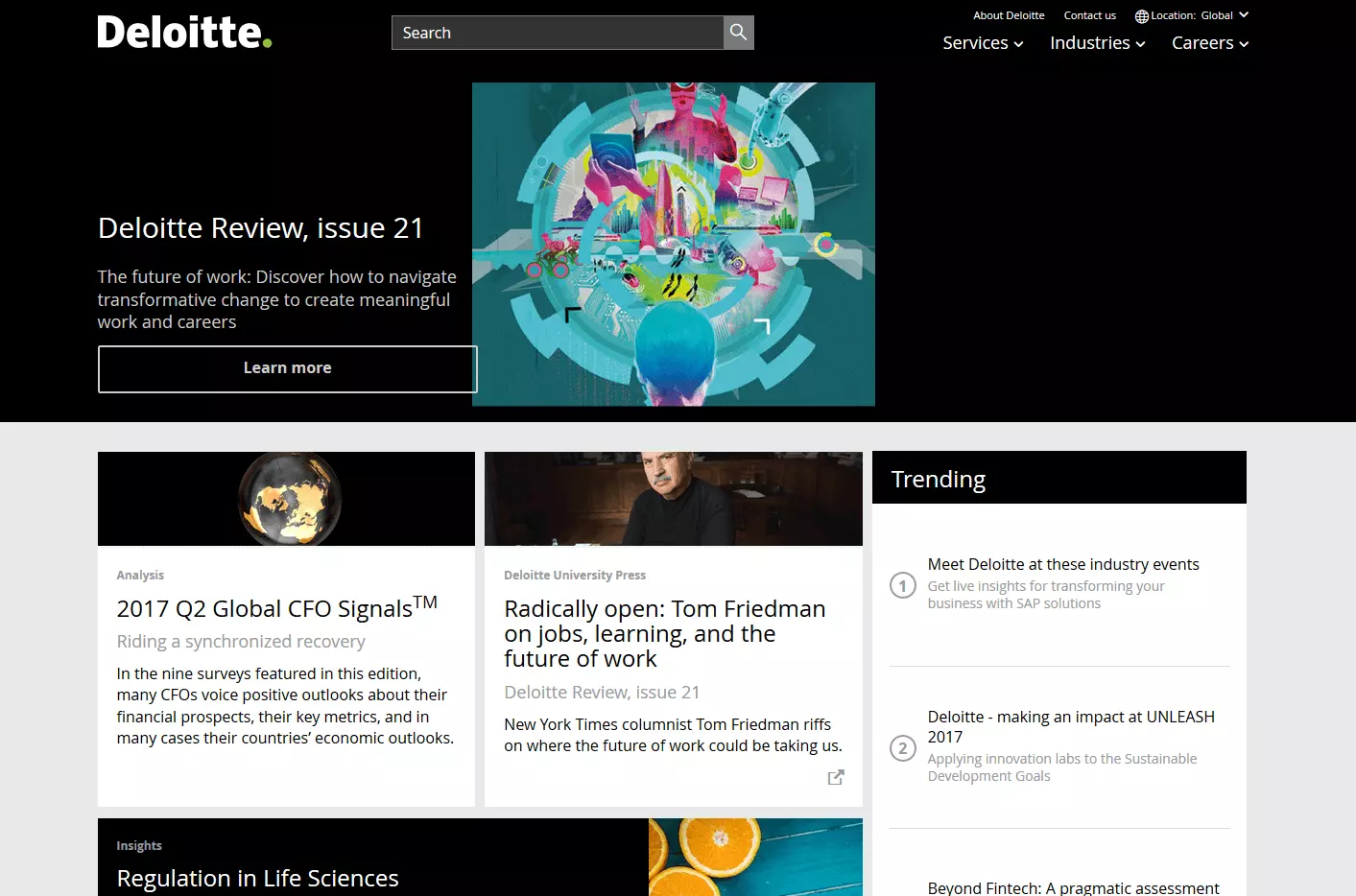
The topics are very broad and scattered across all industries: at the time the screenshot was taken, the homepage contained articles about the future of work as well as 2017 Q2 Global CFO Signals™. In addition, there are direct elements at the bottom of the page that allow you to make contact easily. Interested visitors can ask for quotations, sign up to the newsletter, and follow Deloitte’s social media channels. This sets you up for generating new leads quickly with B2B content marketing.
item Industrietechnik
The third and last of our B2B content marketing examples is item Industrietechnik, a company from Germany. This company developed the so-called MB modular system (software for the mechanical engineering sector). Its individual elements from the fields of industrial workplaces, platforms, and mechanical engineering can be combined and expanded as desired. The website not only offers an online store, but also helpful content elements, such as a configurator or a blog with news, as well as articles on industry trends and projects.
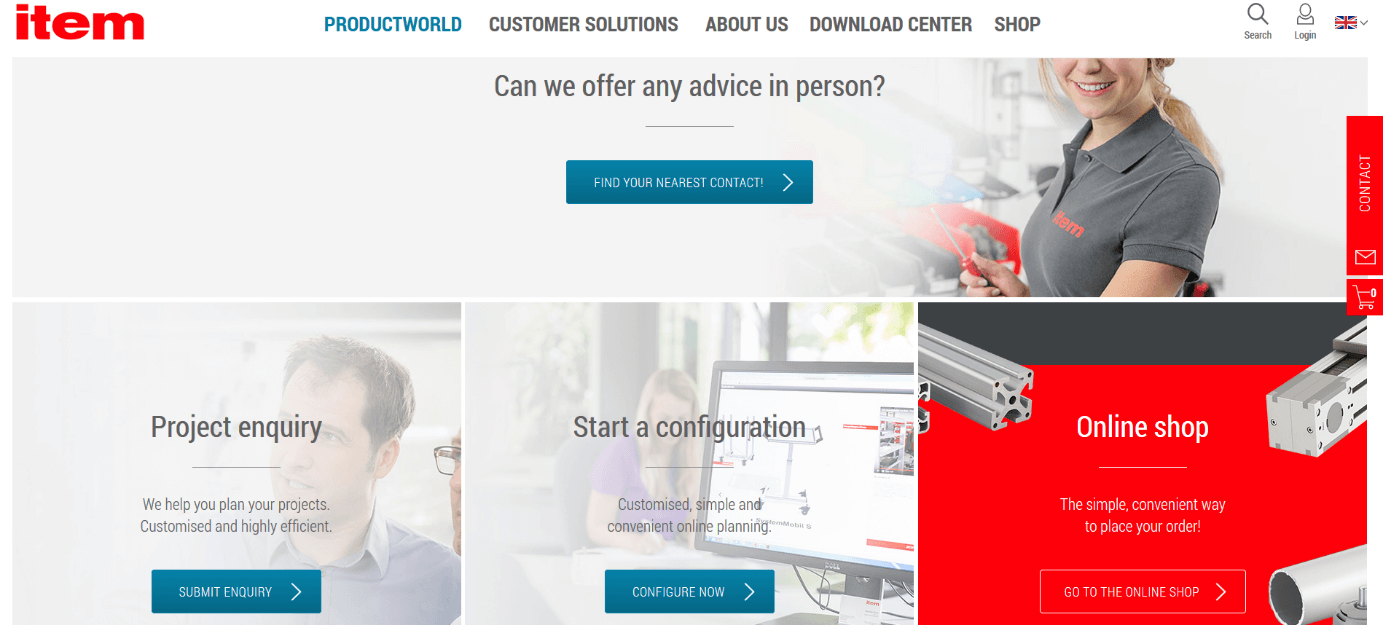
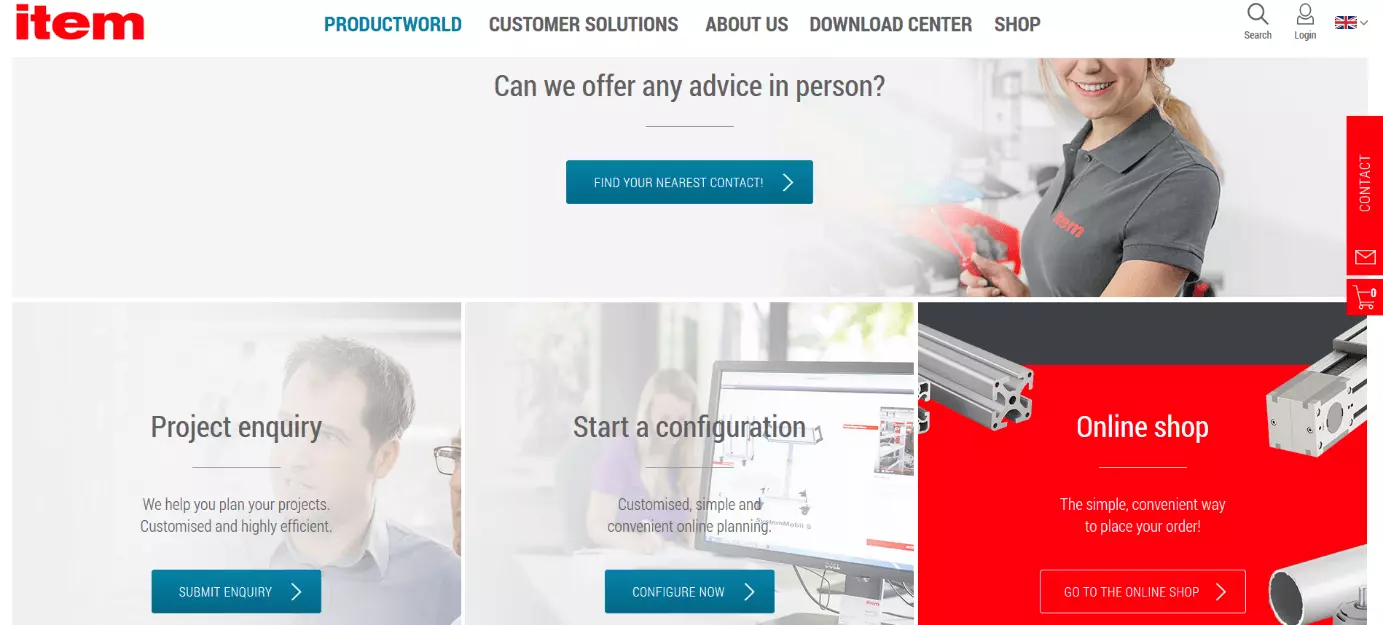
The website doesn’t just offer informative content, but also the opportunity to get in touch with personal consultants and ask questions about projects. On the blog, you can sign up for a newsletter or download whitepapers for free. The close interaction and information on this website promises many new leads.