

The best smart speakers: Google Home vs Amazon Echo

Smart speakers are more becoming more and more common in daily life: they read us recipes, give us personal daily updates, let us watch YouTube videos on TV, or dim the bedroom lights for us. Today, speech technology is digital, networked, and interactive. What makes smart speakers special is that they aim to unite all available personal data, digital services, and domestic services in a central control system. They become the new interface between man and technology.
While digital assistants like Siri (Apple) or Cortana (Microsoft) are primarily used as organizational tools, “external” smart speakers go a step further: As independent devices primarily designed for the home, they network the owner’s digital life to their home. The speech function of these speakers make the technology more human, the AI elements make it more intelligent, and the smart home networking makes your home more comfortable. This market was opened by Amazon, but now Google is joining the race.
Google Home and Amazon Echo are synonymous with being the best home smart speakers on the market. When Google Home was launched in the US in May 2016, it seemed almost like a carbon copy of Amazon’s Echo. Nevertheless, Google was able to score points with their huge knowledge base right from the start. Google Home has now moved even closer to their biggest competitor, thanks to extensive updates rolled out about a year later. In this article, we will discuss the most important aspects when buying a smart speaker, and compare their respective features in detail.
What makes a good smart speaker?
What are the qualities that make up a good smart speaker? What should you look out for when searching for the perfect one? When making your choice, the most important element is high sound quality, a powerful voice technique, and appealing design. These things together form the device’s user interface and will influence how much you end up interacting with the speaker. However, the entire product really hangs on performance aspects.
Depending on what you will be using the device for, its ability to answer everyday questions is crucial: how reliable is the speaker’s reaction to questions about the weather, the traffic situation, or general facts? Smart speakers could end up eclipsing smartphones, at least in terms of domestic use: Ask your question out loud and the omniscient speaker will reply promptly. It is worth your while, however, to ensure that your device has a knowledge of databases and reliable voice recognition.
Those who want to get the most out of their smart speakers should also pay attention to how much they coordinate with third-party programs: which music streaming services are supported? Do they have links to delivery services or shopping portals? There is a long line of service providers that see promising platforms in Google Home and Amazon Echo as a way to increase the popularity of their own apps. What this means for the user is more skills and options for your device.
For many people, the thought of these devices is still very futuristic: the smart home, or the Internet of Things. But technical developments in our lifestyles are what products like Echo or Google Home are aiming to work with. That is why Google and Amazon are working with numerous providers from the smart home sector, creating networks for their smart speakers with other appliances such as central heating, a dish washer, or a TV. Having these capabilities also influences the functional diversity of their products.
The so-called Internet of Things is an all-encompassing network of physical and virtual objects. “Smart home” is the term for a private living space. The light is regulated by voice commands, or the refrigerator is networked with an online food provider. This should facilitate everyday life and increase the quality of life for inhabitants.
Last but not least, it is very important how well the device functions as a personal assistant. Smart speakers are busy bees in terms of organization: they integrate calendars, to-do lists, and reminders. They collect a lot of data about their users, which makes them even more responsive to them. For example, smart speakers in the US can already recognize their users by their voices: a speaker can differentiate between the voices of different family members and automatically play their favorite music or give them their personal day briefing.
Comparing smart speakers: Google Home vs. Amazon Echo
Echo and Home are the undisputed market leaders among smart speakers and are in direct competition with each other. As the first smart speaker available for purchase, Amazon Echo secured a large market share. The corporation maintains this lead because they successfully advertise the product in their own shopping portal.
Considering the head start already taken by Amazon, Google took an astonishing amount of time in the USA and abroad to launch their Home product. The economic market for smart speakers is therefore dominated by the Amazon Echo. But is it really a better product? Here we compare the most important functions of both speakers and identify their strengths and weaknesses.
A comparison of central functions
When you compare the most important features of the Amazon Echo and Google Home, you can see how balanced their advantages and disadvantages are. This makes it all the more important to really do your research on both products before choosing one. The more details you have, the easier it will be to make the right choice.
Technology and design
The Amazon Echo smart speaker comes in the form of a high cylinder, with a large speaker on the lower half of the device. Echo is available in black and white, with a blue ring of light activated in the upper half when the voice function is activated. The device has two manual options: the button can be used to turn off the microphone, and another is a multifunction button.
Google Home does not differ significantly from the Echo, but it is somewhat squatter, more belligerent, and has a less discreet loudspeaker. Moreover, Home only weighs about half of the Amazon Echo. The lower half of the unit is available in different colors and materials (black, gray, copper), while the upper part is always made of white, hard plastic. The only visible button is the microphone; other manual commands are recorded via a touch-sensitive interface.
There are differences in terms of taste, but the general opinions found in IT magazines and experience reports fall in favor of Google Home. The unit is smaller, lighter, and offers more design options. Overall, however, both products are so pared back in their optics that both the Amazon Echo and Google Home can easily be integrated into every household.
Speaking function
In terms of language and speaking functions, which are really the crux of smart speakers, there are smaller but notable differences. Just like the speakers’ technical aspects, Google Home’s voice data is projected through two microphones, while Amazon’s Echo has seven sound sensors, which are also able to filter out background noise.
The speech recognition aspect works somewhat better for the Echo; it is more reliable at distinguishing its owners’ voice over any background din. In a neutral situation, both devices are equally good for users, they both react promptly to queries at distances of up to 15 meters and respond to inquiries. Both devices are also always ready to be woken up and activated using their code word – “OK Google” or “Echo”.
There are also small differences to be noticed in the sound quality. If you want to play music directly with the devices rather than connecting to external speakers, Google Home offers a fuller, more rounded sound. However, Google’s AI voice sounds a bit more mechanical than the Echo’s AI voice, and Google Home’s volume capacity is a few decibels lower than Echo’s.
When it comes to language intelligibility, Google is winning the race: Although Home is still newer to the market, its voice AI has much better conversational capability because it remembers conversations and can keep up with follow-up questions. On the other hand, the Echo still has problems understanding simple questions. Additionally, the Echo is not always able to formulate answers that are grammatically correct. Google Home’s advantage over Amazon’s Echo is hardly surprising, considering that Google is deeply invested in spoken language comprehension research.
Nevertheless, language intelligibility varies depending on the subject area. While Google Home answers general knowledge questions and information reliably, the Echo deals better with questions about purchasing and products. Both devices revise and improve speech recognition on a regular basis. To summarize: The Echo has better hearing capabilities, and Home has better comprehension.
Multimedia
Both devices are surprisingly small entertainment boxes that can send YouTube videos to your TV screen or play your favorite songs. Amazon Echo can play from music streaming services like Amazon Music, Prime Music, TuneIn, or Spotify. The Echo can activate your radio transmitter of choice on request, and can also access mobile devices or private music collections using a Bluetooth connection. The device is also compatible with Amazon Fire TV and can comprehend instructions involving YouTube or Netflix. Something that Google Home lacks: the Echo can play audiobooks through the Audible app upon request.
Google Home does not differ enormously from Echo in terms of capability, but it does integrate Google Play Music and Google Chromecast instead of offering Amazon’s streaming services. If you already have a Google Chromecast device, Google Home will be a better choice for you – Google devices communicate fairly seamlessly with one another, which really extends Google Home’s multimedia features.
Google Home does however have one major disadvantage: the speaker is not Bluetooth enabled, so loudspeaker boxes can only be attached using a cable connection. Although cable connections are admittedly more reliable, it is still a significant reduction in the device’s flexibility, especially when compared to the Amazon Echo. Google Home still has ways to go to catch up with the Echo in terms of multimedia.
Third-party features
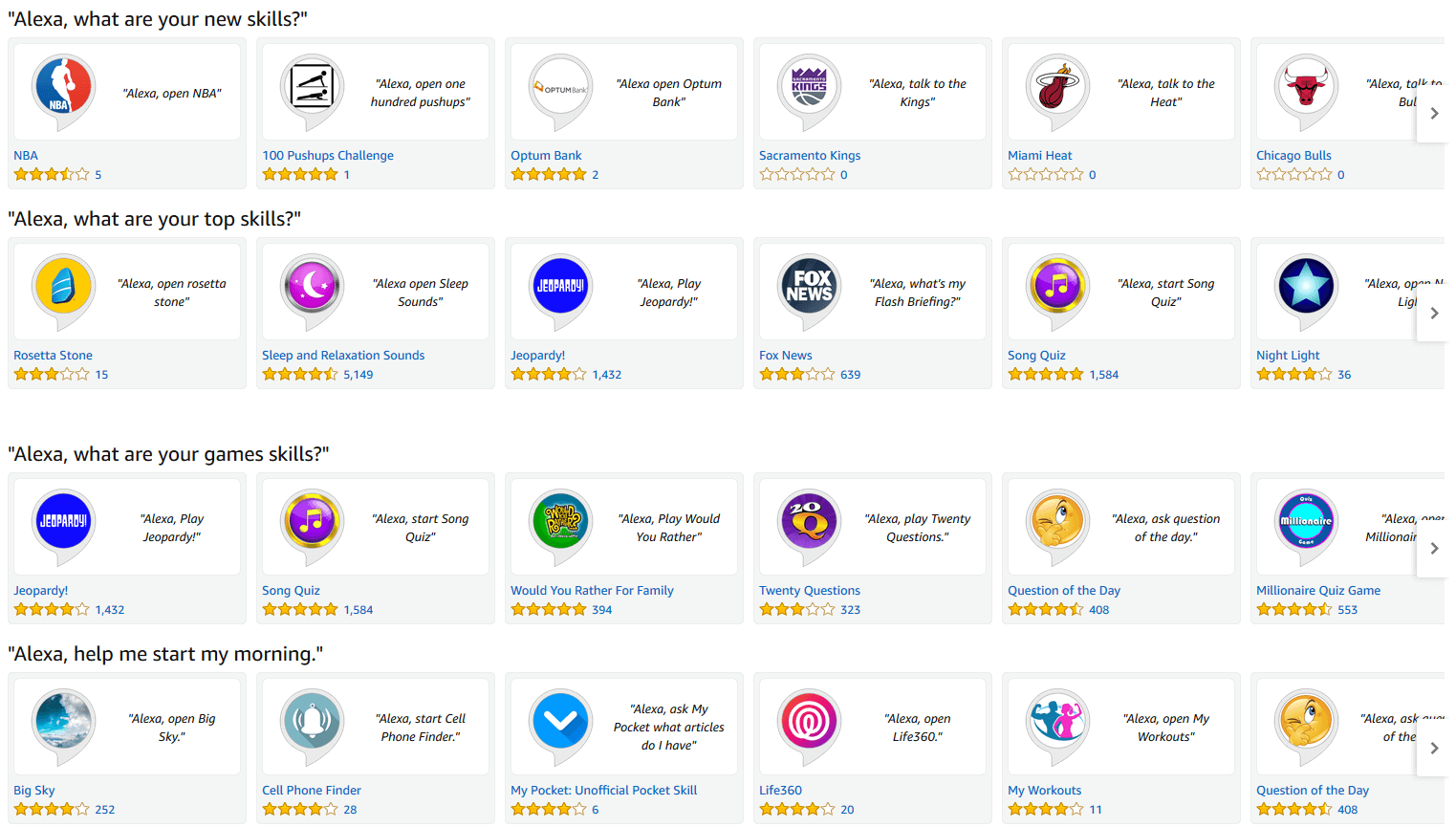
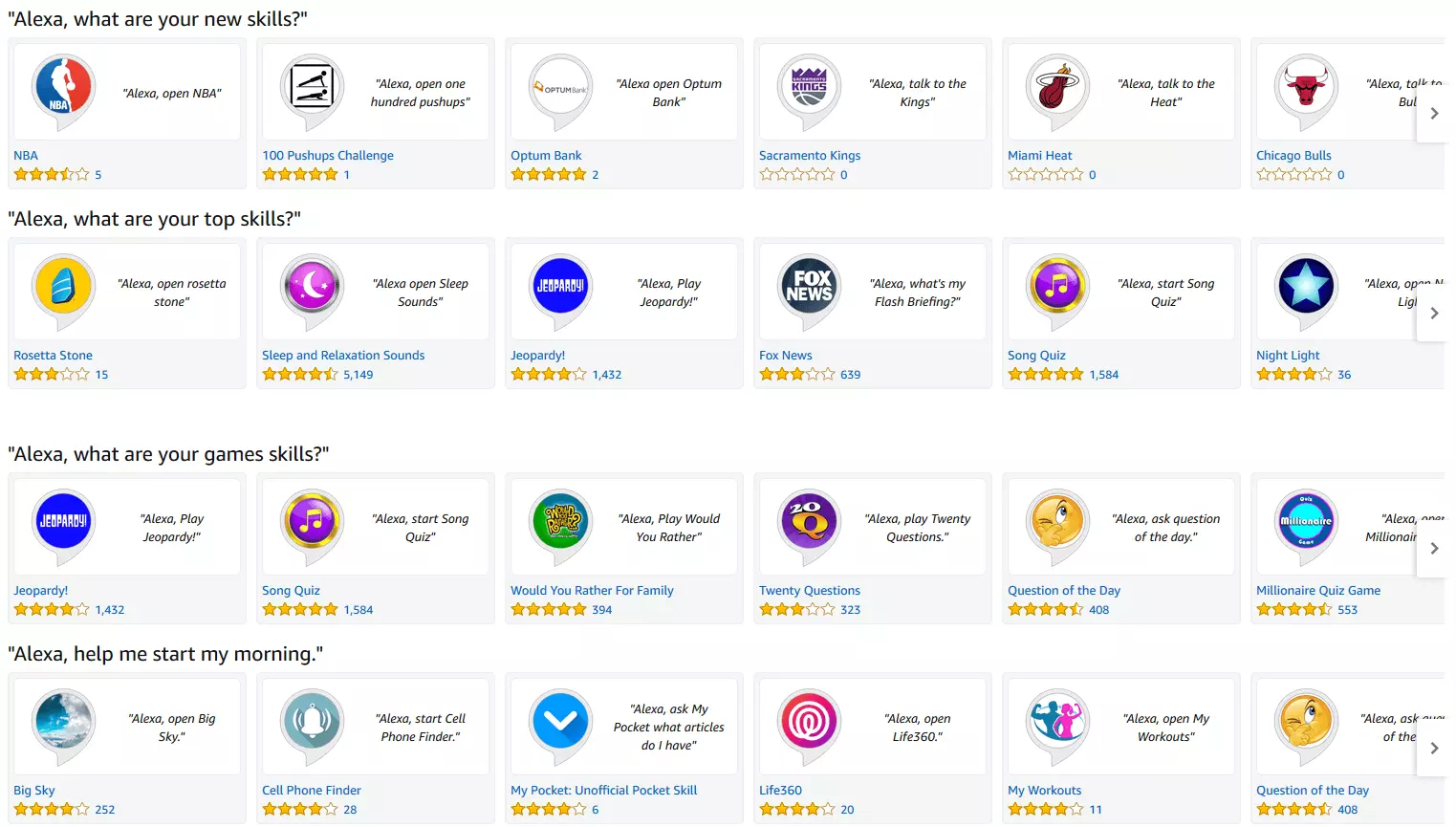
Overall, Amazon Echo does offer more third-party features than Google Home, and the number of Amazon partnerships with external parties is growing. Amazon Echo currently provides access to over 15,000 skills (skills are their term for voice-based applications), ranging from controlling home applications to ordering an Uber, keeping up with your Fitbit, or ordering a pizza from Domino’s.
The Echo has earned its place, particularly in the smart home sector: unlike the younger Google Home, the Echo has been expanding its collaborations over the years and now has a long line of smart home services that enable the Amazon device to activate lights, regulate heating, start up the vacuum cleaner, or communicate with radio sockets or the dishwasher. Google Home, however, does integrate the most popular Smart Home providers – including Phillips Hue, Nest and Samsung SmartThings – but they still have a long way to go before they catch up with the Echo.
Still, it can be assumed that Google Home will catch up in this area. As previously mentioned, if you already have a Google Chromecast system connected to the TV, your Home device can interact with it. Instructions like “Ok Google, play ‘The Simpsons’ on the TV in the kitchen” run smoothly.
Personal assistant
The Echo and the Home have many personal assistant functions in common: both create calendar entries and to-do lists, read messages, and create personal day briefings. Google Home has a slight upper-hand in being able to create a more complex profile of its users through access to giant data sets like Google Search in Gmail. Google is also known for its complicated search algorithms and its technical lead in the field of artificial intelligence. Google Home also benefits from this technological capital, but users would hardly notice this in their day to day use of the device. Almost all investigative reports agree that in terms of practicality, Amazon Echo does not lag significantly behind Google Home.
The smart speaker’s strengths and weaknesses
Both IT giants make use of their background business know-how: Google Home scores points as an intelligent knowledge assistant, while Amazon Echo wins as a versatile consumer assistant. Including the overall strengths of your business makes sense, because after all, smart speakers bring together a lot of different functions packed into one device. Amazon and Google’s industry expertise are reflected in the strengths of their language assistants.
Amazon Echo: consumer-oriented, and always expanding
Amazon uses its language assistant to focus on distributing consumer goods online. As a global shopping empire, Amazon has a strong distribution network and knows its users’ consumption needs extremely well. This expertise is optimized by Amazon for the Echo, as confirmed by all test results which show that it provides accurate shopping and product information. In the US, where everyday goods are ordered online, the Echo has a clear competitive advantage.
Amazon also make use of their expertise in online sales in other areas. From the outset, the company has pursued a strategy of opening its smart speakers’ potential by networking with as many third parties as possible, to provide easy access to consumer goods and services. The Amazon Echo is strongly oriented towards the outside world and has been accumulating a steadily growing number of partnerships and skills to make it attractive to consumers. Among them are popular multimedia platforms, order or information services.
This is especially noticeable in the smart home sector. The Amazon Echo plays an important role in this area: The devices are offered and purchased through the Amazon store, and once the Echo is set up in the home, it functions as the central control system for all smart home functions.
Advantages:
- Reliable speech recognition, even in the case of auxiliary noises
- Speaks fluently with a natural voice
- Bluetooth connection with loudspeakers or other devices is possible
- Good selection of shopping providers
- Reliable shopping and product information
- Many third-party collaborations and a wide range of “skills”
- Versatile product for use with a smart home system
Disadvantages:
- Restrictions when implementing search algorithms: questions about general facts or information are not always answered reliably
- Restrictions on language intelligibility: response to follow-up questions and formulating grammatically correct sentences is still somewhat problematic
Amazon Echo’s most appealing feature is its variety of functions and features. Networking with other services and its many “skills” help make the Echo an attractive choice. Also, the smart speaker is particularly helpful when it comes to information about products and online sales.
Google Home: personal and knowledge-oriented
Google Home has a different focus to the Amazon Echo. The product is geared towards natural communication and building knowledge of its users’ personal preferences. The technical foundation for Google Home, Google Assistant, was designed to provide a completely individual user experience using AI technology. Google’s expertise lets Google Home personalize answers, which is very advantageous in the long run. After all, as a user, you want natural, personal communication with your assistant. Google Home is already profiting from its language intelligence capabilities, which are constantly being developed especially for Google Search. The intelligent speech function is a big advantage for Google Home. Google Home is also well-liked for its general knowledge – and it makes ample use of the company’s background as a search engine. Google Home is excellent at handling questions about general knowledge and information: see a test with 45 questions, conducted by Forbes, which shows Google’s smart speaker to be the clear winner. In recent tests, they seem to be doing even better. Anyone who is looking to stay regularly informed from the comfort of their couch and would like to have short conversations with their smart speaker will be satisfied with Google’s product. Advantages:
- Choice of design options
- Wide sound range thanks to the built-in speaker
- High speech intelligibility and reliable response to connection requests
- Complex AI technology and proven user preference
- Good implementation of knowledge databases, reliable information
Disadvantages:
- Limited range of skills and features
- Cooperates with only the most important smart home providers
- No Bluetooth connectivity
- Higher level of data protection by networking with other Google services
Google Home scores highly because of its intelligent voice recognition and good implementation of other Google services. It provides a particularly intelligent conversational partner and information supplier.
Features overview
Google Home vs. Amazon Echo – ultimately, it is up to you to decide which language assistant features are most important to you. This is the only way to find out what smart speaker will be the most suitable for you. Here is a tabular overview of the most important aspects of the Echo and the Home:
| Amazon Echo | Google Home | |
|---|---|---|
| Price | approx. $129 | approx. $129 |
| Start word | Alexa, Echo, Amazon, Computer | OK Google, hey Google |
| Always accessible? | Yes | Yes |
| Multimedia options | Amazon Music, Prime Music, TuneIn, Audible, Spotify, Amazon Fire-TV, Deezer, YouTube, Netflix | Google Play Music, Google Chromecast, Spotify, TuneIn, Deezer, YouTube, Netflix |
| Smart Home compatible | Samsung SmartThings, Insteon, Ecobee, Phillips Hue, August Smart Lock, etc. | Phillips Hue, Samsung SmartThings, Nest, etc. |
| Quality of the personal assistant | Sets appointments, creates to-do lists, personal briefings, alarm clock, news reports, and more | Sets appointments, creates to-do lists, personal briefings, alarm clock, news reports, and more |
| Design options | Black, White | Slate (light gray), Carbon (black), Copper |
| Bluetooth capable | Yes | No |