

Inverted Pyramid Principle

Reader behavior online is very different from reading a printed article. Many readers tend to look at the most important information in front of them, and then quickly skim through the text: Their attention is strongest at the top of the page, and then decreases further down the page, which leads to the F-pattern. This changed reading behavior means that it’s necessary to adapt the text structure – and an inverted pyramid has proven to be particularly effective. Ironically, this structuring comes from classic print journalism, but it actually works online better than it ever has. Read here what the inverted pyramid principle is, how it works, and why it is so important in online marketing.
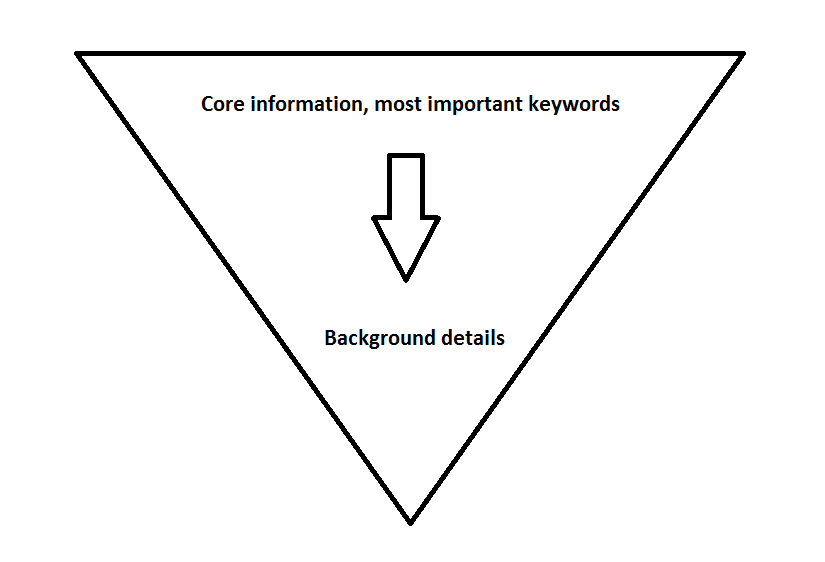
It is possible to stagger information according to its core content and feature the most important details first. This does not mean, of course, that the bottom of the text isn’t informative or has no meaning. Here is where you can add specifications and background information. This rounds off the text nicely and offers value for readers who aren’t content with the densely packed first few paragraphs.
The same design principle can also be applied to individual paragraphs: Each paragraph is limited to a core statement, which is briefly explained at the start and then described in more detail later on. The paragraphs are typically structured with a short heading, which allows the reader to quickly gain an overview of the article, its structure, and content.
Why is the inverted pyramid important for online texts?
The principle of the inverted pyramid is used today in online media so as not to lose the reader. The reader gets deeper into the subject matter and gets information from every paragraph, understanding more and more of the context. The first inverted pyramid originated from the times when newspapers were still printed with typecases: with this technique, a text or a page had to be shortened if necessary. Thanks to the inverted pyramid, this was possible without losing the core points. The technique has now become standard for news reporting and has already been adapted by press releases. In this way, journalists can shorten news pieces as they like and seamlessly integrate them into the layout of a newspaper page.
Being able to shorten a text is less relevant online today, since the layouts are more open and text space can be dynamically adapted. Since there’s a difference between reader behavior on the web compared to offline texts, texts on the internet have completely different structural requirements: they must be able to be read quickly and easily. If the most important information is mentioned at the beginning of the text, the reader’s thirst for knowledge is quenched quite quickly and there’s less risk of them going elsewhere for the information. This is a lot easier to do online: After two or three clicks the reader is already on a different website, which may provide them with the information a lot faster. It’s no wonder that the inverted pyramid has been discovered by those working in online marketing and is being taken advantage of.
What role does the inverted pyramid principle play in online marketing?
Good content, which offers the reader added value, is a decisive factor in online marketing and in search engine optimization. This communication strategy is similar to the journalism approach: the focus is on high quality, relevant, and informative content, and not on direct advertising. When it comes to online marketing, the inverted pyramid strategy is proving more and more effective. This is because the principle offers several advantages for different online marketing efforts.
The importance of the inverted pyramid for content marketing
By adapting to readers’ online behavior, content marketing strategies address the reading habits of the web-based target group. This enables them to meet their structural expectations in the online text. But what does that mean for you as a webmaster? In short, your texts must be easily accessible and convey information quickly. With the inverted pyramid principle, you can quickly attract your readers’ attention and make sure that the core statement is in the most prominent part of the text.
By staggering the information in the text, you’ll keep the reader interested until the end. If the reader does jump ship before reaching the bottom, at least they have taken in the most important information if it’s included at the start of the text. It is crucial that this is easy to find and accessible.
If the inverted pyramid principle is also applied to the individual text paragraphs, your readers will find it easier to filter out which information is relevant to them. Dividing the text with several headings also makes it easier for the reader to process the information. These headings can be created according to the inverted pyramid: by starting with a prominent slogan, you are more likely to catch the reader’s attention. To give further information, separate the headline with a dash or colon, just like the title of this article: 'The inverted pyramid: how to optimize your writing style for online reader behavior'.
All of these textual measures ultimately lead to the reader spending more time on the text. The headings can serve as teasers and should give an idea about the information contained in the paragraph or the entire text. This enables you to attract the attention of potential readers and to maintain their interest throughout the text.
The inverted pyramid principle from an SEO perspective
The pyramid is also important from another angle. In addition to pure content strategies, it also helps with search engine optimization (SEO), since helpful content has a positive influence on Google rankings and that of other search engines. The problem with poorly structured content is that it isn’t easily accessible. The consequence: the reader will lose interest and try to find what they’re looking for on another website. The surplus of information online makes it easy for users to simply move onto another website if they don’t find their answer quickly enough. This places a lot of pressure on the writer to make their texts as informative as possible. The problem from the SEO perspective is obvious: search engines now recognize how long readers stay on a page, which links they click on, and when they leave a page. From this, they can derive which information is relevant to the search query and which isn’t. This is why it’s necessary to provide well-prepared, high-quality content from a SEO point of view. Readers need to be able to find the answer quickly without having to scroll all the way to the bottom of the text. If they’re showing interest and the text is well-structured, your visitors will continue to read and stay on the page longer. One handy 'side effect' of the inverted pyramid: If you include the most important information first, you will automatically use relevant keywords at the beginning of the text and in the heading. This means that your page will be recognized by search engines as being relevant to the user’s search query. What’s especially important are the headings: If the central keywords are included in the headings, you’re not only informing the readers, but also the search engines about what your text is about. These are more intensive at the start of a text: The search engine recognizes the topic of the text due to the 'h' tags and the 'strong' tags contained in the HTML source code. It’s important to use these tags to signalize what is happening. Again, the top priority when writing good SEO content: write the text primarily for the reader. This means you should avoid using too many keywords, known as 'keyword stuffing'. Otherwise, you might find yourself with a lower ranking. Finally, search engines aim to help users by showing only the most relevant content at the top. When writing a SEO text, you should always put yourself in the reader’s shoes and ask yourself what is important for the target group and what they might expect from the text. Whatever the answer, this should be included first and be easy to find.