

How to use a multiple domain strategy for SEO

In a multi domain strategy, several separate domains are used to increase visibility in search engines. Here, the individual domains can refer to different target groups, products or regions, for example.
In this article, we refer to the SEO technical term “SERP”. The abbreviation stands for “Search Engine Results Page” which is the results pages of a search on Google or another search engine.
What’s the connection between content, domain, and search engines?
The multiple domain strategy is an advanced approach to search engine optimization (SEO) using multiple domains. In multiple domain SEO, as in all other SEO approaches, the maxim “content is king” applies. To understand what makes a functioning multiple domain strategy, let’s first take a look at how content, domains, and search engines are connected.
Normally, a website’s contents can be found under a single domain. For example, imagine a website with the domain example.com. Its contents are usually structured and can be accessed via corresponding URLs. The search engine’s bots primarily crawl the URLs and index the content they contain.
A multi domain setup is evaluated completely differently by search engines. A search engine considers all content under one domain as belonging together. In contrast, multiple domains imply a clear separation of content. If you want to benefit from content distributed across multiple domains, you need a sophisticated multi domain content strategy.
Structure web content with directories
The directories follow the domain and form a so-called “path”. In principle, these directories are similar to the ones on your computer’s hard drive. Here is an example of the URL of a sample site’s logo.
- The domain is followed by the directory “images”, where the file “logo.png” is stored:
http://example.com/images/logo.png
Structure web content with permalinks
Usually, most of the content on a larger website does not exist as individual files in directories. Instead, the content is generated by a dynamic process. For example, it is loaded from a database and visualized based on a template. Each piece of content is assigned a fixed URL – called a “permalink”. Here are a few examples of possible permalink structures.
- Permalink contains title of article:
http://example.com/multiple-domain-strategy - Permalink contains title of article “multiple-domain-strategy” and category “article”:
http://example.com/article/multiple-domain-strategy - Permalink contains title of article and date of publication “2020/02”:
http://example.com/2020/02/multiple-domain-strategy - Etc., whereby mixed forms are also possible.
Structure content at domain level with multi domain setups
So far, we’ve looked at ways to structure web content below a domain. As you can see, there are many different approaches. In some cases, however, it makes sense to distribute web content across multiple domains. This is called a multi domain setup.
As a rule, the use of a multi domain setup increases the complexity of the entire system. The approach should be well considered before you commit; it is a strategic decision. Above all, multi domain SEO must be considered from the very beginning. So what are the motivations for using multiple domains?
- Free Wildcard SSL for safer data transfers
- Free private registration for more privacy
- Free Domain Connect for easy DNS setup
Use customized technical infrastructure with multi domain setup
A single domain is usually served by a single server. In certain cases, you may want to implement parts of a website with standalone systems. Imagine a company website that contains an online store and blog in addition to the informative pages. If a single, central system is used for the three areas, bottlenecks quickly become apparent. Given a certain level of complexity, it would be beneficial to manage the three areas separately. A viable approach would be the following, in which three domains are used:
- Static pages for the company website:
www.example.com - WordPress for the blog:
blog.example.com - Magento for the online shop:
shop.example.com
Each of these systems is perfectly adapted to the task at hand and is separately retained. If you want to optimize one of the systems, the others are not affected. Furthermore, the individual systems can be hosted on different servers without issues. The administrative advantage is offset by the need to operate a well-coordinated multi domain SEO. Otherwise, you risk issues with ranking individual sites and the external presentation of the brand.
Split groups of content across sites with multi domain setup
Some websites contain vast amounts of content. If the relation between groups of content is weak, it makes sense to organize them independently. For example, imagine a large, multi-lingual news website. Independent editors oversee the editions for different languages or countries. The different versions do not resemble each other in content or content structures. The following multi domain setup would be suitable here:
- Homepage automatically redirects users to the homepage of the appropriate edition:
www.example.com - German edition:
de.example.com - English Edition:
en.example.com - Analog for other languages
You may be familiar with the use of language-specific subdomains from Wikipedia. With Wikipedia articles, however, there’s a special feature with regard to multi domain SEO. An article in one language should link to the same article in all other language versions. To realize this, the hreflang attribute of the link element is used. This tells search engine bots that the content under the different domains represents one and the same content in different languages.
Let’s look at a final example. With WordPress.com anyone can create their own WordPress website. It’s hosted free of charge and can be operated as a blog or website. Each added WordPress instance is created under its own subdomain, for example example.wordpress.com. Here, subdomains from a SEO point of view are the right choice; if these were sub-directories instead, the hosted sites would compete in search results.
Implement a multiple domain strategy with multi domain setup
On a technical level, the core of a multiple domain strategy consists of two components:
- Distribute targeted content to multiple sites under different domains.
- Link the content or set up specific redirects between contents.
For search engines, this creates a structure that extends beyond a single domain. If implemented correctly, this results in decisive ranking advantages. If the individual sites contain similar keywords, they may dominate the first page of the SERPs. By using different keywords, specific niches can be occupied.
The critical point here is that only the content hosted via the domains counts for SEO. Only indexed content is included in the ranking of the domain. Contrary to popular belief, there is no immediate SEO advantage in redirecting multiple domains to one main domain. Nevertheless, it can make sense to practice domain parking which helps to prevent typosquatting and similar questionable practices.
Choose the right domains for your multiple domain strategy
We tend to use the terms “domain” and “subdomain” intuitively. Even just by looking at the name, we can see a clear connection between example.com and sub.example.com. However, from a search engine’s perspective, these are independent domains. The following table illustrates the terms of the domain hierarchy:
| Fully Qualified Domain Dame (FQDN) | Top-Level Domain (TLD) | Second-Level Domain (SLD) | Third-Level Domain (Subdomain) |
|---|---|---|---|
sub.example.com
|
com | example | sub |
For a multiple domain strategy, you can also use different second level domains. The latter implies a clear visual separation and thus has a different effect on our perception. The use of subdomains or second level domains offers various advantages and disadvantages. Decisive are the desired effects for SEO during domain selection. Here is an overview of possible solutions for two example sites:
| Application | With sub-director | With subdomain | With alternative TLD | With alternative SLD |
|---|---|---|---|---|
Online shop for example.com
|
example.com/shop/
|
shop.example.com
|
example.shop
|
exampleshop.com
|
English language version for example.com
|
example.com/en/
|
en.example.com
|
example.en
|
example.en
|
When are multiple domains useful for SEO?
A multiple domain strategy is useful in the following cases:
- As part of a long-term SEO strategy when other SEO techniques have been exhausted.
- To better position an entire brand rather than a single site.
- To achieve keyword dominance on the first page of SERPs.
- To expand into new markets, either geographically or with new products.
Multiple highly ranked results in SERPs increase the probability that a user will click on one of the results. Furthermore, a domain network is more resistant to changes in search engine algorithms. A possible penalty then only affects one of the sites.
Two ways to use the multiple domain strategy
To use a multiple domain strategy, first we need several domains. But where do you get them from? In principle, there are four ways to obtain a domain for multiple domain SEO:
- Create a subdomain as part of a main domain (second-level domain, SLD)
- Register a new domain
- Register expired SLD
- Purchase existing (registered) SLD
Each has advantages and disadvantages. We have summarized these for you here:
| Domain | Advantage | Disadvantage |
|---|---|---|
| Subdomain | ✓ Complete control; guaranteed availability; (visually subordinate to the main domain). | |
| Register new SLD | ✓ Complete control; use of new TLD | |
| Register expired SLD | ✓ Potentially valuable backlinks | |
| Purchase registered SLD | ✓ Perfect name; potentially valuable backlinks |
Use microsites for multiple domain strategy
A proven way to implement the multiple domain strategy is to build multiple microsites. A microsite is a website type with a narrowly defined focus on a specific product. Each of the microsites is optimized for a specific niche, audience, or keywords. Links are then created from the pages of the microsites to the actual main site. This results in the potential to dominate the SERPs for selected keywords.
You can entrust the creation of a microsite to a freelancer or an agency. However, this may incur considerable charges for the website creation. A less expensive option is the MyWebsite Design Service from IONOS. Alternatively, create your own microsite with the MyWebsite Website Builder.
In any case, make sure that your microsite has a valid SSL certificate. Also, ensure a canonical tag is set for all content to avoid duplicate content and negative consequences for your Google ranking.
Use redirects for a multiple domain strategy
Instead of building up microsites under several domains, a more direct approach is to buy the existing sites including their domains. It’s best to choose sites or domains with strong rankings for interesting keywords. When using 301 redirects, specific URLs of the purchased sites are redirected to pages of the main site. Search engines respect 301 redirects and transfer the “link juice”. The ranking of the main site for new keywords improves.
This approach requires a lot of planning and subtlety. Although in principle it is possible to redirect the entire domain of a purchased site to a main site, this should be avoided. It is more promising to keep indexable content under a purchased domain and redirect only specific URLs. Search engine expert Neil Patel notes that link juice is increasingly lost when you replace the old content of the domain.
Examples of multiple domain strategy
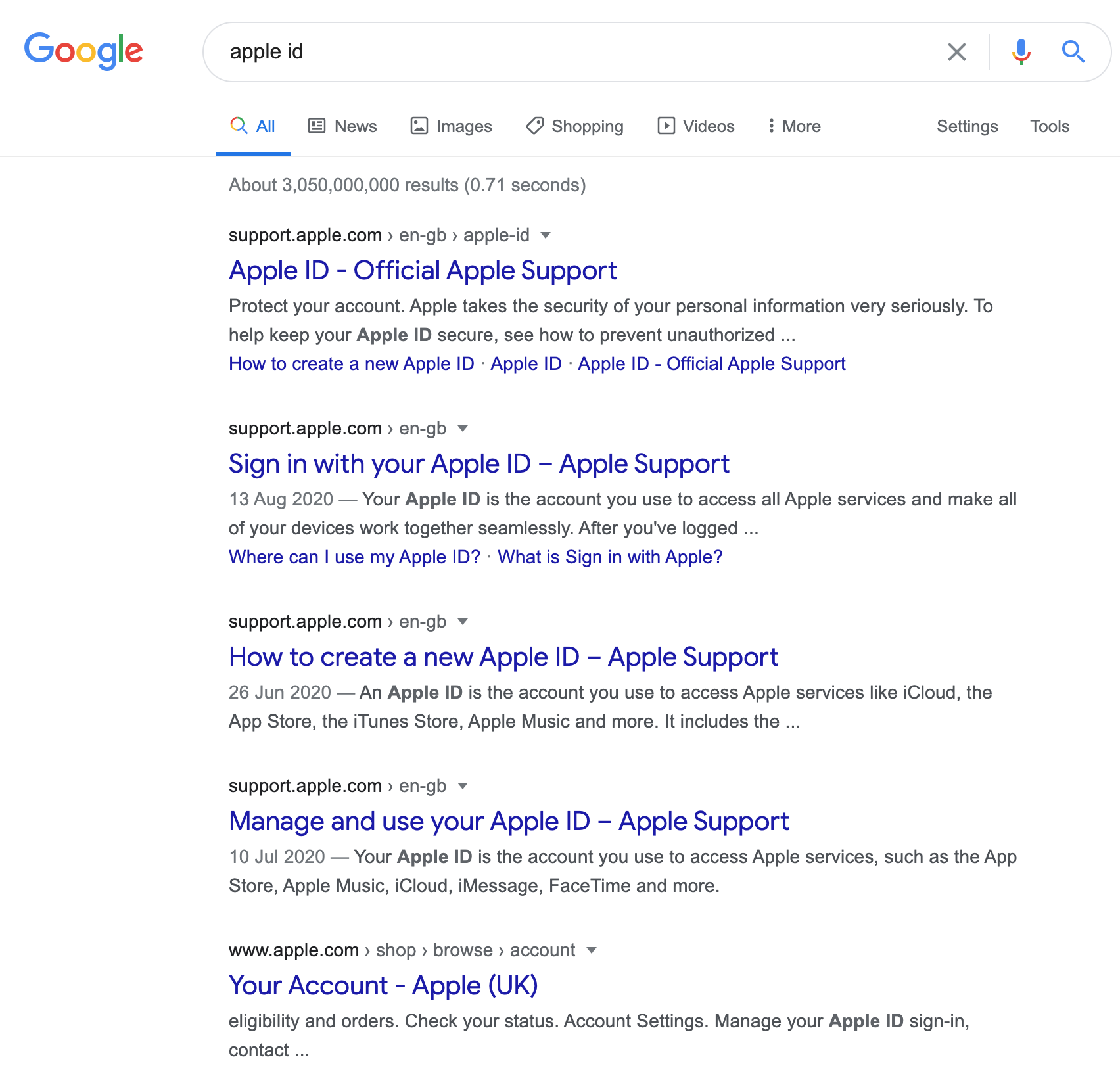
Below you’ll find an example of Apple’s multiple domain strategy.
In order to understand the following searches, you must run them in an incognito window. Depending on your browser settings and the location of your search, you may still see different results than in our screenshots.
Perform a Google search for the search term “apple id”. As you can see, the first page of search results is dominated by Apple. Three Apple domains are shown:
| Domain | Explanation | Domain type |
|---|---|---|
appleid.apple.com
|
Microsite for Apple ID management | Subdomain |
support.apple.com
|
Apple Help Portal Support Pages | Subdomain |
www.apple.com
|
Apple Shop account management pages | Second Level Domain (SLD) with www subdomain |
Pros and cons of a multiple domain strategy
A multi domain strategy can make sense, but usually requires a lot of effort. Since it’s a long-term strategy, it’s more suitable for larger companies. We’ve compiled the advantages and disadvantages of multiple domains below:
| Advantages | Disadvantages |
|---|---|
| ✓ Target group-specific websites | ✗ Expensive |
| ✓ Specialized content | ✗ High administrative effort |
| ✓ Better ranking results | ✗ Risk of duplicate content |
| ✓ Regional focus possible | ✗ May be confusing for users |
The two approaches described for a multi domain strategy also differ in terms of their advantages and disadvantages. Note that they are by no means mutually exclusive. Rather, a functioning multiple domain strategy can include both purchased and self-created microsites. Depending on the specific use case, linking and redirecting can be employed.
| Multiple domain approach | Advantage | Disadvantage |
|---|---|---|
| Build microsites | ✓ Complete control | ✗ Complex, expensive |
| Use redirects | ✓ Uses existing Link Juice | ✗ Requires a lot of finesse, expensive |