

Performance marketing: measuring advertising success

Whether an advertising spot, a billboard, a newspaper advertisement, or an online banner, anyone who places an advertisement wants to know how it’s received by potential customers. In online advertising, which includes, amongst others, social media advertising, your own website, or e-mail and affiliate marketing, this desire is met with a special strategy: performance marketing. In this discipline of online marketing, the marketing measures applied lead to clearly measurable reactions of the advertising recipients, which in turn allows advertising success to be measured. How exactly does this work, and what other advantages does performance marketing offer companies and the self-employed?
What is performance marketing?
Performance marketing, also known as performance advertising, is a subfield, or a strategy of online marketing, in which communication measures are intended to trigger measurable reactions or transactions. As the name suggests, this is a strongly performance-oriented approach that is characterized by its high measurability and controllability. To put it simply: performance marketing is about measuring the impact of online advertising, adapting it as needed, and making it more effective. For this purpose, performance marketing uses various instruments such as SEO, affiliate marketing, or display advertising. Billing is also based on performance, using standard billing models:
Pay per sale (PPS): The advertiser only pays if they can successfully sell a product through the corresponding advertising measures.
Pay per lead (PPL): The advertiser pays as soon as a potential customer contacts them – e.g. the user signs up to a newsletter.
Pay per click (PPC): The advertiser pays a predetermined amount for every click on the online advertisement – e.g. advertising banner or text ad.
Performance marketing can be classified as direct marketing and belongs to the below-the-line communication (“non-classical” communication and advertising measures).
Performance marketing is a strategy or subfield of online marketing and is used especially in the area of customer acquisition and customer retention. Its goal is to trigger measurable user reactions and/or transactions. A “measurable reaction” is understood to mean, for example, clicks on online advertising banners or registration for a newsletter.
For companies and self-employed people, performance advertising is a cost-efficient way to optimize marketing efforts and budgets throughout the campaign period. Large companies such as eBay and Amazon have long relied on performance advertising to complement the classic, brand-building advertising.
Important features of performance marketing
- Measurability
- Optimization
- Modularity
- Networking
Measurability
The measurability plays an extremely important role in performance marketing. While success in classical marketing is often difficult to measure, in performance marketing you can record all reactions and transactions of the target group clearly and promptly – the range of corresponding tools and additional programs is now very broad. For example, a newly registered user, the purchase of a product, a newsletter registration, or clicks on an advertising banner can be monitored, measured, and analyzed accurately. However, performance marketing can only work if the behavior of the site visitor is observed throughout their entire stay.
Optimization
Whether advertising design, ad text, environments, or click offers, it’s possible to adjust various parameters at any time with online performance advertising. Through constant adjustment and optimization, the efficiency of the respective marketing campaign can be influenced and improved throughout its entire duration.
Modularity
In order to adapt the campaign at any time, a performance marketing strategy must consist of numerous small budget modules. The big advantage of this is that each of these budget modules can be analyzed and evaluated independently of the others. This allows you to effortlessly determine which module is particularly worth investing in. If you compare the individual modules directly with each other, you will also quickly see which of them have a low efficiency and need to be adapted accordingly.
Networking
Together you are stronger and can achieve more – performance marketing cannot be imagined without this guiding principle. It’s linked with other marketing elements in a variety of ways. For example, a strong interaction can be observed between the awareness of the advertising platform and the respective click rate. Online performance marketing is partly dependent on other important interaction elements, but can also be easily integrated into any classic campaign as an element itself.
The four areas of performance marketing
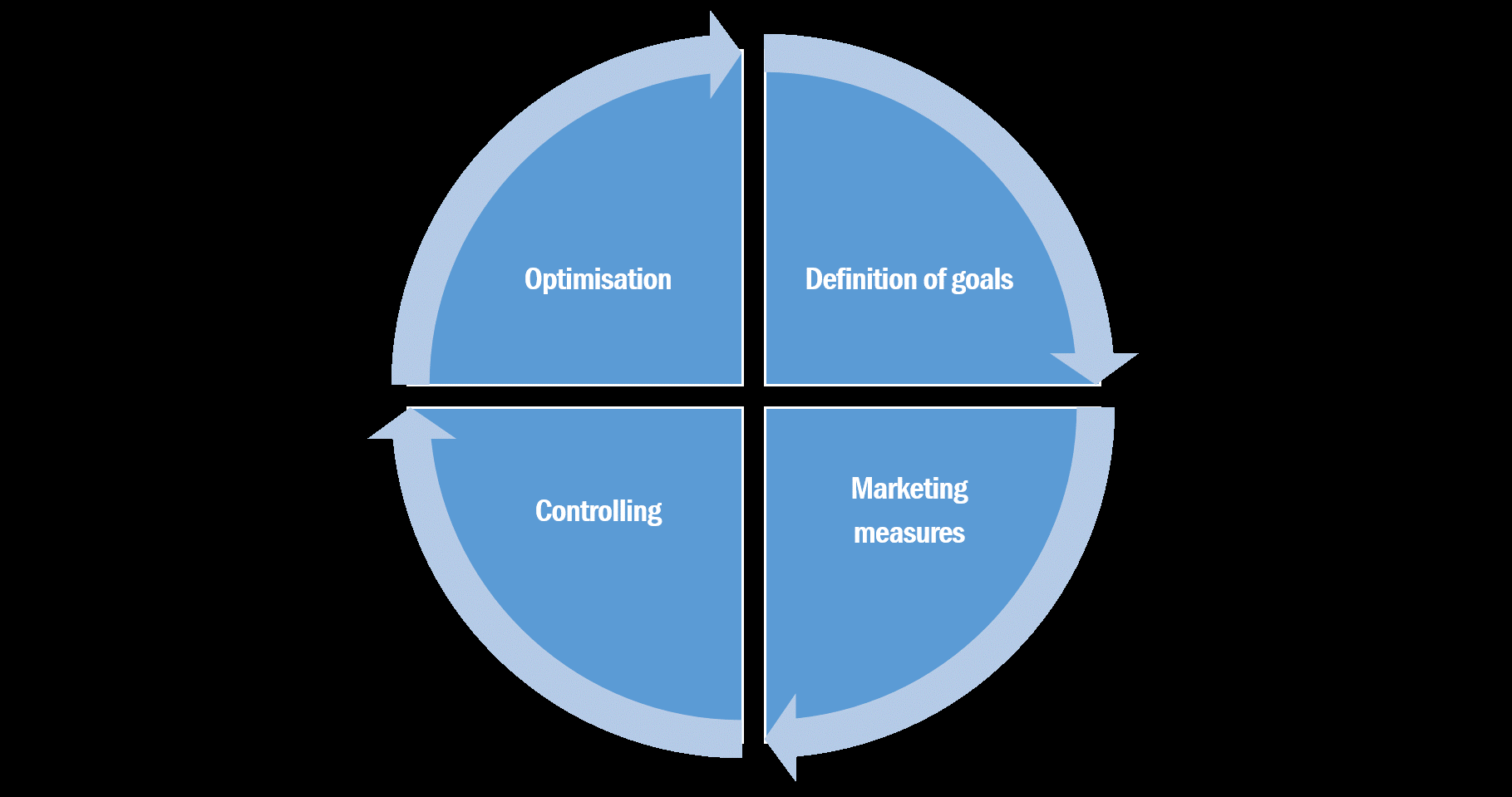
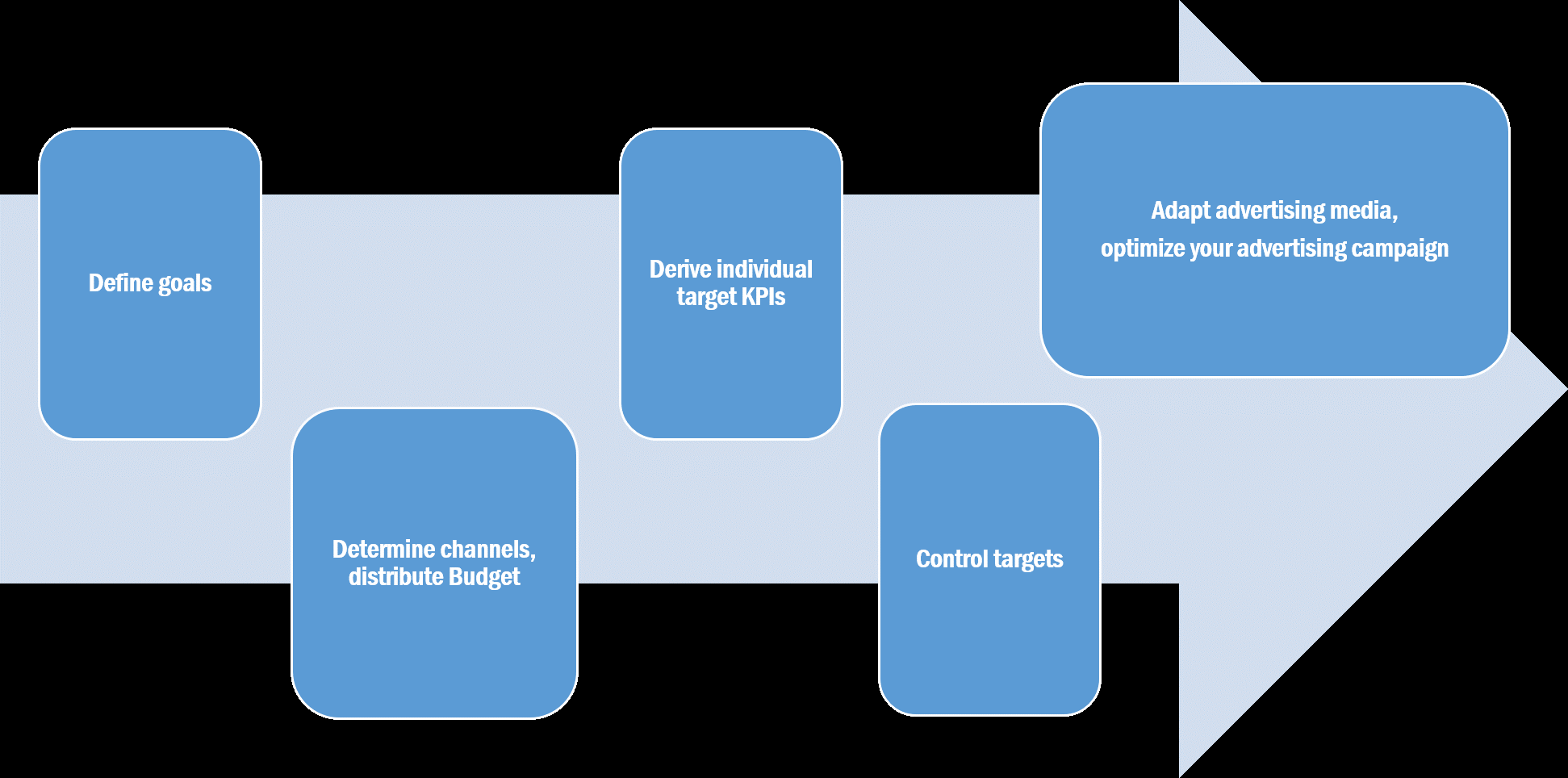
Performance marketing can usually be divided into four different areas:
Goals
As with all marketing disciplines, setting concrete goals plays an enormously important role in performance advertising.
- What exactly do I want to achieve?
- When do I want to achieve this or in what time period?
- What budget can I set aside for this?
The basis should primarily be higher-level marketing and corporate objectives (e.g. conversion targets or “sales increase by x percent over the previous year”). These objectives partly complement each other, but also compete with one another. Many performance marketing campaigns are very strongly focused on sales and distribution, which unjustifiably narrows the view of the different areas of application within this online marketing principle. Performance marketing can also be an effective instrument in the context of pre-sales, when contact with a customer has only just been established, or also during the after-sales period (sales follow-up marketing).
Which goals can be set during a performance marketing strategy?
| Marketing strategy goals | Company goals | Customer-related goals | Area/campaign objectives |
|---|---|---|---|
| Improve customer structure | Increase return on sales | Improve customer loyalty | Achieve a certain amount of website visitors |
| Increase company and product awareness | Achieve or maintain market share | Measure customer satisfaction | Introduce a new product |
| Reduce marketing costs per customer | Achieve additional contribution margin | Prompt/increase repeat purchases | Define certain sales figures for your product |
Source: (translated from German) Thomas Eisinger, Lars Rabe, Wolfgang Thomas (Hrsg.), “Performance Marketing – Erfolgsbasiertes Online-Marketing. Mehr Umsatz im Internet mit Suchmaschinen, Bannern, E-Mails & Co.”. 3., überarbeitete und erweiterte Auflage, Göttingen: BusinessVillage, 2009.
Depending on the chosen marketing channels (see below) for your campaign, you can derive individual target KPIs (key performance indicators). Using these, you can then check to what extent a target has already been achieved. The following simple examples illustrate how different performance marketing objectives can be formulated:
| General marketing tasks | Example performance marketing goals |
|---|---|
| Increase awareness and reach | Generate 20,000 visitors for your website and 1,000 information requests in two months |
| Improve awareness and new customer acquisition | 5,000 new subscribers to the company’s internal newsletter |
| Increase sales | Generate 500 orders for your website while reducing costs per order by 30% |
Marketing measures
To achieve the defined goals, online performance marketing requires the use of various tools. Each of the below performance marketing channels is important for a successful marketing campaign.
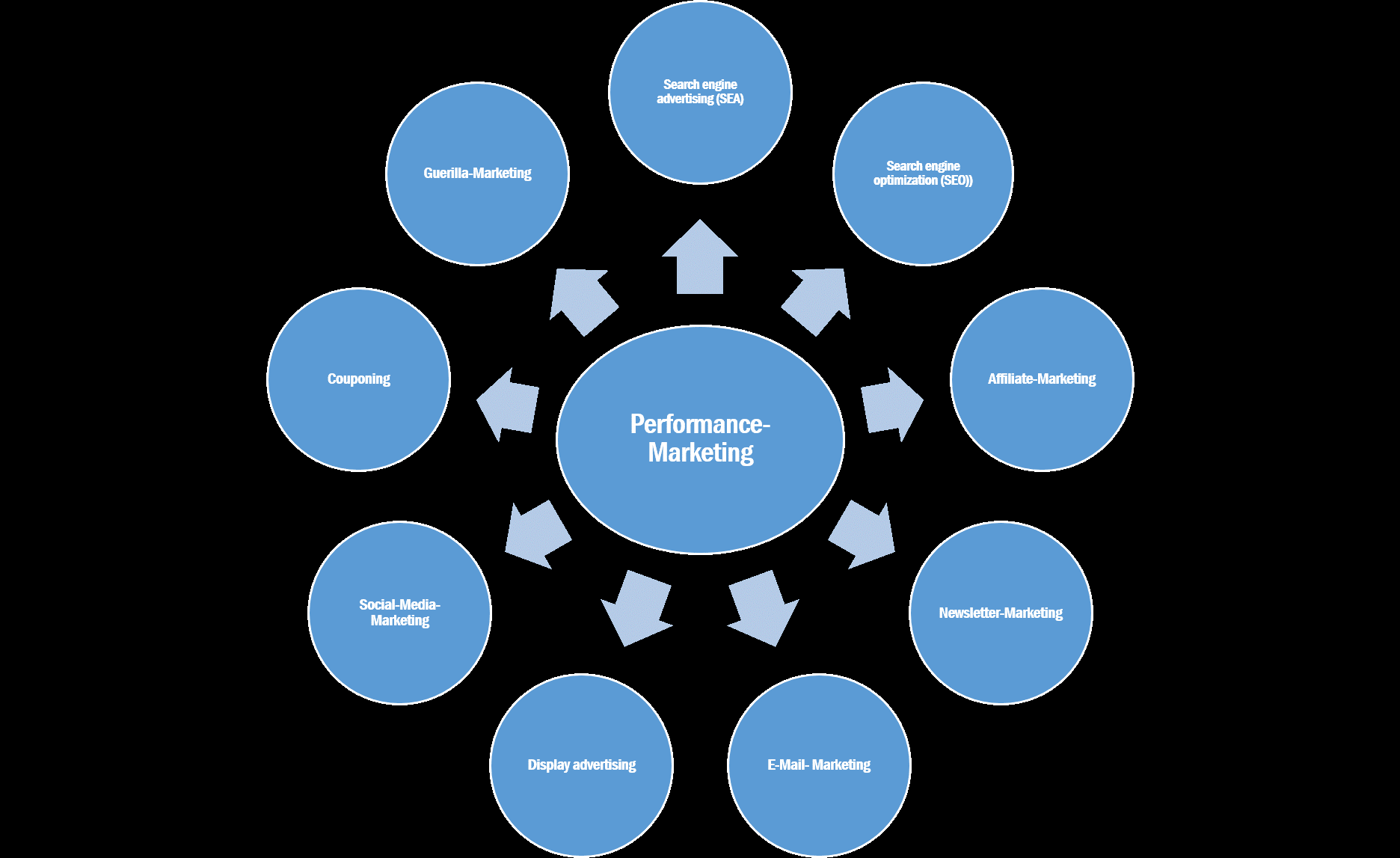
Search engine advertising (SEA): Search engine advertising, includes paid ads that primarily appear on the results pages of Google or other search engines. The website operators buy themselves a better ranking: their website is played out by the search engine (marked as an advertisement) above, beside or below the organic search results for certain keywords.
The term search engine advertising is often used in relation to search engine marketing (SEM). SEM includes both SEA and SEO measures.
Search machine optimization (SEO): Search engine optimization combines all measures that lead to a website being displayed as high as possible in the organic search results of a search engine (especially Google). For example, the website is structured in such a way that search engines can read and analyze it better. If this is the case, the site usually gets a better ranking and is found faster by users and visited more frequently.
Affiliate marketing: Affiliate marketing is when website owners place third-party links on their website. The website owner (also known as the publisher or the affiliate) provides the advertiser (or the merchant) with advertising space, and therefore the reach of their website, for a fee. The advertiser only has to pay if the link placed is successful, i.e. if the link is clicked on or has led to the establishment of contact or the sale of the offered product.
Newsletter and e-mail marketing: These two online marketing channels are very useful tools for increasing a website’s traffic and strengthening a company’s customer loyalty. With e-mail marketing, you can address either a single person (one-to-one communication) or a number of people simultaneously (one-to-many communication). A newsletter, on the other hand, is usually aimed at a large number of interested parties who have signed up to it.
Read more on how to create a professional newsletter in our Digital Guide.
Display advertising: Those who lean towards display advertising, use advertising space beyond their own website. While SEO, for example, mainly focuses on text content, display advertising mainly uses graphic advertising media such as advertising banners.


Social media marketing: This form of online marketing has grown in importance in the last few years. In the meantime, advertising on social networks like Facebook, XING, Twitter, Pinterest, or Instagram has become an integral part of the marketing concept for many companies. According to a recent SCORE infographic, 77% of small businesses in the US use social media for marketing purposes.
Couponing: Whether it’s washing detergent, chocolate, hand soap, or pasta, those who present savings coupons at the checkout when shopping get a discount. For companies, they are a reliable marketing tool. With coupon websites such as Groupon and coupons.com, couponing in the US has become very popular in recent years.
Guerrilla marketing: Guerrilla marketing is always used when an advertiser wants to increase the visibility or awareness of their brand without being too intrusive. As a rule, this is achieved through advertising campaigns that attract a great deal of attention.
Controlling
Performance marketing makes the impact of advertising measurable, but how exactly is it measured? First of all, it is important that you monitor the objectives not only after the campaign has been completed, but also during it. There are various analysis tools that can be used for this such as Google Analytics, GoAccess, Google Ads, or similar. For example, you can determine how many internet users have seen an advertisement, how many have clicked on it, and how many have actually placed an order. After a detailed evaluation of this data, it becomes clear whether and to what extent the budget used led to an increase in turnover – in simple terms: how successful the respective advertisement was.
Optimization
The measures that you implement as part of performance marketing can therefore be continuously monitored and controlled. This allows you to adapt the respective advertising media at any time and improve the campaign before it expires.
The advantages of performance marketing
The decisive advantages of a well thought out performance advertising strategy are:
- The billing is based on performance – as an advertiser, you know exactly what you get for your money.
- Success can be measured precisely – not just after the campaign has ended, but throughout the entire duration of the campaign. In this way, the advertising media used can be adapted in good time and the campaign as a whole can be optimized.
- Performance marketing can easily be integrated into a classic marketing campaign.
A practical example of implementing a performance marketing strategy
In theory, performance advertising is easy to define, but what is the best way to implement it in practice? Let’s take a look at the following performance marketing example:
Suppose you run an online vintage store and want to use performance marketing to increase awareness, traffic, and ultimately, revenue.
Your performance marketing strategy should begin by taking a critical look at your online store. All content should remain up to date: this not only includes product descriptions, prices, promotions, etc., but also information about the company or changes to the payment or shipping information. Furthermore, you should check whether you can further improve the design and functionality of your site – responsiveness, clarity, and monitorability are prerequisites for a successful performance marketing campaign.
During optimization, you should also check out other important areas such as product and price and adjust them as required. Can you keep up with your biggest competitors in terms of price? Do your products offer a unique selling point (a USP)? Do you differentiate yourself enough from your competitors?
Clarifying such questions is crucial for the success of your online shop. After this is complete, you can look towards the optimization of your online store’s user interface. In order for visitors to feel comfortable browsing your online store and stay there longer, the site must be intuitive to use, load quickly, and contain a good search function – further user interface tips can be found in our Digital Guide. These factors have a big influence on the conversion of new visitors to customers. Usability and conversion optimization play a big role in the success of any online marketing campaign.
If you did not take search engine optimization (SEO) into consideration when setting up your store, you should definitely do so as part of your performance marketing campaign. Appropriate measures (on-page and off-page optimization) help your store achieve a better ranking, which makes it easier for new visitors and potential customers to find you on search engines such as Google. In addition, you can have an ad on Google (SEA measures) or an advertising banner (display advertising) speak for your online store and so increase the awareness of your shop – in e-commerce the competition is particularly high.
However, before you use these measures as part of a performance marketing campaign, you should do some important preparatory work and internalize the following points for effective performance measurement:
Define your subgoals as precisely as possible
By defining your goals as precisely as possible, you will be able to see the important subgoals for your marketing campaign. For example, if your goal is to “increase sales,” the subgoal would be “increase conversion rate,” “sell more products,” or “sell products with a larger profit margin.”
Choose your KPIs carefully
Indexes and KPIs are no less important to a successful performance marketing campaign, as they help you measure the degree to which your goals are met. The term “KPI” and “indexes” are often used interchangeably, but they have very different meanings. An index is a measurable value, such as the number of page views or the number of website visitors.
A KPI, on the other hand, is not directly measurable, but shows the extent to which certain goals have already been achieved – which is why an exact target is so important. For example, if the target is to gain an average of 100 new customers per day via channel XY in two months, the KPI shows the deviation from the target value. If, for example, the value after one month is only one third, you know that there is still room for improvement in this area.
Keep an eye on the cost
With an online performance marketing campaign, you have the great advantage that you can divide your budget into individual modules and can keep a much closer eye on costs. To make the campaign a success, you should control costs throughout the entire campaign and make changes to the catalog of measures if necessary.
Regularly review your set goals
Not only the costs, but also the set targets and corresponding KPIs should be closely monitored throughout the entire campaign. To get a good overview, you can use Google Analytics, for example, which displays and analyzes your data in a clear dashboard.
The decision for or against certain marketing channels largely depends on your goals. If you want to increase the awareness of your brand, nowadays it’s difficult to avoid the Google Display Network (GDN) – a cost-effective addition to the classic AdWords ad in Google search.
The GDN is a network consisting of several million websites that have free advertising space available and would like to rent it out. Similar to the auction with Google Search Network, the advertising space is auctioned off via the ads platform. Instead of using exactly defined keywords. The GDN works mostly with thematically defined ads. Additionally you can display classic text ads in the display network, as well as video, image, and rich media ads.
The term rich media refers to ads that consist not only of text and image elements, but ads that also include moving image, video, audio, and animated content. The interactive elements, or the animated elements, are intended to attract the attention of potential customers and help increase the interaction rate or conversion rate. Rich media ads should always be used sparingly; otherwise internet users may feel uncomfortable and want to leave the respective website quickly.
When it comes to effective brand marketing, influencer marketing has now been developed into a very popular instrument. Whether Kylie Jenner or Evan Fong/VanossGaming, they belong to the modern opinion-makers and are trendsetters of the digital age. Many young people, in particular, play the role of digital role models, which makes them excellent brand ambassadors. However, those who enter into a brand partnership with a YouTube or Instagram star should carefully consider their choice.


While influencer marketing has clear benefits such as building customer loyalty, improving brand awareness, and driving purchasing decisions, there are also things to be cautious of. According to an article written on the Influencer Marketing Hub, choosing the wrong influencer or brand ambassador can have a negative effect on publicity. The classic mistake is collaborating with an influencer that does not suit the brand image or when inconsistencies arise. It is therefore important to remember that, just as your product must match your social influencer, so too must the selected influencer match your product.
Our guide on how to become an influencer provides information and tips for starting off in the world of influencer marketing.
Conclusion
We have introduced only a few measures that you can use as part of your performance marketing campaign. It is important that the selected channels always correspond to your goals, your budget, and last but not least, your target group. At the end of each campaign, a comprehensive analysis and evaluation should be carried out to assess the marketing channels used and the results of the campaign itself. This way, you will gain valuable knowledge for your future campaigns and have an even better idea about the budget with which positive results can be achieved.