Definition of semantic web

The semantic web refers to the next stage in the development of the world wide web. In what is known as Web 3.0, information is no longer just linked, but web content is enriched and linked with machine-readable, semantic metadata. The aim is to optimize the information exchange on the web by enabling machines to distinguish and specifically process machine-readable meanings, i.e. semantic content.
- Simple registration
- Premium TLDs at great prices
- 24/7 personal consultant included
- Free privacy protection for eligible domains
Semantic web: history of terminology
The term “semantic web” is one of many terms used to define a semantic development of the world wide web. In addition to semantic web, the following terms for the global, semantically linked information network are also being discussed:
- Web 3.0: Has been circulated by US journalist John Markoff to describe how machine-readable meanings are being added to the interactive, collaborative Web 2.0.
- GGG (Giant Global Graph): Used by Tim Berners-Lee, inventor of the www, as a description of a global information structure that uses semantic structuring of metadata and content; GGG overlaps conceptually with web semantics.
- Linked Open Data: Coined in 2007 to emphasize metadata standards, query routines, and networked semantic data as the foundation of the semantic web.
- Web of data: Definition introduced by the W3C, the World Wide Web Consortium, in 2013 to combine the syntactic and semantic interconnectedness of data in one term.
Semantics is a branch of linguistics that describes the meanings of characters and character strings. The semantic web adds semantic information to web content and gives machines the ability to distinguish between meanings (depending on the context, a character, e.g. word, can have multiple meanings and different characters can have the same meaning). To this end, various standards and ontologies (sets of information) are used to formulate machine-readable semantic metadata.
Background of semantic websites
Until now, the www has been primarily oriented toward the syntax of information. Here, computer programs use algorithms that analyze data indexes, keywords, and search queries. Depending on how unique a query is, search engines deliver more or less appropriate search results (SERP). However, it is important for users and companies that programs process search and user intent as efficiently as possible. The semantic web not only aligns with search terms and syntax, but also with meaning values. In this way, machines can find content and understand and distinguish their meaning.
For example, if users search for the phrase “When did Barack Obama’s presidency begin?”, search engines would not simply return “January 20, 2009”, but rather the most appropriate hits possible for Barack Obama. In the semantic web, machines understand not only the content but also the meaning of a search query and provide an exact answer. Moreover, the analysis of meanings in the semantic web includes not only text, but also images, sound, numbers, and symbols – in other words, all features that carry meaning.
Basis of the semantic web
If we are to understand the semantic web as the development stage of the world wide web, i.e. Web 3.0, then it is based on Web 1.0 and Web 2.0. If it were up to Tim Berners-Lee, the founder of the www, Web 1.0 would already have been based on meaning in addition to location and form of information. The “classic” web is based on standards such as HTML, URLs, and HTTP, i.e. the markup language, address description, and the transmission protocol for structuring data. However, most web content is still distributed across the web in an unstructured way.
HTML documents rarely define what their contents mean and how they differ from others. Although metadata is used, it is still limited in its meaningfulness. Thus, computer programs can search for content addresses, but they cannot identify what the information they are looking for means or how it differs from others. Additional logical statements help programs find content, but also understand it if it is placed in a preformulated, semantic context.
What are entities and ontologies?
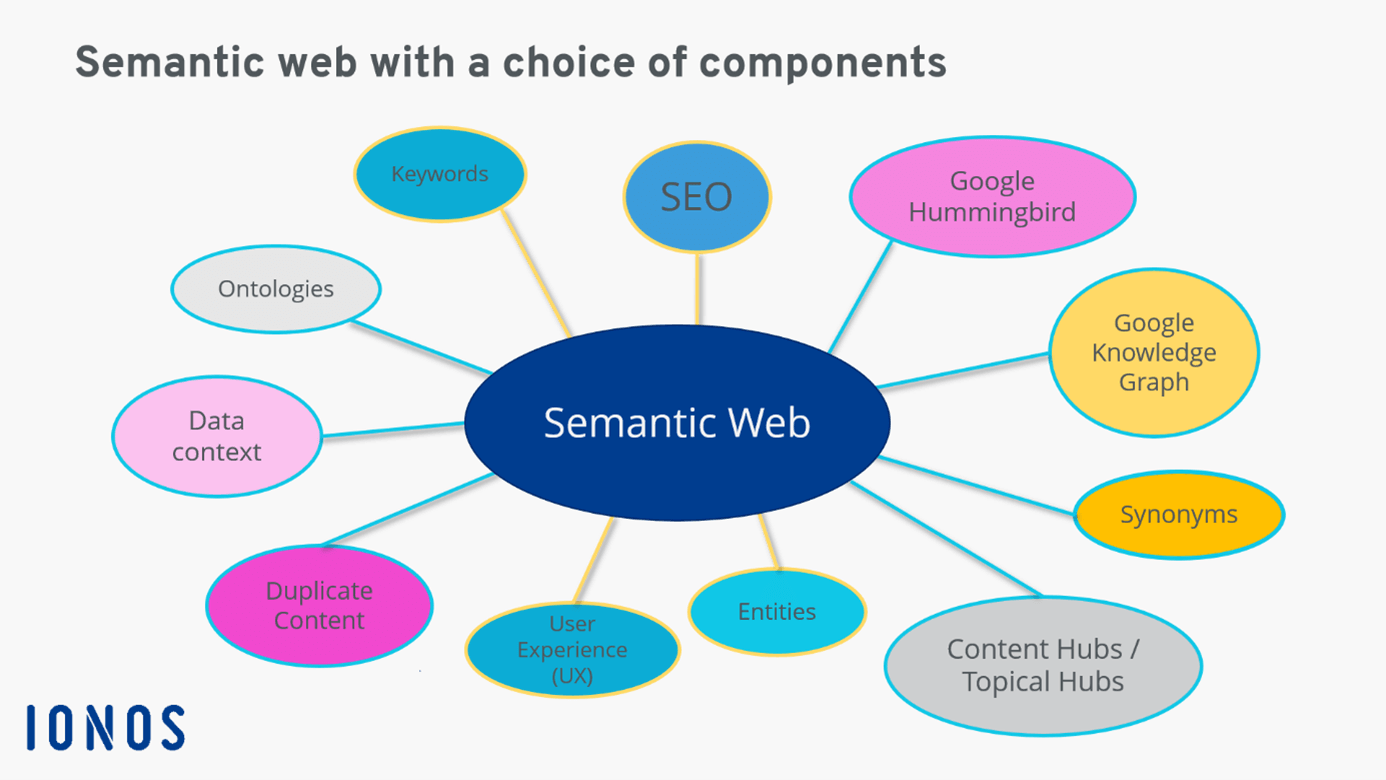
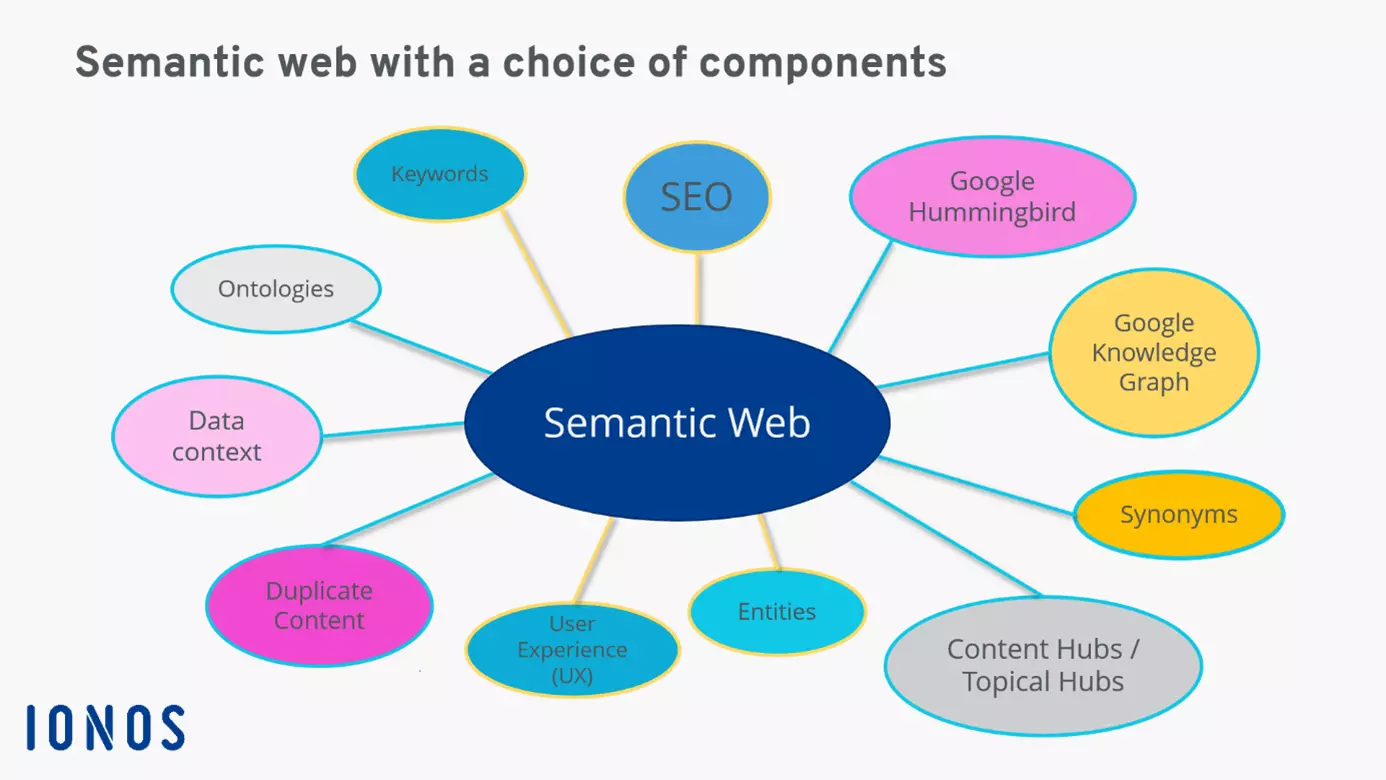
Entities and ontologies are among the core components of the semantic web. “Entity” is a term from semantics – it consists of an identifier and associated attributes. As an example, “Barack Obama” would be the identifier in an entity, while information such as “US President”, “lawyer”, “democrat” are the attributes, i.e. descriptive properties. Entities, in turn, can be related to one another and thematically related or different.
If entities stand in a context to one another, they’re called “ontologies”. Ontologies are ordered sets of information and logical statements that are formulated in a way that is readable for humans or machines and that establish connections and show relationships.
Entities and ontologies are essential for the semantic web. Programs use them to understand relationships between words, sentences, images, and characters, intelligently filter multiple meanings and duplicate content, interpret web content, and thematically distinguish entities. In this way, a rich knowledge network is created that consists not only of unstructured information, but also of keywords and addresses. In the future, artificial intelligence will be able to superficially search the accumulated knowledge of the www, and understand and interpret it in a more goal-oriented manner.
- Free Wildcard SSL for safer data transfers
- Free private registration for more privacy
- Free Domain Connect for easy DNS setup
How does the semantic web work?
To realize the semantic web, computer programs must learn to extract meaning. This is only possible if existing or new www content contains structured data that is formulated in a machine-readable way. Structured data is formulated using specific standards and classifications and is encoded on websites in the form of a schema markup and in-page markup. Structured data allows programs to clearly distinguish, for example, “bank” as a financial institution from the object “bank” referring to the sides of a river. In turn, a uniform machine-readable language requires Semantic Web Standards, as formulated by the W3 Consortium.
Other approaches to uniform semantic web standards include the Contextual Browsing Language (CBL), which describes relationships between information, and the Web Ontology Language (OWL), which organizes and classifies information hierarchically. In addition, the following markups and standards, among others, help create semantic meta-statements, standards, and rules:
- RDF/RDFa (Resource Description Network in Attributes): Used to describe websites in detail to make logical, semantic statements about arbitrary content, and can be extended by RDFa to integrate RDF with XML.
- URI (Uniform Resource Identifier): Identifies information units and points to available Linked Open Data (LOD), i.e. continuing data in HTTP documents.
- RIF (Rule Interchange Format): Defines rules according to which contextual meaning is created.
- Dublin Core: A standard for metadata embedded in digital documents and for machine-readable interpretation of elements formulated in RDF.
- RDFS (Resource Description Framework Scheme): Identifies the RDF vocabulary and specifies the structure and syntax to be used.
- SPARQL (SPARQL Protocol And RDF Query Language): Serves as a query language and protocol for content from the RDF system, which consists of logical descriptions and relationships of data.
Semantic web and its meaning for online marketing
The advantages of the semantic web should not be underestimated. Companies are already relying on it to adapt to the digitalization of the business world. Those who analyze purchasing and search behaviors of customers and target groups can provide personalized information and generate more traffic. In online marketing, advertising that is geared to the semantics of web content can be better adapted and linked to keywords that correspond to a company's services and products.
For search engine optimized websites, too, it's not just a matter of good keywords, but of semantic information that structures content and ensures a machine-readable information architecture. Be sure to include structured data in websites and make web content as meaningful as possible using semantic standards. In this way, you can improve your search engine ranking and can be found by the target groups you wish to attract.
Practical examples of web semantics
The semantic web is still in its infancy, but the first steps towards its realization have already been taken. For example, the possibilities of the semantic web can be seen in Google's Rank Brain, which can thematically assign search queries previously unknown to the algorithm. Google's image search already “recognizes” what users are searching for and delivers thematically similar image results. Similarly, Google's Knowledge Graph feature is able to recognize semantic entities and display the most important related or connected information in addition to search results. Similarly, Google's Rich Snippets and rich cards prepare structured data in the form of information carousels and excerpts from websites.
A well-designed, modern website is important, but its content should also be well-formulated, and search engine optimized. Use the IONOS rankingCoach to improve the ranking of your website and target your audience more effectively.