
The most important social media platforms at a glance

Social media marketing is an important component of every marketing strategy in web 3.0. That’s why it’s so important for companies to have a solid answer to the following questions: which social media channels should be used? Is a company Facebook page enough? Or should other platforms like Twitter, and Instagram play a role as well? And which other social media platforms are attractive for business use? From professional social networks and platforms for finding images to options for bloggers and social video networks, you’re sure to find something that matches your needs. When choosing the right channels, marketing experts can help deliver an overview on the social media platforms with the widest reach.
Social networking websites
Social networking websites are social media channels that don’t tend to focus on any one specific topic and instead aim to attract a wide spectrum of users. Users communicate, click, and share different content types that reflect their interests, making the themes on such social networks just as diverse as the users themselves.
The behavior of some members of social media sites allows their interests to be narrowed down to a particular category. This is due to the fact that particularly active users often follow certain profiles and channels, like certain content elements, and join or open groups that are related to these interests. Marketers are able to use this information to their advantage and can create tailored campaigns that speak to these demographics.
Facebook: the social hostess with the mostest (users)
There’s simply no getting around the original social network when discussing social media, and the rise of new competition over the past few years has done little to chip away at the market leader’s supremacy. One of the premier annual reports on the sector, the Social Media Marketing Report, confirms once again that Facebook is the king of the hill with 93% of all marketing specialists opting for the Palo Alto-based tech giant.
Strengthening customer loyalty Facebook is widely considered to be the mother of all social media platforms and its most basic functions consist of providing an outlet for its members to communicate with each other as well as with private companies, through various Facebook marketing campaigns. A services or a brand's social media page is often home to a constant exchange of praise, criticism, and reports of user experiences. And while this real time interaction can be a challenge for community managers, it also presents attractive possibilities for strengthening customer loyalty.
Facebook adds 500,000 new users every day, that's 6 new profiles every second!
Viral marketing: a fool’s errand without compelling content
Social engagement via Facebook is now common practice for most companies. As a global marketing and interaction platform, Facebook offers businesses exceptional reach. Interesting posts that are shared by users have the potential to spread like wildfire, reaching a large number of users in the process. This phenomenon is known as “going viral”. Combined with its low cost and its broad reach to a wide range of potential customers, viral marketing is becoming increasingly important for many companies. On Facebook, authenticity and relevant content count most. Only professional-grade posts and appropriate topics are the material you need to make a real impact. As an interface between perspective customers and businesses, Facebook profiles serve as ideal mediums for customer care and serve as outlets where input and ideas for new approaches to products can arise.
➔ Like no other social media platform, Facebook offers businesses the largest reach for gaining new customers. No other platform enables target groups to be so directly contacted and motivated towards interaction. Remember, Rome wasn’t built in a day, and it’ll take time to develop a successful strategy for using Facebook to win over more customers. In addition to own company or campaign profiles, this platform also offers fade-in advertisements.


Image networks: Pinterest and Instagram
With image sharing platforms, visual aspects are put at the forefront: the focus here lies on publishing photos and videos; comments play a smaller role. What counts the most are entertaining posts that leave a strong and lasting visual impression on target groups. But what options are out there in addition to the market leaders, Pinterest and Instagram?
With roughly 1 billion active users, the micro blog for photos and videos Instagram is one of the most popular social networks currently on the market. And while it’s possible to share pictures and videos with Facebook, Instagram has its own unique dynamic that is centered on pictures. The app offers countless photo editing features. Entries are categorized with the use of hashtags.
Instagram also lends itself particularly well to reaching target groups through good content and well-thought out strategies. But there are also other ways to gain more attention for your companies outside of your own Instagram account. Over the past few years, product placement has again proven itself as a serious means of advertising, with businesses using influencers to market their products. Instagram has also recently introduced the option of placing ads in users’ news feeds.
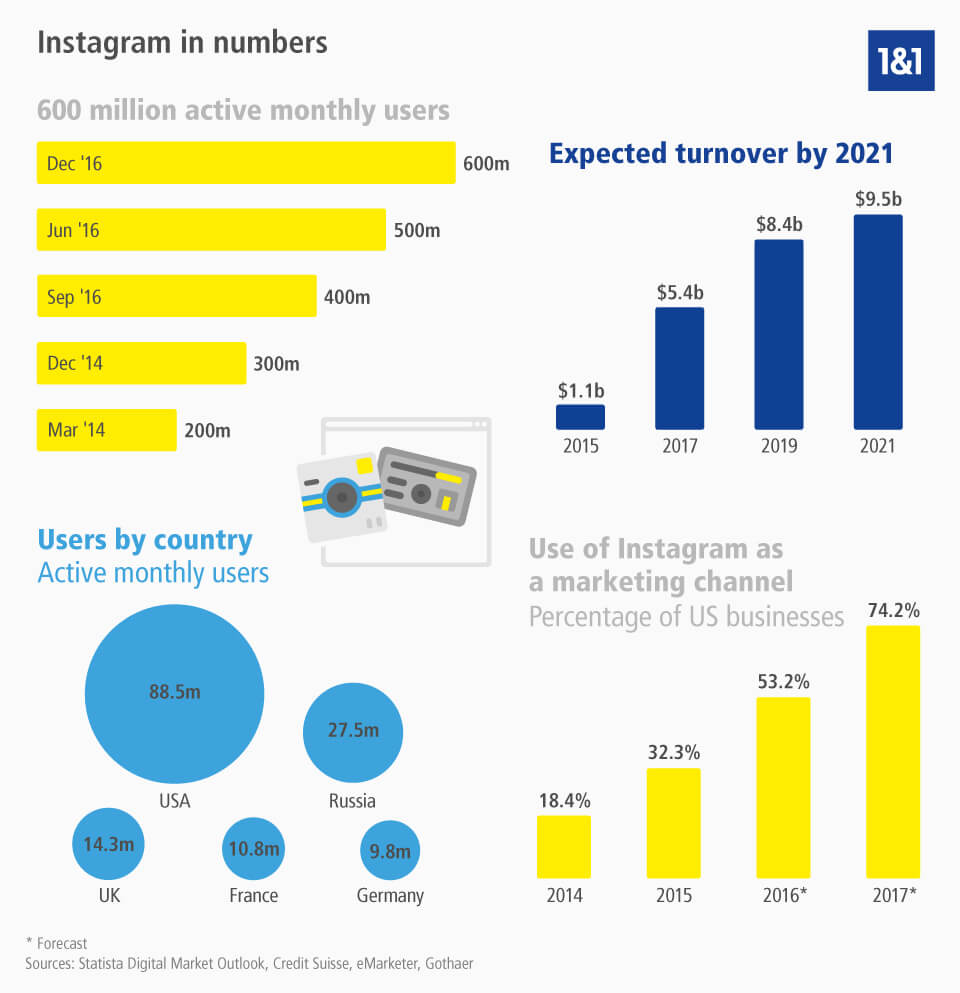
Click here to download the infographic on Instagram.
When Facebook bought Instagram in 2012, there were just 40 million Instagram users, today that number has increased to 400 million!
Instagram stories
First launched in August 2016, this feature allows users to share pictures and short videos (which can additionally be labeled and drawn upon) that weave together a story when viewed in temporal sequence. What makes this function so special is that these pictorial narratives are automatically deleted after 24 hours. This latter aspect makes Instagram Stories remarkably similar to Snapchat’s ‘My Story Function’, a similarity that Instagram co-founder and CEO, Kevin Systrom, was ready to recognize. The degree to which this aspect can be used for marketing purposes, however, remains to be seen. One possibility may be to generate attention for products and services and expanding a brand’s reach through creative, target-group focused stories.
According to estimates, there are roughly 100 million Pinterest users, with 81% of users identifying as female. Many use the platform as a source of inspiration for topics concerning fashion, lifestyle, and travel. At its essence, Pinterest is a kind of virtual bulletin board and doesn’t entirely adhere to the set-up of conventional social networks. Although traditional aspects of social media, like interaction and communication, don’t play such a large role on this site, the network is a great tool for increasing customer loyalty and strengthening your brand. The concept here is simple: users collect pictures and posts or those of others and share them on their pin boards. Pin boards can be structured according to different themes. Other users can also be followed; as a follower you will then receive their latest “Pins” in your feed. As a further advertising option “promoted pins”, are included into the natural, or organic content of users.


Snapchat
Among the social networks mentioned here, Snapchat occupies somewhat of a special role. This platform isn’t so much a traditional social media platform as it is an image messaging app. The mobile app, which is available for both Android as well as iOS, is used to send photos and videos that have been created and edited (often with drawings and animation) on smartphones or tablets. The trick here is that the sent images and recordings automatically delete themselves 10 seconds after they’re viewed. It should be noted, though, that there are ways to recover and save these images. This app is particularly popular among teenagers, a fact that can partly be attributed to host of playful features the program offers.
Snapchat has gone through some major developments over the last few years. It’s ‘My Story’ function enables users to publish pictures that have been loaded in sequential order so that they tell a story. These can then be accessed over a 24 hour-period after which they are then automatically deleted. Additionally, conventional text messages as well as video calls are also possible.
Marketing with Snapchat: still uncharted territory
Snapchat is quickly growing in popularity among marketing departments throughout the industry. But social media marketing on Snapchat is still relatively new terrain for many companies and is still being experimented with. Some companies even run their own accounts, providing relevant content for their target groups. They also often work together with influencers in order to further make potential customers more aware of their offerings. It’s more difficult for traditional advertising clips to gain traction with this app, as only there is only little user data available, making specifically targeted advertisements a challenge. What’s more, clips need to be presented in Snapchat’s vertical format, which can’t be used for almost any other format.
Flickr
The online community for images is among the oldest of its kind. Images taken by both amateurs and professionals alike can be found on the platform. In addition to images, the platform also allows videos whose length does not exceed three minutes to be uploaded to the site; there, users can also add other information and buzzwords to their recordings. In addition to enabling files to be archived, Flickr also makes it possible for users to view and comment these images, facilitating an exchange of sorts among these. The platform also commonly used by some companies to archive and distribute press photos. As of March 2016, though, automatic upload of larger amounts of data is no longer gratis and now requires users to be registered ‘pro’ members in order to take advantage of this function. Many experts see this as a chance for platforms like Google Fotos (the successor of the web application, Picasa), which allows many image files to be uploaded free of charge.
Tapping into emotion to increase customer loyalty
Clever use of Pinterest and Instagram can be an excellent way for businesses looking to gain more attention from potential customers. Pictures and videos offer clear advantages over texts in that their messages are conveyed much more directly. Visual media is also an effective means for tapping into emotions and can prove especially useful for image building. By “giving a face” to your business through photos and videos, visual marketing is able to substantially contribute to branding efforts.
➔ Effectively using Pinterest and Instagram requires communication to be particularly image-heavy. Popularity on Facebook doesn’t guarantee similar success on other social networks. And it is precisely this sort of half-hearted approach to social media that prevent many companies from reaching their full potential. Only by truly investing time and energy in such platforms will your business begin to reap the benefits of a solid visual marketing scheme.
Carving out a niche: blogging networks
The origins of platforms like Twitter and Tumblr can be traced back to the blogging scenes. Today, however, they’re often used outside of the blogosphere. Twitter in particular has many accounts that have been set up by companies, organizations, media outlets, celebrities, politicians, etc. Users of both networks share different types of content (news, links, images, videos). Those who chose to follow a particular timeline are then presented with news regarding this profile in their time line, just as is the case with Facebook. Users who aren’t registered with the account also are able to view all the content that’s posted.
According to estimates, there are some 680 million Twitter users. Of these, approximately 305 million are active users. Twitter has established itself as a reliable marketing channel in the United States, with most major companies presiding over at least one account. One of the biggest challenges in getting your message across on this platform has to do with Twitter’s design. Tweets are only allotted a maximum of 140 characters. In terms of how these messages are spread, Tweets are posted chronologically on users’ profiles and appear within followers’ newsfeeds.


The need for a quick response With the help of the ‘@’ symbol, users are directly addressed, and by incorporating a hashtag (#) individual posts can be assigned to specific topics. Tweets coupled with photos, videos, or links are particularly effective in grabbing your followers’ interest. Ideally, with enough exposure, Tweets geared at target groups will provide your account with more followers. Another possibility for boosting your business’ profile comes in the form of Twitter Advertising, which provides sponsored profiles and tweets. Operating in real time, Twitter demands quick reactions to current events and a high posting frequency from its users.
High Potential for courting controversy Although Twitter has proven time and again to be a powerful resource for increasing the reach of your brand or company, those overseeing social media accounts need to be well aware of one potentially dangerous pitfall: hashtag-hijacking. One form of hashtag-hijacking occurs when a Twitter user exploits, knowingly or not, trending topics for their own private gain. Such stints almost always backfire and social media teams often find themselves reeling against a very unforgiving onslaught of outraged users. Another version of this phenomenon comes about in a very different way. Some companies have seen their Twitter accounts overrun due to a mistake being made in good conscious. By inviting followers, or the broader Twittersphere, to comment via a promotional hashtag on your brand or product with the hopes of gaining popularity, you are putting yourself at the mercy of the general public. The results of this aren’t always pretty and may require extensive damage control measures to be taken. ➔ With its high post rate and real time posting, Twitter can be a helpful medium for interacting with potential clients and customers. Further advantages include the ability to share links, pictures, and videos. Drawbacks are the 140 maximum character length and the potential for mass backlash against promotional campaigns.
Tumblr
Unlike Twitter, Tumblr is a more traditional blogging platform given that texts here aren’t limited by a minimum number of characters. In addition to posts, images can also be published on users’ blog space. And while it may not have the same clout as other, more prominent social media networks, with some 230 million users worldwide, most of which are teens are young adults, the platform is nonetheless still full of potential for marketers. Tumblr is also a popular social media platform for companies in North America, and, due to the nature of its demographics, is especially well suited for more international audiences as well as campaigns aimed at younger audiences.
According to Tumblr founder and CEO, David Karp, the publishing platform was never intended to be a social network; however, this is exactly the route that the platform has taken over the past few years. Following this, Tumblr listened to its users’ wishes and introduced an instant messaging function, which enabled registered members to communicate with one another. As a user, one of the site’s main focuses is to share the entries of other Tumblr bloggers.
Another aspect Tumblr has in common with more conventional social media platforms is the fact that content and topics can also be labeled with hashtags, making these relevant posts easier to find. This feature makes it easier to spread high-quality content and increase the chances that an entry will go viral. In order to build up a network and publish target-group specific content, it’s first necessary, however, to acquire your own following of sorts. This can be done by posting relevant content, following users similar to the target group that you’re trying to reach as well as by sharing and communicating others’ content. The trick here is to come off as authentic and genuine as you can. This allows you to more quickly gain the trust and attention of other users.
➔ While not as prolific as Facebook, Twitter and Tumblr enable companies to reach younger, more media savvy audiences.
Professional networks
Most experts agree that, at least as social media is concerned, that it’s best to maintain a healthy barrier between your work life and private life. For this reasons, many companies advise their employees to avoid communicating with business contacts via networks like Facebook. Professional networks like LinkedIn, however, have created themselves a niche market by catering explicitly to a more professional environment. This platform model facilitates an exchange between business partners, employees as well as applicants and companies to occur. They aim to offer all of the advantages that sites like Facebook have in terms of communication but in a more professional setting.
The file hosting service, SlideShare, which is owned by LinkedIn, contains presentations, documents, and videos on topics from a wide spectrum of occupations and professional disciplines. Users are able to upload content themselves or simply access other files that have already been uploaded.
The primary focus here is to share information, rather to build up or expand a network.
Many experts advise against openly sharing too much information on social media platforms. Companies have been known to use sites such as Facebook, Twitter, etc. to screen applicants before deciding to invite them in for an interview. While shying away from social media may do wonders for your work-life balance, for some professionals, not having an easily accessible social media presence can be a major drawback. This is where professional networks like LinkedIn come into play: here, there is little need for users to share personal information, and they can instead focus exclusively on business-related matters.
As the go-to networking site for users around the world, LinkedIn hosts a respectable 332 million total users. This social network is structured into three pillars: the network area, which involves building up and expanding your own personal network, the knowledge section, which encompasses internal messages as well as the transfer of knowledge among users, and, finally, the opportunity portion on the website, which deals with continuing education possibilities and refocusing career paths.
SlideShare
What Instagram or Flickr offer for images, SlideShare offers for presentations: SlideShare allows you to publish and archive company or job-related content online, which unregistered users are also able to access. In addition to presentations, documents, infographics, webinares, and videos can also be uploaded. And when these are also labeled with the right keywords, then they can also be found in the Google search results. Those who publish information about their company, industry, product, or service also have the opportunity to receive feedback from users in the form of evaluations and comments, which can then be shared in your social networks. Renowned organizations and businesses like the White House, NASA, IBM, and Hewlett Packard all use the platform for their content. LinkedIn recognized the potential of this service and ended up acquiring it in 2012.
Networking and maintaining an image
LinkedIn is first and foremost about making new contacts and staying in touch with former colleagues and associates. But it would be a mistake to think that the network is set up exclusively for business-to-business topics. People who are active on a professional network are also potential customers of the companies in their contact lists. LinkedIn also serves as a job portal where both potential employees and employers are able to find out more about one another before further steps of the employment process are taken. Current or former colleagues have the option of rating each other. It’s important to note that on LinkedIn, companies are judged by their merits as employers, rather than the quality of their products or services.
Things look a bit different when it comes to SlideShare. Here, companies can demonstrate their expert knowledge, in addition to other their products, services, or innovations. The content published on this platform should always be professional in terms of its appearance and structure and should further include appropriate keywords so that these presentations can also be found in search engines.
➔ LinkedIn is the best platform for connecting with business contacts. As a part of a broader social media strategy, this professional network enables companies to strengthen their own image, scout talent, and share professional competencies.
Video networks
For quite some time, YouTube was the only video portal that many marketers considered worth investing their time and energy in, and in some respects, choosing to focus exclusively this platform was in many cases perhaps the right decision: it is, after all, by far the most widely used channel of its kind and offers a lot of potential for those who know how to make the most of it. And it’s not just celebrities and businesses that are able to gain hundreds of thousands of subscribers — innovative ideas are awarded on this channel, allowing some individuals to turn their hobby into a career and make money on You Tube. As the home of so many influencers, it’s no wonder that it’s so popular among marketers.
Aside from the market leader, there are also additional video networks that may be of relevance for social media marketing-related purposes. In addition to niche platforms like Twitch (content on video games) and Vine (maximum six-minute long clips that are shared via apps), Vimeo is the name that stands out the most here.


YouTube
YouTube is another social media marketing outlet that offers great potential for spreading your outreach. The site can be reached directly through Google search results, making it particularly appealing. A total of 6 billion hours of video are watched on YouTube every month. This means standing out amongst the competition can be a fierce undertaking. And as is ever the case when it comes to content marketing: the quality has got to be right. Otherwise, you’ll be sure to be confronted with an onslaught of negative comments and ratings by unimpressed YouTube visitors. In addition to creating customized channels, YouTube also offers marketers the opportunity to promote their products or clients through target-group appropriate influencer marketing.
Vimeo
Vimeo is especially interesting for those looking to promote more technically advanced videos that put a greater emphasis on looks. Not only does the website appeal to more refined and professional audiences with its looks, its content also reflects this aesthetic: wobbly smartphone videos can’t be found on this platform. What users will encounter are professional, high-quality film productions, many of which that are of a more artistic and creative nature.
Vimeo is set up in a similar way to YouTube — anyone can watch the videos, but only community members are allowed to evaluate and comment on these. But the two portals differ in the way they deal with the topic of membership: those wishing to upload more than 500 MB of video material per week have to switch to a fee-based scheme. Companies wishing to post videos containing advertisements or content commercial nature are forced to sign up for a paid membership option. Independent production companies, charitable organizations, and artists are all exempted from this rule. A paid account may be worth it for companies; this is especially the the case for those wishing to engage with a more artistic or creative target audience.
Tough competition
There’s no single recipe for success when it comes to setting up and operating a YouTube channel. An expensive, professional production can easily lose out to a short, amateur clip of a pet doing something funny. But the rewards for striking viral video gold can be well worth the efforts. The list of world-wide viral hits is long and YouTube is often the place of origin for many of these. Companies can profit from the emotional appeal of many videos, and YouTube’s visual nature lends itself particularly well to creating such connections. A further bonus is that new products or services can be quickly and easily explained and described to viewers.
In addition to its enormous audience, one of YouTube’s biggest advantages is that one needn’t be an experienced film maker in order to experience success. In stark contrast to this model, there’s Vimeo, which rather lends itself to posting more advanced and professional content. On both channels, companies are able to profit from the emotional character of many of their videos. In general, it’s much easier to create an emotional attachment with videos than it is with other media forms. Videos are also a great way to explain to customers how now products and services work.
➔ YouTube and Vimeo should always be seen as channels that complement your other marketing efforts. When utilized in tandem with other portals, these outlets can provide significant support in maintaining the image or brand of your company.
Target groups rather than channels
In today’s advertising environment, opting out of campaigns on social media platforms simply isn’t an option. When executed thoughtfully, businesses have the potential of starting a viral phenomenon that can translate into enormous gains in viewership, web traffic, and ultimately profit. But maintaining this wave of success is only half the battle. An expansive reach is of little use when target groups are ignored. By cleverly adding social media platforms to your marketing mix, businesses and companies are able to gather input directly from their customers, without having to perform extensive, large-scale surveys.