

Brontobyte: The data quantity of the future

In the year 2000, the legendary Nokia 3310 cellphone came on to the market with a storage capacity of 1 MB. Nowadays, a single digital photo taken with a 12-megapixel camera takes up about 2-4.5 MB. The times change and with them the relevant quantities of data. Since computers are processing more and more information, it’s normal that digital units of measurement also keep growing. The biggest officially recognized data quantity is the yottabyte. After that comes the brontobyte. Keep reading to find out all about the brontobyte.
- Simple registration
- Premium TLDs at great prices
- 24/7 personal consultant included
- Free privacy protection for eligible domains
The brontobyte and big data
The day will soon come when no one remembers what a floppy disk was. And one day CDs and DVDs will soon also be forgotten relics of the past. We might even ask ourselves soon what the point of 128 GB USB sticks was when we can easily store all our data in the cloud. Just like every part of daily life, our storage devices are continually adapting to the needs of the present day. The bigger the market for digital technologies, the more data we produce and the more storage space we need.
While digital devices get smaller and smaller, tech giants like Apple, Alphabet (Google), Amazon and Microsoft are building bigger and bigger data centers with growing storage capacities. The masses of data that are processed there are called big data. This data is too big to be handled by conventional computing capacities. Data sizes like the brontobyte aren’t relevant to our daily lives, but for Apple, Tesla, and Google they’ll soon be perfectly normal.
But of course that doesn’t change the fact that it all started with the bit, the smallest unit of information. A bit can represent one of two information states: 1 or 0. Bits form the basis of any digital data processing, even in the world of big data. A byte (B) consists of 8 bits and is the smallest commonly used quantity of data. The byte is too small to express storage quantities relevant to us, which is where other units in exponential powers of the byte come in.
The brontobyte as a data quantity
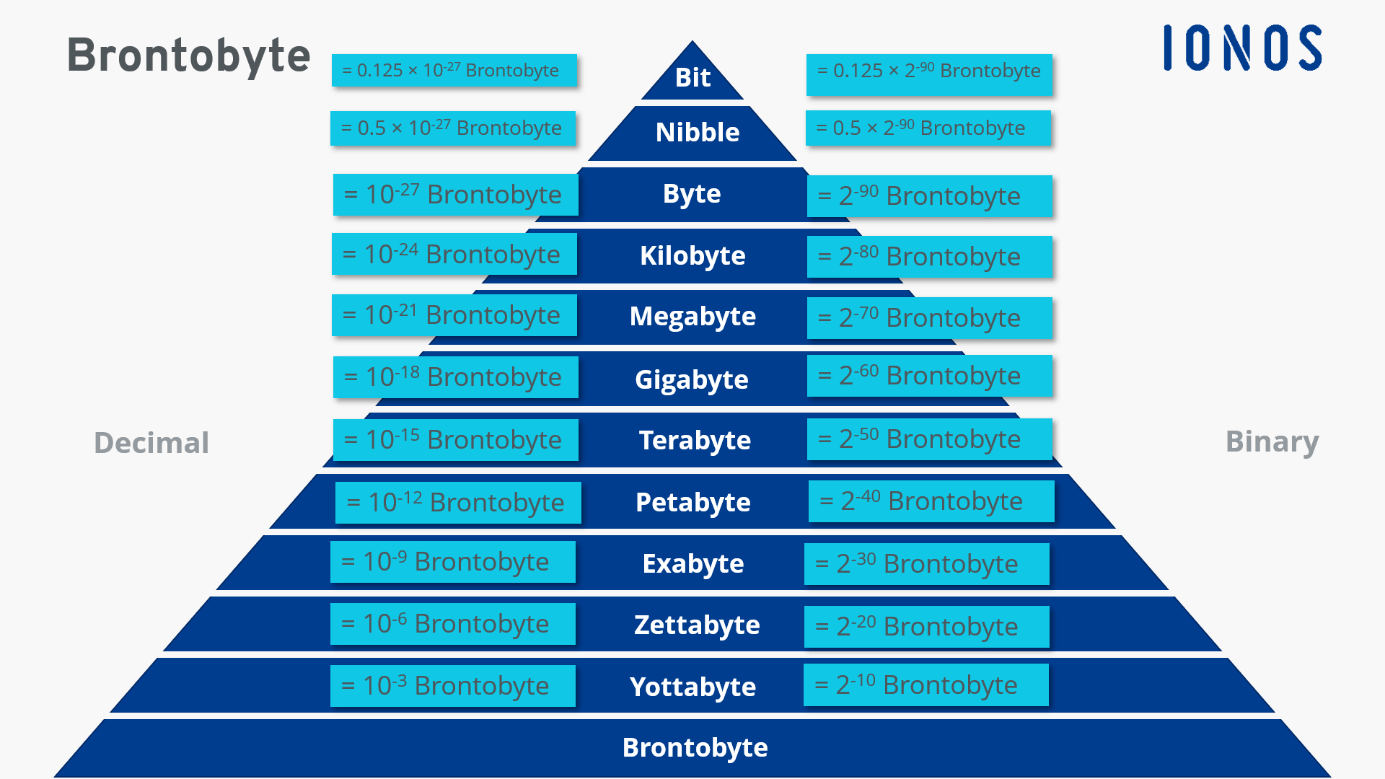
There are two standards for labeling storage sizes: binary prefixes and decimal prefixes. Binary prefixes operate in powers of two and decimal prefixes in powers of ten. These are the standard data sizes expressed with both binary prefixes and decimal prefixes:
| Binary prefixes | Decimal prefixes |
| Kibibyte (KiB) | Kilobyte (KB) |
| Mebibyte (MiB) | Megabyte (MB) |
| Gibibyte (GiB) | Gigabyte (GB) |
| Tebibyte (TiB) | Terabyte (TB) |
| Pebibyte (PiB) | Petabyte (PB) |
| Exbibyte (EiB) | Exabyte (GB) |
| Zebibyte (ZiB) | Zettabyte (ZB) |
| Yobibyte (YiB) | Yottabyte (YB) |
| Brobibyte (BiB) – not standardized, yet | Brontobyte (BB) |
Since binary prefixes haven’t gained a lot of traction, you’ve probably only come into contact with the decimal prefixes. Despite the fact that the binary prefixes are more precise, decimal units are more common even in the IT field.
| Binary (number in bytes) | Decimal (number in bytes) |
|---|---|
| Kibibyte (KiB) = 1,024 (210) | Kilobyte (KB) = 1,000 (103) |
| Mebibyte (MiB) = 1,048,576 (220) | Megabyte (MB) = 1,000,000 (106) |
| Gibibyte (GiB) = 1,073,741,824 (230) | Gigabyte (GB) = 1,000,000,000 (109) |
| Tebibyte (TiB) = 1,099,511,627,776 (240) | Terabyte (TB) = 1,000,000,000,000 (1012) |
| Pebibyte (PiB) = 1,125,899,906,842,624 (250) | Petabyte (PB) = 1,000,000,000,000,000 (1015) |
| Exbibyte (EiB) = 1,152,921,504,606,846,976 (260) | Exabyte (GB) = 1,000,000,000,000,000,000 (1018) |
| Zebibyte (ZiB) = 1,180,591,620,717,411,303,424 (270) | Zettabyte (ZB) = 1,000,000,000,000,000,000,000 (1021) |
| Yobibyte (YiB) = 1,208,925,819,614,629,174,706,176 (280) | Yottabyte (YB) = 1,000,000,000,000,000,000,000,000 (1024) |
The reason why the brontobyte doesn’t appear on either of these two lists is simple: It hasn’t yet been standardized as a unit of measurement for data. But it’s just a matter of time. The yottabyte, like the brontobyte, is also still a purely theoretical quantity of data and has already been standardized. The next theoretical level above the brontobyte could be gegobyte or geopbyte, which would correspond to 1,000 brontobytes or 1030 bytes.
In any case, the dimensions are enormous. In decimal notation, 1 brontobyte is 1,000,000,000,000,000,000,000,000,000 (1027) bytes. In binary notation, 1 “brobibyte” (not standardized, yet) is 1,237,940,039,285,380,274,899,124,224 (290) byte.
The biggest non-theoretical quantity of data is currently the zettabyte. In 2016, the amount of data traffic worldwide exceeded 1 zettabyte, bringing us into the zettabyte era. 1 brontobyte is equivalent to 1,000,000 zettabytes. The brontobyte era is thus still a way away.
For context: The biggest quantity of data that a data giant like Google is currently storing is between 10 and 15 exabytes. One exabyte can fill a data center the size of a city block. Everything ever written by humans would take up 50 petabytes of space - significantly less than Google’s storage capacities. 1 zettabyte requires 1,000 data centers. Another example: If the earth represents 1 gigabyte, then the sun would be equivalent to 1 exabyte. In comparison to that, 1 nibble (made up of 4 bits) is as small as bacteria.
How long has the brontobyte been around?
It’s not without reason that the word “brontobyte” might make you think of dinosaurs. Brontosaurs are some of the largest living things that we know of. How long the term “brontobyte” has been around, however, isn’t clear. What we do know is that the word “byte” originated with IBM engineer Walter Buchholz, who coined the term in 1956.
The future looks like brontobytes
Currently we don’t have the storage capacity to house one brontobyte. Commercially available hard drives and computers with large storage capacities operate in the terabyte range. All of the hard drives in the world couldn’t store 1 brontobyte. That will of course change with time. The most likely areas of application for the brontobyte are the internet of things, artificial intelligence, quantum computing, and sensor data. Smart homes and self-driving cars will probably be the first everyday technologies that need to process data in the range of yottabytes and brontobytes.
The faster digital technologies develop, the more storage space we need. Fast data processing is hardly possible with a full memory. Cloud storage provides a practical solution. HiDrive Cloud Storage by IONOS can help you store your data securely and centrally in the cloud. That way you’ll have access to your data on the go from various devices. Choose the package that’s right for you, from 100 to 2,000 GB.