
What is a pillar page?

Pillar pages are an innovative concept for structuring content and optimizing SEO pages. They are centralized, thorough pages that cover a broad topic and serve as a hub for related subpages. When used right, they can improve your search engine performance.
What is the definition of a pillar page?
Pillar pages are a central part of content marketing and SEO. They form the foundation of a content strategy aiming to provide comprehensive information on a specific topic without going into too much detail. Pillar pages give an overview of a broad topic and serve as an anchor for a variety of related content that is more specific.
The word “pillar” reflects the part they play in the structure of a website. Pillar pages serve as a strong, structural column on a website. Related content (called topic clusters) is grouped around the pillar page, which internally links to the clusters.
It’s important not to confuse pillar pages with hub pages. Hub pages offer a broad overview of a topic and contain links to various related pages. Like a table of contents, they help users to orient themselves within a larger area of interest. Pillar content, on the other hand, is more thorough and dives deeper into a topic.
What are topic clusters and pillar content?
Pillar pages are at the center of a topic cluster strategy. Topic clusters are collections of content grouped around a central topic. The core topic is discussed on the central pillar page. The topic cluster consists of various kinds of content related to a subtopic, which is referred to as cluster content or cluster pages. Each of those pages focuses on specific subtopics or keywords that are related to the main topic.
For example, say there’s a pillar page on the topic of digital marketing. The pillar content would include extensive information on that overarching topic, while the topic clusters would provide information on subtopics like SEO, content marketing, social media marketing and pay-per-click advertising. The cluster pages delve deeper into those areas and link back to the pillar page.
Pillar content creates a network of content that makes it easier for search engines to understand the connections between individual pages. Linking within a cluster strengthens the SEO authority of the pillar page, since it’s supported by so many other relevant pages. At the same time, the cluster pages benefit from the authority of the pillar page, since linking to it confers a part of that authority on them.
Why are pillar pages and topic clusters important?
Pillar content and cluster pages can play a big role in improving search engine rankings. Due to their detailed coverage of a topic, pillar pages are relevant for a variety of different searches. This increases their chances of ranking well in search results. And internal linking between pillar pages and cluster pages spreads that link authority across the entire website, which also improves the ranking of individual pages.
Moreover, the clear navigation structure of pillar content (including its use of breadcrumb navigation) increases user friendliness. Users can find the content they are looking for more easily, which also leads to longer dwell time and lower bounce rates. Those are both factors that search engines consider when rating a page’s quality. Additionally, a pillar page’s comprehensive coverage of its topic and topic clusters increases the authority of the site.
The use of voice searches and mobile devices is increasing, leading search queries to get longer and more complex. Pillar pages that discuss a topic thoroughly are ideal for these types of searches. Users are usually looking for overarching information that covers a topic in its entirety. Pillar pages and topic clusters offer just this in one central place.
- Intuitive website builder with AI assistance
- Create captivating images and texts in seconds
- Domain, SSL and email included
How to create a pillar page
Creating a pillar page requires careful planning and execution, as it will play a key part in your content strategy. You’ll also need to regularly check and update your pillar content to ensure that it remains relevant. We outline the most important steps below.
Step 1: Find a topic
Choose a topic that’s relevant to your target group and offers sufficient subtopics for cluster pages. The topic should be broad enough that it can support a large number of related articles but specific enough that it has a clear focus. Do some keyword research to identify relevant keywords that will come in handy when you’re choosing topic clusters.
Step 2: Develop topic clusters
Create an overview of all the subtopics that come together to form the main topic. Consider making a mind map for this. Choose a specific focus for each subtopic. The subtopics should be interesting for your target group and have enough substance to stand on their own as content. If a subtopic isn’t relevant enough for your target group or isn’t substantial enough, it likely doesn’t make sense to give it its own cluster page.
Step 3: Create content
As soon as you’ve finished your strategic planning, you can start creating content. First sketch the main points for each cluster page. That way you’ll ensure that the main content on the pillar page doesn’t go into too much detail or overlap too much with the cluster pages. Cluster pages can use a variety of formats, from blog posts to videos to infographics.
Step 4: Create clusters
Start building clusters from your pillar page by linking to the subpages. Don’t forget to link back from the cluster pages to the pillar page. You don’t have to wait until all the cluster pages are finished – you can expand a cluster bit by bit.
Use calls to action (CTAs) to get users to explore your subpages.
Step 5: Update pillar page and topic clusters
In the SEO world, your work is never really finished. You should continuously analyze the performance of your pillar page and update it as necessary. The same goes for your cluster pages. Over time, subtopics that weren’t so relevant when you created the page might gain importance.
Example of a pillar page and topic cluster
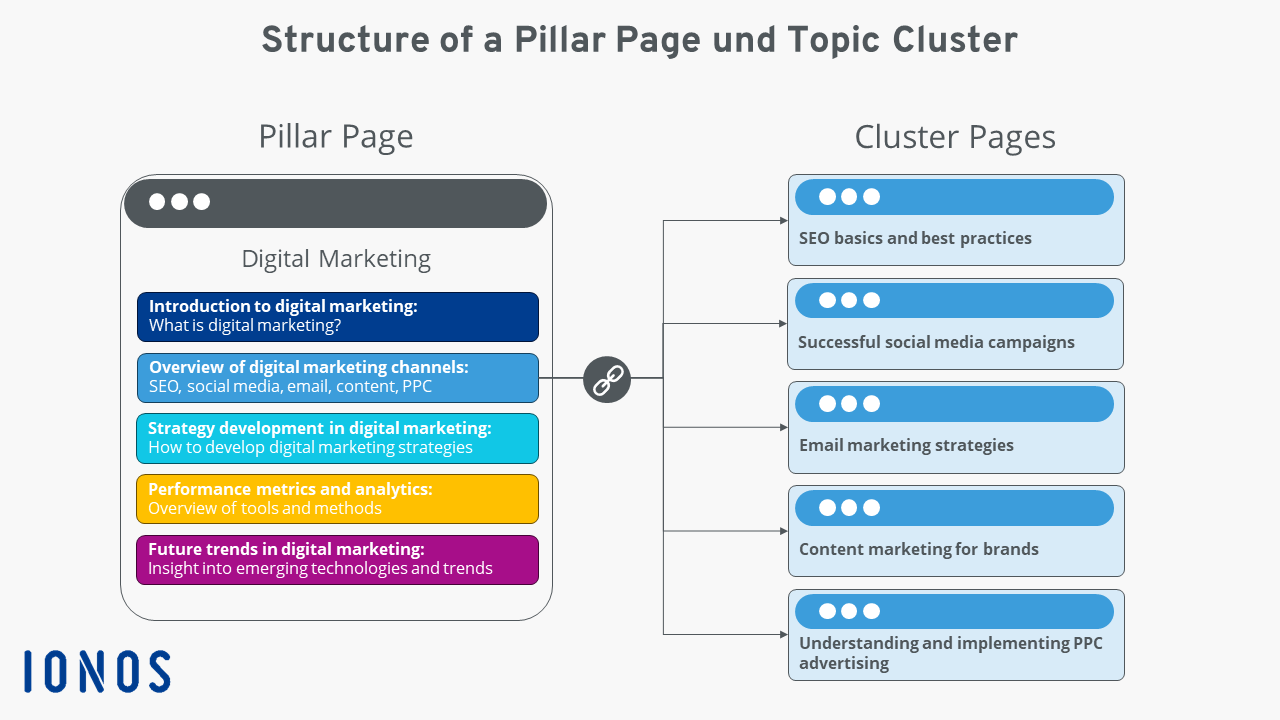
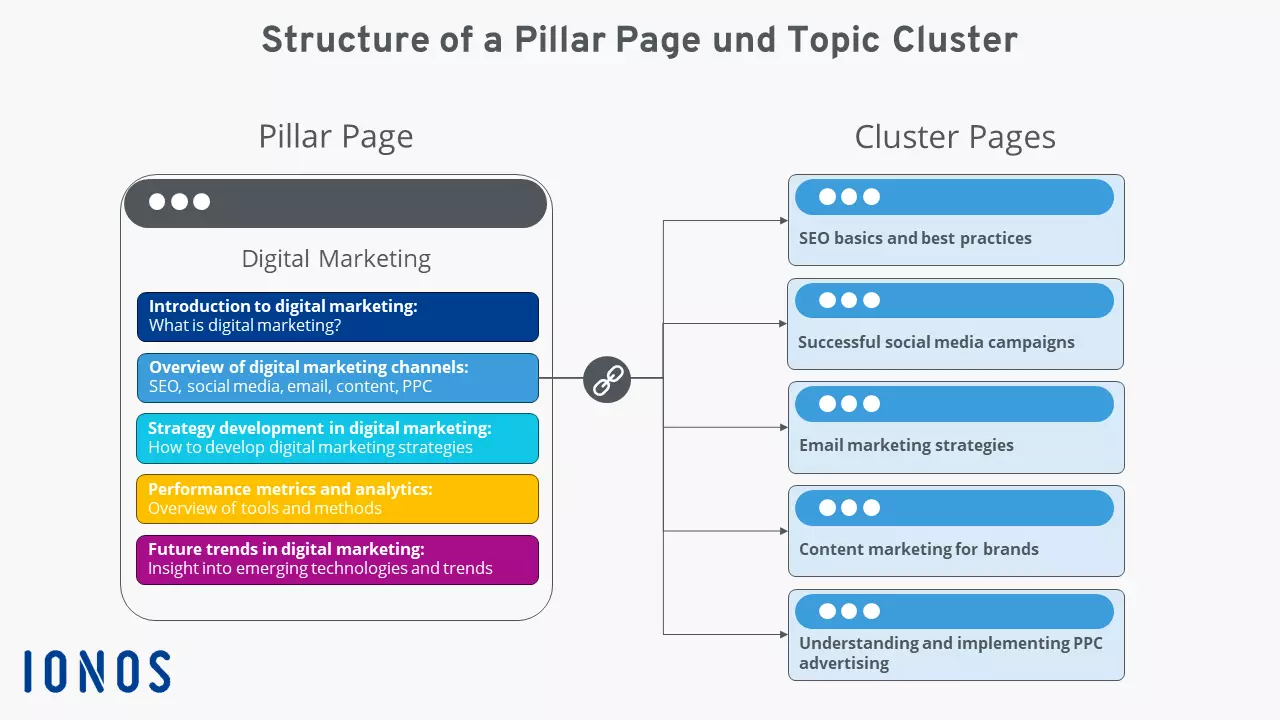
Let’s say you’re creating pillar content on digital marketing. The pillar page will serve as a comprehensive resource for all aspects of digital marketing. It will offer your target group a detailed overview of various strategies, tools and trends in digital marketing and serve as a launching point for more specific, in-depth content. It will cover basic concepts and link to more detailed cluster pages that talk about specific marketing channels and strategies.
Content on the pillar page:
- Introduction to digital marketing: What is digital marketing?
- Overview of digital marketing channels: SEO, social media, email marketing, content marketing, PPC (pay-per-click)
- Developing strategies in digital marketing: How to develop digital marketing strategies
- Metrics and analytics: Overview of tools and methods for measuring and analyzing performance
- Future trends in digital marketing: Insight into emerging technologies and trends
The following cluster pages will then delve deeper into the aspects of digital marketing that were mentioned under the heading “Overview of digital marketing channels.” Each page will offer specific, detailed information and link back to the pillar page.
- Cluster page “SEO basics and best practices”: This page will provide a thorough introduction to SEO and an SEO guide for small companies. It covers important strategies and methods for good search engine rankings and discusses key concepts such as keywords, optimization of on-page elements and backlinks.
- Cluster page “Successful social media campaigns”: This page will talk about how to strategically use social media channels and show how they can be used for different target groups and marketing goals.
- Cluster page “Email marketing strategies”: This page will focus on creating email marketing campaigns. The reader will be taken through the process step by step, from creating email content to building effective email sequences that move the recipient to action.
- Cluster page “Content marketing for brands”: This page will provide an extensive guide to developing and implementing content marketing strategies. Readers receive a detailed overview of the various kinds of content, from blog posts and articles to videos and infographics.
- Cluster page “Understanding and implementing PPC advertising”: This page will cover all the most important aspects of PPC advertising, from the basics to advanced techniques. First it will discuss the basics of how pay-per-click advertising works. Then it will explain how it can be used to steer users to a website or landing page.