

CMS comparison 2025: The most popular content management systems

To attract lots of visitors to your website and ensure that they spend a good while there, your content needs to be appealing. However, managing content can be extremely time-consuming depending on the size of the website. That’s why it’s important to find the right content management system (CMS). Here is our 2025 comparison of CMSs.
How do you choose the right CMS?
It’s a jungle out there when looking for the perfect CMS, and it’s easy to get lost. There are between 250 and 350 different programs currently available on the market. From simple building tools to expansive enterprise systems, the possibilities are endless. The question that needs answering is what CMS requirements need to be met in order to optimally support your online project.
A content management system (CMS) is software that allows you to create, edit and publish web content such as texts and multimedia. With a CMS, you can create and manage your content together with others via a graphical user interface, even if you don’t have programming skills.
What are content management systems used for?
Content management systems are typically used in three central areas: web content management, blog publishing/news and social publishing/communities. When selecting a software solution for a new web project, you should base your decision on which area is most important to your project’s development.
To find the best CMS for your project and to benefit from its advantages, it’s important to have a clear understanding of content as well as of your project’s goals.
Web content management
With classic web content management, the main emphasis is on creating and managing content for the web. Multiple editors usually need to have access to the backend, which in turn requires complex sharing and approval methods. A system should also be able to efficiently support the use of multimedia content on a website. Other important factors include managing user rights, full text search capabilities, an efficient news management system, and the ability to present necessary content in more than one language.
What types of websites are there? Find out more in our article on this topic!
Blog publishing/news
This use case, as the name suggests, is mainly focused on blogging. Here, preparing content, categorization, finding links and linking to social media platforms and other web 2.0 functions is particularly important. The ability to interact with the reader and determine when blog posts are published may also be important features to consider. Being able to quickly and easily create content is equally, if not more important, as well as being able to do so from a mobile device.
Social publishing/communities
Developing online communities and making them available to a larger audience requires a much larger range of features than managing a simple blog does. This is mostly because online communities target active user groups instead of passive readers. Ideally, the site has content that is created by the site operator as well as (user-generated content). Social publishing solutions are usually modular in design and can be expanded with certain web 2.0 features if necessary.
No matter which category your project falls into, every online project starts with a domain. You can use our Domain Checker to check whether the domain you want to use is available.
Proprietary vs. open-source CMS
Many content management systems are available as open-source software through major project communities. With an open-source CMS, the system and the program code are freely accessible. The source code of the CMS can, in principle, be viewed by anyone. Users are allowed to make changes, improvements, add extensions and to adapt the CMS to their individual requirements.
The opposite of open-source software is proprietary software. Here, the CMS is developed by a company and distributed as a commercial project. To use a proprietary management system, you usually need to purchase a license, and users do not have access to the source code.
Open-source software, on the other hand, is often available without licensing costs. That’s why these solutions are, from an economic standpoint, particularly attractive for companies. In terms of technological developments, established open-source CMS are in no way inferior to proprietary solutions. High-level developer communities are behind some of the most famous projects, such as WordPress or TYPO3. Extensive documentation and a transparent development process also ensure that software errors and security gaps are resolved promptly.
A global comparison of CMS software
The most popular solution for publishing content quickly and cost-effectively is by far WordPress. According to W3Techs, a company that analyzes CMS usage, over 40% of websites worldwide use the open-source CMS. Other open source projects in the top ten most popular software solutions for operating websites are Joomla! and Drupal.
Open-source content management systems, available to users in free community versions, can even compete with established HTML editors like Adobe Dreamweaver.
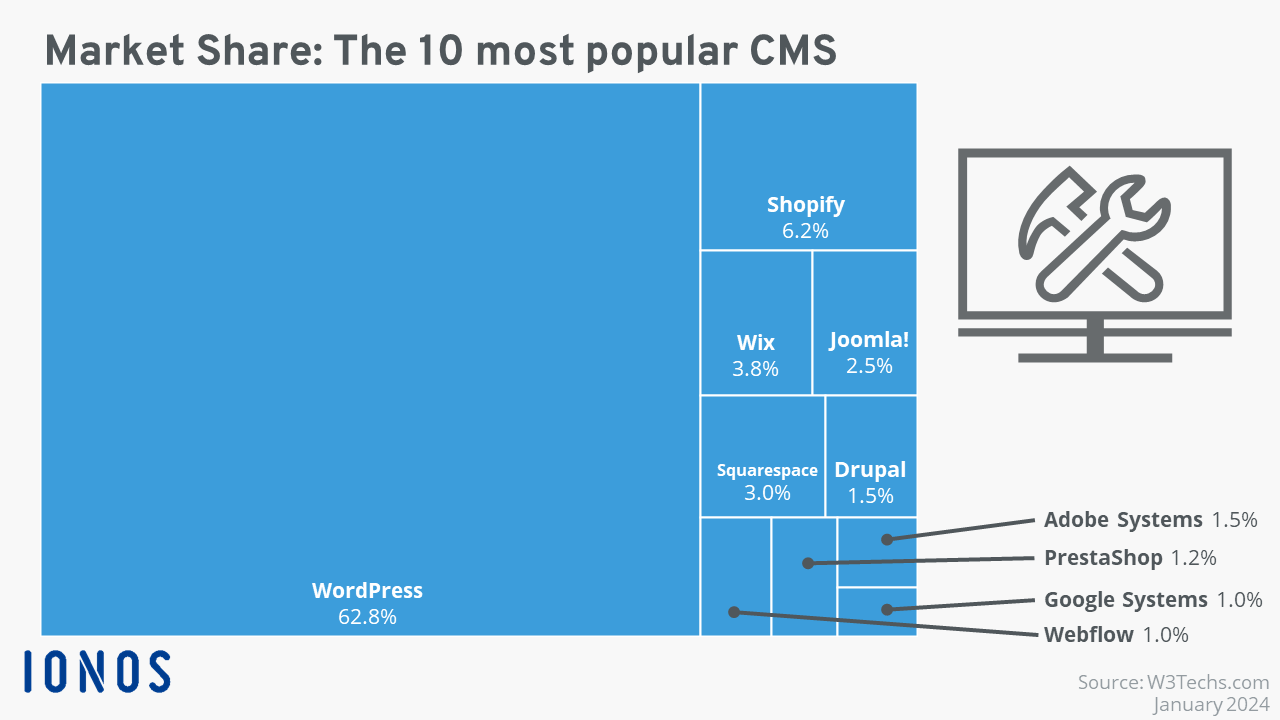

Comparison of the most used software solutions for websites (January 2024):
| CMS | Market share |
|---|---|
| Wordpress | 62.8% |
| Shopify | 6.2% |
| Wix | 3.8% |
| Squarespace | 3.0% |
| Joomla! | 2.5% |
| Drupal | 1.5% |
| Adobe Systems | 1.5% |
| PrestaShop | 1.2% |
| Google Systems | 1.0% |
| Webflow | 1.0% |
| Bitrix | 0.9% |
| OpenCart | 0.8% |
| TYPO3 | 0.6% |
| Weebly | 0.6% |
| Duda | 0.6% |
Last updated: January 2025
According to statistics, open-source solutions are also popular worldwide. Many online shops put their trust in the e-commerce platform Magento, Shopify’s system or the French shop software PrestaShop. The success of these systems shows that open-source products can hold their own against standard solutions when it comes to operating commercial websites. Website builders from commercial providers are also very popular in some cases.
With open-source software projects being such a popular option, we’ll take a closer look at some of the most popular open-source CMS solutions in the next section. We’ll compare their essential features and look at the differences between the CMSs. To round out the comparison, we’ve included two proprietary solutions, MyWebsite Now and Dreamweaver. We’ve also included a collection of tables in the section on CMS expectations and requirements. These include a detailed description of the systems and their features with special attention given to the following areas:
- Installation and configuration
- User management
- Operation and content creation
- Search engine optimization and responsive design
- Security and service
What are the most popular content management systems?
Open-source systems like WordPress, TYPO3, Joomla!, Drupal, Contao, and Neos are currently the most popular standard solutions for professional website operation. But every system is not equally suited to every individual purpose. Here, we’ve put together the main features, use cases and system requirements for different content management systems. We’ve included pros and cons tables for each CMS so it’s easier for you to decide which content management system is right for you.
- Stay online with 99.99% uptime and robust security
- Add performance with a click as traffic grows
- Includes free domain, SSL, email, and 24/7 support
WordPress
WordPress is the most-used open-source CMS worldwide. Originally conceived as a system for blogging, several extensions are now available for the basic installation, making it possible to upgrade the software to a fully functional content management system.
- Stress-free, no matter your skill level with easy AI tools
- Fully customizable with themes and plugins
- Hassle-free updating and less admin
Facts
- More than 58,000 extensions and a huge range of free design templates
- Five-minute installation via Wizard
- Search engine friendly URLs
- Publishing and management tools for mobile solutions
System requirements for WordPress 6.4.3
- Web server: Every server with PHP and MySQL/MariaDB support (recommended: Apache or NGINX)
- Middleware: PHP 7.4 or higher
- Database: MySQL 5.7 or higher, MariaDB 10.4 or higher
- Other recommendations: HTTPS support
The software’s large user community benefits from an enormous choice of themes, plugins and widgets. Critics, however, say that the system is not only too complex, but also confusing and awkward to use.
WordPress shares the same problems as all successful software developments. Due to its high circulation, it’s a popular target for hackers. Because of that, users need to update their WordPress software fairly regularly with security updates. These updates come out quickly after security incidents occur but aren’t always compatible with all the extensions that are required to use the software properly. As a result, software updates can mean considerable administrative effort, especially when it comes to large projects.
Because of its low-effort, basic installation, WordPress is good for small websites that have a simple structure. WordPress is an effective CMS with an intuitive web interface, especially for bloggers who want to provide their visitors with frequently changing content in attractive layouts. As the complexity of the online project increases though, the user-friendliness of the software significantly decreases. Theoretically, WordPress can be used to implement large enterprise projects too, but needing a greater number of functions and features will inevitably be accompanied by an increase in administrative effort.
If you’re striving for stable website operation, it’s important to keep in mind that WordPress places high demands on the server as traffic to your website increases. Users who are developing complex multi-domain projects with a multilingual focus should choose a CMS like TYPO3 instead of WordPress.
| Pros | Cons |
|---|---|
| ✓ Large community | ✗ CMS functionality requires additional extensions |
| ✓ Minimal effort for installation and setup | ✗ Plugins often have security gaps |
| ✓ Intuitive user interface | ✗ Limited stability and performance capability with high traffic |
| ✓ Simple integration of plugins and other extensions | ✗ Frequent security updates lead to additional administrative effort |
Just getting started with WordPress? The managed Hosting for WordPress plan from IONOS comes with a 1-click installation. By choosing this option, you pass all technical and server-side administration duties to a hosting provider, allowing you to fully focus on your content.
Interested in the leading CMS program? You can find further information on the popular blogging software in our WordPress articles “What is WordPress” and “How to start a WordPress blog”.
TYPO3
Alongside WordPress, TYPO3 is among the most popular open-source CMSs. The software project is an enterprise management system and is constantly updated by a team of experienced developers. TYPO3 is a great solution for large corporate portals and e-commerce platforms.
Facts
- Enterprise content management system
- Huge range of functions
- Extensive integrated rights management
- Simple integration of other systems such as CRM or ERP solutions
System requirements for TYPO3 CMS 12 LTS
- Web server: Apache (recommended), MS IIS, NGINX, Caddy Server
- Middleware: PHP 8.1 or higher
- Database: MySQL 8.0 or higher, MariaDB 10.3, PostgreSQL 10.0 or higher, SQLite 3.8.3 or higher
- Hardware: At least 256 MB RAM
- Other recommendations: GraphicsMagick or ImageMagick; GDlib; Freetype; zlib; If using an Apache server: mod_gzip, mod_deflate, mod_rewrite; PHP cache (for example APCu, PHP accelerator, OPcache, or Zend Accelerator); individual extensions may require additional software.
TYPO3 has a large community that provides quick and easy help for technical problems or questions that beginners may have. There are also numerous professional providers who specialize in support forTYPO3 and provide agency services to business users.
Professional use of the high-performance CMS requires expert knowledge. If you do have the expertise, you have the possibility to create complex site structures with multilingual content. The considerable range of functions ensures professional rights management at enterprise level and provides interfaces for classic business applications such as CRM and ERP systems. On the other hand, critics point out that it takes a long time to become familiar with the system and the amount of effort needed for administration is comparatively high.
The giant spectrum of functions offered by TYPO3 makes it possible to implement any kind of online project. This, however, comes with asignificant amount of effort that needs to be invested in the installation, configuration and maintenance of the software. The CMS’s prominence and good reputation are why it’s favored by small websites. The downside is that users are usually expending much more effort than they need to. If a website operator doesn’t need the entire spectrum of functions offered by the enterprise CMS, a modular program with a lean basic installation would, generally speaking, be a better option for their website. For complex projects run by experienced IT specialists though, TYPO3 is the optimal foundation for a successful online presence.
| Pros | Cons |
|---|---|
| ✓ Widely distributed CMS with a large community (including numerous experts) | ✗ Implementation, configuration and administration require IT expertise |
| ✓ High variety of functions, flexibility and expandability | ✗ Large functional spectrum means higher demands on hosting than with comparable systems |
| ✓ Extensive rights management at enterprise level | ✗ Learning curve for beginners is comparatively high |
In our Digital Guide, you can find out how to install TYPO3. In our article covering the basics of TYPO3, you can also read a detailed description of the extensive functionality of the CMS.
Joomla!
With a near 3% market coverage, Joomla! is another favorite in the CMS market. The software is aimed at both beginners and advanced users but is more challenging to use than WordPress. Unlike the market leader, comprehensive CMS functionalities are included without having to install extensions. A bonus for users without a professional IT background is that there is good documentation in the form of community-supported online handbooks and active user forums.
Facts
- Currently over 6,000 available extensions
- Object-based content management
- Community support through forums
System requirements for Joomla! 5.x
- Web server: Apache HTTP Server 2.4 with mod_mysql, mod_xml, and mod_zlib, NGINX 1.21 (1.25 or higher is recommended), MS IIS 10
- Middleware: PHP 8.1.0 (8.2 or higher recommended)
- Database: MySQl 8.0.13 with InnoDB support (8.1 or higher recommended), MS SQL server 10.50.1600.1 (10.50.1600.1 or higher recommended), MariaDB 10.4.0 (11.1.0 or higher recommended), PostgreSQL 12.0 (16.0 or higher recommended)
Joomla! is a continuation of the open-source CMS Mambo. The system is particularly popular in the U.S. and is characterized by a fully object-oriented software design that is based on a stand-alone MVC framework. This allows Joomla! users to write their own extensions and share these with the community if they want to. They can do so using the Joomla! extensions directory, where extensions can easily be installed via the backend. Templates can be created with Joomla! modules by combining predefined content elements.
| Pros | Cons |
|---|---|
| ✓ Comparably low installation and configuration effort | ✗ Inadequate rights management |
| ✓ Large pool of extensions and designs | ✗ Advanced extensions can be pricey |
| ✓ User-friendly template creation | ✗ Extensions often require manual implementation |
Because of its complexity, it’s advisable to use Joomla! through a hosting provider. With Joomla! hosting, the technical infrastructure and regular updates are taken care of by the provider, which makes it much easier to manage the CMS. With a hosting provider, the CMS can be easily installed using a 1-click app.
You can learn more about the range of functions that the user-friendly open-source CMS offers in our Joomla! basics article.
Drupal
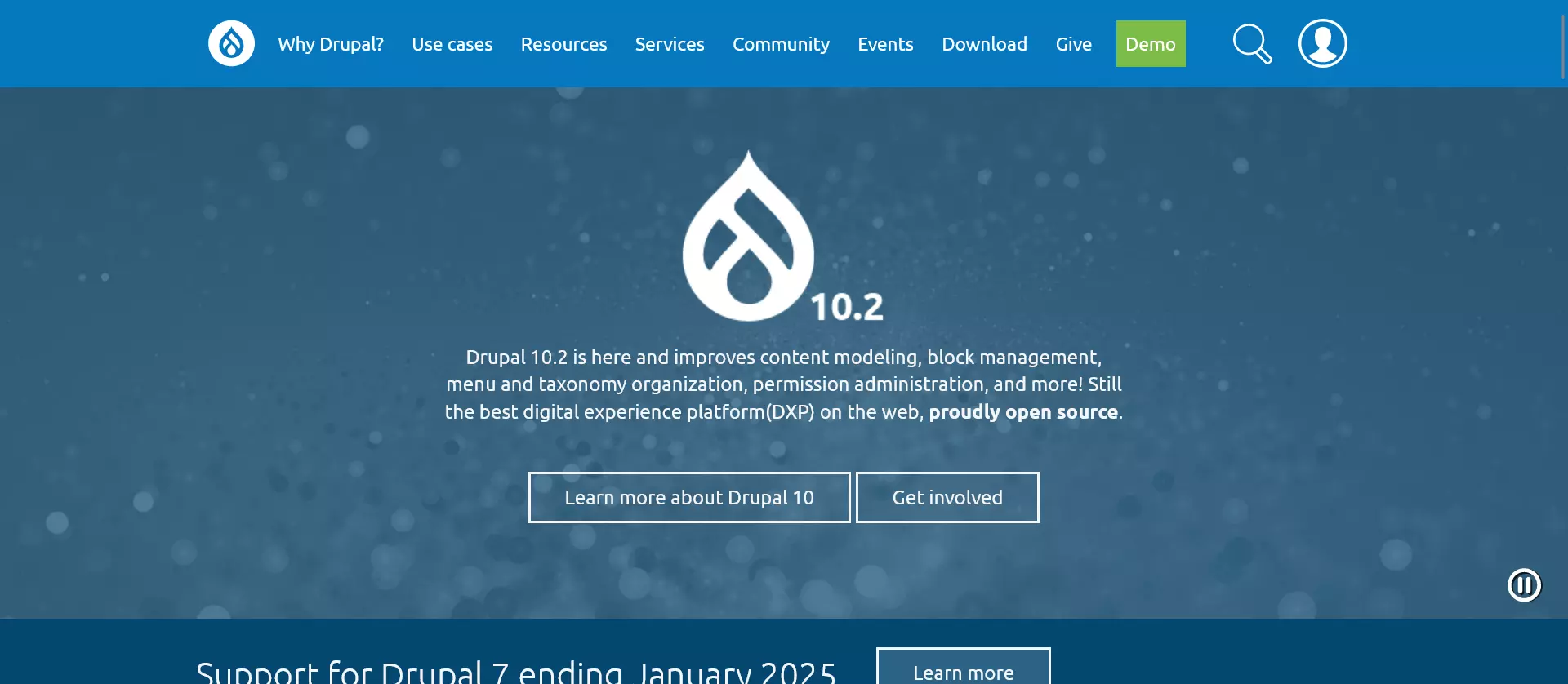
The modular CMS Drupal was originally developed as a student community solution but is now available as a full-fledged open-source CMS. The software comes with an extremely lean basic installation, which can be extended quite a bit with modules. Today, the project’s strength lies in its community. The basic module has numerous web 2.0 and community functions like blogs, forums and tag clouds.
Facts
- Very flexible, modular layout
- Lean basic installation with more than 51,000 extension modules
- Focus on social publishing and community projects
- More than 1,400 distributions that serve as complete solutions for typical use cases
System requirements for Drupal 10.2
- Web server: Apache 2.4.7 or higher, NGINX 1.1.x or higher, MS IIS 5 or any other web server with PHP support
- Middleware: PHP 8.3
- Database: MySQL 5.7.8 or higher, MariaDB 10.3.7, Percona server 5.7.8 or higher, PostgreSQL 12 or higher (with pg_trgm extension), SQLite 3.26 or higher
With its modular layout, Drupal offers extensive opportunities for customization. Users who know exactly what they need won’t have to spend time manually compiling software components. For many scenarios, pre-configured distributions based on the Drupal framework are available.
With its focus on social publishing, Drupal is particularly suited to small and medium-sized community projects. The large spectrum of extensions makes it possible to implement company portals with complex multi-domain structures. But the administration of a CMS core with comprehensive extensions requires expertise and finesse. If the basic functions of the software aren’t sufficient, additional modules will have to be installed manually via FTP. This can be a complex process. As extensions are not always compatible, updating them can sometimes prove difficult.
Drupal is primarily used to build social publishing and community platforms. Thanks to its flexible, modular system, the CMS offers an ideal solution for highly dynamic platforms that are centered around user-generated content.
| Pros | Cons |
|---|---|
| ✓ Compact software core | ✗ Complex configuration due to poor backend compatibility |
| ✓ Large selection of extension modules and pre-defined Drupal distributions | ✗ Lean basic installation requires lots of extra installations |
| ✓ Supports multi-domain management | ✗ Installation of additional modules only possible via FTP |
Data security is of the utmost importance, especially when using Drupal as a community platform. With Drupal web hosting from IONOS, you can not only significantly improve the security of the system, you can also access it from anywhere. With the 1-click app, installation is easier than ever.
Read our article about the basics of Drupal for more information and tips.
Contao
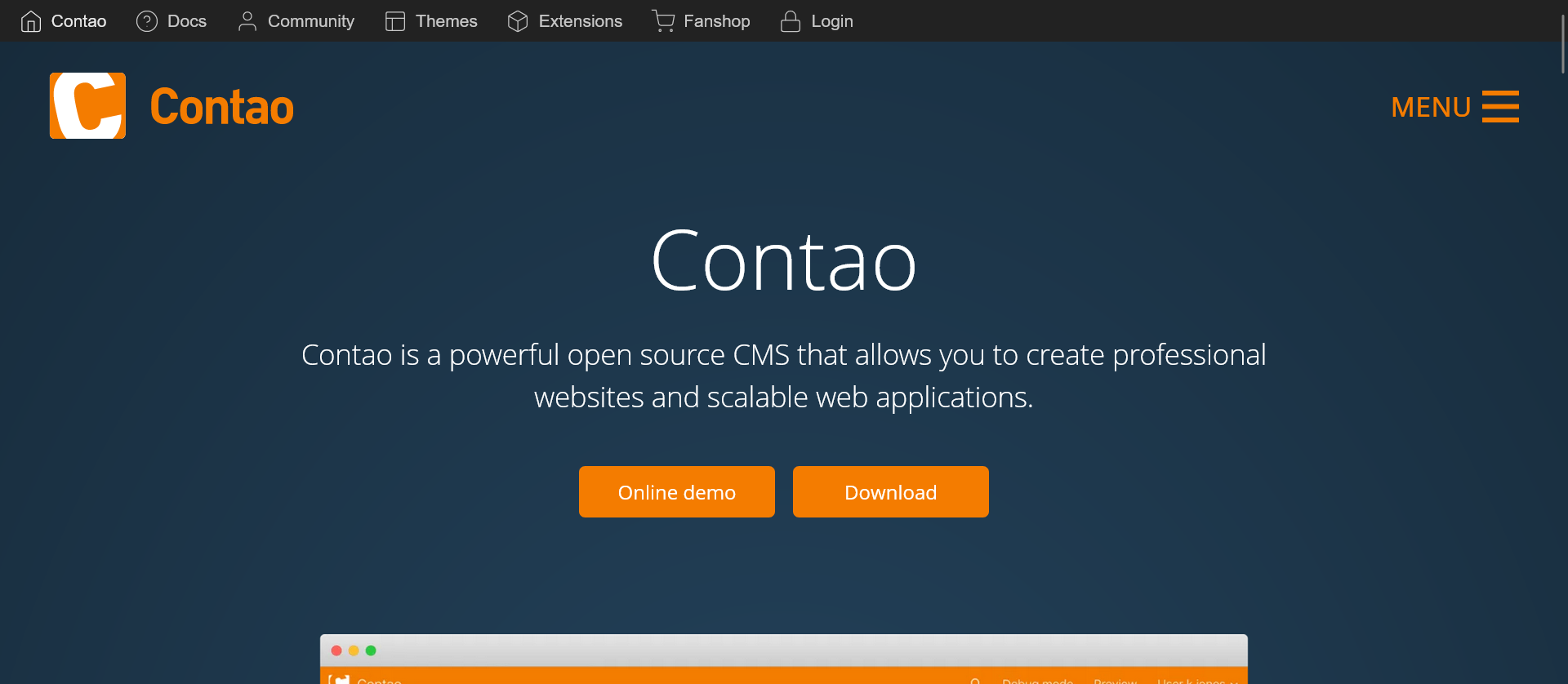
The CMS Contao is a clearly structured, user-friendly content management solution. The system features an intuitive, multilingual backend and a clearly structured administrative layer. The software pays particular attention to compatibility with web standards, providing barrier-free online content in HTML 5.
Facts
- User-friendly CMS with large range of functions
- More than 1,900 available extensions
- Multilingual backend
- Online demo
- 2-factor authentication (from Contao 4.6)
System requirements for Contao 4.13 Long Term Support (LTS)
- Web server: Apache or NGINX with PHP and MySQL support
- Middleware: PHP 7.4 or higher
- Database: MySQL 8.0 or higher
- Other recommendations: To benefit from the full range of functions, the following PHP extensions are necessary: DOM, PCRE, Intl, PDO, ZLIB, JSON, Curl, Mbstring, GD
The software’s basic configuration comes with a comprehensive range of functions that can be flexibly adapted to individual needs with more than 1,900 available extensions.
The CMS also offers an integrated theme manager. This makes it possible to individually configure the design and layout of a website with the help of pre-designed modules. In addition, website owners have access to professional themes for various use cases and industries via the Contao website. These themes usually have to be purchased though.
The software is known for its high-security standards. The LTS version of the CMS comes with a four-year guarantee. During this period, the LTS version receives bug fixes and security updates, but no new features. The LTS version is stable and recommended for active websites.
In addition, there is a development version that includes bug fixes and security updates for half a year and contains new features that are not included in the LTS version. These features will then be incorporated in the next LTS version. This version is recommended for everyone who wants to test new features.
An online demo, as well as extensive documentation material, enables a quick introduction to creating websites. Server compatibility can be ensured using the Contao Check.
The flexible CMS is suitable for websites of all sizes. The software provides users with a powerful system architecture, which can be adapted to the various requirements of the professional website operation using extensions. Intranet solutions, e-commerce platforms, corporate portals or microsites, for example, can all be put into action, leaving no wish unanswered – even when it comes to search engine optimization and web analysis.
Multi-level workflows, however, can’t be implemented with Contao in the standard configuration. But there are extensions that can map a workflow in Contao 4.
| Pros | Cons |
|---|---|
| ✓ High performance and extendable system architecture | ✗ Multi-level workflows are not supported in the basic system, but made possible through extensions |
| ✓ User-friendly installation, management and actualization of extensions | ✗ Comparatively small, but active community |
| ✓ Good security balance | |
| ✓ Easy updates |
With a hosting plan from IONOS, you can install Contao with just one click.
Further information and a detailed description of the underlying page structure of the CMS is provided in our Contao basics article.
Neos
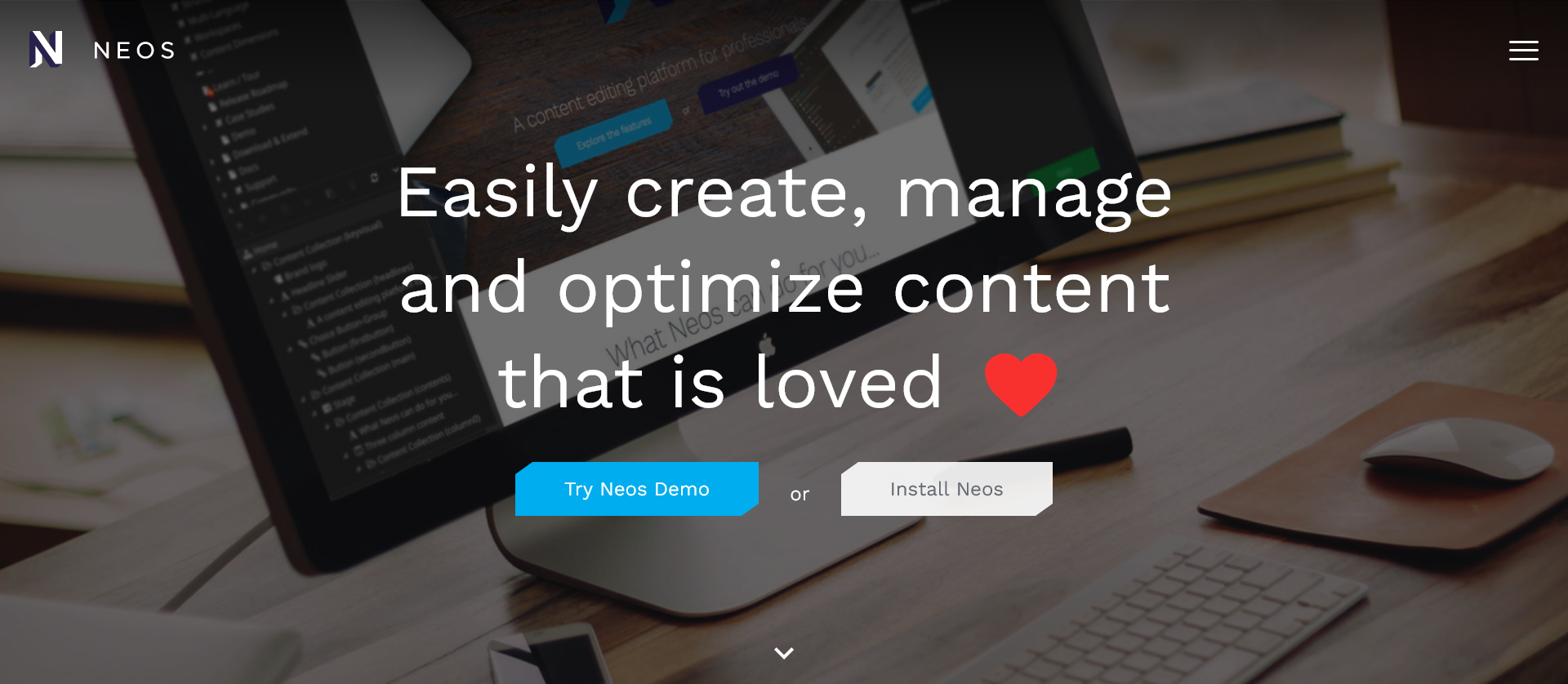
Neos is, alongside TYPO3, a true open-source enterprise content management system. The CMS has a special focus on editors and developers: Editors can create content in a real WYSIWYG (What You See Is What You Get) editor, and developers get a state-of-the-art system with planned extensibility, living style guides and atomic design. Neos is the ideal system for linking content with third-party systems (ERP, CRM, shops, etc.).

Facts
- Open-source enterprise content management system
- True WYSIWYG editor (inline editing)
- Search engine friendly URLs
- Publishing and management tools for mobile solutions
- Planned expandability to connect with other systems such as shop, CRM or ERP solutions
System requirements Neos CMS 8.3:
- Web server: Apache, NGINX
- Middleware: PHP >= 8.0 (PHP CLI must have the same version for development) PHP modules: mbstring, tokenizer, xml, pdo_mysql, imagick or gmagick PHP functions: exec(), shell_exec(), escapeshellcmd() and escapeshellarg()
- Database: Officially supported: MySQL > 5.7.7, MariaDB > 10.2.2 and PostgreSQL > 9.4
- Optional: Oracle, Microsoft SQL Server, SAP Sybase SQL Anywhere, SQLite, Drizzle
- Hardware: at least 256 MB RAM
- Further recommendations: Individual extensions may require additional software
“Content’s first choice” is not only Neos’ motto, but what the CMS strives to achieve on the daily. Right from the start, Neos was designed to be user-friendly. The focus is on inline editing with a real WYSIWYG editor. In contrast to other, traditional content management systems, editors no longer have to fill out dozens of form fields for headings, titles, etc. to get a rough preview of the new content via the preview button. Instead, editors can edit the content directly in the layout of the page that will be displayed later on.
The same applies to other display formats such as a tablet, smartphone or Google search results. Users can easily switch back and forth between views without having to leave the page. This allows content to be quickly and easily optimized for different channels.
Another special feature is the content dimensions. The highlight here is that editors can create any number of versions of content for different target groups. The content is not only available in different languages, but also tailored for different target groups (gender, culture, country, region, etc.) This allows for marketing campaigns to be controlled in a targeted manner. Managing large amounts of multisites in a Neos system also belongs to the standard repertoire.
New content in companies often goes through several review and approval processes from creation to publication. Using user and group workspaces, supported by flexible rights management, you can easily integrateNeos into existing processes.
Despite its focus on content, Neos is not just a CMS. It was developed for integration and extensibility and is a powerful CMS that comes with an equally powerful PHP framework called Flow. Developers can design Neos the way they need to use it.
The community calls Neos a Content Application Platform. This should make it clear that the strengths of the CMS lie in complex projects as well as in classic websites. The integration of third-party software, connection to external systems (ERP, CRM, etc.) and shop integrations are all possible with Neos. Existing extensions can easily be installed via Composer (e.g., Google Analytics, IBM Watson, Elasticsearch, etc.).
Nothing stands in the way of custom extensions either. Neos 4.0 introduced the Assets API, which enables direct access to external media resources (Google Drive, Dropbox, OwnCloud, etc.). You can also use photo services such as Fotolia or Unsplash to edit your images without having to leave the page.
There are hardly any limits to the expandability of Neos. For example, the Neos Award 2018 went to a project that exports online content directly from Neos to a printable InDesign template, including special markups for the pre-press stage. This eliminates the need to enter and check content twice.
After the recently completed revision of the user interface in React, the developers are currently working on integrating machine learning and on reimplementing the Neos Content Repository with CQRS and EventSourcing. The latter makes Neos particularly interesting for banks, insurance companies and public authorities, as it securely stores various revisions of content to prevent changes later on.
| Pros | Cons |
|---|---|
| ✓ WYSIWYG editor (inline editing) that shows content as it will be displayed later on, eliminating the need for users to click a preview button | ✗ Setup for smaller projects usually quite challenging |
| ✓ No PHP knowledge required to build complex pages | ✗ Getting used to the platform takes a while for newcomers |
| ✓ Helpful community with over 2,000 users in official Slack from Neos | ✗ A range of Neos functions may require professional-level hosting |
| ✓ Connecting CMS and PHP framework facilitates the extension of Neos considerably | |
| ✓ Supports two-stack CMS architecture for large projects with maximum scalability, resilience and security |
MyWebsite Now: The easy and effective CMS alternative
Beyond the popular content management systems, there is a growing demand for website builders. One of the most modern contenders in this category is MyWebsite Now, the simple and effective CMS alternative from IONOS. The website solution comes with a custom domain and a TLS/SSL certificate and is available as a monthly subscription. Users not only benefit from simple, modular software, which makes programming unnecessary, they also receive a hosting environment for their website. IONOS takes care of the management and maintenance of the website.
The heart of MyWebsite Now is the easy-to-use website editor. A simple drag-and-drop function lets you move website components to the desired position, while pre-made building blocks with content suggestions make working on your project easy. Thanks to a wide range of design, color and layout options, users benefit from a high degree of customization. In addition, users can select a thematically suitable design template right at the beginning, with options catering to private websites, club sites or websites for businesses. To ensure that the result looks good on all devices, templates are responsive and optimized for all display sizes.
With project administration and maintenance being the responsibility of the provider, MyWebsite Now gives you the opportunity to focus entirely on your ideas. IONOS has over 30 years of experience in the field and a proven track record in terms of security and performance. All projects are hosted in high-performance, ISO-certified data centers, which offer the highest level of data and system stability. Should problems occur with the software or the website, you’ll have personal support at hand at all times.
| Pros | Cons |
|---|---|
| ✓ Domain, hosting, and TLS/SSL certificates included | ✗ Dependent on external service providers |
| ✓ Ready-to-use building blocks to design your own web project | |
| ✓ Hosting in ISO-certified, fail-safe data centers | |
| ✓ Updates and maintenance of software and website are the responsibility of the provider |
- Professional templates
- Intuitive customizable design
- Free domain, SSL, and email address
Dreamweaver: The Creative Cloud’s web design software
Looking at the statistics from W3Tech, one alternative to open-source content management systems stands out. Many website owners prefer to build their website from scratch using the HTML editor from Dreamweaver. The web design software, originally developed by Macromedia and now distributed by Adobe Systems, is available to Creative Cloud (CC) users as a proprietary product for macOS and Windows.
For the editing of visual elements of websites and mobile content, Dreamweaver combines a WYSIWYG editor with a high-performance coding engine. This makes diverse functions like syntax highlighting, automatic code integration, validation and browser previews available to developers in real time. In addition to HTML 5 and CSS, the software supports web standards like PHP, Java, JavaScript, ASP and XML, as well as the CSS preprocessors SASS, LESS and SCSS. A modern, responsive web design can be implemented using the integrated CSS framework Bootstrap.
Due to the extensive range of functions and comparatively high cost for a user license, the high-performance software is primarily directed at professional users and agents. For more information on Adobe Dreamweaver and a description of appealing alternatives based on open source, check out our article on Dreamweaver alternatives.
What new content management systems are there?
In addition to the big, well-known content management systems, some new systems have appeared in recent years. While they aren’t as widely used, they do have an active community behind them. For some projects or approaches, these CMS may be exactly the right thing, even if they’re not that appealing to most users. What’s more, the CMSs presented below provide important new ideas that even the big competition can profit from.
Craft
The content management system Craft was developed in 2012 and continues to lead a niche existence. This could be due to two reasons. The first is that it’s fundamentally difficult for new products to establish themselves in a highly competitive market. Secondly, while WordPress is designed to be as easy to use as possible, Craft is aimed much more at professional developers. This isn’t necessarily a disadvantage though.
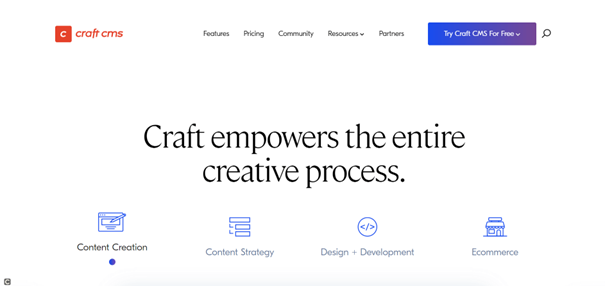
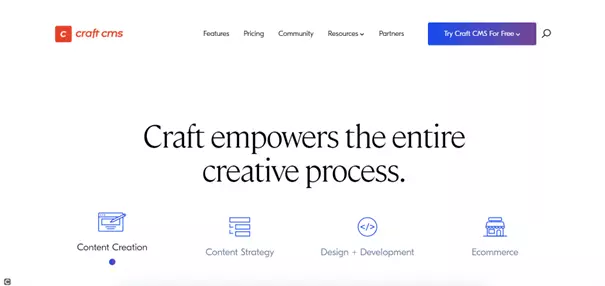
While other CMSs rely on pre-made themes to make the design as easy as possible for beginners, Craft assumes that professionals would rather write their HTML and CSS code themselves. This approach means that the entire system is very tidy. The website code stays neat, and the structure of the stored files is logically organized. Instead of using chronologically ordered folders, Craft users create rules that specify which file type belongs in which directory.
Craft also has a clearly structured backend where website operators can easily find their way around and put new articles online. Individual plugins have also been developed to extend the range of functions offered by the sleek CMS. The CMS was developed for professional developers, and this is reflected in the pricing. If you only want to create a website for yourself, you can get a free license. But if you want to develop websites for others, you’ll have to purchase a license.
| Pros | Cons |
|---|---|
| ✓ Tidy code | ✗ Only suitable for professional developers |
| ✓ Good support of content creation and content strategies | ✗ High licensing costs for full functionality |
Grav
Content management systems are generally based on databases. When users visit a website, the corresponding entry in the database is accessed. Nowadays, there are some systems that break with this tradition and get by as a CMS without a database. Such systems save important information in files and then save these files in a corresponding directory structure. An example of a CMS without a database is Grav. With this CMS, you only need a web server that has sufficient storage space and (at least) PHP 7.3.6.
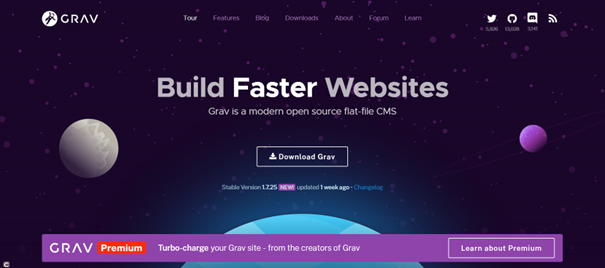
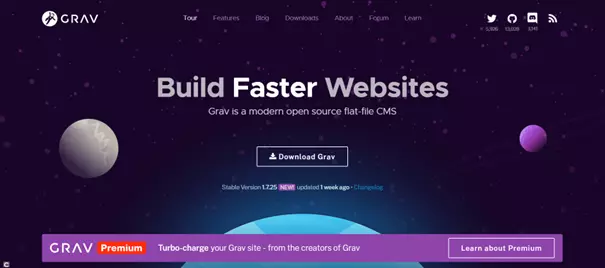
Grav places a high value on speed but doesn’t disregard aesthetics. On the official website, you can find installation data (a small ZIP archive) as well as over 100 themes that can be used to customize the design of your website. You can also extend your website’s functionality with more than 350 plugins. For example, you can set up a backend where you can perform administrative tasks. If you don’t want to assemble all the settings and extensions yourself, you can also use a skeleton, which is a preconfigured package that already contains sample websites.
| Pros | Cons |
|---|---|
| ✓ Fast and effective | ✗ More suitable for smaller projects |
| ✓ Can be extended with themes and plugins | |
| ✓ Skeleton (preconfigured installation packages) | |
| ✓ Open source with MIT license | |
| ✓ Functions without a database management system |
Kirby
Flat-file CMSs, like Kirby from Germany, also more or less do away with databases. This is why CMSs without databases and flat-file CMSs are often mentioned in the same breath, making the distinction between the two somewhat unclear. A flat-file CMS consists primarily of flat files. This means that there’s no complex and relational database management system like MySQL or MariaDB running in the background. Instead, this type of CMS relies on a folder structure that only stores flat files, which don’t reference each other. This type of CMS even allows for the integration of flat databases.
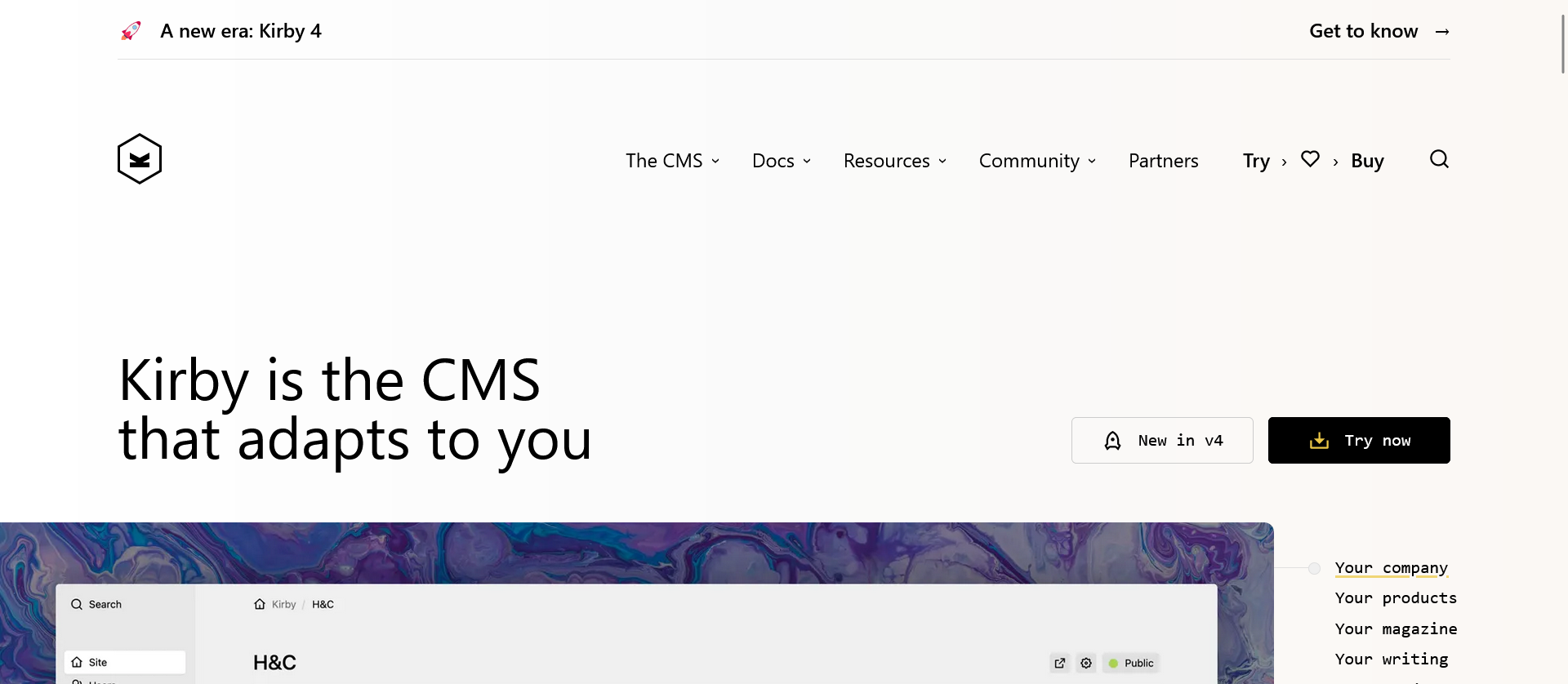
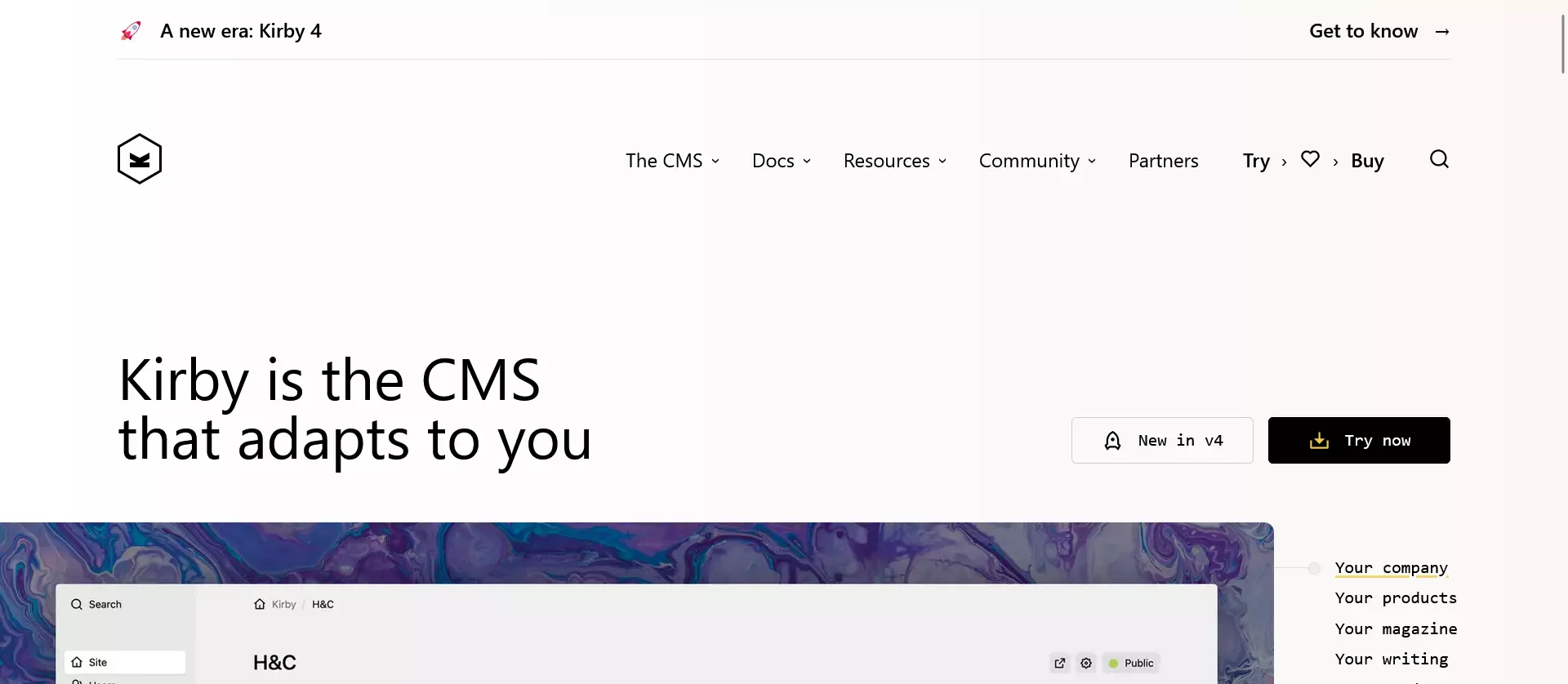
Just like with Grav, Kirby, users only need to upload the few files contained in the starter kit to the server (Apache 2, NGINX, LiteSpeed, Caddy, PHP server), which needs to have PHP available. In principle, it’s not necessary to have an admin interface with a WYSIWYG editor. You can simply create the content with a text editor and then load it to the server in the correct folder or use the Kirby panel, a simple, clearly structured backend.
| Pros | Cons |
|---|---|
| ✓ Fast and effective | ✗ Fee-based |
| ✓ Can be extended with themes and plugins | |
| ✓ Functions without database management system |
Bolt
Another lightweight CMS is Bolt. The developer’s approach was to build a fast system that’s tidy and only offers as much as users need. But that doesn’t mean that you get a disappointing range of functions with Bolt. With the necessary know-how and the use of extensions, more comprehensive online projects can also be realized with this CMS.
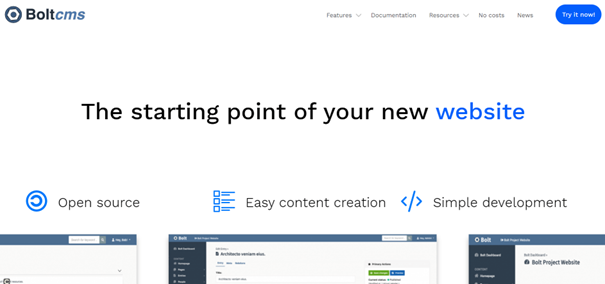
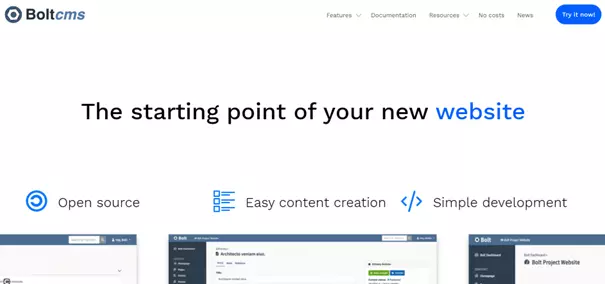
The original development of Bolt started with a Dutch marketing company that developed the CMS so they could create websites for their customers. Now, the open-source project is also supported by others. Bolt is still aimed at web developers, both for the initial website creation as well as for additional configuration. Bolt has a clearly structured backend that you can create content in. But working with the CMS is not as intuitive and simple as with WordPress, for example.
| Pros | Cons |
|---|---|
| ✓ Good performance, lightweight | ✗ Requires extensive knowledge in web development |
| ✓ Open source with MIT license |
Different CMS requirements, functions and features compared
Before you decide on one of the many content management systems available, it’s important to first define the goal of your online project. Ask yourself the following questions:
- What type of content should the website have?
- Who is going to provide the content?
- Who is the target group?
- What resources are available for operating the website?
It’s also important to estimate how many people will be working on the CMS at the same time and which workflows will be used. Is it going to be a single blogger addressing the online community, or will an entire editorial team be creating the content or even the website visitors themselves?
Your priorities as they relate to installation and configuration efforts, use, management and functionality must be considered. While usability or being able to simply connect to other systems is important to some, others may be more concerned with search engine optimization, barrier-free access to online content or enterprise level security.
Choosing a CMS that is right for your project means ensuring that the enormous spread of different functions and features is in line with your individual requirements. Since these differ from user to user, a direct comparison can be extremely helpful. Check out the comparisons below to find out which solutions are best suited to which use cases, and which system resources you’ll need to have for a smooth operation.
CMS differences regarding implementation, installation and configuration
The first obstacle when it comes to implementing a CMS-supported online project is installing the software that you have decided to use. The more complex the system, the more time consuming the installation and upkeep is. Joomla! and WordPress provide a Wizard, which drastically reduces the time required for installation. Small web projects can be put online in a matter of minutes. Drupal also offers users a lean basic installation process, but many functions require additional modules, which can only be installed via FTP.
The installation of the self-contained enterprise content management system TYPO3 is also rather complex. It’s primarily intended for users who want to implement large online projects, such as company portals or e-commerce platforms. Website operators should possess solid IT skills in order to ensure that the installation, configuration and administration are carried out without any errors.
All open-source solutions in our CMS comparison are based on the PHP programming language. TYPO3 users should also have knowledge of the database language SQL and the client-side scripting language JavaScript. Website operators who want to create or customize their own templates will need PHP knowledge to use Joomla!, WordPress, Drupal and Contao. TYPO3 users will have to learn the TYPO3 template language TypoScript.
All the content management systems presented in our CMS comparison can be extended using extensions, plugins, widgets or modules. Multiple functions can only be used with extensions. The comparison table shows which features are supported natively and which require additional installations.
| WordPress | TYPO3 | Joomla! | Drupal | Contao | Neos | |
|---|---|---|---|---|---|---|
| Category | Weblog software | Enterprise CMS | Web CMS | Web CMS | Web CMS | Enterprise CMS |
| License | GNU GPLv2+ | GNU GPLv2+ | GNU GPLv2+ | GNU GPLv2+ | GNU LGPLv3 | GNU GPLv3+ |
| Operating system | Cross-platform | Cross-platform | Cross-platform | Cross-platform | Cross-platform | Cross-platform |
| Supported web servers | Web server with PHP and MySQL support | Apache, NGINX, MS IIS, Caddy Server | Apache, NGINX, MS IIS | Web server with PHP support | Web server with PHP and MySQL support | Apache & NGINX preferred, although others work |
| Supported databases | MySQL, MariaDB | MySQL, MariaDB, PostgreSQL, MS SQL Server, SQLite | MySQL, MS SQL Server, PostgreSQL | MySQL, MariaDB, Percona Server, PostgreSQL, SQLite | MySQL | MySQL, MariaDB, PostgreSQL, Oracle, Microsoft SQL Server, SAP Sybase SQL Anywhere, SQLite, Drizzle |
| Middleware | PHP | PHP, SQL, JavaScript | PHP | PHP | PHP | PHP |
| Template language | PHP | TypeScript | PHP | PHP | PHP | Fluid, AFX |
| Extensions | ✓ | ✓ | ✓ | ✓ | ✓ | ✓ |
| Browser-based backend | ✓ | ✓ | ✓ | ✓ | ✓ | ✓ |
| Reporting functions (e.g., for data mining) | Only with extension | Only with extension | ✓ | ✓ | Only with extension | Only with extension |
| XML interface | Only with extension | Only with extension | Only with extension | Only with extension | Only with extension | Only with extension |
| Integration of own scripts | ✓ | ✓ | Only with extension | ✓ | ✓ | ✓ |
| Consideration of current web standards | ✓ | ✓ | ✓ | ✓ | ✓ | ✓ |
| Craft | Grav | Kirby | Bolt | |
|---|---|---|---|---|
| Category | Mini CMS | CMS without database | Flat-file CMS | Mini CMS |
| License | Proprietary | MIT | Proprietary | MIT |
| Operating system | Cross-platform | Cross-platform | Cross-platform | Cross-platform |
| Supported web servers | Apache, NGINX, MS IIS | Apache, NGINX, MS IIS, LiteSpeed, Lightly etc. | Apache, NGINX | Apache, NGINX |
| Supported databases | MySQL | ✗ | SQLite, MySQL | SQLite, MySQL, PostgreSQL |
| Middleware | PHP | PHP | PHP | PHP |
| Template language | Twig | Twig | PHP/HTML | Twig |
| Extensions | ✓ | ✓ | ✓ | ✓ |
| Browser-based backend | ✓ | ✓ | ✓ | ✓ |
| Reporting functions (e.g., for data mining) | Only with extension | ✓ Only with extension | ✓ | |
| XML interface | Only with extension | Only with extension | Only with extension | Only with extension |
| Integration of own scripts | ✓ | ✓ | ✓ | ✓ |
| Consideration of current web standards | ✓ | ✓ | ✓ | ✓ |
User management
All open-source solutions in our CMS comparison can be used as a multiple user system. With these types of systems, the question inevitably arises, “Who is allowed to do what”? The functionalities for user administration should be a central selection criterion for a CMS, especially if a website is going to be used by several users at the same time. The following table shows that almost all systems in our CMS comparison natively support the essential user management functions. Multi-level workflow is the only area where the CMS Contao requires an extension, as this feature is primarily intended for medium-sized companies.
| WordPress | TYPO3 | Joomla! | Drupal | Contao | Neos | |
|---|---|---|---|---|---|---|
| Multi-client capability | ✓ | ✓ | ✓ | ✓ | ✓ | ✓ |
| User capabilities | ✓ | ✓ | ✓ | ✓ | ✓ | ✓ |
| Inheritance of user rights | ✓ | ✓ | ✓ | ✓ | ✓ | ✓ |
| Restriction of user rights | ✓ | ✓ | ✓ | ✓ | ✓ | ✓ |
| Multi-level workflows | ✓ | ✓ | ✓ | ✓ | Only with extension | ✓ |
| Craft | Grav | Kirby | Bolt | |
|---|---|---|---|---|
| Multi-client capability | ✗ | ✗ | ✗ | ✗ |
| User capabilities | ✓ | ✓ | ✓ | ✓ |
| Inheritance of user rights | ✓ | ✓ | ✓ | ✓ |
| Restriction of user rights | ✓ | ✗ | ✓ | ✓ |
| Multi-level workflows | ✓ | ✗ | ✓ | ✓ |
Operation and content creation
Website operators rely on content management systems to facilitate the creation and publication of online content. A good CMS offers functionalities that enable their users to create and manage website content without needing programming skills. Central selection criteria include an intuitive WYSIWYG editor with preview functions and spellchecker, import capabilities for non-textual elements like videos, interactive animations and audio content as well as a search function with full-text search.
To provide website visitors with navigation to relevant content, the CMS should also have a tagging system that allows for the organization of content based on meaningful keywords.
If news publishing is the focus, the CMS should support blogging functionalities that enable new content to be promoted in web feeds and provide feedback channels for readers, such as a guestbook or comment function. Users who want to implement international projects should ensure that content can be made available in several languages.
| WordPress | TYPO3 | Joomla! | Drupal | Contao | Neos | |
|---|---|---|---|---|---|---|
| WYSIWYG editor | ✓ | ✓ | ✓ | ✓ | ✓ | ✓ |
| Multimedia elements (videos, audio content or flash animations) | ✓ | ✓ | Only with extension | ✓ | ✓ | ✓ |
| Blog system | ✓ | Only with extension | Only with extension | ✓ | Only with extension | ✓ |
| Spellchecker | ✓ | Only with extension | Only with extension | ✓ | ✓ | ✓ |
| Preview function | ✓ | ✓ | ✓ | ✓ | ✓ | ✓ |
| Multiple languages | Only with extension | ✓ | Only with extension | ✓ | ✓ | ✓ |
| Search function | ✓ | Only with extension | Only with extension | ✓ | ✓ | Only with extension |
| Tagging | ✓ | ✓ | ✓ | Only with extension | Only with extension | ✓ |
| Craft | Grav | Kirby | Bolt | |
|---|---|---|---|---|
| WYSIWYG editor | ✓ | ✓ | ✓ | ✓ |
| Multimedia elements (videos, audio content or flash animations) | Only with extension | ✓ | ✓ | ✓ |
| Blog system | ✓ | Only with extension | ✓ | ✓ |
| Spellchecker | ✗ | ✗ | ✗ | ✗ |
| Preview function | ✓ | ✗ | ✓ | ✓ |
| Multiple languages | ✓ | ✓ | ✓ | Only with extension |
| Search function | ✓ | Only with extension | ✓ | ✓ |
| Tagging | ✓ | ✓ | ✓ | ✓ |
Search engine optimization and responsive design
High-value content is key to a successful website. Here, search engine optimization is playing an increasingly important role. Website operators who want to conquer a top spot in the search engine rankings need to fulfill certain technical requirements. It’s important to pay attention to the URL structures on your website, metadata and how your website content is displayed on mobile devices.
All of the open-source solutions in our CMS comparison offer users the possibility to rewrite parameterized URLs into SEO-friendly URLs that can be interpreted by both human users and search engines. Not every CMS natively supports this function.
An essential influence on search engine rankings is metadata. This includes the title and description of a web page. These are displayed to users together with the URL as a snippet in the search result and serve as a teaser to encourage the user to click. All the open-source systems presented here offer users the opportunity to manually create individual metadata for every subpage of an online project.
The rising number of mobile devices being used to access websites has changed the demands that users put on how a website is displayed. Operators who only think about desktop users when designing the layout of their website will lose potential visitors and notice a decline in search engine rankings. When creating new online projects, it’s important to make mobile-friendly presentation a priority. In principle, CMSs accommodate users by strictly separating content and presentation. For all the systems presented below, you’ll find templates which automatically adjust the display size to different user devices using responsive design. They’re not all available for free, however.
| WordPress | TYPO3 | Joomla! | Drupal | Contao | Neos | |
|---|---|---|---|---|---|---|
| Search engine friendly URLs | ✓ | ✓ | ✓ | ✓ | ✓ | ✓ |
| Manual entry of metadata such as title, description, and keywords | ✓ | ✓ | ✓ | ✓ | ✓ | ✓ |
| Responsive web design possible | ✓ | ✓ | ✓ | ✓ | ✓ | ✓ |
| Craft | Grav | Kirby | Bolt | |
|---|---|---|---|---|
| Search engine friendly URLs | ✓ | ✓ | ✓ | Only with extension |
| Manual entry of metadata such as title, description, and keywords | Only with extension | ✓ | ✓ | Only with extension |
| Responsive web design possible | ✓ | ✓ | ✓ | ✓ |
Security & service
Service and support are deciding factors when selecting a CMS. Small and medium-sized enterprises usually can’t afford to pay a professional agency to design, implement and maintain their website.
When it comes to the secure operation of a website, what’s crucial is whether or not an open-source CMS has the necessary information available as well as resources in the form of themes, plugins and regular updates. In this CMS comparison, we concentrate exclusively on systems that have a large user and developer community and that provide users with all the information needed for secure deployment in detailed project documentation. All projects offer public release plans, regular software updates and a transparent security protocol.
| WordPress | TYPO3 | Joomla! | Drupal | Contao | Neos | |
|---|---|---|---|---|---|---|
| Documentation | ✓ | ✓ | ✓ | ✓ | ✓ | ✓ |
| Tutorials | ✓ | ✓ | ✓ | ✓ | ✓ | ✓ |
| Community | ✓ | ✓ | ✓ | ✓ | ✓ | ✓ |
| Craft | Grav | Kirby | Bolt | |
|---|---|---|---|---|
| Documentation | ✓ | ✓ | ✓ | ✓ |
| Tutorials | ✓ | ✓ | ✓ | ✓ |
| Community | ✓ | ✓ | ✓ | ✓ |
Quick recap of our CMS comparison for 2024
Every solution presented in this CMS comparison is based on certain software development goals that can significantly influence the direction of a project. It’s difficult to find a content management system that fulfills every requirement on a website operator’s list. That’s why there is no clear winner. Instead, the goal of this comparison is to outline the benefits and drawbacks of each system as it relates to individual projects and their requirements.
While WordPress is primarily intended for bloggers and needs to have extension added to it before it can be used as a CMS, a system like TYPO3 offers an extensive range of functions in its basic state. For smaller online projects, one rarely needs that level of functionality though.
The modular CMS Drupal came from a community project, but still offers today’s users a wide range of web 2.0 functions. If you don’t need these for your project, you should consider going with a different CMS option – for example, Joomla!. This system also offers users a large selection of extensions that can be used to adapt the system to their respective needs.
If user-friendly operation and barrier-free access to online content is the focus, then Contao is a good solution. As this is the smallest of the projects presented here, users will have to accept that it also comes with the smallest community. Compared to the other projects, it doesn’t offer as many extensions, and users have a smaller selection of professional themes to choose from.
Here is a final comparison of the solutions with criteria that is essential for choosing a CMS:
| WordPress | TYPO3 | Joomla! | Drupal | Contao | Neos | |
|---|---|---|---|---|---|---|
| Installation and configuration | ↑ | → | ↗ | → | ↗ | ↗ |
| User-friendly editors | ↑ | ↗ | ↗ | ↗ | ↑ | ↑ |
| User-friendly admin | ↑ | ↗ | ↗ | ↗ | ↑ | ↑ |
| Cost for extensions/additional service and support | ↗ | → | → | ↗ | ↗ | ↑ |
| Expandability/customizability | ↑ | ↗ | ↗ | ↗ | → | ↑ |
| Community | ↑ | ↑ | ↑ | ↑ | ↗ | ↗ |
| Security | → | ↗ | → | ↗ | ↑ | ↑ |
| Craft | Grav | Kirby | Bolt | |
|---|---|---|---|---|
| Installation and configuration | → | → | → | → |
| User-friendly editors | ↗ | → | → | → |
| User-friendly admin | ↑ | ↑ | ↑ | ↑ |
| Cost for extensions/additional service and support | ↗ | ↑ | ↑ | ↑ |
| Expandability/customizability | ↗ | ↗ | ↗ | ↗ |
| Community | ↑ | ↑ | ↑ | ↑ |
| Security | ↗ | ↑ | ↑ | ↑ |
- Stay online with 99.99% uptime and robust security
- Add performance with a click as traffic grows
- Includes free domain, SSL, email, and 24/7 support