

How does local SEO work?

Local SEO—short for local search engine optimization—is playing a bigger role than ever. Whether people are looking for a coffee shop in Seattle, a lawyer in Chicago, or the nearest toy store in Austin, local search queries are part of everyday life. Businesses that rank well in local search results can increase their visibility and naturally attract more customers.
Local SEO is search engine optimization for regional companies
Local online marketing plays a key role for businesses that operate on a regional level, as an increasing number of consumers search online for products and services tied to a specific city or area. Naturally, companies with a local presence want to appear in search results when users look for offerings in their region. The potential for acquiring new customers is huge if your business can be found in local search queries such as “restaurants in Chicago”.
To achieve this, you must make yourself as easy as possible for the target group to find. The focus of local SEO lies on optimizing web presences for local search – and therefore the discoverability in the local search results. Local SEO is an increasingly important part of general search engine optimization.
The three main factors that influence your ranking in local search results are:
- Relevance (How well does your business match the search query?)
- Distance (How close is your business to the person searching?)
- Prominence (How well-known or reputable is your business online?)
There are clear local search queries (like “web design Seattle”) where users include both a service or product and a city/region in their search. But even with general terms (like “web design”), Google often delivers local results based on the user’s IP address or their logged-in Google account location.
What are the objectives of local SEO?
For local searches, Google places the best-known business listings high up in the search results. The main goal of local SEO is to earn a spot in the so-called 3-pack—the top three local search results that appear alongside the Google Maps snippet.
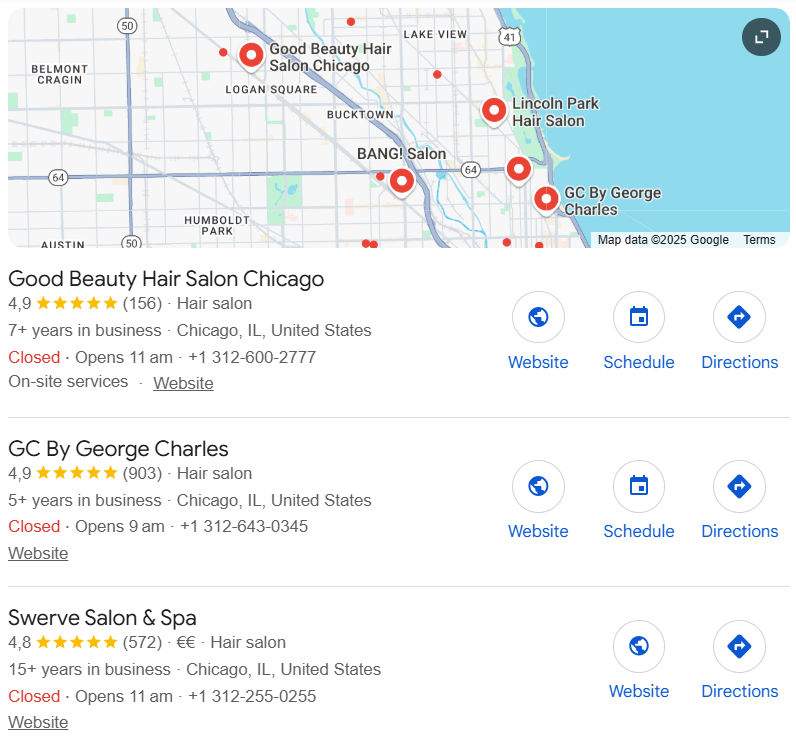
Local search results are always displayed alongside a Google Maps preview of the area. In addition to the business location, users can quickly see opening hours, contact details, and customer reviews. With just one click on the “Website” button, they’re taken directly to the company’s website. The “Directions” option lets Google Maps calculate the fastest route to the location. By clicking on “Schedule”, users are able to book, plan, or view times related to services, events, or appointments—without needing to click through multiple pages.
In a separate guide, we walk you through how to create a Google Maps listing for your business.
Merging online and offline
Google has been continuously improving local search for years—and for good reason. Searching online for local shopping options is one of the most popular ways people use the search engine. And in many cases, users take immediate action after a local search—either by getting in touch with the business or by visiting the physical store. The line between online and offline is increasingly blurred. This pattern, where people search online but make purchases in person, is known as the ROPO effect (“Research Online, Purchase Offline”).
Local searches are also primarily done on mobile devices, reflecting broader usage trends. That’s why mobile optimization (Mobile SEO) is a key part of any effective local SEO strategy.
The three core steps of local search engine optimization
An effective local SEO strategy is built on three key steps. Ideally, a top ranking in the SERPs is the result of a successful combination of three main components: your Google Business Profile, on-page optimization, and what’s known as local citation.
Step 1: Google Business Profile
A complete Google Business Profile (formerly known as Google My Business) is essential for earning a spot in the “3-pack” and being easily found on Google Maps. Without this profile, your business won’t appear in those listings. Plus, the signals sent through your Google Business Profile are among the most important local ranking factors.
Google uses all the information in your profile to determine your ranking in local searches. The more complete your profile is, the better your chances of ranking well. Businesses should include accurate contact details, a clear and concise business description, and select the most relevant category. Uploading photos—such as a storefront image—is also recommended. Photos, opening hours, and customer reviews appear directly alongside local search results.
Step 2: On-page optimization
The same rules that apply to traditional SEO also apply to local SEO—which means every website should be optimized for both technical and content quality factors. Key elements include:
- a solid page structure, including a sitemap
- logical navigation and internal linking
- a clear URL structure
Optimized metadata and well-structured, unique content are also essential. Be sure to maintain consistent formatting throughout. Clear business naming and accurate contact details are a must. As always, the more (high-quality) information you provide, the better. On-page optimization is just one of the two main SEO disciplines. While off-page optimization plays a smaller role in local SEO, adding to your backlink profile with links from locally relevant sources—such as blogs, newspapers, or city portals—can significantly improve your visibility.
More and more local searches are being made through voice assistants like Google Assistant or Siri. To increase the chances of being included in those results, businesses should use structured data. The appropriate Schema.org markup for local businesses (“LocalBusiness” markup) not only boosts your ranking in local search results but also improves how your listing appears in rich snippets and voice search.
Step 3: Local citation
Local citation builds on the previous point and can be considered a part of off-page optimization. Just like in traditional SEO—where Google sees backlinks as endorsements—local SEO relies on mentions of NAP data (name, address, phone number) as a signal of trust. To positively impact your ranking, publish your NAP data consistently across reliable platforms.
Local citations can appear in many different contexts and on various platforms: blogs, forums, news articles, press coverage, review sites, and business directories. You can manually add your business to many directories. As always, consistency is key. Make sure your business name, address, and phone number are formatted the same across all listings—even small differences in formatting (like (212) XXX, +1212 XXX, or 212 XXX) can affect your visibility. Other important citation factors include choosing the correct category, adding photos and opening hours, filling out your profile completely, and encouraging customer reviews—both on review platforms and on Google Places.
- Improve your Google ranking without paying an agency
- Reply to reviews and generate social media posts faster
- No SEO or online marketing skills needed