

Customer journey: turning viewers into paying customers

The term ‘customer journey’ refers to the individual phases that customers go through before they decide to purchase a certain item or service. The following example helps illustrate this concept:
While watching a YouTube video, a hobby mountain biker learned about the possibility of recording his tours by using an action camera. The viewer’s interest has now been aroused. In order to find out more about the camera, the potential customer does a Google search for the product and runs into an SEA ad placed by the manufacturer. The conveyed information sounds promising, and the product appears to be just we our dedicated hobbyist has been looking for. But what have other users said about the camera? And are there any alternatives? Further research leads the biker to a user forum, where they encounter positive reviews of the producer they are interested in. This last comment was enough to motivate the mountain biker to get onto the company’s start page. Lo and behold: there’s a sale going on, and the cyclist ends up making a purchase.
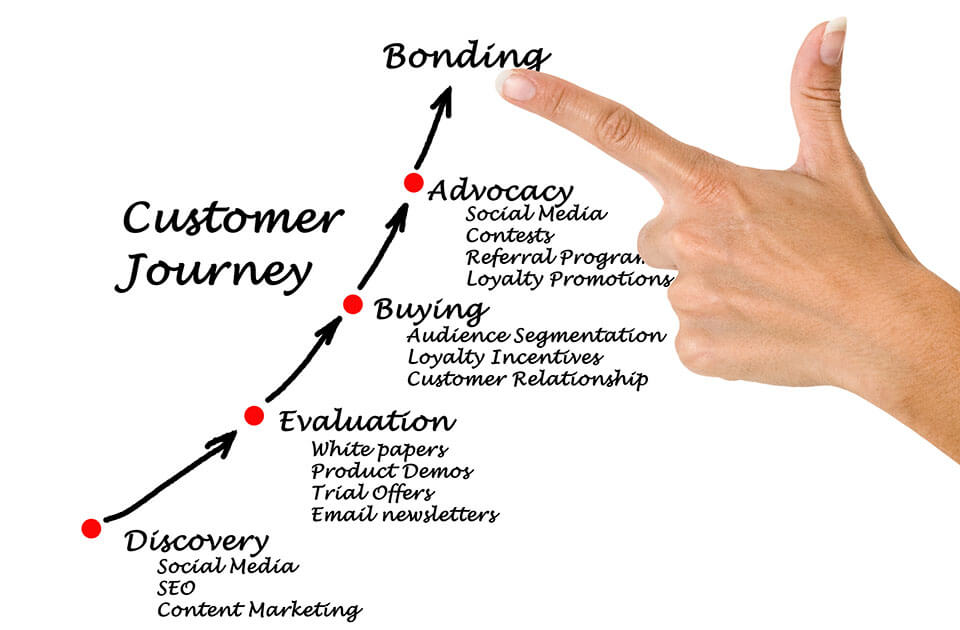
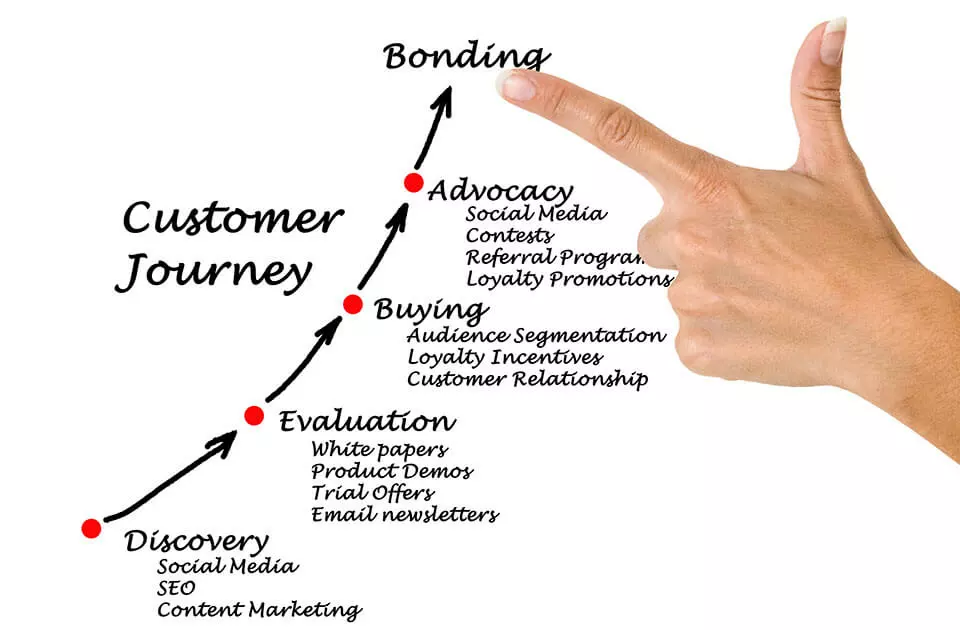
As this example shows, the customer journey is shaped by many different ‘touch points’, where the customer comes into contact with the product, brand, or company of interest. These touch points are located throughout different parts of the purchase decision-making process, and each of them fulfill different purposes. Online retailers can optimize marketing measures by analyzing which phases of the customer journey a potential customer passes through, allowing them to best reach customers during the buying decision process. Generally, the customer journey is broken down into the following phases:
- Awareness: this first phase begins once a potential customer becomes cognizant of a certain product or service’s existence. After they’ve been informed of the product through an advertisement or word of mouth, the consumer generally recognizes a need or a desire for it. But this desire sometimes isn’t strong enough to motivate them to actively research the product. Service providers and manufactures ensure that potential customers become aware of their offers through brand advertising. For instance, in the case of the mountain bike, the advertisement on YouTube led to an interest - or awareness - being awoken.
- Favorability: once the consumer actively begins to search for information on a certain product or service, they enter the second phase of the customer journey. At this stage, potential customers try to get an overview on products and potential alternatives by doing research. In the mountain biker example, the search engine research constitutes the second phase of the customer journey.
- Consideration: once an interest for a concrete product has been aroused, the customer enters into the third phase of the customer journey. This stage is also shaped by the consumer’s active search for information. This general interest turns into something more concrete, i.e. an intention to make a purchase, after any pros and cons are taken into account and prices are compared. From the example, the mountain biker finally makes the decision to purchase the item after researching and reading various user experiences and test reports.
- Intent to purchase: just because a consumer has made a concrete decision to purchase an item doesn’t mean they’re automatically going to end up becoming customers. Often another motivating factor is needed in order to finalize the purchase. Such incentives can come in the form of a special offer, as seen in the example above.
- Conversion: in the last phase of the consumer journey, the desired results have finally been achieved: the consumer makes a product purchase, or begins using a service.
What are the goals of a customer journey analysis?
Designing the ideal customer journey presents a major challenge to companies. But with the help of web controlling mechanisms, the e-commerce sector is especially well equipped for this task. Companies have many ways to understand different customer journeys and determine which of the online touch points lend themselves well to marketing measures. Touch points are so important because they lead to website visits, survey responses, or even transactions. The goal of a customer journey analysis is to collect information on consumer behavior and, using this information, develop the best strategy for optimizing the user’s path - from a potential customer to a paying one.
To this end, analyses of purchase decision processes focus on the following questions:
- What roles do different marketing channels, like display advertising, search engine marketing, or newsletters play for the customer journey?
- In which contexts do the individual touch points of a customer journey arise?
- And how long does this entire process last (from initial contact to the desired interaction being achieved)?
Customer journeys: Online marketing touch points
Touch points refer to any kind of contact occurring between a consumer and a company or its products or brands. Here, a distinction is made between direct and indirect touch points. While direct touch points are actively steered by businesses, indirect touch points can only be controlled in a limited manner, if at all. The following direct and indirect touch points are especially prevalent in online marketing:
Direct online touch points:
- Individually operated websites
- Organic web searches (SEO)
- Paid web searches (SEA)
- Display advertising
- E-mail marketing
- Pages of providers found in social media networks
Indirect online touch points:
- Social media comments (Facebook, Twitter, etc.)
- Inbound links from other websites
- Editorial reviews (online media)
- User experiences and reviews (e.g. on Amazon)
- Online portals for ratings and evaluations
- Blogs
- Forums
Evaluating the customer journey
In order to gain a representative image of a purchase decision-making process, customer journeys should always be thoroughly compiled and evaluated. This is because the effects that specific advertising measures have on the customer journey can only be assessed if the sequence of individual touch points is able to be reconstructed. This knowledge makes it possible for online retailers to tailor advertisements to potential customers.
Online retailers acquire this necessary data by enlisting the help of modern web analysis tools, like eTracker and Google Analytics. Programs compile information on how long internet users had been in contact with a certain advertisement, as well as which contacts came before and after this touch point. For example, when using the ‘top conversion path’ on Google Analytics, users are able to determine the number of transactions that a specific sequences of touch points led to - and how much turnover these were able to generate.
And for those who aren’t interested in carrying out their own analyses, data derived from buying decision processes can be used in order to plan further marketing measures. This is due to the fact that Google provides free access to large-scale studies on customer journeys on its blog, ‘Think with Google’.
The interactive report is based on the analyses of around 36,000 Google analytics accounts that have made their collected user data available. With just a few clicks, online retailers are able to determine which touch points are most important for their businesses-specific industries.