

Social selling for artists and craftspeople on Facebook and Instagram

The term “social media” relates to much more now than simply platforms for the digital exchange of information. The enormous reach and high status of Facebook, Instagram, and similar networks has awakened the interest of companies: They use these networks to strengthen their own brand and, increasingly, to sell products directly to their followers. Even for small businesses and self-employed people, the new selling strategy known as social commerce has become increasingly interesting due to its broad user spectrum.
In this article, you’ll find out how to make the most of social selling as an artist or craftsperson, and why you should be selling your products on Instagram and Facebook.
- Simple registration
- Premium TLDs at great prices
- 24/7 personal consultant included
- Free privacy protection for eligible domains
Why social commerce is on the rise
The fact that social networks offer a huge opportunity to directly influence the purchasing behavior of users has long been known. While users have for some time logged on to various social networks to research purchases, to get recommendations from friends and acquaintances, and to discover new brands, the more recent approach of social selling has established itself as a strong addition to the social experience. With social selling, shoppers use the platform’s shop buttons or third-party buttons to access external shops to make direct purchases.
Digitalization plays an important role in the business world. For local businesses, too, it’s becoming increasingly important to face the digital future! Our article “The importance of digitalization for local businesses” takes a closer look at this topic.
Especially generation Z (born mid-nineties-the star of the 2000s) have a huge influence on social media, a trend which the millennial generation is unsurprisingly continuing. What’s more, the corporations behind the biggest social media platforms are driving the sales potential of their channels in a targeted way, which is why further growth in social commerce can be expected in the next few years.
The current coronavirus crisis also plays a decisive role in this development: because of the pandemic, a reorganization of sales strategies was and continues to be on the agenda for most companies in 2020. The possibility of converting their own Facebook or Instagram profile into a direct sales channel, regionally targeting different target groups with posts, sounds like an exciting opportunity to most. Even as an artist or craftsperson, you are currently more than ever dependent on this kind of alternative advertising and sales platform to counter the consequences brought about by social distancing and hesitant buying behavior.
Why is social selling so important to artists and craftspeople?
When it comes to the topic of social commerce, many handicraft businesses and artists are probably initially faced with the question of whether marketing themselves via social platforms is at all relevant to their business. Due to the additional effort involved in setting up and maintaining their channel, including direct product sales on Facebook or Instagram, this question is certainly justified. However, you should look at your social media efforts as an investment in the future of your business.
If your business involves craftsmanship, then the quality of your work is of particular importance. Today, however, it’s not as easy to get the word out as was previously possible with word of mouth marketing. And this is where social media comes into play: Due to their popularity and reach, platforms like Facebook and Instagram are the perfect place to show potential customers the quality of your products or services in today’s fast-paced world. Comments, reviews, and stories can also show how satisfied your customers are – another important factor in the purchasing decisions of interested users.
It’s obvious why it’s worthwhile to also sell your artworks or handmade products directly via Instagram or Facebook: The conversion from user to paying customer doesn’t require any intermediate step. The direct conversion therefore reduces the risk of spontaneous abandonment. In addition, the store on Facebook or Instagram is the perfect sales solution for every artist or craftsperson who doesn’t run their own online store, and the perfect accompaniment to an artist’s or tradesman’s website.
As Facebook and Instagram have different strengths, the two platforms offer companies different opportunities in terms of marketing and sales. Due to its high number of users, Facebook has the potential to offer e-commerce businesses enormous reach. Instagram, on the other hand, promises a potentially higher interaction rate, as users of the image-based network often bring along a basic interest in online shopping.
Setting up a shop on Facebook or Instagram for artists or craftspeople
If you want to sell your handmade items on social channels, you have a variety of options. On both Facebook and Instagram, for example, you can run advertising campaigns as a business account or add a buy button to your posts or stories, which will lead users directly to your online store. In addition, there are platform-specific opportunities such as the Facebook Marketplace, a kind of eBay for e-commerce purposes, which is directly integrated into the social network.
IONOS offers a Social Buy Button designed for social commerce, which allows you to easily reach customers where they already are!
Far more interesting for artists and craftspeople, however, is the option to create and set up a store that is directly integrated into the respective social platform. Facebook has already been offering this feature for several years – Instagram introduced a corresponding option for Business and Creator accounts in May 2020.

Step 1: Set up company page or business account
To run your own Facebook store, you’ll need (as with the buy button solution) a fully set up company page. With a standard Facebook profile, you can only sell your crafts via the Marketplace. Once you’ve got your standard profile set up, you must firstly create a Facebook company page before following the instructions presented below to create and set up your own store on the social network.
To launch the shop feature in Instagram and get started, you’ll need a business account as a craftsperson or artist. To find out how to turn a standard profile into a business profile, we’ve got a dedicated article for you “Instagram for business part 1: What is Instagram?”.
Step 2: Launch the Facebook Commerce Manager
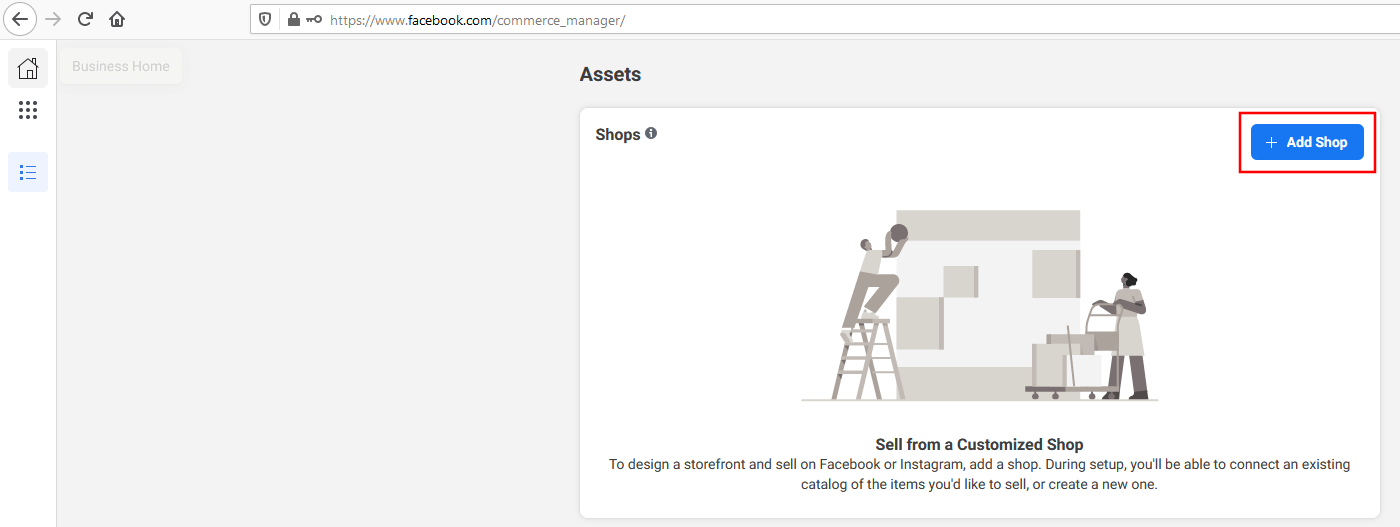
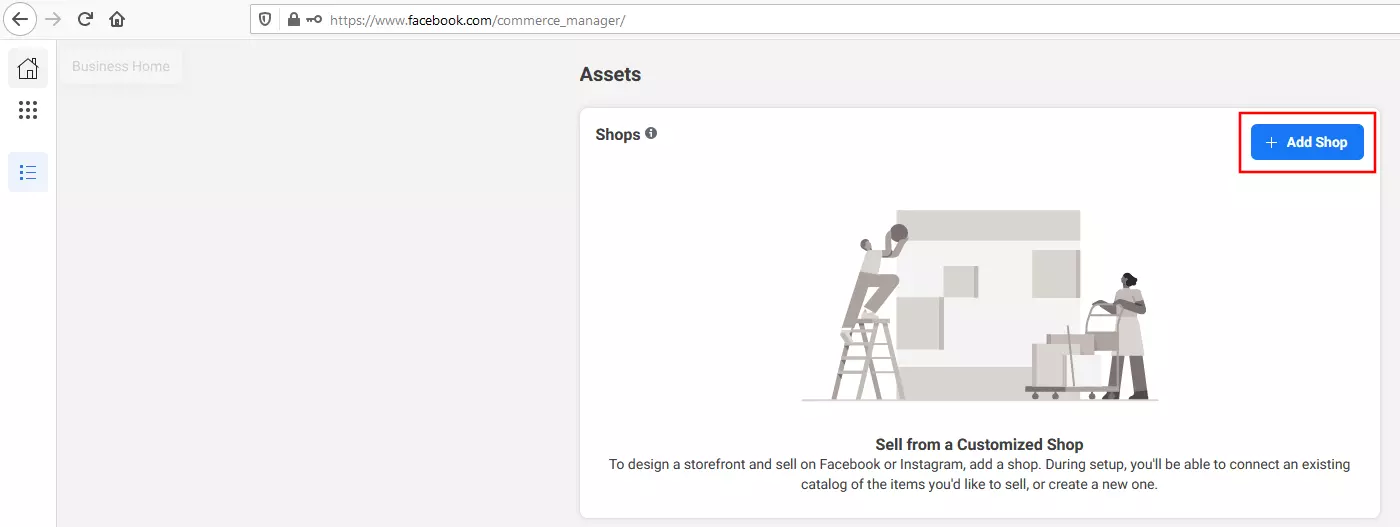
Creating your personal craftsperson or artists shop on Facebook can be done with the Facebook Commerce Manager, which you can launch at this stage. To do this, sign in with your business profile and then click on the “Add shop” button:
Step 3: Select the type pf transaction
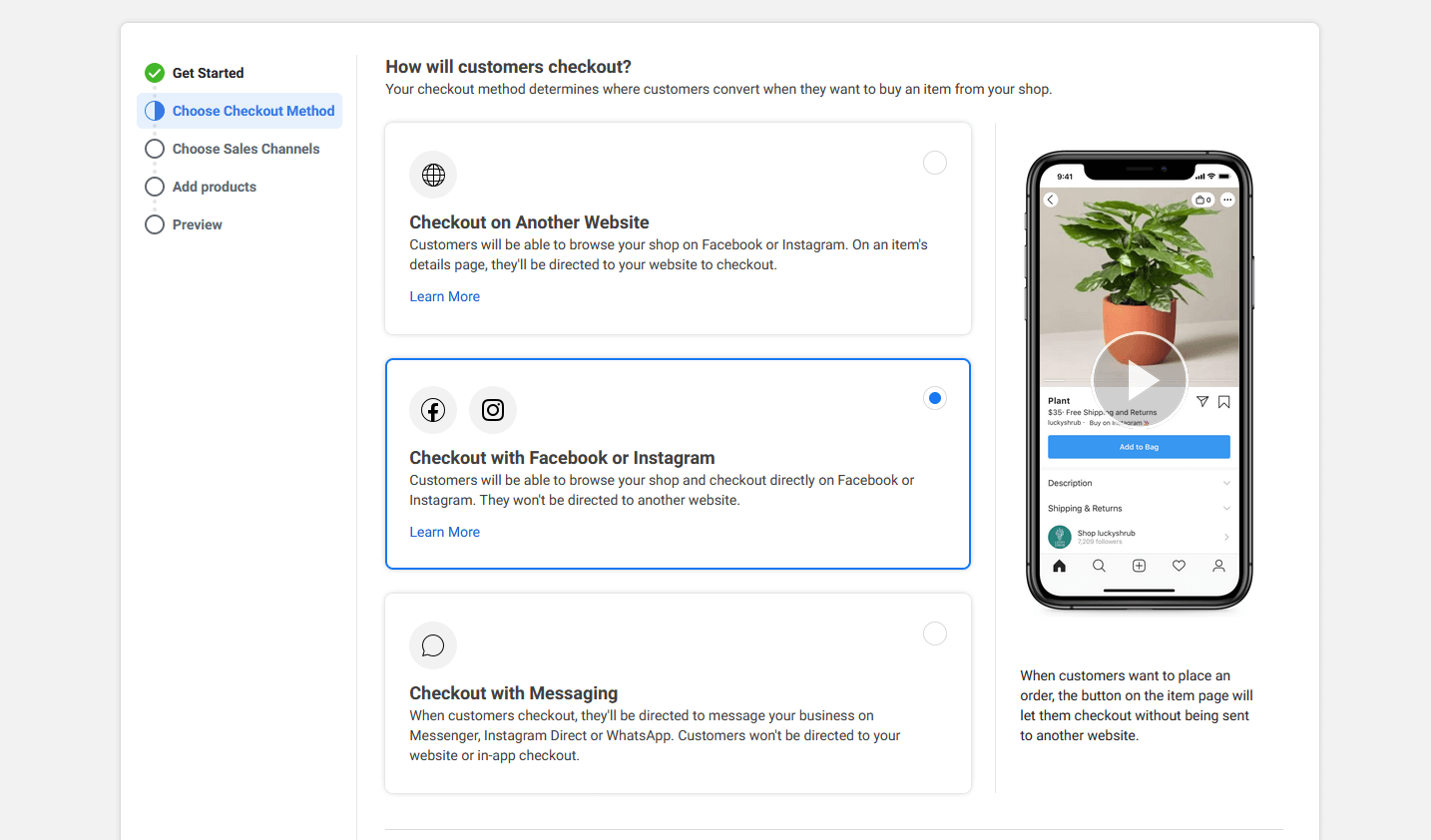
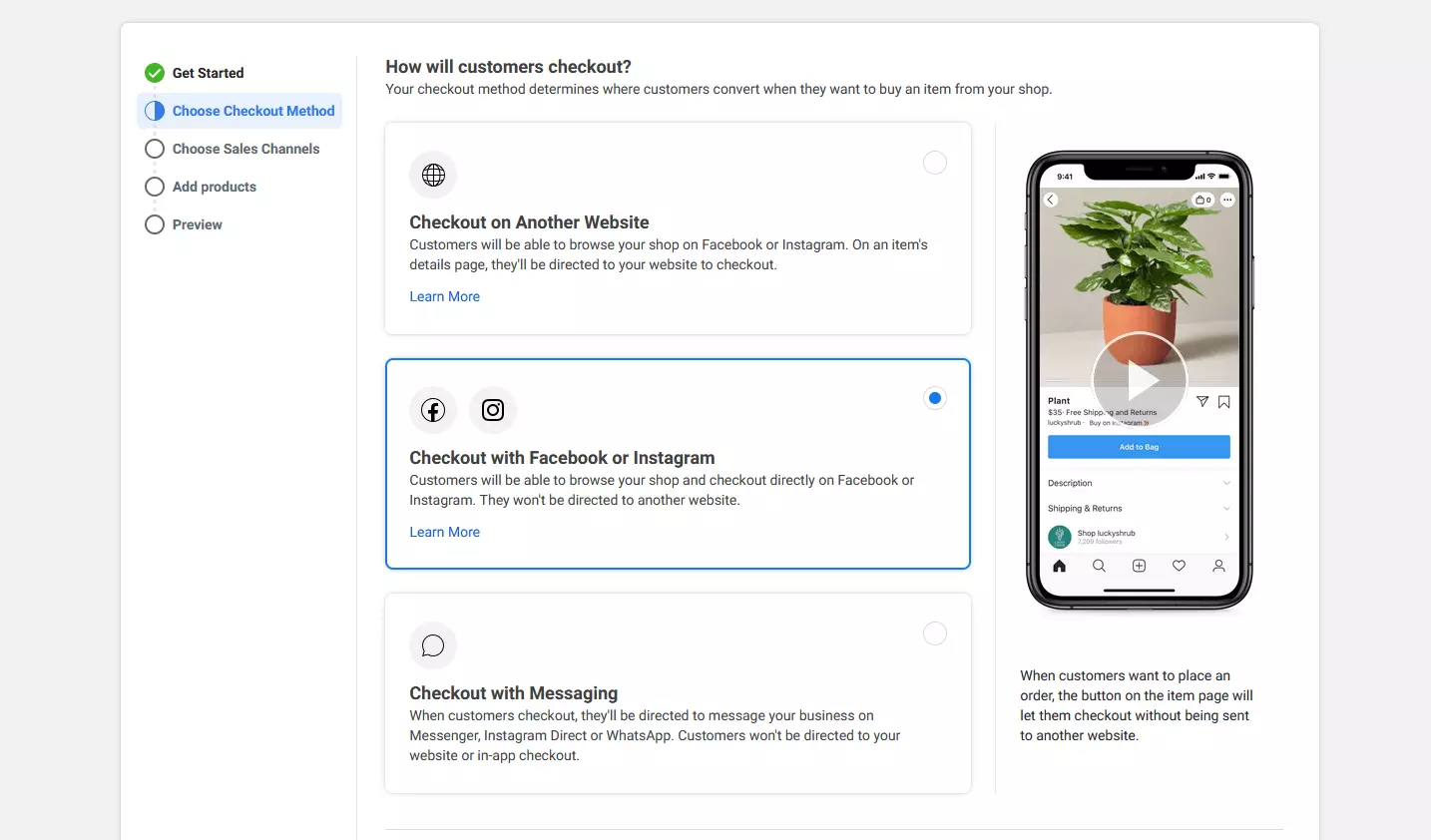
Click on “Continue” to proceed with the set up of the page. A selection menu will now open where you can choose how the transactions should be completed. Here you can define which channel you use to complete transactions with your potential customers. Your options include:
- Complete purchase on another website: Customers can browse your craftsperson/artist store on Facebook or Instagram. Only when they reach a product page will they be redirected to your website or online store to complete the purchase.
- Complete purchase by message: If users agree to the purchase, they are redirected to either Facebook Messenger, Instagram Direct, or a WhatsApp conversation, where you can clarify all further formalities.
- Check out with Facebook or Instagram: Users can browse your products in the Facebook or Instagram store and buy the items there directly, without being redirected to another website or page.
Do you want to combine your shop on Instagram or Facebook with your own online shop? With the eCommerce Website Builder from IONOS you’ve got the perfect foundation – whether setting up a small online store or a big e-commerce platform!
Step 4: Provide bank, tax, and payment details
In the next step, select the option “Set up in Commerce Manager”. As an alternative, you can link up with an existing shop system like Shopify or Magento and implies that you already have this kind of software solution in place.
Next, provide all the basic details about your account (the current requirement is that you must have an account with a US bank) and important business information such as your tax ID, shipping options, return policies, etc.
Step 5: Add product catalog
Finally, you can now create a product catalog in which you present all your artworks or services, including suitable visuals. It’s a good idea to take enough time for this – the photos of your art are, along with recommendations, the most important factor in getting the attention of users and attracting potential customers. If you are a newcomer in this field, we recommend that you read our article on product photography for your online store, which summarizes the most importance tips and tricks in all things product photography.
If you have already created a catalog, simply select it at this point and your store will be created automatically. You can customize and personalize the appearance of your craftsperson/artist store on Facebook or Instagram at any time later.
Products that sell well on social media
For artists and craftspeople, social commerce holds a lot of potential, because the products you create can be easily sold with good images. The typical top products on social networks, such as clothing or accessories, also benefit from this fact. In the rarest cases, social media is about presenting the product individually – it is much more important to show application scenarios and, ideally, to provide users with further sources of inspiration at the same time.
For example, if you have built a chair and would like to add it to your product catalog, you will achieve significantly more impact with an image that presents a matching table and living space. In addition, this is an ideal chance to get your customers excited about other products in your product range. Images that show you or employees or colleagues of your company performing your artistic skill or craftsmanship in action can also be an important factor in building trust.
- Write perfect emails with optional AI features
- Add credibility to your brand
- Includes domain, spam filter and email forwarding